




How Much Does A Gallon of Gas Weigh?

How Much Does a Gallon of Gas Weigh?
A gallon of gasoline weighs about 6 to 6.3 pounds per U.S. gallon.
The simple answer is this: use 6.2 pounds per gallon as the practical average for gasoline weight. J.D. Power lists regular gasoline at about 6.073 pounds per gallon at 59°F, while midgrade and premium can weigh slightly more depending on blend and temperature.
So if you are doing quick math:
1 gallon of gas weighs about 6.2 pounds.
5 gallons of gas weighs about 31 pounds.
10 gallons of gas weighs about 62 pounds.
15 gallons of gas weighs about 93 pounds.
20 gallons of gas weighs about 124 pounds.
A full 25-gallon truck tank adds roughly 155 pounds of fuel weight.
Why Gasoline Weight Changes
Gasoline does not have one exact weight because the formula changes.
Fuel weight can vary depending on octane, ethanol content, refinery blend, seasonal fuel mix, and temperature. Cold gasoline is denser, so it weighs slightly more per gallon. Warm gasoline expands, so a gallon can weigh slightly less.
The U.S. Energy Information Administration explains that gasoline is made from crude oil and other petroleum liquids, and that finished gasoline is blended before being sold at retail stations. That blending process is why one gallon of gas is not always the exact same weight everywhere.
Does Premium Gas Weigh More Than Regular?
Usually, premium gas can weigh slightly more than regular gas, but the difference is small.
J.D. Power lists regular gasoline at about 6.073 pounds per gallon, midgrade at about 6.35 pounds, and premium at about 6.27 pounds under the same temperature reference.
For normal drivers, this difference does not matter much. If you are calculating trailer weight, fuel storage, racing weight, or payload, using 6.2 pounds per gallon is a safe practical estimate.
Gasoline vs Diesel Weight
Gasoline is lighter than diesel.
Gasoline is usually around 6.2 pounds per gallon, while diesel is commonly around 7 pounds per gallon. That means a diesel truck with a full tank carries noticeably more fuel weight than a gas truck with the same tank size.
Gasoline is also lighter than water. One U.S. gallon of water weighs about 8.34 pounds, which is why gasoline floats on water.
Why Fuel Weight Matters
Fuel weight matters if you are towing, hauling, storing gasoline, calculating payload, or transporting fuel cans.
For example, five gallons of gasoline weighs about 31 pounds, plus the weight of the gas can. A 20-gallon tank adds roughly 124 pounds when full. A large truck tank can add well over 150 pounds of fuel weight.
That weight is not usually a big deal for normal commuting, but it can matter when you are close to payload limits, towing capacity, trailer tongue weight, or axle ratings.
FAQs About Gasoline Weight
How much does 1 gallon of gas weigh?
One U.S. gallon of gasoline weighs about 6 to 6.3 pounds, with 6.2 pounds being the best practical average.
How much does 5 gallons of gas weigh?
Five gallons of gasoline weighs about 31 pounds, not including the weight of the gas can.
How much does 10 gallons of gas weigh?
Ten gallons of gasoline weighs about 62 pounds.
How much does 20 gallons of gas weigh?
Twenty gallons of gasoline weighs about 124 pounds.
Is diesel heavier than gasoline?
Yes. Diesel is heavier than gasoline. Gasoline is about 6.2 pounds per gallon, while diesel is commonly around 7 pounds per gallon.
Final Answer
A gallon of gas weighs about 6.2 pounds on average.
The exact weight changes slightly by fuel blend, octane, ethanol content, and temperature, but 6.2 pounds per U.S. gallon is the number to use for quick calculations.
How Much Does It Cost to Replace a Tire?
How Much Does It Cost to Replace a Tire?
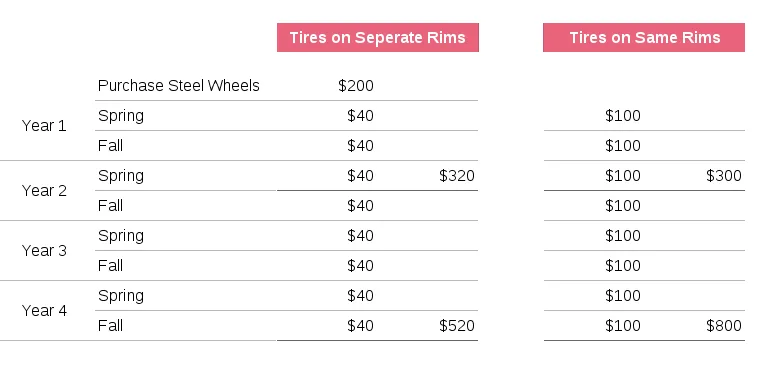
Replacing one tire usually costs $120 to $350 installed for most regular cars and SUVs. For trucks, luxury vehicles, EVs, performance cars, or vehicles with large wheels, one tire can cost $250 to $600 or more installed.
The simple answer is this: the tire itself is only part of the cost. You also need to include mounting, balancing, valve stem or TPMS service, disposal fees, taxes, and sometimes alignment. Consumer Reports found that members paid an average of $212 for their last tire, while J.D. Power notes that many tire options fall around $150 to $200 or more per tire, with some budget options closer to $100 and some premium tires much higher.
So if you are asking, “How much does it cost to replace a tire?” the realistic answer is: expect about $150 to $300 for one normal tire replacement, and more if you drive a truck, SUV, EV, luxury car, or performance vehicle.
What Is Included in Tire Replacement Cost?
A tire replacement bill usually includes more than just the rubber.
The main cost is the tire itself. Then the shop charges to remove the old tire, mount the new tire on the wheel, balance it, install a valve stem or service the TPMS sensor, and dispose of the old tire.
Goodyear says installation for four tires purchased through Goodyear.com is estimated at about $99.80, which includes mounting and balancing. That works out to about $25 per tire before any extra services, taxes, or add-ons.
Your final bill may include:
The new tire.
Mounting.
Balancing.
Valve stem or TPMS kit.
Tire disposal fee.
Shop supplies.
Sales tax.
Road hazard protection if you choose it.
Alignment if needed.
That is why a $160 tire can become a $200 to $230 installed tire once everything is added.
Average Cost to Replace One Tire
For a normal passenger car, one tire replacement usually costs around $120 to $250 installed.
For a compact SUV or midsize sedan, it may land around $150 to $300 installed.
For a truck, large SUV, EV, luxury car, or performance vehicle, one tire can easily cost $250 to $600+ installed.
The price depends on tire size, brand, speed rating, load rating, tread type, and vehicle category. A basic 16-inch tire for an older sedan is much cheaper than a 22-inch tire for a performance SUV or truck.
Cost to Replace All Four Tires
Replacing all four tires usually costs $500 to $1,200 installed for many regular cars and SUVs.
For trucks, large SUVs, luxury vehicles, EVs, and performance models, a full set can cost $1,000 to $2,000 or more.
J.D. Power explains that popular all-season tire models can put the total cost for four tires around $500 to $1,000, depending on tire type and installation assumptions. Higher-end tires can cost much more.
If you drive a Ram truck, Jeep Wrangler, Dodge Durango, Grand Cherokee, or another larger vehicle, expect pricing to be higher than a basic compact car because the tires are larger, heavier, and often have higher load ratings.
Why Some Tires Cost So Much
Tire prices vary because not all tires are built the same.
A cheap economy tire may be fine for basic commuting, but it may not match the grip, comfort, tread life, snow traction, wet braking, or load capacity of a better tire.
Tire cost increases with:
Larger wheel size.
SUV or truck fitment.
All-terrain tread.
Performance rating.
Run-flat construction.
EV-specific design.
Winter tire compound.
Premium brand.
Higher load rating.
Higher speed rating.
Low-profile sidewall.
A 17-inch all-season tire for a sedan may be reasonable. A 20-inch all-terrain tire for a truck or a 21-inch performance tire for a luxury SUV can cost much more.
Can You Replace Just One Tire?
Sometimes, yes.
If the damaged tire is fairly new and the other tires have similar tread depth, replacing one tire may be fine. But if the other tires are worn, replacing only one can create mismatched traction and handling.
For front-wheel-drive or rear-wheel-drive vehicles, shops often recommend replacing tires in pairs on the same axle. J.D. Power explains that for FWD or RWD vehicles, replacing the damaged tire and the other tire on the same axle is commonly recommended.
For AWD and 4WD vehicles, it can be more complicated. Mismatched tread depth can affect the drivetrain, traction control, and handling. Some AWD vehicles may require all four tires to be closely matched.
If you drive an AWD SUV or truck, ask the shop to measure tread depth before replacing only one tire.
When Should You Replace a Tire?
You should replace a tire if it has unsafe tread depth, sidewall damage, deep cuts, bulges, exposed cords, repeated air loss, or damage that cannot be safely repaired.
AAA says that in most places, the legal minimum tread depth is 2/32 of an inch. If your tires are below that, they are unsafe and may be illegal.
Transport Canada also says tires with tread worn down to the tread wear indicator, about 1.5 mm or 2/32 of an inch, must be replaced. It also warns that deep cuts, cracks, blisters, bulges, and slits can be dangerous.
Do not wait until the tire is completely bald. Wet braking, hydroplaning resistance, snow traction, and emergency handling all get worse as tread wears down.
Can a Flat Tire Be Repaired Instead?
Sometimes a flat tire can be repaired instead of replaced.
A tire repair is usually possible if the puncture is small, located in the tread area, and the tire has not been driven on while flat. If the damage is on the sidewall, shoulder, or too large, the tire usually needs replacement.
A proper repair usually means removing the tire from the wheel, inspecting it from inside, and using a plug-patch repair. Quick external plugs may be temporary and may not be accepted as a permanent repair by every shop.
If the tire has sidewall damage, a bulge, exposed cords, or internal damage, replace it. Do not gamble with a tire that can fail at highway speed.
Do You Need an Alignment After Replacing Tires?
Not always, but it is often smart.
If your old tires wore unevenly, the steering wheel is off-center, the vehicle pulls to one side, or you hit a pothole or curb, an alignment may be needed.
An alignment adds cost, but it can help protect your new tires. Skipping alignment when the vehicle needs one can cause the new tire to wear out faster.
Investopedia says a typical front-end alignment can cost around $50 to $100, while a four-wheel alignment can range from about $100 to $200, depending on vehicle type, location, and service center.
If you are already spending money on new tires, alignment is worth considering.
Tire Replacement Cost for Trucks and SUVs
Truck and SUV tires usually cost more than car tires.
That is especially true for larger wheels, off-road tires, heavy-duty load ratings, all-terrain tires, mud-terrain tires, and premium brands.
A Jeep Wrangler with all-terrain tires, a Ram 1500 with 20-inch wheels, or a Dodge Durango with larger performance tires will usually cost more than a compact sedan.
For trucks and SUVs, tire choice matters more because the vehicle may tow, haul, drive off-road, carry heavy passengers or cargo, or use 4WD/AWD systems. Do not buy the cheapest tire if it does not match your vehicle’s load and traction needs.
Tire Replacement Cost for EVs
EV tires can cost more than regular tires.
Electric vehicles are heavier, make instant torque, and often use tires designed for low rolling resistance, quiet ride, and load capacity. That can raise the price.
EV tires may also wear differently because of the vehicle’s weight and torque. If you drive an EV aggressively, tires can wear faster.
If your EV came with EV-specific tires, compare replacements carefully. A cheaper standard tire may reduce range, noise comfort, or load performance.
How to Save Money on Tire Replacement
The best way to save money is to compare total installed price, not just tire price.
A tire that looks cheap online may not be cheap after mounting, balancing, disposal, taxes, shipping, and TPMS service. A tire shop may also offer installation bundles, rebates, road hazard protection, or free rotations.
Consumer Reports recommends comparing tire types, shopping around, and looking at total value rather than just the lowest sticker price.
You can also save by rotating tires on schedule, keeping proper tire pressure, fixing alignment issues early, and replacing suspension parts before they destroy the tread.
Should You Buy the Cheapest Tire?
Not always.
The cheapest tire may be fine for a low-mileage commuter car in mild weather, but it may not be the best choice for highway driving, rain, snow, towing, heavy SUVs, or performance vehicles.
Tires affect braking, steering, ride comfort, noise, fuel economy, and safety. They are not just accessories. They are one of the most important safety parts on the vehicle.
A mid-range tire from a reputable brand is often a better value than the cheapest tire available.
What to Ask Before Replacing a Tire
Before approving the repair, ask the shop for the full out-the-door price.
Ask whether the quote includes mounting, balancing, valve stem or TPMS service, disposal fee, taxes, and road hazard warranty. Ask whether the other tires need to be replaced too. Ask whether the tread depth is close enough to replace only one tire.
Also ask if the vehicle needs alignment. If the old tire failed because of uneven wear, the new tire may wear out quickly unless the root problem is fixed.
FAQs About Tire Replacement Cost
How much does it cost to replace one tire?
Replacing one tire usually costs $120 to $350 installed for most regular cars and SUVs. Trucks, EVs, luxury vehicles, and performance cars can cost $250 to $600+ per tire installed.
How much does it cost to replace all four tires?
A full set of four tires usually costs $500 to $1,200 installed for many cars and SUVs. Trucks, large SUVs, EVs, and performance vehicles can cost $1,000 to $2,000+ installed.
Can I replace only one tire?
Sometimes. If the other tires are still close in tread depth, replacing one may be fine. If the other tires are worn, you may need two or four tires, especially on AWD vehicles.
Is tire installation included in the tire price?
Not always. Some shops include installation packages, while others charge separately for mounting, balancing, TPMS service, disposal, and taxes.
How much is tire mounting and balancing?
Mounting and balancing often costs around $20 to $40 per tire, but prices vary by shop, tire size, wheel type, and location.
When should tires be replaced?
Tires should be replaced when tread depth reaches 2/32 of an inch, or sooner if they have sidewall damage, bulges, cracks, exposed cords, or unsafe wear.
Is it cheaper to repair a tire than replace it?
Yes, if the tire can be safely repaired. A proper puncture repair is usually much cheaper than replacement. But sidewall damage, large punctures, or internal damage usually require a new tire.
Final Thoughts: Tire Replacement Cost Depends on the Vehicle
A tire replacement usually costs $120 to $350 installed for one normal tire, but the final price depends on your vehicle, tire size, tire brand, installation fees, TPMS service, and whether you need one, two, or four tires.
For most drivers, the smart move is to compare the full installed price, not just the tire price. Check tread depth, ask whether one tire is enough, and consider alignment if the old tire wore unevenly.
Tires are not the place to guess. They affect braking, traction, ride quality, and safety every time you drive.
Average Lifespan of a Jeep Wrangler Engine?
Average Lifespan of a Jeep Wrangler Engine
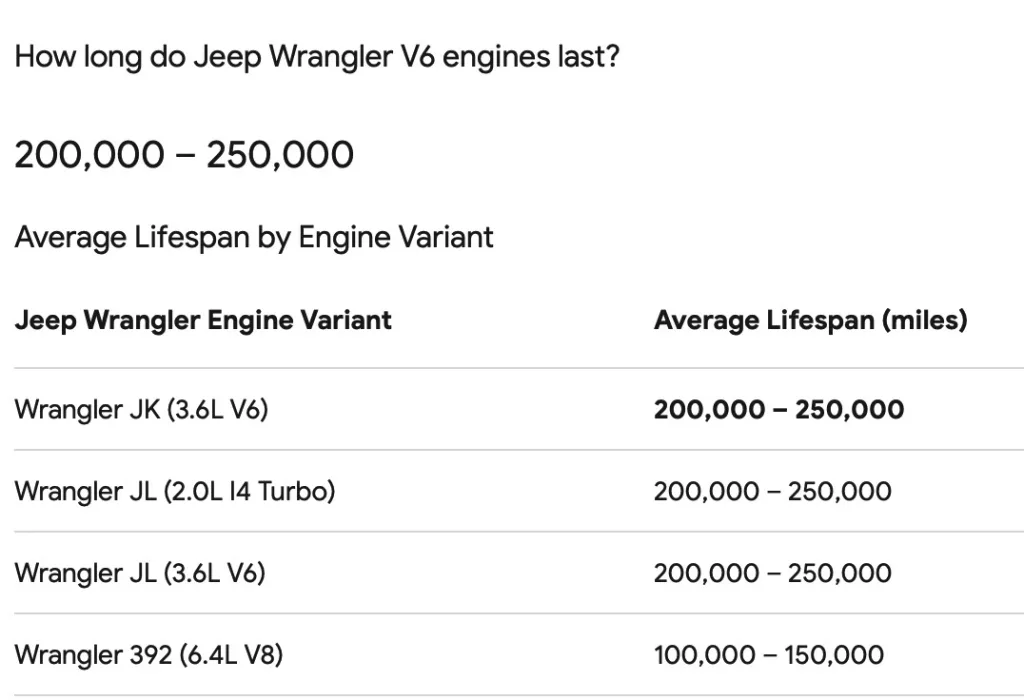
A Jeep Wrangler engine can last 150,000 to 200,000 miles with normal maintenance, and many well-cared-for Wranglers can go beyond 250,000 miles.
The simple answer is this: the average Jeep Wrangler engine lifespan is usually around 150,000 to 200,000 miles, but the 3.6L Pentastar V6 can last longer when maintained properly. The engine itself is not usually the only thing that determines how long a Wrangler lasts. Maintenance, rust, off-road use, modifications, oil-change history, cooling system health, and previous owner habits matter just as much.
A stock, well-maintained Wrangler used mostly on-road has a much better chance of long engine life than a lifted Wrangler with oversized tires, hard off-road use, poor maintenance, and unknown repair history.
How Long Does a Jeep Wrangler Engine Last?
Most Jeep Wrangler engines can last between 150,000 and 200,000 miles before major engine work becomes more likely.
That does not mean the engine dies at 200,000 miles. It means that after that point, wear items, leaks, sensors, cooling system parts, timing components, valve cover gaskets, oil leaks, and accessory parts become more common.
A Wrangler can last longer than its engine rating suggests if it has been maintained well. The 3.6L Pentastar V6, used in many 2012 and newer Wranglers, is common across many Jeep, Dodge, Chrysler, and Ram vehicles. That helps with parts availability and mechanic familiarity.
RepairPal gives the Jeep Wrangler a 3.5 out of 5.0 reliability rating and lists the average annual repair cost at $694. It also notes that major repairs are uncommon for the Wrangler because the frequency of repairs is relatively low, even though repairs can be more severe than average when they happen. RepairPal
Best Jeep Wrangler Engine for Lifespan
For most used buyers, the 3.6L Pentastar V6 is the safest Wrangler engine choice.
It arrived in the Wrangler JK for the 2012 model year and continued into the JL generation. It offers better power than the older 3.8L V6 and has become one of the most common modern Jeep engines.
The 3.6L Pentastar is not perfect, but it is widely used, widely serviced, and easier to recommend than more complex options like the Wrangler 4xe plug-in hybrid if your main goal is long-term simplicity.
The older 3.8L V6 found in 2007 to 2011 JK Wranglers can last, but it is less powerful and now found in older vehicles that may have more age-related issues. The 2.0L turbo can also be a good engine, but turbocharged engines depend heavily on clean oil, proper cooling, and disciplined maintenance. The 4xe is powerful and efficient for the right driver, but it adds hybrid complexity.
If you want the least complicated long-term engine, a stock Wrangler with the 3.6L V6 is usually the best bet.
Jeep Wrangler 3.6L Pentastar Engine Lifespan
A well-maintained Jeep Wrangler 3.6L Pentastar engine can often last 200,000 miles or more.
The key is regular oil changes, cooling system maintenance, clean air filters, proper spark plug replacement, and not ignoring warning lights or overheating. Like any engine, the Pentastar does not like neglect.
If you are buying used, check for ticking noises, oil leaks, coolant leaks, overheating history, rough idle, misfires, and maintenance records. A clean 3.6L Wrangler with records is usually a better buy than a cheaper one with unknown history.
Jeep Wrangler 3.8L Engine Lifespan
The 3.8L V6 was used in the 2007 to 2011 Wrangler JK.
It can last a long time, but it is not as desirable as the later 3.6L Pentastar. It makes less power, feels slower, and is usually found in older Wranglers that now have more age-related wear.
A 3.8L Wrangler can still be worth buying if it is clean, stock, rust-free, and maintained properly. But if you are shopping for the best long-term engine, most buyers prefer the 3.6L.
Jeep Wrangler 2.0L Turbo Engine Lifespan
The 2.0L turbocharged Wrangler engine can be reliable, but it needs proper maintenance.
Turbo engines run hotter and put more stress on oil than naturally aspirated engines. That means oil quality, oil-change intervals, warm-up habits, and cooling system health matter more.
The 2.0L turbo can be a good choice for drivers who want strong torque and better efficiency than older engines, but it is not the simplest Wrangler powertrain. If your goal is maximum long-term simplicity, the 3.6L V6 is usually easier to recommend.
Jeep Wrangler 4xe Engine Lifespan
The Wrangler 4xe is different because it combines a gas engine with a plug-in hybrid system.
The gas engine may last a long time, but the full powertrain includes a battery, electric motors, hybrid control modules, charging components, extra cooling systems, and more software. That added complexity means long-term ownership is not only about the engine.
There have also been major recalls affecting Wrangler 4xe models. AP reported that Stellantis recalled more than 320,000 plug-in hybrid Jeep vehicles in the U.S., including 2020 to 2025 Wrangler 4xe models, due to a battery defect that can pose a fire risk. AP News
Car and Driver also reported a recall for 2023 to 2025 Wrangler 4xe models after an over-the-air software update created a communication issue that could cause loss of drive power. Car and Driver
The 4xe can still be a good choice, but if your goal is the longest, simplest engine lifespan, the gas-only Wrangler is usually easier to own long term.
What Makes a Jeep Wrangler Engine Last Longer?
Maintenance is the biggest factor.
A Wrangler engine lasts longer when the owner changes oil on time, uses the correct oil, replaces filters, fixes coolant leaks early, avoids overheating, and does not ignore small problems.
The Wrangler is also affected by how it is used. Off-roading, deep water crossings, mud, sand, towing, oversized tires, heavy accessories, and poor-quality modifications can all shorten engine and drivetrain life.
Consumer Reports notes that the Wrangler has poor fuel economy, wind noise, an uncomfortable interior, and reliability scores near the bottom of its rankings. Consumer Reports That does not mean a Wrangler engine cannot last. It means Wrangler ownership should be treated differently from owning a basic crossover.
A Wrangler is built for capability, but capability creates stress when the vehicle is used hard.
Common Things That Shorten Wrangler Engine Life
Overheating is one of the biggest engine killers.
If a Wrangler has a bad radiator, failing water pump, coolant leak, stuck thermostat, damaged fan, or ignored temperature warning, engine life can drop quickly.
Other problems that can shorten engine life include:
Skipped oil changes.
Wrong oil viscosity.
Cheap filters.
Dusty off-road use without filter maintenance.
Oil leaks left unrepaired.
Coolant leaks left unrepaired.
Misfires ignored too long.
Bad spark plugs or coils.
Poor tune-ups.
Cheap modifications.
Deep water ingestion.
Overloading or towing beyond limits.
A Wrangler engine can handle a lot, but it cannot survive neglect forever.
Is 100,000 Miles a Lot for a Jeep Wrangler Engine?
No, 100,000 miles is not automatically a lot for a Jeep Wrangler engine.
At 100,000 miles, the engine should still have plenty of life left if it has been maintained properly. But this is the point where maintenance history becomes very important.
At 100,000 miles, check for oil leaks, coolant leaks, transmission service history, spark plugs, belts, hoses, suspension wear, axle seals, and rust. Also make sure the 4×4 system works correctly.
A 100,000-mile Wrangler with service records can be a good buy. A 60,000-mile Wrangler with no records, poor modifications, and overheating history can be a worse buy.
Is 200,000 Miles Too Much for a Jeep Wrangler?
A Wrangler with 200,000 miles is high mileage, but not automatically done.
At that mileage, condition is everything. The engine may still be good, but you should expect more repairs around the cooling system, gaskets, sensors, suspension, steering, transmission, transfer case, axles, and electrical parts.
If you are buying a 200,000-mile Wrangler, get a pre-purchase inspection. Also check compression if there are engine concerns, look for overheating signs, verify oil pressure, check the frame for rust, and inspect the drivetrain.
A 200,000-mile Wrangler can be a fun budget 4×4, but it should be priced like a high-mileage vehicle.
Can a Jeep Wrangler Last 300,000 Miles?
Yes, a Jeep Wrangler can reach 300,000 miles, but that is not the average.
Getting to 300,000 miles usually requires excellent maintenance, mostly responsible use, quick repairs, and some replacement parts along the way. By that mileage, the engine may still be alive, but many surrounding systems will likely have been repaired or replaced.
Suspension, steering, wheel bearings, cooling system parts, alternator, starter, sensors, exhaust parts, and drivetrain components may all need attention over time.
A Wrangler can be a long-life vehicle, but it is not maintenance-free.
Best Wrangler Years for Engine Longevity
For engine longevity, some of the safest used Wrangler years are 2015, 2016, and 2017 from the JK generation, plus 2019, 2020, and 2021 from the JL generation.
The late JK models are appealing because they have the 3.6L Pentastar V6 and came after Jeep had years to refine the JK platform. The JL models are newer and more refined, but they have more technology.
If you want the simplest long-term used Wrangler, a stock 2016 or 2017 Wrangler with the 3.6L V6 is a strong choice. If you want newer comfort and features, a clean 2020 or 2021 JL with the 3.6L V6 is also worth considering.
What to Check Before Buying a High-Mileage Wrangler
Before buying a high-mileage Jeep Wrangler, inspect the engine and everything around it.
Listen for ticking, knocking, rough idle, or misfires. Check for oil leaks around the valve covers, oil cooler area, oil pan, and rear main seal area. Look for coolant leaks, overheating evidence, low coolant, or stained radiator areas.
Check the oil condition. Look under the oil cap for sludge. Inspect the air filter box for dirt or signs of off-road dust. Check the exhaust for smoke. Test the transmission and 4×4 system. Look underneath for rust, impact damage, and fluid leaks.
Also inspect modifications carefully. Lift kits, oversized tires, re-gearing, aftermarket intakes, tuners, and off-road accessories can all affect long-term reliability if poorly installed.
If you are shopping locally, compare available used Jeep inventory by year, mileage, engine, service history, and modification quality. For newer models with warranty coverage, check available new Jeep inventory.
How to Make a Wrangler Engine Last Longer
Change the oil on time.
Use the correct oil and filter.
Replace air filters regularly.
Fix coolant leaks early.
Never ignore overheating.
Replace spark plugs when due.
Keep the cooling system clean.
Avoid poor-quality modifications.
Do not overheat the engine off-road.
Avoid deep water unless the Jeep is properly prepared.
Use the right gearing for oversized tires.
Do not tow beyond the rating.
Keep service records.
The Wrangler rewards owners who maintain it correctly. It punishes owners who treat it like a toy and skip the basics.
FAQs About Jeep Wrangler Engine Lifespan
How long does a Jeep Wrangler engine last?
A Jeep Wrangler engine usually lasts 150,000 to 200,000 miles, and many can go beyond 250,000 miles with proper maintenance.
Which Jeep Wrangler engine lasts the longest?
The 3.6L Pentastar V6 is usually the best long-term engine choice for most used Wrangler buyers because it is common, widely serviced, and generally durable when maintained properly.
Is 100,000 miles a lot for a Jeep Wrangler?
No. A Wrangler with 100,000 miles can still have plenty of life left if it has clean service records and no major engine, rust, or drivetrain problems.
Can a Jeep Wrangler last 300,000 miles?
Yes, some Wranglers can reach 300,000 miles, but that is not average. It requires strong maintenance, careful ownership, and repairs along the way.
Is the Jeep Wrangler 4xe reliable long term?
The Wrangler 4xe is more complex than a gas-only Wrangler. It can be a good vehicle, but buyers should check recall completion, battery-related service history, charging performance, and warranty coverage.
What kills a Jeep Wrangler engine early?
Skipped oil changes, overheating, coolant leaks, poor air filtration, bad modifications, deep water ingestion, and ignored warning lights can shorten a Wrangler engine’s life.
Final Thoughts: A Wrangler Engine Can Last a Long Time With Proper Care
The average lifespan of a Jeep Wrangler engine is usually 150,000 to 200,000 miles, but many well-maintained Wranglers last much longer.
The 3.6L Pentastar V6 is usually the safest engine choice for most used buyers. The older 3.8L can last but feels weaker. The 2.0L turbo can be good but needs disciplined maintenance. The 4xe is powerful and efficient, but it adds hybrid complexity.
If you want a Wrangler engine to last, buy the cleanest example you can find, avoid abused or poorly modified Jeeps, keep up with oil changes, fix cooling issues early, and inspect the vehicle before buying. A good Wrangler can go a long way, but it needs the right owner.

The Best Trucks on the Market for Towing
The Best Trucks on the Market for Towing
When you need a vehicle that can pull a camper, boat, trailer, equipment, or work gear, the right truck matters. Towing is not just about buying the biggest pickup you can find. You need the right engine, frame, axle ratio, trailer package, brakes, cooling system, and payload rating.
A good towing truck should feel stable, powerful, and controlled under load. It should also match your real trailer weight, not just the biggest number on a brochure. Whether you need a half-ton truck for weekend towing or a heavy-duty pickup for serious hauling, today’s truck market gives you plenty of strong options.
What Makes a Good Towing Truck?
A strong towing truck starts with power. Torque is especially important because it helps the truck pull weight from a stop, climb grades, and stay confident at highway speeds.
Frame strength matters too. A towing truck needs a solid platform that can handle trailer forces without feeling unstable. Suspension, brakes, cooling, transmission tuning, and trailer technology all play a role.
Payload is just as important as towing capacity. Payload includes passengers, cargo, tools, accessories, and trailer tongue weight. A truck can have a big tow rating and still run out of payload if it is loaded heavily.
Ford F-150: America’s Towing Favorite
The Ford F-150 has been one of the most popular towing trucks for decades because it offers a wide range of engines, trims, and towing setups. It can work as a daily driver, family truck, work truck, or serious towing machine depending on how it is equipped.
Ford’s full-size pickup lineup is known for strong towing technology, available trailer-assist features, and multiple powertrain choices. Depending on configuration, the F-150 can tow large campers, boats, utility trailers, and work trailers with confidence.
The key is choosing the right setup. A basic F-150 and a properly equipped towing-focused F-150 are not the same truck. Engine, axle ratio, drivetrain, cab style, bed length, and towing package all matter.
Chevrolet Silverado 1500: Reliable and Strong
The Chevrolet Silverado 1500 is one of the strongest half-ton towing choices. It offers several engine options, including gas V8 power and an available Duramax diesel that gives the truck serious pulling strength.
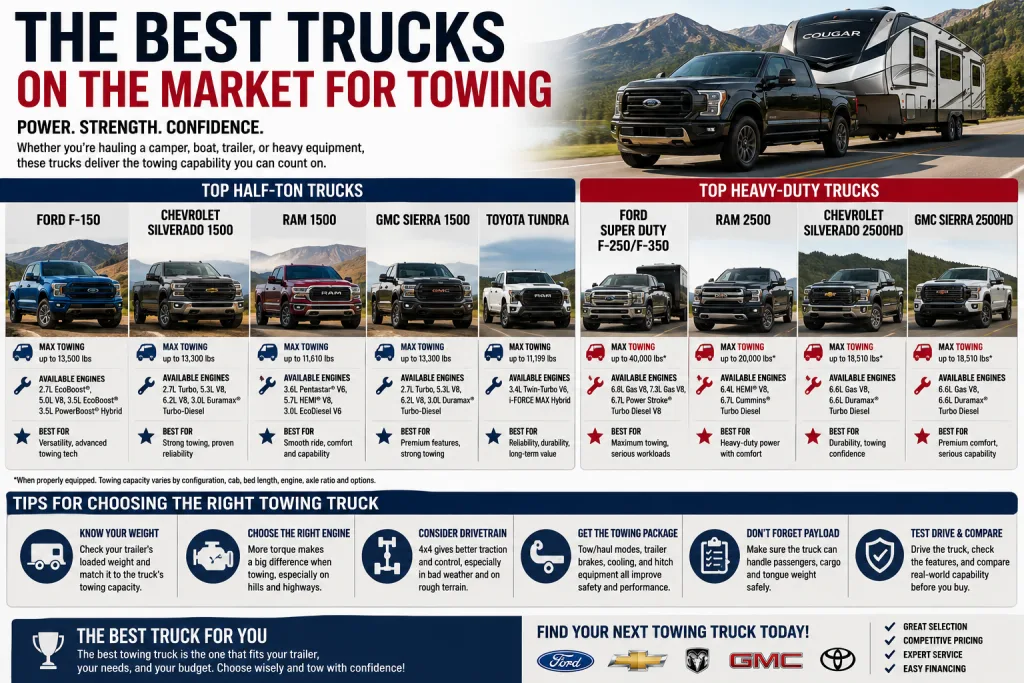
For 2026, Chevrolet’s official trailering guide shows the Silverado 1500 can tow up to 13,300 pounds when properly equipped. That makes it a strong fit for drivers who need to pull campers, trailers, boats, and work equipment without moving into a heavy-duty truck.
The Silverado also offers useful trailering technology, camera views, and towing packages that make it easier to hitch, maneuver, and monitor a trailer.
Ram 1500: Smooth Ride With Serious Power
The Ram 1500 is known for combining towing strength with a comfortable ride. It is one of the best choices if you want a truck that can tow on the weekend but still feel refined during the week.
For 2026, official Ram capability information lists the Ram 1500 with up to 11,610 pounds of towing capacity and up to 2,360 pounds of payload when properly equipped. That gives it enough strength for many campers, boats, utility trailers, and recreational loads.
The Ram 1500 also stands out for comfort. Its cabin quality, ride feel, and available technology make it a strong choice for drivers who use their truck every day.
GMC Sierra 1500: Premium Towing Capability
The GMC Sierra 1500 shares much of its capability with the Silverado but adds a more premium feel, especially in higher trims. It is a strong choice for drivers who want towing power with upscale styling and advanced truck features.
GMC says the 2026 Sierra 1500 can tow up to 13,300 pounds when properly equipped with the available Duramax 3.0L Turbo-Diesel engine, Max Trailering Package, and the right wheel and cab configuration. You can review that rating on the official GMC Sierra page.
The Sierra is especially appealing in trims like SLT, AT4, Denali, and Denali Ultimate. It gives buyers capability, comfort, and a more premium truck experience.
Toyota Tundra: Dependable and Ready for Work
The Toyota Tundra has a strong reputation for durability and long-term dependability. It moved away from the old V8 formula and now uses a twin-turbo V6 setup, with hybrid power available on select trims.
For 2026, Toyota Canada lists the Tundra at up to 11,199 pounds, or 5,080 kilograms, of towing capacity when properly equipped. The official Toyota Tundra page also lists maximum payload at 1,940 pounds, or 880 kilograms.
The Tundra is a strong choice for buyers who want a modern full-size truck with Toyota reliability, useful towing strength, and a comfortable cabin.
Nissan Titan XD: A Unique Middle-Ground Option
The Nissan Titan XD is no longer a new-production truck, but used models can still be worth considering. It was built to sit between a regular half-ton and a traditional heavy-duty truck, giving buyers a tougher feel without moving fully into three-quarter-ton territory.
Nissan says the 2024 Titan lineup offered a gooseneck towing rating of up to 11,050 pounds. That official Nissan Titan information shows why the XD still appeals to used-truck buyers who want a strong V8 pickup with a more substantial platform.
Because the Titan has been discontinued, shoppers should focus on condition, mileage, service history, and parts availability when buying used.
Ford Super Duty: Heavy-Duty Muscle
If a half-ton truck is not enough, the Ford Super Duty lineup is one of the strongest places to look. The F-250, F-350, and F-450 are built for heavy towing, commercial work, large fifth-wheel trailers, livestock trailers, and serious equipment hauling.
Ford Canada lists the 2026 Super Duty with up to 40,000 pounds of gooseneck towing, up to 35,000 pounds of fifth-wheel towing, and up to 30,000 pounds of conventional towing. Those official Ford Super Duty numbers show why it remains one of the top heavy-duty towing choices.
For most private buyers, an F-250 or F-350 is already more than enough. The F-450 is for the biggest towing jobs.
Ram 2500: Heavy-Duty Capability Wrapped in Comfort
The Ram 2500 is a great choice for drivers who need heavy-duty pulling power but still want a comfortable truck. It is popular with RV owners, contractors, farmers, and anyone who regularly tows more than a half-ton truck should handle.
Ram lists the 2026 Ram 2500 with up to 17,750 pounds of gas towing and up to 20,000 pounds of diesel towing when properly equipped. The official Ram 2500 page also lists up to 3,930 pounds of gas payload and up to 3,600 pounds of diesel payload.
The available Cummins diesel is the big reason many buyers choose the Ram 2500. It gives the truck serious low-end torque and confidence under load.
Chevrolet Silverado 2500HD: Dependable Workhorse
The Chevrolet Silverado 2500HD is built for buyers who need more towing strength than a Silverado 1500 can provide. It is a strong choice for work trailers, large campers, equipment, and heavy-duty use.
The Silverado HD lineup is known for gas and Duramax diesel options, stable towing performance, and strong trailering technology. It also gives buyers a more serious frame, suspension, and braking setup than a half-ton truck.
If you tow regularly and a half-ton pickup feels close to its limit, the Silverado 2500HD is the kind of truck you should compare.
GMC Sierra 2500HD: Premium Heavy-Duty Strength
The GMC Sierra 2500HD gives buyers heavy-duty towing capability with a more upscale feel than many work-first pickups. It is closely related to the Silverado HD but often adds more premium styling, interior materials, and feature content.
It is a strong option for drivers who need serious towing power but do not want a bare-bones work truck. Denali and Denali Ultimate trims are especially appealing for buyers who want luxury and capability in the same package.
For RV owners and business users who spend long hours behind the wheel, that added comfort can matter.
How to Choose the Best Truck for Towing
Choosing the best towing truck starts with knowing your trailer. Look at the loaded trailer weight, not just the empty weight. Add cargo, water, fuel, tools, passengers, gear, and hitch weight.
If you tow small trailers, a half-ton truck like a Ram 1500, Silverado 1500, Sierra 1500, F-150, or Tundra may be enough. If you tow large campers, equipment trailers, or heavy work loads, a heavy-duty truck like a Ram 2500, Silverado 2500HD, Sierra 2500HD, or Ford Super Duty may be the smarter choice.
Do not buy based only on the maximum number. Check the truck’s specific door sticker, payload rating, axle ratio, engine, towing package, and hitch equipment.
Gas vs. Diesel for Towing
Gas trucks are usually less expensive to buy and maintain. They work well for occasional towing, lighter trailers, and daily driving.
Diesel trucks usually cost more upfront, but they offer stronger torque, better confidence under heavy load, and better long-distance towing performance. If you tow heavy trailers often, diesel is usually worth considering.
For many buyers, the decision comes down to frequency. If you tow a few times a year, gas may be enough. If you tow every week or pull heavy loads across long distances, diesel can make more sense.
Half-Ton vs. Heavy-Duty Truck
A half-ton truck is easier to live with every day. It is usually more comfortable, more affordable, easier to park, and better for drivers who tow moderate loads.
A heavy-duty truck is stronger but more serious. It usually costs more, rides firmer, and uses more fuel, but it gives you more towing confidence and payload capacity.
If your trailer pushes the limits of a half-ton, step up to heavy-duty. Towing near the maximum all the time is not ideal. A truck with extra capacity will usually feel safer and more relaxed.
Find the Right Towing Truck
The best trucks for towing depend on what you need to pull. The Ram 1500, Chevrolet Silverado 1500, GMC Sierra 1500, Ford F-150, and Toyota Tundra are strong half-ton options for everyday drivers and weekend towing. The Ram 2500, Ford Super Duty, Chevrolet Silverado 2500HD, and GMC Sierra 2500HD are better for heavier trailers and more demanding work.
Before choosing, compare real towing capacity, payload, engine choice, cab configuration, drivetrain, hitch equipment, and trailer technology. The right truck should match your actual trailer, not just the biggest number in an ad.
Visit Simi Valley Chrysler Dodge Jeep Ram to browse new inventory, compare used inventory, check your trade-in value, or apply for financing before choosing your next towing truck.

Jeep Wrangler’s High Price Tag: Learn the Shocking Truth Behind It
The Jeep Wrangler is expensive because it is not built like a normal crossover SUV.
A Wrangler costs more because it uses a body-on-frame construction, standard four-wheel drive, serious off-road hardware, removable roof and door engineering, strong resale value, and a huge lifestyle brand identity that few SUVs can match. In Canada, Jeep lists the 2026 Wrangler with an MSRP range from $44,490 to $73,735, depending on trim and equipment. In the U.S., Kelley Blue Book lists the 2026 Wrangler 2-Door starting around $38,030, while 4-Door models can run much higher depending on trim and options. Jeep Canada and Kelley Blue Book both show how wide the Wrangler price spread can get.
So yes, the Wrangler is expensive. But the real question is whether that price is inflated hype, or whether you are paying for hardware most SUVs do not have.
The Wrangler Is Not a Regular SUV
Most SUVs today are crossovers. They are built mainly for comfort, fuel economy, safety tech, and daily commuting.
The Jeep Wrangler is different. It is closer to a purpose-built off-road truck than a typical family crossover. That difference is one of the biggest reasons it costs more.
A Wrangler has real four-wheel-drive capability, rugged suspension design, strong approach and departure angles, removable body features, and trim levels built around trail use. The Wrangler is not trying to be the quietest, smoothest, cheapest SUV in the segment. It is built to do things most crossovers are not designed to do.
That specialty engineering adds cost.
Standard 4×4 Capability Costs Money
One reason the Jeep Wrangler has a high price tag is that four-wheel drive is not just an option added for marketing. It is central to the vehicle.
Every Wrangler is built around off-road capability. Depending on trim, buyers can get advanced 4×4 systems, locking differentials, disconnecting sway bars, skid plates, upgraded axles, all-terrain tires, rock rails, and trail-focused gearing.
That hardware is expensive compared with a simple front-wheel-drive crossover. A basic compact SUV can be cheaper because it does not need the same drivetrain strength or off-road durability.
If you are only driving to work, school, Costco, and the beach, you may not use all that hardware. But it is still built into the Wrangler’s price.
Body-on-Frame Construction Is Part of the Cost
The Wrangler still uses a more rugged construction approach than most modern SUVs.
Many crossovers use unibody platforms because they are lighter, more efficient, and better for normal road comfort. The Wrangler keeps a truck-like identity because it is built for rougher use.
That kind of vehicle architecture helps with durability, articulation, and trail capability, but it can cost more to develop, produce, and refine. It also usually brings tradeoffs in ride comfort, wind noise, fuel economy, and handling.
That is part of the shock for some buyers. The Wrangler can be more expensive than a smoother crossover, while also feeling less refined on the highway. But that is because the money is going into different priorities.
Solid Axles Are Rare and Expensive
The Wrangler’s solid-axle setup is another major reason it feels different from regular SUVs.
Most modern SUVs use independent suspension because it improves road comfort and handling. The Wrangler keeps solid front and rear axles because they are valuable off-road. Solid axles help with articulation, durability, and predictable traction on uneven trails.
That is not the cheapest way to build a comfortable road SUV. It is a deliberate off-road choice.
For buyers who want real trail capability, this is part of the appeal. For buyers who only care about quiet commuting, it may feel like paying extra for hardware they will never use.
Removable Doors and Roof Add Engineering Cost
The Wrangler’s removable roof and doors are not just gimmicks.
Designing a vehicle that can safely and legally operate with removable panels is more complicated than building a fixed-roof SUV. Jeep has to engineer weather sealing, body structure, wiring connections, hinges, latches, roof panels, storage solutions, and crash-related design around a vehicle that can be opened up in ways most SUVs cannot.
That freedom is one of the biggest reasons people buy Wranglers. But it also contributes to cost.
A Honda CR-V, Toyota RAV4, Mazda CX-5, or Jeep Grand Cherokee does not need to solve those same problems. The Wrangler does.
The Rubicon Drives the Price Even Higher
If the base Wrangler already seems expensive, the Rubicon can feel shocking.
But the Rubicon is not just a badge. It is the trail-focused version with serious off-road upgrades. Depending on the model year and configuration, Rubicon models can include locking differentials, electronic sway bar disconnect, upgraded axles, rock rails, aggressive tires, and improved crawl capability.
Those parts are expensive from the factory, but they also save some buyers from having to modify the Jeep later. A buyer who actually off-roads may see the Rubicon as a better value than buying a cheaper Wrangler and adding parts afterward.
For buyers who only want the look, though, the Rubicon price may not make sense.
Wrangler Resale Value Keeps Prices High
One of the biggest reasons Wranglers are expensive is resale value.
Wranglers tend to hold value better than many other SUVs. That affects both new and used prices. If a vehicle depreciates slowly, used examples stay expensive, and new ones can feel less discounted because demand remains strong.
This is why used Wranglers often shock shoppers. A five-year-old Wrangler can still cost more than people expect because the market knows they are desirable.
Kelley Blue Book has repeatedly recognized Wrangler for strong resale value in past awards, and Jeep even promotes Kelley Blue Book trade-in tools directly on its own Jeep trade-in value page. Strong resale can hurt buyers upfront, but it can help owners later when they trade or sell.
Demand Is Huge
Jeep does not have to price the Wrangler like a normal SUV because buyers do not treat it like a normal SUV.
The Wrangler has one of the strongest enthusiast communities in the automotive world. People buy it for trail use, beach driving, camping, overlanding, customization, removable-roof fun, and the Jeep lifestyle.
That demand gives Jeep pricing power.
A lot of SUVs compete on practicality. The Wrangler competes on identity. That is why people still pay premium prices even when there are cheaper, quieter, more fuel-efficient SUVs available.
Customization Adds to the Cost
The Wrangler is one of the most customizable vehicles on the road.
Lift kits, wheels, tires, bumpers, winches, lighting, roof racks, fenders, recovery gear, interior accessories, and overland setups are all part of the culture. Jeep knows buyers love options, and that shows up in factory packages too.
When buyers add bigger wheels, upgraded tops, tech packages, safety packages, leather, premium audio, towing equipment, and off-road upgrades, the price can climb quickly.
A Wrangler can start at one number and end up thousands higher after options.
Fuel Economy Is Not the Wrangler’s Strongest Point
Another reason the Wrangler feels expensive is that the cost does not stop at the purchase price.
Wranglers are not known for being fuel-economy leaders. The boxy shape, off-road tires, 4×4 hardware, weight, and aerodynamics all work against it. A crossover can usually deliver better fuel economy because it is smoother, lighter, and more road-focused.
That means Wrangler ownership can cost more at the pump, especially if you choose larger tires, lift the vehicle, or drive mostly in the city.
For some buyers, that is worth it. For others, it is a reason to consider something more efficient.
Maintenance and Repairs Can Add Up
The Wrangler is not the cheapest compact SUV to maintain.
RepairPal gives the Jeep Wrangler an average annual repair cost of $694, compared with $521 for compact SUVs and $652 for all vehicle models. It also ranks the Wrangler 25th out of 26 compact SUVs for reliability, though it notes that the number of repairs is low and major repairs are uncommon. RepairPal
That does not mean the Wrangler is bad. It means ownership costs should be taken seriously.
Off-road use, modifications, oversized tires, suspension changes, and rough driving can increase wear. A stock Wrangler that is maintained well can be manageable. A heavily modified one with cheap parts can become expensive fast.
The Used Wrangler Market Is Still Pricey
Many shoppers think the smart move is to skip a new Wrangler and buy used.
Sometimes that works. But used Wranglers are often still expensive because of resale value and demand. A clean used Wrangler with low mileage, four doors, the right trim, and popular options can hold value surprisingly well.
The upside is that a Wrangler may lose less value over time compared with many SUVs. The downside is that finding a true bargain can be hard.
If you are shopping used, pay close attention to maintenance records, accident history, rust, water leaks, lift kits, tire wear, steering feel, suspension condition, and whether the Jeep has been off-roaded hard.
For local shoppers, checking available used Jeep inventory is a good starting point because condition, mileage, trim, and modifications matter as much as price.
Is the Jeep Wrangler Overpriced?
The Wrangler can feel overpriced if you judge it like a normal SUV.
If you compare it only on quietness, fuel economy, cargo space, highway comfort, and price, many crossovers look better. A Toyota RAV4, Honda CR-V, Mazda CX-5, Subaru Forester, or even a Jeep Grand Cherokee may make more sense for daily comfort.
But if you judge the Wrangler by off-road capability, removable-roof fun, resale value, customization, and brand identity, the price becomes easier to understand.
The Wrangler is expensive because it is one of the few vehicles that still delivers that specific experience from the factory.
Should You Buy a Wrangler or Another Jeep?
Buy the Wrangler if you want the real Jeep experience.
That means removable doors, removable roof, strong trail capability, huge aftermarket support, and a vehicle that feels different from everything else on the road.
Consider another Jeep if you want better everyday comfort, quieter road manners, or more family-friendly refinement. A Grand Cherokee, Grand Cherokee L, Compass, or Cherokee can make more sense if you do not need the full Wrangler lifestyle.
If you want a new Jeep with warranty coverage, compare available new Jeep inventory. If you are budgeting around payments, trade value, or approval options, start with the dealership’s finance application.
How to Avoid Overpaying for a Wrangler
The best way to avoid overpaying is to buy the Wrangler you actually need, not the one that looks the most aggressive online.
Do not buy a Rubicon if you will never use Rubicon hardware. Do not pay extra for a lift if the work was done cheaply. Do not assume every used Wrangler is worth top dollar. Do not ignore rust or water leaks. Do not stretch your budget just because Wranglers hold value.
Focus on the right trim, clean history, proper maintenance, and realistic ownership costs.
A Sport or Willys may be enough for many buyers. A Sahara may be better for comfort-focused daily driving. A Rubicon makes sense for real off-road use. A 4xe can make sense if your driving habits fit plug-in hybrid ownership, but it adds complexity.
FAQs About Why Jeep Wranglers Are Expensive
Why are Jeep Wranglers so expensive?
Jeep Wranglers are expensive because they use real 4×4 hardware, off-road-focused engineering, removable roof and door systems, body-on-frame construction, solid axles, and strong resale value. They are specialty vehicles, not regular crossovers.
Are Jeep Wranglers overpriced?
They can feel overpriced if you only want a basic daily SUV. But for buyers who want off-road capability, removable-roof freedom, customization, and strong resale value, the price is easier to justify.
Do Jeep Wranglers hold their value?
Yes, Wranglers are known for strong resale value. That keeps both new and used prices higher than many competing SUVs.
Is a used Jeep Wrangler worth it?
A used Wrangler can be worth it if it has clean maintenance history, no major rust, no bad modifications, no water leaks, and a fair price. Used Wranglers are often expensive because demand and resale value are strong.
Is the Rubicon worth the extra money?
The Rubicon is worth it if you actually need serious off-road hardware. If you mostly drive on pavement, a Sport, Willys, or Sahara may be the smarter buy.
Is the Jeep Wrangler expensive to maintain?
The Wrangler can cost more to maintain than many compact SUVs. RepairPal lists the average annual repair cost at $694, which is higher than the compact SUV average.
Final Thoughts: The Wrangler Costs More Because It Does More
The Jeep Wrangler’s high price tag is not just random.
You are paying for real off-road capability, removable body features, rugged hardware, strong resale value, customization potential, and one of the strongest lifestyle brands in the SUV market.
That does not mean every buyer should get one. If you only need a quiet, efficient, low-cost daily SUV, there are better values. But if you want the full Jeep experience, the Wrangler is one of the only vehicles that still delivers it straight from the factory.
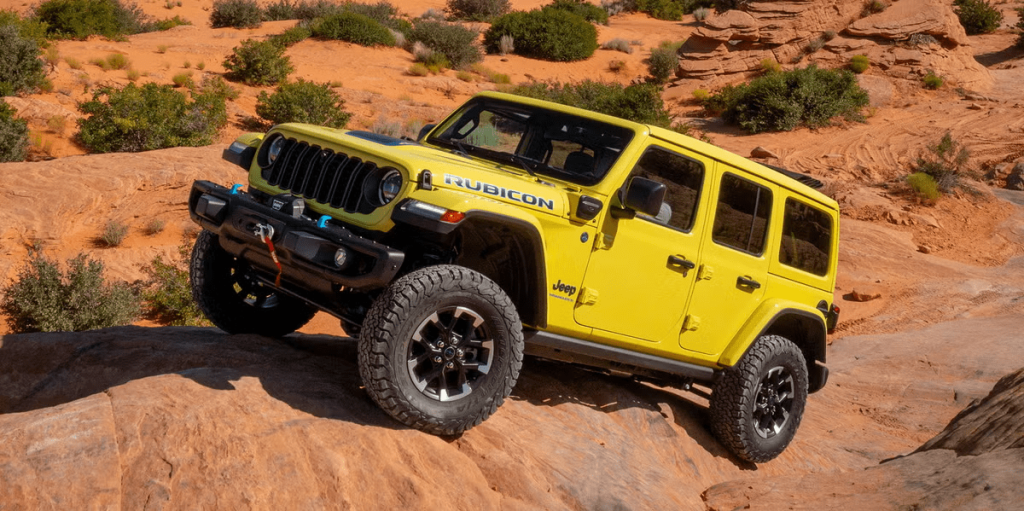

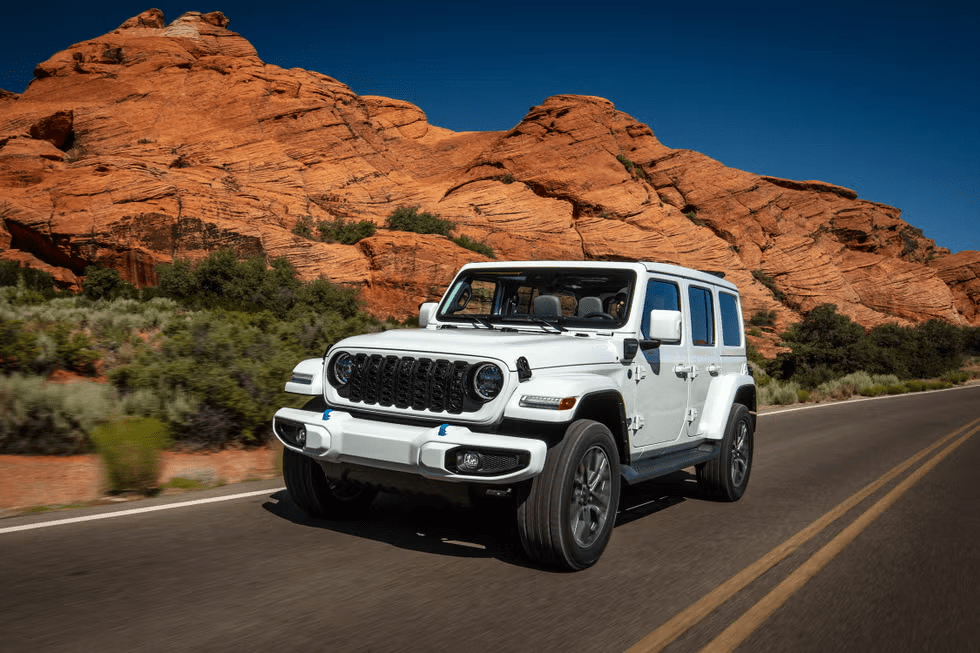
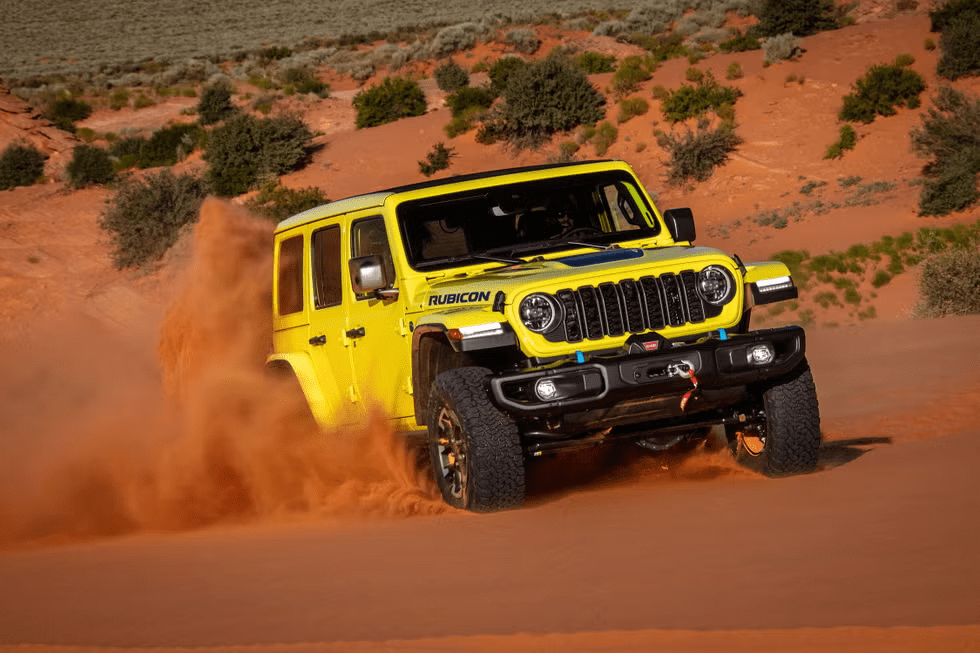
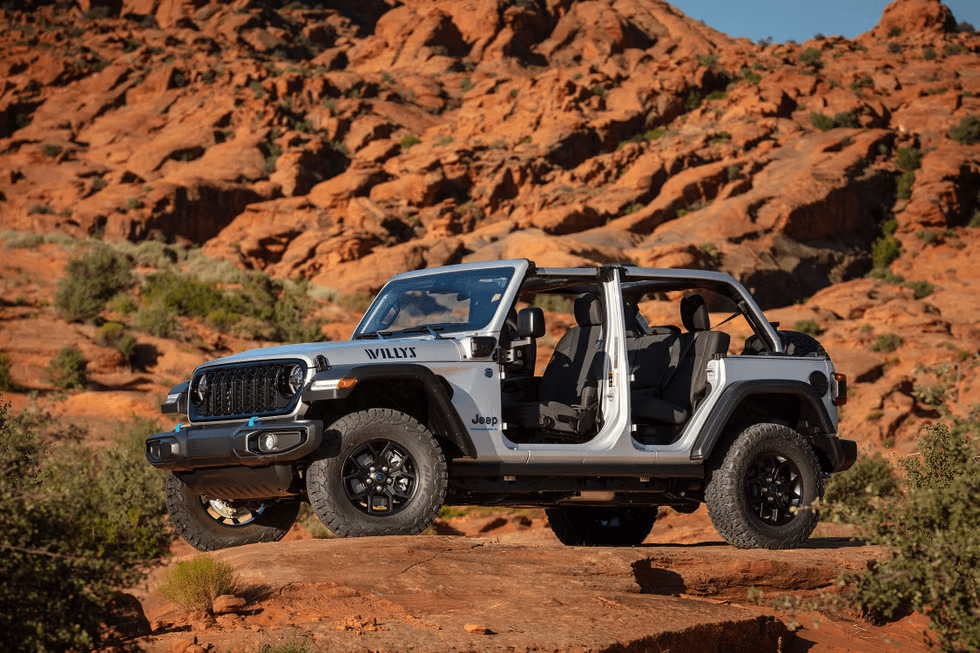


Is Jeep Making a 2026 Trackhawk? Everything You Need to Know
The short answer is no, Jeep has not officially confirmed a 2026 Grand Cherokee Trackhawk.
For now, the 2026 Jeep Grand Cherokee lineup is focused on a refreshed design, updated technology, and a new turbocharged 2.0L Hurricane 4 engine. Jeep’s official 2026 Grand Cherokee information highlights the new powertrain, available 12.3-inch touchscreen, available Hands-Free Active Driving Assist, and towing capability of up to 6,200 pounds, but it does not list a Trackhawk trim. You can see the current official details on the 2026 Grand Cherokee page.
That does not mean performance Jeep fans are imagining things. There are real signs that Jeep and Stellantis are thinking seriously about high-performance SUVs again. But as of now, a 2026 Trackhawk has not been announced.
What Was the Jeep Trackhawk?
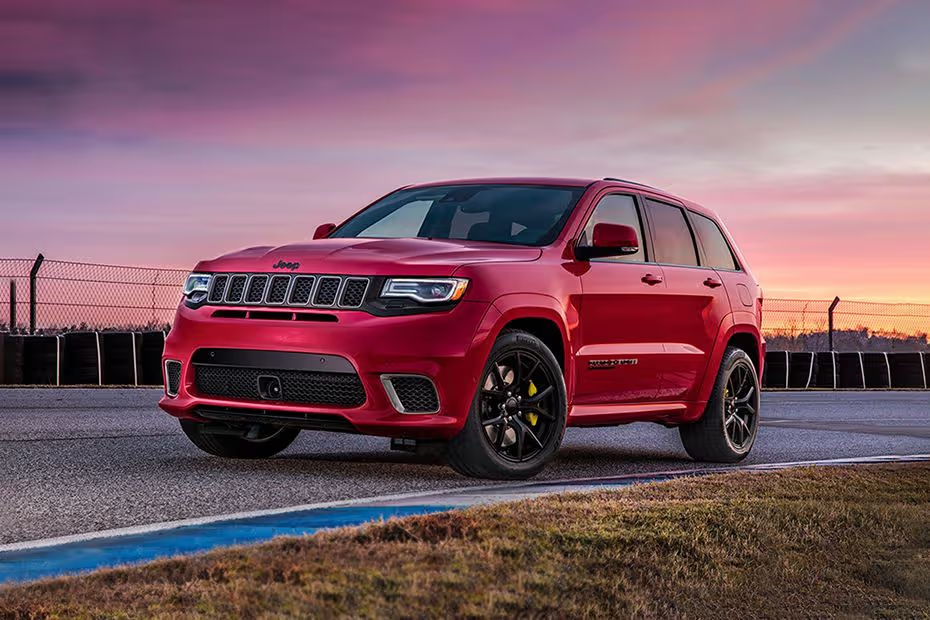
The Jeep Grand Cherokee Trackhawk was one of the wildest performance SUVs ever sold.
It used a supercharged 6.2L HEMI Hellcat V8, the same basic engine family that powered some of Dodge’s most famous Hellcat models. In the Grand Cherokee Trackhawk, that engine made 707 horsepower and turned a practical SUV into a legitimate performance machine.
The Trackhawk was based on the previous WK2-generation Grand Cherokee. When that generation ended, the Trackhawk disappeared with it. The newer WL-generation Grand Cherokee arrived with more refinement, more technology, and a plug-in hybrid 4xe option, but no direct Trackhawk replacement.
That is why so many shoppers keep asking the same question: is Jeep making a 2026 Trackhawk?
Is There a 2026 Jeep Grand Cherokee Trackhawk?
No confirmed 2026 Jeep Grand Cherokee Trackhawk exists right now.
Jeep’s official 2026 Grand Cherokee lineup does not include a Trackhawk, SRT, Hellcat, or supercharged V8 version. The current lineup is built around mainstream luxury, capability, off-road confidence, and efficiency rather than extreme muscle-SUV performance.
For 2026, Jeep is talking more about its new Hurricane 4 Turbo engine than a HEMI V8. Stellantis Fleet lists the new 2.0L Hurricane 4 Turbo at 324 horsepower and 332 lb-ft of torque, paired with a new Gen IV transmission. That engine also helps the Grand Cherokee reach a claimed maximum towing capacity of 6,200 pounds. You can view those specs on the Stellantis Fleet Grand Cherokee page.
That makes the 2026 Grand Cherokee more powerful than many shoppers may expect from a four-cylinder engine, but it is not a Trackhawk successor.
Why People Think the Trackhawk Could Return
The rumors are not coming from nowhere.
In early 2026, several automotive outlets reported that Jeep may be reconsidering high-performance Grand Cherokee variants. Autoblog reported that Jeep leadership suggested “everything is on the table” when discussing future high-performance models, including possible V8-powered Grand Cherokee variants.
That is not the same as confirmation, but it is enough to keep the Trackhawk conversation alive.
There have also been spy-photo discussions around unusual Grand Cherokee test vehicles. TFLcar reported on a Grand Cherokee mule that raised questions about whether Jeep could be testing a future SRT or Trackhawk-style model. The outlet noted that the prototype’s appearance and exhaust setup created speculation around a performance version. You can read that report from TFLcar.
Again, this is not official confirmation. It is speculation based on testing activity and industry reporting.
Trackhawk vs SRT: What Might Come Back First?
If Jeep brings back a performance Grand Cherokee, it may not start with the Trackhawk name.
The more likely first step could be an SRT model. A Grand Cherokee SRT would probably sit below a full Trackhawk-style Hellcat model, using a powerful naturally aspirated V8 or another high-output performance engine.
That matters because the original Trackhawk was the top of the mountain. It was not just a sporty Grand Cherokee. It was the supercharged Hellcat version.
A new SRT could return before a full Trackhawk. That would give Jeep a performance halo model without immediately jumping back to a 700-plus-horsepower SUV.
Car and Driver has already created future-facing coverage around a possible Grand Cherokee SRT, but that reporting points further ahead, not to a confirmed 2026 Trackhawk.
Why a 2026 Trackhawk Is Unlikely
There are a few reasons a 2026 Trackhawk is unlikely.
First, Jeep has already revealed the direction of the 2026 Grand Cherokee. The official model information focuses on the refreshed design, new interior technology, driver-assistance features, towing, and the Hurricane 4 Turbo engine. A Trackhawk would be a major performance announcement, and Jeep has not made that announcement.
Second, the old Trackhawk’s supercharged Hellcat V8 was tied to an era of Stellantis performance that has been changing quickly. Dodge ended production of the traditional Charger and Challenger Hellcat models, and Stellantis has been moving toward new Hurricane engines, hybrids, and electric performance vehicles.
Third, a Trackhawk is not a minor trim. It would require major powertrain, cooling, braking, suspension, drivetrain, emissions, and durability work. Jeep would likely promote that heavily before launch.
So while a future performance Grand Cherokee is possible, a 2026 Trackhawk specifically looks unlikely based on current official information.
Could Jeep Use a Hurricane Engine Instead?
Yes, and this may be the more realistic path.
Instead of bringing back the old supercharged Hellcat V8, Jeep could use a high-output Hurricane inline-six or another modern performance powertrain in a future Grand Cherokee SRT-style model.
Stellantis already has the Hurricane engine family in production, and it fits the company’s move toward smaller-displacement, turbocharged performance. A high-output Hurricane six-cylinder could give Jeep strong performance without relying on the old Hellcat formula.
That would not be the same emotional recipe as the original Trackhawk, but it could make more business sense.
What About an Electric Trackhawk?
An electric or hybrid performance Jeep is also possible in the long term.
Jeep already sells electrified models, including 4xe plug-in hybrids, and Stellantis has been developing EV platforms for future performance vehicles. Electric motors can deliver instant torque, which makes them a natural fit for quick SUVs.
However, there is no confirmed 2026 electric Trackhawk either.
If Jeep does build a new performance flagship, it could use a V8, a Hurricane engine, a plug-in hybrid setup, or a fully electric performance system. Right now, Jeep has not confirmed which direction it will take for a future Trackhawk-style Grand Cherokee.
Should You Wait for a 2026 Trackhawk?
If you specifically want a new 2026 Jeep Grand Cherokee Trackhawk, waiting may not be the best move because Jeep has not confirmed one.
If you want a Grand Cherokee now, the 2026 model still brings meaningful updates. Jeep Canada lists the 2026 Grand Cherokee with available towing of up to 2,812 kg, or 6,200 lb, along with a refreshed design and available 31.2 cm, or 12.3-inch, touchscreen. You can review the Canadian model details on the Jeep Canada site.
If you want Trackhawk-level performance, your better options may be:
A used Grand Cherokee Trackhawk.
A used Grand Cherokee SRT.
A Dodge Durango SRT or Hellcat, depending on availability.
Waiting for Jeep to confirm a future SRT or Trackhawk replacement.
For shoppers who care more about capability, comfort, towing, and everyday usability, the 2026 Grand Cherokee still makes sense. For shoppers who want 700-horsepower madness, the used market is still where the Trackhawk lives.
FAQs About the 2026 Jeep Trackhawk
Is Jeep making a 2026 Trackhawk?
Jeep has not officially confirmed a 2026 Grand Cherokee Trackhawk. The current 2026 Grand Cherokee information does not list a Trackhawk trim.
Will the Jeep Trackhawk come back?
It could come back in the future, but nothing is confirmed. Industry reports suggest Jeep may be considering high-performance Grand Cherokee models again, but that does not guarantee the Trackhawk name will return.
What engine would a new Trackhawk use?
A future Trackhawk could use a V8, a high-output Hurricane engine, a hybrid system, or an electric performance setup. Jeep has not confirmed the engine for any future Trackhawk model.
Is there a 2026 Jeep Grand Cherokee SRT?
Jeep has not confirmed a 2026 Grand Cherokee SRT. Some reports suggest an SRT-style Grand Cherokee could return later, but not as a confirmed 2026 model.
What replaced the Jeep Trackhawk?
There is no direct replacement for the Jeep Grand Cherokee Trackhawk right now. The current Grand Cherokee lineup focuses on luxury, capability, technology, towing, and available 4xe electrification rather than Hellcat-level performance.
Final Thoughts: The 2026 Trackhawk Is Not Confirmed Yet
So, is Jeep making a 2026 Trackhawk?
As of now, no official 2026 Jeep Grand Cherokee Trackhawk has been confirmed.
The 2026 Grand Cherokee is real, and it brings important updates, including a refreshed design, new technology, and the new Hurricane 4 Turbo engine. But if you are looking for a direct successor to the 707-horsepower Trackhawk, Jeep has not announced one yet.
The good news is that performance Jeep rumors are getting louder. Jeep leadership has left the door open, spy reports have fueled speculation, and enthusiast demand is still strong. But until Jeep officially reveals a new Trackhawk or SRT model, the safest answer is simple: the 2026 Trackhawk is not here yet, but the story may not be over.
2026 Ram 2500: Official Comprehensive Guide
2026 Ram 2500: Official Comprehensive Guide
The 2026 Ram 2500 is built for drivers who need more truck than a half-ton pickup can offer. It is made for towing heavy trailers, carrying serious payload, handling jobsite work, and giving drivers the confidence to take on demanding jobs without moving all the way into a one-ton truck.
Ram positions the 2500 as a heavy-duty pickup with big power, strong diesel torque, useful towing technology, and a more comfortable cabin than many older work trucks. The available High-Output 6.7L Cummins Turbo Diesel I6 gives the 2026 Ram 2500 up to 1,075 lb-ft of torque, while official Ram capability specs list maximum diesel towing at 20,000 pounds when properly equipped.
What Is the 2026 Ram 2500?
The 2026 Ram 2500 is a heavy-duty pickup that sits above the Ram 1500 and below the Ram 3500. It is designed for drivers who need stronger towing and payload ratings than a regular full-size truck can provide.
That makes it a strong fit for contractors, RV owners, farmers, fleet buyers, landscapers, equipment haulers, and anyone who regularly pulls trailers or carries heavy cargo. It is also popular with private buyers who want a powerful truck for both weekday work and weekend travel.
The Ram 2500 is not just about strength. It also gives buyers modern technology, comfortable seating, available premium trims, and a smoother daily driving experience than many people expect from a heavy-duty pickup.
2026 Ram 2500 Engine Options
The 2026 Ram 2500 gives buyers two main engine choices. The standard engine is the 6.4L HEMI V8, while the available upgrade is the High-Output 6.7L Cummins Turbo Diesel I6.
The gas engine is the more straightforward choice. It is strong, capable, and usually less expensive to buy and maintain than the diesel. It works well for drivers who need heavy-duty capability but do not tow maximum loads every day.
The available Cummins diesel is the serious towing engine. Ram says the High-Output Cummins delivers 430 horsepower and 1,075 lb-ft of torque, giving the truck the low-end pulling strength heavy-duty buyers want. Those official Ram truck specs make the diesel the better choice for frequent towing, long-distance hauling, and heavier trailers.
Gas Towing Capacity
The 6.4L HEMI V8 is not just a basic engine. It gives the 2026 Ram 2500 enough strength for many real-world towing jobs. Ram lists maximum gas towing capacity at 17,750 pounds when properly equipped.
That is more than enough for many utility trailers, boats, smaller equipment trailers, horse trailers, and travel trailers. For many buyers, the gas engine gives the right mix of power, price, and ownership simplicity.
The gas model also offers strong payload capability. Ram lists maximum gas payload at 3,930 pounds, which makes it useful for tools, materials, equipment, and jobsite loads.
Diesel Towing Capacity
The diesel Ram 2500 is the one to choose if towing is the main reason you are buying the truck. With the available High-Output Cummins engine, the 2026 Ram 2500 can tow up to 20,000 pounds when properly equipped.
That number matters for RV owners, commercial users, and drivers pulling larger enclosed trailers or heavy equipment. Diesel torque helps the truck feel more confident under load, especially when climbing hills, merging onto highways, or towing over long distances.
The diesel also gives the Ram 2500 a maximum payload rating of 3,600 pounds, according to official Ram capability information. That makes it a strong choice for buyers who need both towing strength and practical bed capacity.
Payload Capacity
Payload is one of the most important numbers for heavy-duty truck buyers. Towing tells you what the truck can pull. Payload tells you what the truck can carry in the bed and cabin.
The 2026 Ram 2500 can carry up to 3,930 pounds with the gas engine and up to 3,600 pounds with the diesel engine when properly equipped. This includes the weight of passengers, tools, bed cargo, trailer tongue weight, and accessories.
Payload is especially important for contractors and RV owners. Toolboxes, supplies, generators, compressors, hitch equipment, and passengers all count. Before buying, make sure the truck’s payload rating fits your real-world use.
Gas vs. Diesel: Which One Should You Buy?
The gas Ram 2500 is usually the better choice if you want lower upfront cost, simpler maintenance, and strong capability for occasional towing. It is a smart pick for drivers who use the truck for work, daily driving, and moderate towing.
The diesel Ram 2500 is better if you tow heavy trailers often. The Cummins engine gives the truck more torque, stronger pulling confidence, and better performance under heavy load.
If your truck spends most of its time unloaded, the gas engine may make more sense. If your truck regularly pulls a camper, equipment trailer, horse trailer, or heavy commercial load, the diesel is worth considering.
Transmission and Drivability
The 2026 Ram 2500 uses an eight-speed automatic transmission. The available Cummins diesel is paired with a TorqueFlite HD eight-speed automatic transmission designed to handle heavy torque.
This matters because towing is not only about engine power. A good transmission helps the truck stay controlled and responsive when pulling weight. It also helps keep the engine in the right power range when climbing grades, passing, or maintaining highway speed.
The result is a truck that feels more composed than older heavy-duty pickups, especially when equipped properly for towing.
Heavy-Duty Braking
A strong heavy-duty truck needs serious stopping power. Ram equips the 2026 Ram 2500 with heavy-duty four-wheel disc antilock brakes. It also offers an available automatic smart exhaust brake.
The exhaust brake is especially useful for diesel buyers. It helps slow the truck and trailer on downhill grades without relying only on the service brakes. For drivers towing campers, equipment, or enclosed trailers through hills or mountains, that feature can add confidence and reduce brake wear.
That kind of control is one reason heavy-duty truck buyers step up from a half-ton pickup.
Interior Comfort
The Ram 2500 is built for work, but it does not feel stripped-down unless you choose a basic work configuration. Depending on trim, it can offer a comfortable cabin, large screens, premium materials, advanced camera views, and useful storage.
Ram has made interior comfort one of its biggest selling points. The 2026 Ram Heavy Duty lineup is described by Ram as its most advanced heavy-duty truck lineup yet, with modern technology and comfort features available across the range.
That matters for people who spend long hours in their truck. If you drive to jobsites, tow campers, travel long distances, or use your truck as both a work vehicle and family vehicle, cabin comfort is not a luxury. It is part of daily usability.
Technology and Towing Features
The 2026 Ram 2500 offers available technology designed to make towing easier. Depending on configuration, shoppers can find trailer-focused camera systems, towing assistance, trailer monitoring features, and driver-assistance technology.
These systems are helpful because towing a large trailer can be stressful. Better visibility makes it easier to line up a hitch, reverse into a campsite, back a trailer into a jobsite, or monitor what is happening behind the truck.
For buyers who tow often, these features should not be treated as extras. They can make the truck easier and safer to use every day.
2026 Ram 2500 Trim Levels
The Ram 2500 lineup gives buyers several choices, from basic work trucks to premium luxury-style pickups. Ram’s official Build & Price page shows trims such as Tradesman, Lone Star, Big Horn, Laramie, Rebel, Power Wagon, Limited, and Limited Longhorn, depending on configuration.
The Tradesman is the practical work-truck choice. It is best for buyers who care about capability, durability, and price.
The Big Horn and Lone Star trims add more comfort and appearance features while keeping the truck practical.
The Laramie is a strong middle-ground choice for drivers who want a better interior, more technology, and a more refined daily experience.
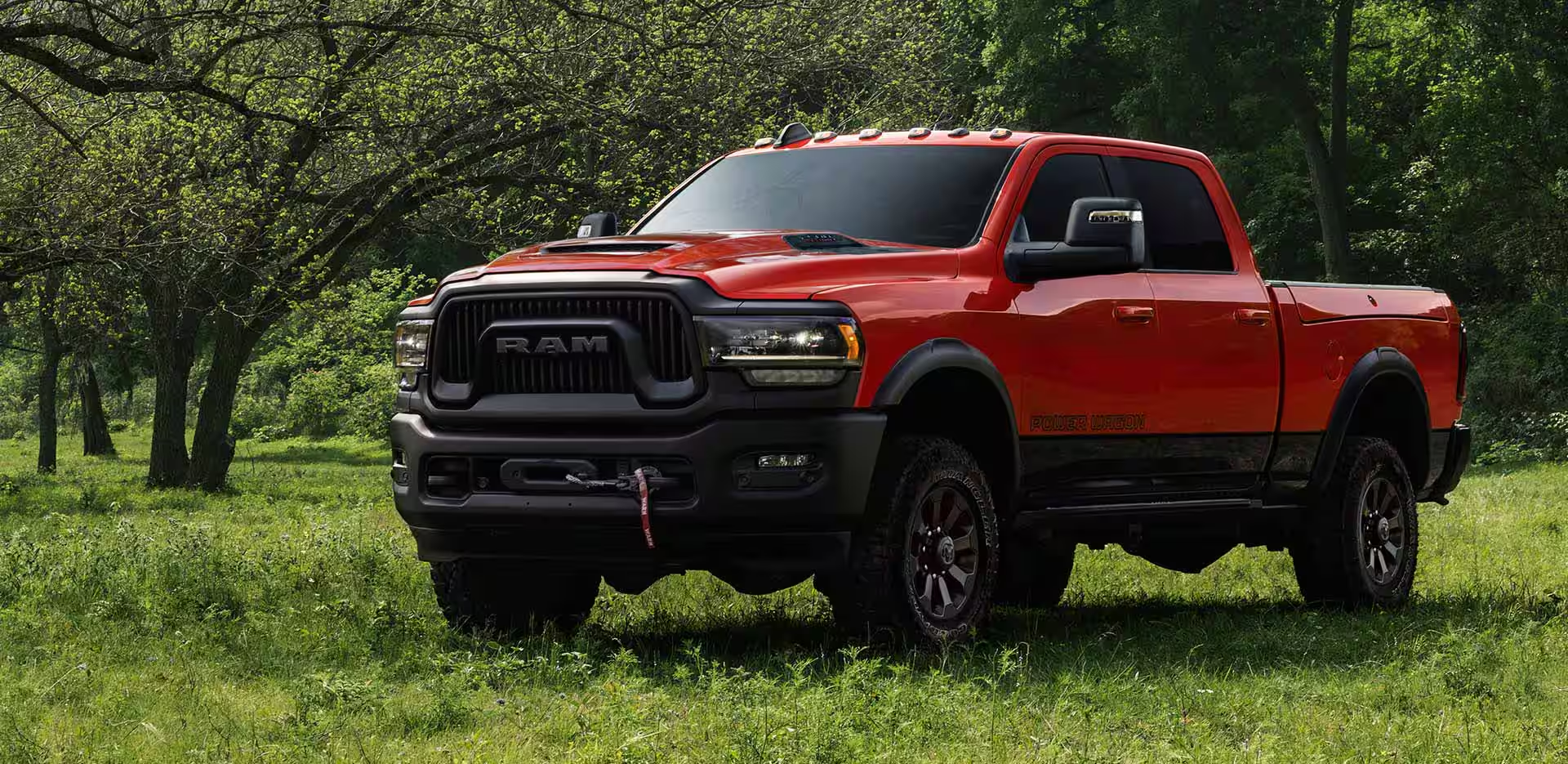
The Rebel and Power Wagon are better for off-road-focused buyers. The Power Wagon is especially known for serious off-road hardware.
The Limited and Limited Longhorn are for buyers who want heavy-duty strength with premium comfort and a more upscale interior.
Is the 2026 Ram 2500 Good for Work?
Yes, the 2026 Ram 2500 is a strong work truck. It has the towing, payload, braking, and power needed for many commercial and jobsite uses.
The gas engine works well for buyers who need payload, tools, and moderate towing. The diesel engine is better for frequent heavy towing and long-distance hauling.
Business buyers should think carefully about cab size, bed length, drivetrain, axle ratio, hitch needs, payload rating, and trailer weight before choosing a truck. The right configuration matters more than just picking the highest trim.
Is the 2026 Ram 2500 Good for RV Towing?
The Ram 2500 is a strong choice for RV owners. With up to 20,000 pounds of diesel towing capacity, it can handle many travel trailers and fifth-wheel setups when properly equipped.
The key is matching the truck to the camper. Do not shop by maximum towing capacity alone. Trailer weight, tongue weight, hitch weight, passengers, cargo, water tanks, and accessories all affect the real number.
For serious RV towing, the Cummins diesel is usually the better choice because of its torque and confidence under load.
Ram 2500 vs. Ram 3500
The Ram 2500 is extremely capable, but some buyers may need the Ram 3500 instead. The 3500 is built for even heavier towing and payload needs.
If you regularly tow very large fifth-wheel trailers, commercial equipment, or heavy gooseneck trailers, the Ram 3500 may be the better fit. If you want heavy-duty capability but do not need maximum one-ton capacity, the Ram 2500 often gives a better balance.
For many RV owners, contractors, and personal-use heavy-duty truck buyers, the Ram 2500 is the sweet spot.
Ram 2500 vs. Ford Super Duty and Silverado HD
The 2026 Ram 2500 competes with the Ford F-250 Super Duty, Chevrolet Silverado 2500HD, and GMC Sierra 2500HD. Each truck has its own strengths.
The Ford Super Duty is known for high towing numbers and a broad engine lineup. The Silverado HD and Sierra HD are strong choices for diesel power, work use, and proven truck capability. The Ram 2500 stands out with available Cummins torque, a comfortable cabin, and a strong mix of towing strength and everyday refinement.
The best truck depends on how you use it. If you value diesel torque, interior comfort, and heavy-duty capability, the Ram 2500 deserves serious attention.
2026 Ram 2500 Pricing
Pricing depends on cab size, bed length, drivetrain, trim, engine, options, and market conditions. Ram’s U.S. Build & Price page shows the 2026 Ram 2500 starting in the upper $40,000 range before destination, taxes, title, registration, options, and dealer fees.
A gas work truck will cost much less than a diesel Limited Longhorn or Power Wagon. The diesel engine, 4×4 system, larger cab, premium trim, towing packages, and technology options can all raise the final price.
Shoppers should compare actual inventory, not just starting MSRP. Two Ram 2500 trucks can have very different prices depending on how they are built.
Who Should Buy the 2026 Ram 2500?
The 2026 Ram 2500 is a strong choice for drivers who need real heavy-duty capability. It makes sense if you tow trailers, carry heavy payload, work in construction, run a business, own an RV, or simply want a truck that can do more than a half-ton pickup.
It may be more truck than necessary if you rarely tow, mostly commute, or do not need the added payload. In that case, a Ram 1500 may be easier to drive and more affordable.
But if you need power, durability, towing confidence, and a comfortable cabin, the Ram 2500 is one of the strongest heavy-duty pickups available.
Find the Right 2026 Ram 2500
The 2026 Ram 2500 gives buyers serious capability without giving up modern comfort. With a standard HEMI V8, available High-Output Cummins diesel, up to 20,000 pounds of towing capacity, strong payload ratings, heavy-duty braking, and useful towing technology, it is built for drivers who need a truck that can work hard.
The right model depends on your trailer, payload needs, budget, trim preference, and daily driving habits. Gas models are practical and capable, while diesel models are better for frequent heavy towing.
Visit Simi Valley Chrysler Dodge Jeep Ram to browse new inventory, compare used inventory, get your trade-in value, or apply for financing before choosing your next heavy-duty truck.

How Many Axles Does a Car Have?
Most cars have two axles: one axle for the front wheels and one axle for the rear wheels.
That means a standard sedan, hatchback, coupe, crossover, or SUV usually rides on two axles and four wheels. The front axle supports or drives the front wheels, while the rear axle supports or drives the rear wheels depending on whether the vehicle is front-wheel drive, rear-wheel drive, all-wheel drive, or four-wheel drive.
The answer can change for larger vehicles, commercial trucks, buses, trailers, and specialty off-road machines, but for everyday passenger vehicles, the simple answer is this: a car usually has two axles. Edmunds gives the same basic answer in its guide to how many axles a car has, while noting that axle design can vary depending on the vehicle.
What Is an Axle?
An axle is a shaft, rod, or axle assembly that connects wheels and helps support the vehicle’s weight. In many vehicles, axles also transfer power from the engine or electric motor to the wheels.
Axles are important because they help your vehicle:
- Support the weight of the car, passengers, and cargo
- Send power to the wheels when the vehicle accelerates
- Work with the steering and suspension systems
- Keep the wheels positioned correctly as the car moves
In older or heavier vehicles, an axle may look like a solid bar connecting the wheels. In many modern cars, especially front-wheel-drive and all-wheel-drive vehicles, the axle system may use half-shafts, CV joints, bearings, and independent suspension components instead of one simple solid beam.
How Many Axles Are on a Standard Car?
A standard passenger car usually has two axles.
One axle is at the front of the vehicle. One axle is at the rear of the vehicle. Each axle position is connected to a pair of wheels, which is why a normal four-wheel car has two axles.
For example, a Toyota Camry, Honda Accord, Dodge Charger, Mazda3, Kia Forte, Jeep Compass, and most regular SUVs all use a two-axle layout. Even many electric vehicles, such as a Tesla Model 3 or Ford Mustang Mach-E, are still considered two-axle vehicles because they have one front axle position and one rear axle position.
Do AWD and 4WD Vehicles Have More Axles?
No, all-wheel-drive and four-wheel-drive vehicles do not automatically have more axles.
A Jeep Wrangler, Subaru Outback, Ram 1500 4×4, or Dodge Durango AWD still usually has two axles. The difference is not the number of axles. The difference is how power is sent to them.
In a front-wheel-drive car, the front axle does the driving. In a rear-wheel-drive car, the rear axle does the driving. In an all-wheel-drive or four-wheel-drive vehicle, both the front and rear axle positions can receive power.
Consumer Reports explains that all-wheel drive can send power to each corner of the vehicle depending on the system design. That does not mean the vehicle has extra axles. It simply means the drivetrain can distribute power to more wheels.
Can a Vehicle Have More Than Two Axles?
Yes. Larger vehicles can have three, four, five, or even more axles.
Heavy-duty trucks, semi-trucks, buses, dump trucks, and large trailers often use extra axles to spread weight across more tires. This improves load capacity, stability, braking support, and road safety.
A dually pickup can confuse people because it has six wheels, but many dually trucks still have only two axles. The rear axle has two wheels on each side, but it is still one rear axle assembly.
A semi-truck is different. A tractor-trailer combination may have several axles because it needs to carry much more weight than a passenger car. This is where axle count matters for commercial regulations, towing, and load limits.
Common Types of Car Axles
Different vehicles use different axle designs. Here are the main ones shoppers and drivers should know.
Live Axle
A live axle sends power to the wheels. It is common in trucks, rear-wheel-drive vehicles, and some off-road SUVs.
Live axles are strong and durable, which is why they are useful for towing, hauling, and off-road driving. The tradeoff is that they may not ride as smoothly as independent suspension setups.
Dead Axle
A dead axle supports weight but does not send power to the wheels.
For example, in many front-wheel-drive cars, the rear axle area supports the back of the vehicle but does not drive the rear wheels. It is still part of the vehicle’s structure and suspension system, but it is not responsible for propulsion.
CV Axle
A CV axle, or constant velocity axle, is common in front-wheel-drive, all-wheel-drive, and many modern vehicles.
CV axles allow power to move to the wheels while still letting the wheels turn and move with the suspension. This is why they are important for steering, ride comfort, and smooth acceleration.
A common sign of CV axle trouble is a clicking or popping sound when turning. AutoZone notes that clicking or popping during low-speed sharp turns can point to a worn outer CV joint.
Stub Axle
A stub axle is usually found at the wheel end of the suspension and steering system. It helps connect the wheel hub to the suspension components.
Most drivers will never need to think about stub axles unless they are dealing with steering, wheel bearing, or suspension repairs.
Why Axle Count Matters
For most drivers, knowing the number of axles on a car is useful because it helps explain how the vehicle carries weight, sends power, and handles different driving conditions.
Axle count can affect:
- Towing capability
- Payload capacity
- Traction
- Repair costs
- Tire wear
- Commercial vehicle rules
For passenger cars, the number of axles is usually simple. For trucks, trailers, and commercial vehicles, it becomes more important because each axle has a weight rating.
The term GAWR, or Gross Axle Weight Rating, refers to the maximum load-carrying capacity of a single axle system as specified by the manufacturer. NHTSA defines Gross Axle Weight Rating as the load-carrying capacity of a single axle system measured at the tire-ground interfaces.
That means overloading a vehicle is not just about total weight. It is also about how much weight sits on each axle.
How to Tell How Many Axles Your Car Has
For most regular cars, you can count the axle positions by counting the wheel pairs.
One pair of front wheels equals one front axle. One pair of rear wheels equals one rear axle. That gives most cars two axles total.
You can also check your owner’s manual, vehicle specification sheet, door-jamb certification label, or manufacturer towing guide. If you drive a truck, commercial vehicle, or trailer, checking the axle rating is especially important before loading or towing.
Signs Your Axle May Need Repair
Axles are built to last, but they can wear out or get damaged. The warning signs depend on the vehicle and axle type, but common symptoms include:
- Clicking when turning
- Clunking when shifting from drive to reverse
- Vibration while accelerating
- Grease around the inside of the wheel
- Shaking at certain speeds
- A vehicle that revs but does not move properly
- Uneven tire wear
If you hear clicking while turning, especially in a front-wheel-drive or all-wheel-drive vehicle, the CV axle or CV joint should be inspected. If there is vibration under acceleration, the axle shaft, joints, wheel bearings, or related drivetrain parts may need attention.
How Much Does Axle Repair Cost?
Axle repair costs vary by vehicle type, drivetrain, and damage.
A basic CV axle replacement on a common passenger car may cost a few hundred dollars per side. A more complex axle repair on a truck, performance vehicle, or four-wheel-drive SUV can cost much more.
Costs can increase if the problem involves the differential, bearings, seals, suspension parts, or a damaged axle housing.
The best move is to inspect the issue early. A torn CV boot, for example, may start as a small grease leak. If ignored, it can lead to joint failure and a more expensive repair.
FAQs About Car Axles
How many axles does a normal car have?
A normal car usually has two axles: one in the front and one in the rear.
Does a four-wheel-drive car have four axles?
No. Most four-wheel-drive vehicles still have two axles. Four-wheel drive means power can be sent to all four wheels, not that the vehicle has four axles.
Does a dually truck have more axles?
Not always. A dually truck has extra rear wheels, but many dually pickups still have two axles. The rear axle simply has two wheels on each side.
Do electric cars have axles?
Yes. Electric cars still have axle positions that support the wheels and help transfer power. Some EVs use electric motors at one or both axle positions, but most regular EVs are still considered two-axle vehicles.
Can a car have three axles?
A regular passenger car usually does not have three axles. Three-axle layouts are more common on heavy-duty trucks, buses, large trailers, and specialty vehicles.
Final Thoughts: Most Cars Have Two Axles
So, how many axles does a car have?
For most passenger vehicles, the answer is two.
One axle is at the front, and one axle is at the rear. The exact design can vary depending on whether the vehicle is front-wheel drive, rear-wheel drive, all-wheel drive, four-wheel drive, gas-powered, hybrid, or electric. But the basic layout is the same for most cars, crossovers, and SUVs.
If you are shopping for a vehicle, towing with a truck, or noticing clicking, clunking, or vibration while driving, understanding axles can help you ask better questions and avoid expensive surprises. For most everyday drivers, the key takeaway is simple: axle count affects how a vehicle supports weight, sends power, and stays stable on the road.
Whether you’re upgrading to a new ride or simply ready to part ways with your current vehicle, selling your car in 2026 is easier than ever—if you choose the right platform.
From major online marketplaces to local dealerships like Simi Valley Chrysler Dodge Jeep Ram, this guide covers the best websites to sell your car, depending on your goals: fast cash, highest value, or a convenient, no-hassle process.
1. Simi Valley Chrysler Dodge Jeep Ram – Local & Trusted Option in California
Best For: Fast, fair appraisals from a reputable local dealer
If you’re in Southern California, selling your vehicle to a trusted dealership like Simi Valley Chrysler Dodge Jeep Ram can be the smartest move. You’ll get a real cash offer, often within 24 hours, and avoid the stress of private buyers or online auctions.
Why Sell to Simi CDJR?
- Transparent trade-in appraisals
- Instant quotes—online or in-person
- Ability to apply your car’s value toward a new or used vehicle
- No obligation to buy if you just want to sell
- Convenient location at 2350 First St, Simi Valley, CA
Pro Tip: You can start the process online by using Simi CDJR’s trade-in tool for a quick appraisal, then finalize in-store.
2. CarGurus – Reach Millions of Private Buyers
Best For: Private sales and high resale value
CarGurus gives you access to a massive audience actively looking to buy. Its pricing transparency helps sellers understand what their car is worth—and whether it’s a “Great Deal,” “Fair Deal,” or “Overpriced.”
Features:
- National exposure
- Free and paid listings
- Price analysis tools
- VIN lookup for easy listing setup
Drawback: You’ll need to manage communication and meet with buyers yourself.
3. Carvana – Instant Offers and Free Pickup
Best For: Selling your car quickly without leaving your home
Carvana revolutionized the car-selling experience by offering instant quotes and free vehicle pickup. Simply enter your VIN or license plate, answer a few questions, and get an offer within minutes.
Pros:
- Contactless experience
- No haggling
- Great for newer vehicles in good condition
Cons: May offer less than private sale value, especially for older models.
4. Vroom – Competitive Offers for Used Cars
Best For: Selling newer vehicles with clean history
Vroom offers a similar model to Carvana, focusing on convenience. They specialize in buying 2015+ model year cars and offer free at-home pickup after you accept the quote.
Pros:
- Quick offers
- No dealership visit
- Easy document handling
Cons: May offer lower values than private marketplaces. Limited appeal for high-mileage or older vehicles.
5. Facebook Marketplace – Free Listings, Local Reach
Best For: Fast, local transactions
With Facebook Marketplace, you can list your vehicle for free and reach thousands of local buyers. Since there are no seller fees and communication is instant, it’s ideal for quick, informal sales.
Pros:
- Free to use
- Built-in messaging
- Wide visibility
Cons: No buyer protection. You’ll need to vet buyers and manage paperwork.
6. Autotrader – Time-Tested Automotive Platform
Best For: Serious car sellers targeting a national audience
Autotrader is a classic name in the automotive world. You can create detailed listings with up to 30 photos, a detailed VIN report, and pricing tools that show how your listing compares to similar models.
Pros:
- Trusted platform
- Paid plans with more visibility
- Dealer and private buyer reach
Cons: Listing fees apply; requires more seller effort.
7. Kelley Blue Book Instant Cash Offer – Partnered With Dealerships
Best For: Fast appraisal from KBB’s dealer network
Kelley Blue Book’s Instant Cash Offer tool lets you input vehicle details and get a real-time offer redeemable at participating dealerships—including many Chrysler Dodge Jeep Ram stores.
Pros:
- Fast online process
- Partnered with reputable dealers
- No obligation to accept offer
Cons: Final offer may change after in-person inspection.
8. Bring a Trailer – Ideal for Classic, Rare, or Modified Vehicles
Best For: Specialty cars and automotive enthusiasts
If you’re selling a collector’s Jeep or a modified off-road build, Bring a Trailer offers curated auctions with highly engaged buyers. It’s ideal for Wrangler Rubicons, Willys editions, or older Grand Cherokees in pristine condition.
Pros:
- Enthusiast audience
- Strong final sale prices
- Auction-style excitement
Cons: Requires seller effort to prep listing; not ideal for average daily drivers.
9. eBay Motors – Global Reach, Auction or Buy It Now
Best For: Sellers looking to reach buyers across the U.S. and beyond
eBay Motors gives you the flexibility to run auctions or set fixed prices. It’s great for unique cars, lifted Jeeps, or off-road builds with nationwide appeal.
Pros:
- Wide audience
- Detailed vehicle listing options
- Buyer rating system for trust
Cons: Fees apply; must coordinate shipping or pickup
Final Thoughts: Where Should You Sell?
The best website to sell your car depends on your priorities:
| Goal | Best Platform |
|---|---|
| Fast cash, no hassle | Simi Valley Chrysler Dodge Jeep Ram |
| Private sale, top dollar | CarGurus or Facebook Marketplace |
| Convenience | Carvana or Vroom |
| Classic/rare vehicle | Bring a Trailer |
| Nationwide exposure | Autotrader or eBay Motors |
Selling in California? Start With Simi CDJR
If you’re located in or near Simi Valley, CA, skip the uncertainty of online listings and start with a real offer from Simi Valley Chrysler Dodge Jeep Ram. Their expert appraisers will give you a competitive, no-obligation offer whether you’re trading in or just selling outright.
📍 Address: 2350 First St, Simi Valley, CA 93065
📞 Phone: +1 (805) 387-9755
🌐 Website: simivalleychryslerdodgejeepram.com
Dodge Charger GT: V6 or V8? The Answer Might Surprise You
The Dodge Charger GT is a V6, not a V8.
The simple answer is this: the Dodge Charger GT uses a 3.6L Pentastar V6 engine, while the V8 Charger models were trims like the R/T, Scat Pack, SRT, and Hellcat. So if you see “Charger GT” on the badge, you are looking at the sportier V6 version of the previous-generation Charger, not a HEMI V8.
Edmunds lists the 2023 Dodge Charger GT AWD with a 3.6L V6, 300 horsepower, 264 lb-ft of torque, and an 8-speed automatic transmission. The Car Guide also lists the 2023 Charger GT AWD with the same 3.6L V6, 300 horsepower, and 264 lb-ft of torque.
Why People Think the Charger GT Has a V8
The confusion makes sense.
The Dodge Charger looks like a muscle car, even in V6 form. The GT trim adds sportier styling, a performance hood, aggressive front fascia, larger wheels, and a more athletic appearance than the base SXT.
That makes many shoppers assume the GT has a V8. But Dodge separated appearance and engine performance across the Charger lineup. The GT looked more aggressive than the SXT, but it still used the V6.
The actual V8 models started with the Charger R/T.
What Engine Is in the Dodge Charger GT?
The Dodge Charger GT uses the 3.6L Pentastar V6.
In many model years, the GT made 300 horsepower and 264 lb-ft of torque. It came with an 8-speed automatic transmission and was available with rear-wheel drive or all-wheel drive depending on model year and configuration.
That engine is not a HEMI, but it is still a useful powertrain. It gives the Charger decent acceleration, lower fuel costs than the V8 trims, and better everyday practicality.
For many used shoppers, the Charger GT is the trim that gives you the Charger look without the fuel bill of a HEMI.
Charger GT vs Charger R/T
The Charger GT is the sporty V6 model. The Charger R/T is the entry-level V8 model.
The R/T used the 5.7L HEMI V8, which made the Charger feel more like a traditional American muscle sedan. Dodge promoted the Charger lineup around HEMI V8 performance, with V8 models ranging from the 5.7L HEMI to supercharged Hellcat engines.
If you want the sound, torque, and feel of a V8, the GT is not the trim to buy. You want the R/T or higher.
If you want the appearance, space, and personality of a Charger without the higher fuel and maintenance cost, the GT makes more sense.
Charger GT vs Charger SXT
The SXT and GT both used the 3.6L V6, but the GT was the sportier version.
The SXT was the more basic Charger. It was usually the value trim, built for buyers who wanted the size and look of the Charger at a lower price.
The GT added more aggressive styling and often came with more equipment. It looked closer to the V8 models, which is why many buyers liked it.
In plain English: SXT is the basic V6 Charger. GT is the sportier-looking V6 Charger.
Is the Charger GT Fast?
The Charger GT is quick enough for daily driving, but it is not a true V8 muscle car.
With around 300 horsepower, the V6 Charger GT has solid passing power, good highway manners, and enough performance for most drivers. But it does not have the low-end torque, sound, or acceleration of the HEMI trims.
A Charger GT is more of a sporty full-size sedan than a serious muscle car.
That is not a bad thing. It depends on what you want.
Is the Charger GT AWD?
Some Charger GT models are available with all-wheel drive.
That is one of the biggest advantages of the GT. Many V8 Charger trims were rear-wheel drive, while the GT could be found with AWD. For buyers in snow, rain, mountains, or colder climates, that can make the V6 GT more practical than a V8 R/T.
If you want a Charger that looks aggressive but handles bad weather better, the GT AWD is one of the smartest versions to consider.
Is the Charger GT Good on Gas?
The Charger GT is better on gas than the V8 models, but it is still a large sedan.
Edmunds lists the 2023 Charger GT AWD at 18 mpg city, 27 mpg highway, and 21 mpg combined. That is not economy-car fuel efficiency, but it is more reasonable than the HEMI V8 models.
If fuel cost matters, the GT is easier to live with than an R/T, Scat Pack, or Hellcat.
Is the Charger GT Worth Buying Used?
Yes, the Dodge Charger GT can be worth buying used if you understand what it is.
It is not the V8 version. It is the sportier V6 version. That makes it a good fit for drivers who want Charger styling, a roomy cabin, available AWD, and lower running costs than the HEMI trims.
It is especially smart if you want the look of a Charger but do not need the extra cost of a V8.
Before buying, check the service history, tires, brakes, suspension, transmission behavior, accident history, and whether the vehicle was modified. If you are shopping locally, compare available used Dodge inventory by mileage, trim, drivetrain, and condition. You can also check current new inventory if you are comparing the older Charger to newer Dodge models.
What About the New Dodge Charger?
The newer Dodge Charger is different from the older gas V6 and V8 sedan lineup.
The latest Charger generation moved away from the old GT, R/T, Scat Pack, and Hellcat structure. Dodge now offers electric Charger Daytona models and gas-powered Charger Sixpack models with the twin-turbo 3.0L Hurricane inline-six. Dodge says the Standard Output Sixpack makes 420 horsepower and 468 lb-ft of torque, while Dodge’s Charger performance page lists the Scat Pack with a 3.0L Sixpack High Output twin-turbo straight-six.
So if you are asking about the older Dodge Charger GT, it is a V6. If you are asking about the newest Charger lineup, the gas version is no longer a V6 or a traditional HEMI V8. It is a twin-turbo inline-six.
FAQs About the Dodge Charger GT
Is the Dodge Charger GT a V6 or V8?
The Dodge Charger GT is a V6. It uses the 3.6L Pentastar V6 engine.
Does the Dodge Charger GT have a HEMI?
No. The Charger GT does not have a HEMI. HEMI V8 engines were found in trims like the R/T, Scat Pack, SRT, and Hellcat.
How much horsepower does a Charger GT have?
Many Charger GT models make 300 horsepower and 264 lb-ft of torque from the 3.6L V6.
Is the Charger GT faster than the R/T?
No. The R/T is faster because it uses the 5.7L HEMI V8 with more torque and stronger muscle-car performance.
Is the Charger GT AWD?
Some Charger GT models are available with AWD. That makes the GT a practical choice for buyers who want Charger styling with better bad-weather traction.
Is the Charger GT worth it?
Yes, the Charger GT is worth it if you want the Charger look, V6 running costs, available AWD, and a roomy full-size sedan. It is not worth it if you specifically want V8 sound and HEMI performance.
Final Thoughts: The Charger GT Is the Sporty V6 Charger
The Dodge Charger GT is a V6, not a V8.
That may surprise some buyers because the GT looks aggressive and carries the Charger’s muscle-sedan personality. But the V8 models were the R/T, Scat Pack, SRT, and Hellcat. The GT gave buyers a different kind of value: Charger style, 300-horsepower V6 performance, available AWD, and lower ownership costs than the HEMI trims.
If you want the sound and punch of a V8, shop for an R/T or higher. If you want the Charger look with better daily practicality, the GT is one of the smartest used Charger trims to consider.
Connect with us


