





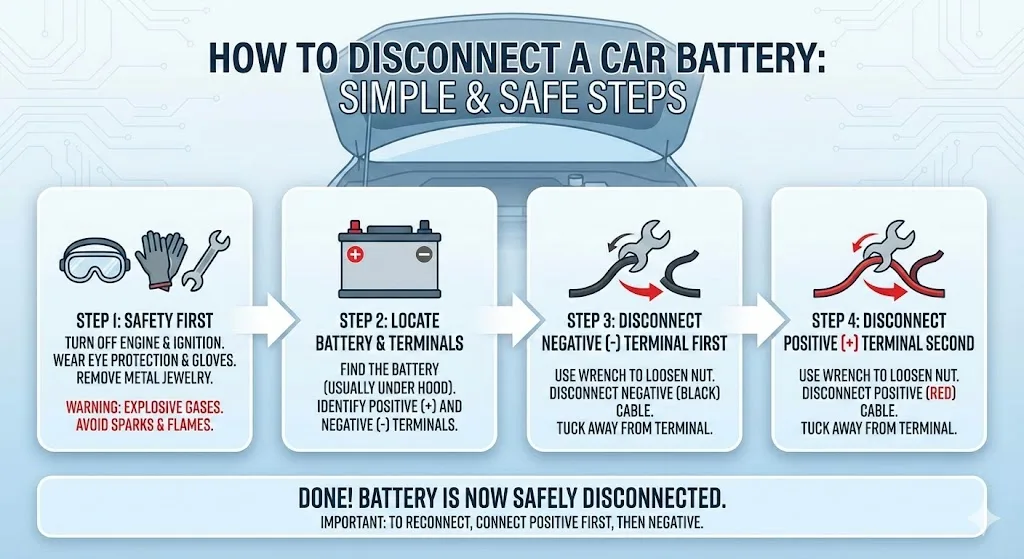
To safely disconnect a car battery:
- Turn the engine off and remove the key
- Engage the parking brake
- Open the hood and locate the battery
- Disconnect the negative (–) terminal first
- Disconnect the positive (+) terminal second
- Secure both cables away from metal surfaces
Rule:
Remove negative first, positive second
Reconnect positive first, negative last
This prevents short circuits, ECU damage, sparks, and electrical system faults.
Safe Car Battery Disconnection Guide
Knowing how to disconnect a car battery properly is essential for safety when performing maintenance, replacing components, storing a vehicle, or working on electrical systems. Incorrect battery disconnection can cause short circuits, ECU damage, blown fuses, electrical fires, and module failures.
Learning the correct battery terminal order protects your wiring system, alternator, ECU, starter motor, and onboard electronics.
When Should You Disconnect a Car Battery? Contact Us
How To Disconnect a Car Battery Yourself
To disconnect a car battery safely, you’ll need:
• Safety gloves
• Safety glasses
• A wrench or socket set
• Proper terminal identification
• Engine fully off
Applies to sedans, SUVs, trucks, and standard 12V battery systems.
Step-by-Step: How To Disconnect a Car Battery Safely
Follow this exact battery terminal order:
- Turn off the engine completely and remove the key
- Engage the parking brake
- Open the hood and locate the battery
- Identify the terminals:
- Negative (–) = black cable
- Positive (+) = red cable
- Loosen and remove the negative terminal first
- Secure the negative cable away from the battery
- Loosen and remove the positive terminal second
- Secure the positive cable away from metal
- If removing the battery fully, unbolt the hold-down bracket and lift carefully
Correct order logic:
Disconnect: negative → positive
Reconnect: positive → negative
Safety Warnings
• Never disconnect battery with engine running
• Never bridge terminals with tools
• Never touch both terminals simultaneously
• Avoid sparks near battery gases
• Avoid disconnecting high-voltage hybrid systems
• Keep cables isolated from metal
If You Have Electrical Issues After Disconnecting
Common issues:
Dashboard warning lights
Module relearn required
Radio not working
Anti-theft reset required
Windows not functioning
Window calibration required
Rough idle
Throttle relearn cycle
Check engine light
Sensor recalibration needed
Schedule Your Service
If electrical issues occur after battery disconnection, professional diagnostics are required. Modern vehicles depend on adaptive ECUs, control modules, and learning systems.
Service diagnostics typically include:
Terminal and wiring inspection
Battery testing
Electrical system scans
ECU reset procedures
Module relearning
Charging system testing
Battery replacement
Safety Precautions That Actually Matter
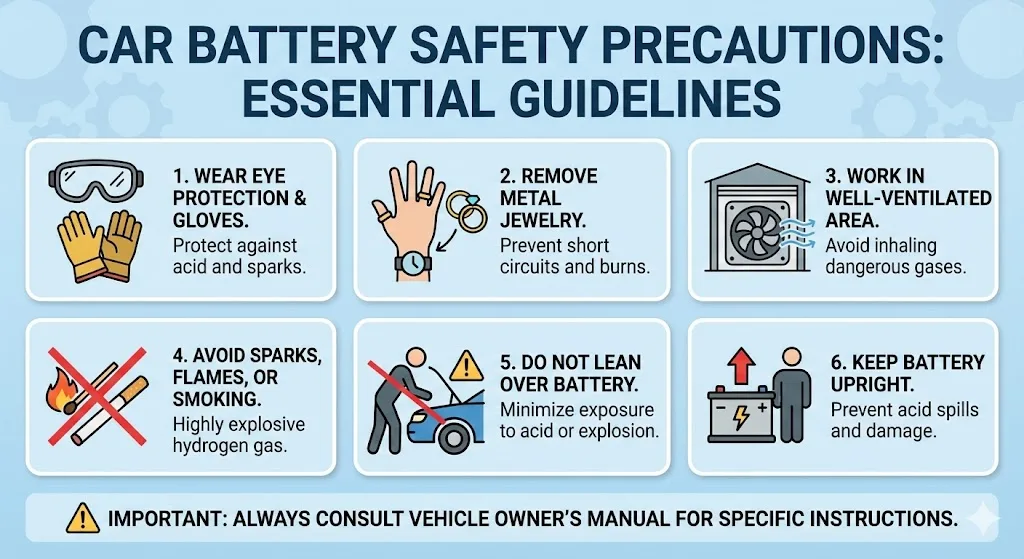
Never allow tools to touch both terminals at the same time.
Never let the positive terminal contact the vehicle body.
Never smoke near a battery.
Avoid open flames or sparks near the battery.
Do not lean directly over the battery while working.
Avoid touching battery acid residue.
Wash hands after handling terminals or cables.
Batteries contain acid and can emit flammable gas. Treat them with respect.
Common Mistakes to Avoid
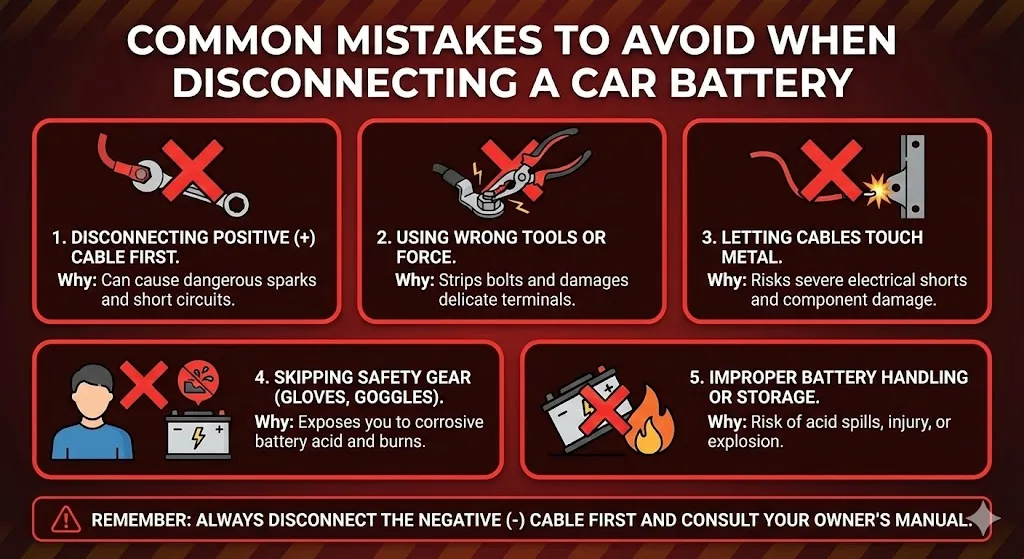
Disconnecting the positive terminal first
Letting cables touch the battery after removal
Allowing tools to bridge terminals
Forgetting about memory resets
Ignoring corrosion on terminals
Over-tightening clamps
Working with the vehicle powered on
Removing the battery without securing cables
Connect with us


