Simi Valley Chrysler Dodge Jeep Ram

Blog / Jeep

Blog

All Jeep General Ram Dodge Questions Car Buying Guides Chrysler Simi Valley Chrysler Dealer Simi Valley Used Cars
How Much Will a Jeep Grand Cherokee Tow

How Much will a Jeep Grand Cherokee Tow?

How Much Will a Jeep Grand Cherokee Tow? The Jeep Grand Cherokee can tow up to 6,200 pounds when properly equipped. That gives it more pulling power than many midsize SUVs and makes it useful for small campers, boats, utility trailers, dirt bikes, ATVs, and weekend gear. For 2026, Jeep lists the Grand Cherokee with a best-in-class maximum towing capacity of 6,200 pounds when equipped with the new 2.0L Hurricane 4 Turbo engine. The official Jeep capability page also compares that rating against rivals like the Toyota Highlander and Ford Explorer, showing that the Grand Cherokee is still built for more than school runs and grocery trips. Jeep Grand Cherokee Towing Capacity The maximum towing capacity for the Jeep Grand Cherokee is 6,200 pounds when properly equipped. That number applies to select gas-powered models with the right towing equipment. For 2025, Jeep Canada listed the Grand Cherokee with a standard 3.6L Pentastar V6 and a maximum towing capacity of 6,200 pounds, or 2,812 kilograms. For 2026, Jeep moved to the new 2.0L Hurricane 4 Turbo engine while keeping the same maximum 6,200-pound towing rating. That means shoppers looking at a recent Grand Cherokee can expect serious SUV towing capability, but the exact number still depends on year, engine, trim, drivetrain, and towing package. 2026 Jeep Grand Cherokee Towing The 2026 Jeep Grand Cherokee gets a new 2.0L Hurricane 4 Turbo engine. According to Car and Driver, the 2026 Grand Cherokee has a maximum towing capacity of 6,200 pounds. That is impressive because many SUVs in this size range focus more on comfort and technology than towing strength. The Grand Cherokee gives buyers a more rugged option without needing to move into a full-size SUV or pickup truck. For drivers who want a family SUV that can still pull a trailer, the 2026 Grand Cherokee is a strong choice. 2025 Jeep Grand Cherokee Towing The 2025 Jeep Grand Cherokee also tows up to 6,200 pounds when properly equipped. Jeep Canada’s official Grand Cherokee specs list the 2025 model at up to 2,812 kilograms, or 6,200 pounds. That rating comes from the 3.6L Pentastar V6 engine. It gives the 2025 Grand Cherokee enough strength for many real-world towing needs, including utility trailers, small campers, personal watercraft, and small boats. If you are shopping used, the 2025 model is a good option because it still offers strong towing power and a proven V6 engine. What Can a Jeep Grand Cherokee Tow? A properly equipped Grand Cherokee can tow a useful range of trailers and equipment. A 6,200-pound rating can cover many common recreational and work needs. It may be able to tow a small camper, fishing boat, motorcycle trailer, ATV trailer, utility trailer, small enclosed trailer, or lightweight work trailer. The actual trailer must still be matched carefully to the vehicle’s rating. Do not shop by the empty weight of the trailer alone. Add passengers, cargo, water, fuel, supplies, hitch weight, and accessories. A camper that looks safely under the limit on paper can get much heavier once loaded for a trip. Jeep Grand Cherokee 4xe Towing The Jeep Grand Cherokee 4xe plug-in hybrid is also a capable towing SUV. It does not always match the gas model’s maximum rating, but it comes very close. Many Grand Cherokee 4xe models are rated up to 6,000 pounds when properly equipped. That makes the 4xe useful for drivers who want plug-in hybrid efficiency but still need towing capability. The 4xe is especially appealing if most of your driving is local but you still want the ability to tow on weekends. It gives you electric driving capability for short trips and gas-electric power for longer travel. Grand Cherokee L Towing The Jeep Grand Cherokee L is the three-row version of the Grand Cherokee. It adds passenger space, which makes it better for families who need an extra row. Depending on model year and configuration, the Grand Cherokee L can also tow serious weight. However, shoppers should check the exact trim and equipment because towing ratings can vary. The Grand Cherokee L makes sense if you need both passenger room and towing ability. Just remember that extra passengers and cargo count against payload, so they can affect how much trailer weight you should safely pull. What Equipment Do You Need for Towing? To reach the highest towing rating, the Grand Cherokee needs the proper equipment. A towing package is usually important because it can add the hardware needed for safer and more confident trailer use. Useful towing equipment may include a hitch receiver, wiring harness, trailer sway control, heavy-duty cooling, trailer-hitch zoom, and load-leveling suspension depending on trim and model year. Some features may be standard on certain trims and optional on others. Before buying, check the window sticker or build sheet. Do not assume every Grand Cherokee can tow the maximum just because the model is rated up to 6,200 pounds. Why Proper Equipment Matters Towing is not just about engine power. A vehicle also needs cooling, brakes, suspension support, stability control, and the right hitch setup. A Grand Cherokee without the correct towing equipment may have a lower tow rating. It may also feel less stable, especially with a heavier trailer. Proper equipment helps the SUV manage heat, control trailer movement, and keep the vehicle more stable under load. That matters most on highways, hills, boat ramps, and long road trips. Payload Also Matters Payload is one of the most overlooked towing numbers. Payload is the weight your SUV carries inside and on the vehicle itself. That includes passengers, luggage, cargo, pets, accessories, and trailer tongue weight. Even if the trailer is under the towing limit, you can still overload the vehicle if you exceed payload. This is especially important for family trips because people and gear add weight quickly. Before towing, check the payload label on the driver’s door jamb and compare it with your real-world load. Is the Grand Cherokee Good for Towing? Yes, the Grand Cherokee is good for towing if you choose the right configuration. A 6,200-pound maximum rating is strong for a midsize SUV, and the Grand Cherokee also gives buyers a comfortable cabin, available 4x4 capability, and useful technology. It is a good fit for drivers who want one vehicle for commuting, family use, winter driving, weekend trips, and moderate towing. It is not the right choice if you need to tow very heavy equipment, large enclosed trailers, or big campers near full-size truck territory. In that case, a pickup like a Ram 1500 or Ram 2500 may be the better fit. Grand Cherokee vs. Other SUVs The Grand Cherokee compares well against many midsize SUVs. Jeep’s official comparison lists the 2026 Grand Cherokee at up to 6,200 pounds, while the 2025 Ford Explorer V6 is listed at up to 5,600 pounds and the 2025 Toyota Highlander turbo is listed at up to 5,000 pounds. That extra towing strength can matter if you are pulling a camper, boat, or equipment trailer. It gives the Grand Cherokee a stronger capability story than many family SUVs. The trade-off is that fuel economy, purchase price, and equipment costs may vary depending on trim and engine. Buyers should compare the full package, not just the tow rating. How to Tow Safely With a Grand Cherokee The first step is knowing your numbers. Check towing capacity, payload, tongue weight, hitch rating, and trailer weight before you hook up. Keep the trailer properly balanced. Too much weight at the back can cause sway, while too much weight on the hitch can overload the rear of the SUV. Make sure your tires are properly inflated, your trailer lights work, and your mirrors give you a clear view. If you are towing near the limit, slow down, leave more braking distance, and avoid sudden steering inputs. A Grand Cherokee can be a strong towing SUV, but safe towing still depends on setup and driving habits. Find the Right Jeep Grand Cherokee for Towing The Jeep Grand Cherokee can tow up to 6,200 pounds when properly equipped, making it one of the stronger towing choices in the midsize SUV market. The 2025 model reached that rating with the 3.6L V6, while the 2026 model reaches it with the new 2.0L Hurricane 4 Turbo engine. For many drivers, that is enough for small campers, boats, utility trailers, ATVs, and weekend gear. The key is choosing the right trim, engine, drivetrain, and towing package. Visit Simi Valley Chrysler Dodge Jeep Ram to browse new inventory, compare used inventory, check your trade-in value, or apply for financing before choosing your next Jeep SUV.

Image

Jeep Wrangler Hybrid vs Gas Engines: One Is Clearly Better (Here’s Why)

Few vehicles inspire as much debate about engines as the Jeep Wrangler. From the old-school V6s of the late 2000s to today’s turbocharged and plug-in hybrid options, Wrangler powertrains have evolved dramatically. Some are genuinely robust. Others demand compromises. This guide breaks down every major Jeep Wrangler engine, including the hybrid 4xe, explains real-world reliability, and answers the recurring question buyers ask: is the Wrangler engine weak without the hybrid assist? Jeep Wrangler Engine Options Explained Over the years, the Wrangler has offered one of the widest engine menus in the off-road segment. Each option exists for a different type of owner, and none are perfect for everyone. 3.6L Pentastar V6 (2012–Present) This is the backbone of modern Wrangler ownership. Why it’s popular Naturally aspirated, simple by modern standards Strong low-end torque for crawling Proven across millions of Stellantis vehicles What to know Early versions (2012–2014) suffered from cylinder head failures and oil cooler leaks. These issues were largely resolved after mid-decade revisions. When maintained properly, this engine routinely crosses high mileage without internal failure. For buyers asking “best Jeep Wrangler engine,” this is still the safest long-term bet. 3.8L V6 (2007–2011) This engine powered the early JK generation and is widely criticized. Reality check Underpowered for the Wrangler’s weight Poor fuel economy Not unreliable, just inefficient and dated The 3.8L rarely catastrophically fails, but it struggles under load, especially with larger tires or armor. Owners upgrade around it rather than because of it. 2.0L Turbocharged Inline-4 (2018–Present) This engine divides opinion more than any other Wrangler motor. Strengths Strong torque delivery Better fuel economy than the V6 Pairs well with the 8-speed automatic Concerns Turbo complexity means heat management matters. Oil quality and service intervals are critical. When maintained, it performs well. When neglected, it doesn’t forgive. This engine feels stronger on-road than the V6 but less mechanical off-road purists trust it less long term. 3.0L EcoDiesel V6 (2020–2023) Torque monster. Niche appeal. Why people love it Exceptional low-rpm torque Ideal for towing and long-distance driving Why it disappeared Emissions complexity Higher ownership costs Limited buyer demand Reliable when driven regularly, problematic for short trips and infrequent use. Jeep Wrangler 4xe Hybrid Engine: Is It Actually Better? The Wrangler 4xe combines: 2.0L turbo gasoline engine Two electric motors 17-kWh battery pack Total system output sits well above the standard engines, but raw numbers don’t tell the whole story. Is the Wrangler engine weak without the hybrid assist? This is a common search for a reason. On its own, the 2.0L turbo is not weak. However, the instant torque from the electric motor completely changes how the Wrangler feels. Off the line, crawling over obstacles, and city driving all benefit from electric assist. Without it, the gas engine feels more conventional and less dramatic. In other words: The engine isn’t weak The hybrid system makes it feel significantly stronger and smoother Reliability reality of the 4xe The hybrid system itself has proven solid so far, but ownership success depends heavily on usage patterns: Regular charging helps battery health Software updates are essential Long-term complexity is higher than any non-hybrid Wrangler This is not a “set it and forget it” drivetrain. It rewards informed owners. Older Wrangler Engines by Year (Quick Reality Check) 2007–2011 Wrangler engines Reliable but underpowered. Buy for simplicity, not performance. 2012–2014 Wrangler engines Avoid early Pentastar years unless documented repairs were completed. 2015–2017 Wrangler engines Pentastar reliability improved significantly. Strong used-market years. 2018–2023 Wrangler engines Modern performance, more electronics, higher repair costs if neglected. Check Engine Light on Jeep Wrangler: What It Usually Means The Wrangler is notorious for triggering check engine lights that range from trivial to serious. Common causes include: Loose or failing gas cap EVAP system leaks Oxygen sensor faults Battery voltage irregularities In hybrids, software and sensor calibration issues can also trigger warnings without mechanical failure. Ignoring a Wrangler check engine light is a mistake. Diagnosing early prevents cascading issues. Engine Replacement and Swap Reality Engine replacement costs vary widely depending on generation and powertrain. Older V6 swaps are straightforward. Modern turbo and hybrid replacements are expensive and often not financially sensible unless under warranty. Hellcat-swapped Wranglers exist, but they are novelty builds, not practical ownership choices. So, What’s the Best Jeep Wrangler Engine? It depends on priorities. Best long-term reliability: 3.6L Pentastar (2015+) Best daily driving feel: 2.0L Turbo Best performance and efficiency: 4xe Hybrid Best torque for towing: EcoDiesel There is no universally perfect Wrangler engine. There is only the right engine for how you actually drive. Final Verdict The Jeep Wrangler engine lineup reflects the vehicle itself: purpose-built, imperfect, and unapologetically specialized. The hybrid doesn’t fix weaknesses so much as it reshapes the experience. The non-hybrid engines are not weak, but they are honest. They demand realistic expectations, consistent maintenance, and an understanding that Wranglers are engineered for capability first, comfort and efficiency second. If you choose the right engine for your use case, the Wrangler remains one of the most mechanically characterful vehicles you can still buy. 1. Is the Jeep Wrangler engine reliable? Yes, most Jeep Wrangler engines are reliable when properly maintained. The 3.6L Pentastar V6 (2015 and newer) has the strongest long-term reliability record, while earlier engines require more caution. 2. Is the Jeep Wrangler engine weak without the hybrid system? No, the engine itself is not weak. However, the hybrid system in the Wrangler 4xe adds instant electric torque, which makes the vehicle feel significantly stronger at low speeds compared to the gas engine alone. 3. What engine does the Jeep Wrangler 4xe use? The Wrangler 4xe uses a 2.0-liter turbocharged four-cylinder gasoline engine paired with electric motors and a battery pack to create a plug-in hybrid system. 4. Which Jeep Wrangler engine lasts the longest? The 3.6L Pentastar V6 is widely considered the longest-lasting Wrangler engine, with many examples exceeding high mileage when oil changes and cooling system maintenance are done on time. 5. Are older Jeep Wrangler engines reliable? Older Wrangler engines can be reliable, but performance and efficiency are lower. Engines from 2007–2011 are mechanically simple but underpowered, while 2012–2014 models had known cylinder head issues. 6. What causes the check engine light on a Jeep Wrangler? Common causes include a loose gas cap, EVAP system leaks, oxygen sensor failures, battery voltage issues, or software faults. Many check engine lights are minor but should still be scanned. 7. Is the Jeep Wrangler 2.0L turbo engine reliable? The 2.0L turbo engine is reliable when maintained correctly. Because it is turbocharged, oil quality, cooling, and service intervals are more critical than with naturally aspirated engines. 8. Is the Jeep Wrangler hybrid engine expensive to repair? Potentially yes. Hybrid components add complexity, and repairs outside warranty can be more expensive than traditional gas engines. Regular charging and software updates reduce long-term risk. 9. What is the best Jeep Wrangler engine for daily driving? For daily driving, the 2.0L turbo and the 4xe hybrid offer the best balance of power and efficiency. The hybrid is smoother in city driving due to electric assist. 10. Which Jeep Wrangler engine should I avoid? Buyers typically avoid early 2012–2014 3.6L engines unless documented repairs were completed, and 2007–2011 models if performance and fuel economy matter. 11. Does the Jeep Wrangler engine overheat? Wrangler engines do not commonly overheat when properly maintained. Cooling issues usually stem from neglected coolant service, faulty thermostats, or aftermarket modifications. 12. How much does it cost to replace a Jeep Wrangler engine? Engine replacement costs vary by year and engine type. Older V6 engines are cheaper to replace, while turbocharged and hybrid engines are significantly more expensive. 13. Is the Jeep Wrangler diesel engine reliable? The diesel engine offers excellent torque and highway efficiency, but emissions systems require regular use and proper driving patterns. It is less suitable for short trips only. 14. Does lifting a Jeep Wrangler affect engine reliability? A lift itself does not damage the engine, but larger tires and added weight increase strain on the drivetrain. Regearing and proper tuning help preserve engine health. 15. What is the best Jeep Wrangler engine overall? For long-term ownership and simplicity, the 3.6L V6 remains the best all-around choice. For performance and efficiency, the 4xe hybrid delivers the most capability if maintained correctly.
Negatives of a Jeep Compass

What are the Negatives of a Jeep Compass?

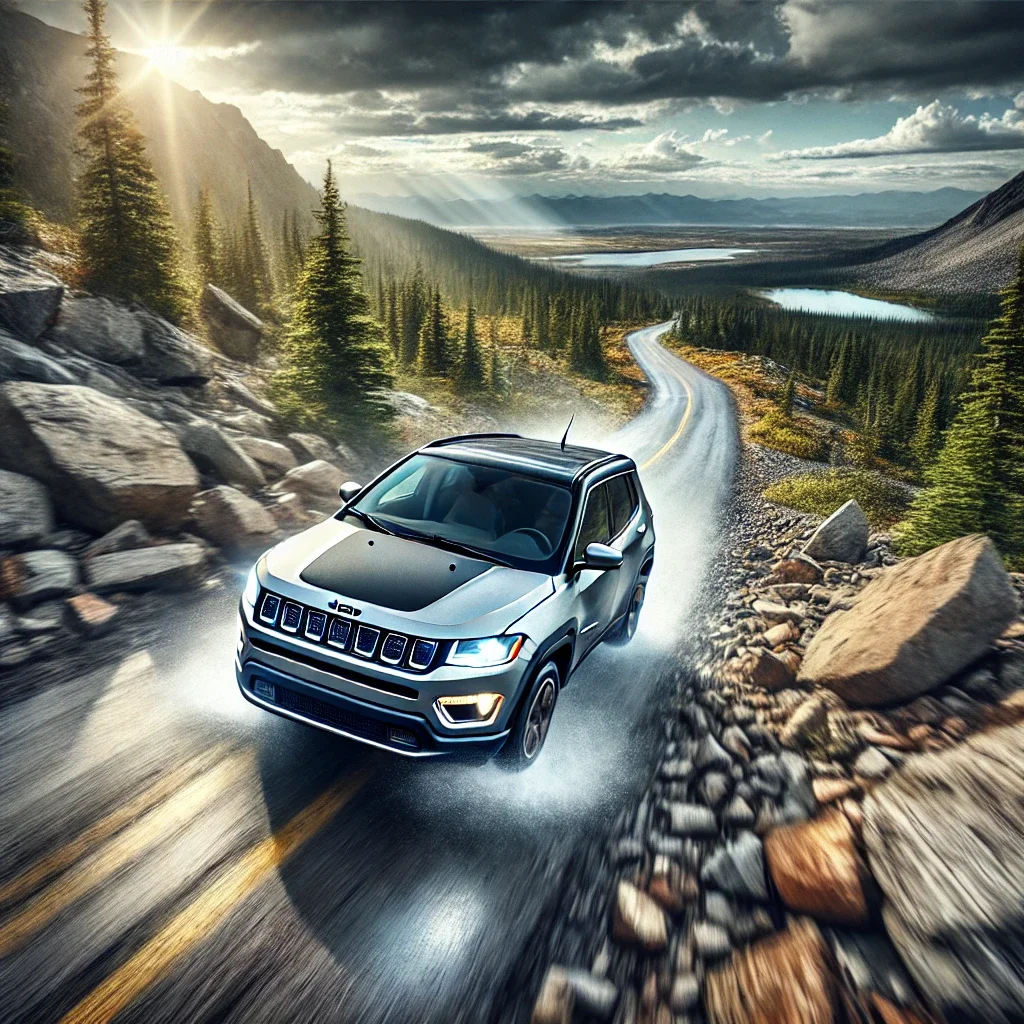
Is the 2024 Jeep Compass Reliable? Exclusive Amazon Deals ( Limited Stock ) The 2024 Jeep Compass is part of a lineup that has been popular for its off-road capabilities, stylish design, and modern technology features. But for many buyers, one of the most crucial factors in choosing a vehicle is its reliability. In this article, we’ll dive into the reliability of the 2024 Jeep Compass, examining key factors such as mechanical performance, safety features, long-term durability, and owner satisfaction. What are the Negatives of a Jeep Compass? Overview of the 2024 Jeep Compass The 2024 Jeep Compass offers a refreshed design and improved technology compared to its predecessors. Available in several trims, from the base Sport to the off-road-focused Trailhawk, it caters to different types of drivers. Jeep has equipped the Compass with a 2.0-liter turbocharged engine that produces 200 horsepower, paired with an 8-speed automatic transmission. While the Compass is known for its off-road capabilities, especially in the Trailhawk trim, potential buyers are often curious about whether it can stand the test of time and daily driving demands. Browse Jeep Compass Engine and Transmission Reliability The 2024 Jeep Compass is powered by a new 2.0-liter turbocharged engine, which is an upgrade from the previous 2.4-liter engine used in older models. This turbocharged engine delivers improved performance and better fuel efficiency. However, with new engines come questions about long-term reliability. Performance and Durability The 2.0-liter turbo engine is a modern powerplant, but it’s relatively new to the Compass lineup. While turbocharged engines can offer better fuel efficiency and power, they also tend to be more complex, which can raise concerns about long-term reliability. Turbo engines typically have more components that could wear out, like the turbocharger itself, leading to potential repair costs down the road. Exclusive Amazon Deals ( Limited Stock ) That said, Jeep has worked to refine its engines over the years, and initial reports on the 2024 model’s engine have been positive, with smooth acceleration and improved fuel efficiency compared to previous years. Browse Jeep Compass Transmission Performance The 8-speed automatic transmission is a solid choice, providing smoother shifts and better fuel efficiency than older models with 6-speed transmissions. So far, there haven’t been any widespread reports of transmission issues with the 2024 model. However, Jeep’s history with transmissions has been mixed in previous generations, so it’s something buyers should keep in mind. What are the Negatives of a Jeep Compass? Build Quality and Interior The Jeep Compass has made strides in improving interior quality, but it still has room for growth in terms of refinement. While the higher trims offer better materials and a more upscale feel, the base models still feature a lot of hard plastics that may not age well over time. Fit and Finish The fit and finish of the interior materials can impact long-term reliability as well. In some previous models, owners have reported that interior components like dashboard panels and buttons can show signs of wear or become loose after several years of use. However, Jeep has been working to improve quality control, and the 2024 model does show improvements in this area. Browse Jeep Compass Infotainment and Technology Reliability The 2024 Jeep Compass comes with the latest Uconnect 5 infotainment system, which is highly regarded for its user-friendliness and responsiveness. However, technology can be a double-edged sword when it comes to reliability. While modern infotainment systems offer many conveniences, they can also be a source of frustration if they malfunction. So far, the Uconnect 5 system in the 2024 Compass has received positive reviews, with minimal complaints of bugs or system crashes. However, it’s still early in the model’s life cycle, so long-term data on the system’s reliability is not yet available. Browse Jeep Compass What are the Negatives of a Jeep Compass? Off-Road Durability One of the Jeep Compass’s selling points is its off-road capability, especially in the Trailhawk trim, which comes with features like all-terrain tires, increased ground clearance, and skid plates. While this is a great feature for those who love adventure, taking the vehicle off-road can put more strain on components like the suspension and drivetrain. Long-Term Durability for Off-Road Enthusiasts For those who plan to use the Compass off-road regularly, it’s worth noting that the extra wear and tear from rough terrain can affect the vehicle’s long-term durability. However, Jeep’s reputation for building rugged vehicles suggests that the Compass should hold up well if maintained properly. Browse Jeep Compass What are the Negatives of a Jeep Compass? Safety and Reliability Ratings Safety ratings are often closely tied to reliability, as a safer vehicle is likely to experience fewer mechanical issues. The 2024 Jeep Compass is equipped with a variety of advanced driver-assistance systems (ADAS), such as blind-spot monitoring, lane-keeping assist, and adaptive cruise control. Crash Test Ratings The 2024 Compass has not yet been fully rated by safety organizations like the National Highway Traffic Safety Administration (NHTSA) or the Insurance Institute for Highway Safety (IIHS), but the 2023 model received decent scores, which bodes well for the latest version. Advanced Safety Features While advanced safety features are a welcome addition, they can also add complexity to the vehicle’s electronic systems. Over time, components like cameras and sensors may need repairs or recalibration, which can be costly. However, Jeep has integrated these features with reliability in mind, and there have been no widespread reports of issues so far with the 2024 model. Browse Jeep Compass What are the Negatives of a Jeep Compass? Consumer and Expert Opinions So far, the 2024 Jeep Compass has received generally positive reviews from both consumers and automotive experts. Early impressions indicate that the new engine is an improvement over the previous model, and the technology updates are well-received. Owner Satisfaction Long-term owner satisfaction will ultimately determine the Compass’s reliability. While Jeep has made improvements over the years, some owners of earlier Compass models reported issues with things like electrical systems or build quality. However, Jeep has been addressing these issues with each new model, and the 2024 version is expected to continue this trend of improvement. Browse Jeep Compass What are the Negatives of a Jeep Compass? Warranty and Maintenance The 2024 Jeep Compass comes with a 5-year/60,000-mile powertrain warranty and a 3-year/36,000-mile basic warranty, which is standard for the industry. This coverage provides peace of mind for the first few years of ownership, but it’s always a good idea to consider extended warranties if you plan to keep the vehicle long-term. Maintenance Costs Regular maintenance is essential to keeping any vehicle reliable, and the Jeep Compass is no exception. Oil changes, tire rotations, and brake checks should be done on schedule to avoid more serious issues down the road. Jeep vehicles typically have average maintenance costs compared to other brands, but it’s worth noting that off-road use or extensive travel can increase wear and tear, leading to higher repair costs over time. Browse Jeep Compass Conclusion: Is the 2024 Jeep Compass Reliable? The 2024 Jeep Compass shows promise in terms of reliability, with a new and improved engine, better technology, and a focus on safety. While it’s still too early to say how the vehicle will perform in the long term, early indicators suggest that Jeep has addressed some of the issues that plagued previous models. However, as with any vehicle, long-term reliability will depend on proper maintenance and care. For those looking for a compact SUV with off-road capability, stylish design, and modern features, the 2024 Jeep Compass is a solid option. While there may be concerns about the complexity of the turbocharged engine and advanced safety systems, the overall reliability outlook is positive based on early feedback. Ultimately, if you’re considering a Jeep Compass, it’s important to weigh the vehicle’s strengths and potential drawbacks based on your own driving needs. Browse Jeep Compass

Is the Jeep Gladiator a Good Purchase? 15 Reasons Why Experts Say Gladiator is good.

15 Reasons Why the Jeep Gladiator is a Good purchase? Reason Description 1. Off-Road Capability Legendary Jeep 4x4 systems, perfect for trails, mud, and sand. More on Jeep's 4x4 systems 2. Unique Pickup Design The only open-air pickup truck on the market, combining the best of Jeep and truck worlds. Explore Gladiator design 3. Removable Doors and Roof Like the Wrangler, the Gladiator offers a convertible experience. See how the doors and roof come off 4. Towing Capacity Best-in-class towing capacity of up to 7,650 lbs, ideal for trailers and boats. More on towing 5. Payload Capacity Can carry a payload of up to 1,700 lbs, making it a solid workhorse. Payload info 6. Trail Rated Performance Every Gladiator comes Trail Rated, certified to tackle tough conditions like water fording and rocky trails. What Trail Rated means 7. Off-Road Accessories Offers tons of Mopar accessories to enhance its off-road prowess. See Mopar accessories 8. Strong Resale Value Jeep vehicles, including the Gladiator, hold their value well. Resale value trends 9. Diesel Engine Option Available 3.0L EcoDiesel engine offers excellent torque and fuel efficiency. Learn more about the EcoDiesel 10. Advanced Tech Features Equipped with Uconnect 4 or 4C NAV, including an 8.4-inch touchscreen, Apple CarPlay, and Android Auto. Explore Uconnect 11. 4x4 Pickup Versatility Combines Jeep’s iconic off-road prowess with the utility of a pickup bed. Learn more about versatility 12. Rugged Durability Built tough with a high-strength steel frame and durable underbody protection. Gladiator durability 13. Spacious Interior The Gladiator offers more rear-seat legroom than most midsize pickups, ensuring comfort for passengers. Interior details 14. Water Fording Capability Gladiator can ford up to 30 inches of water, perfect for adventurous trails. More on water fording 15. Customization Options Offers many factory and aftermarket options to customize it to your preferences. Jeep customization 15 Reasons why the Jeep Gladiator is a Good Purchase? Is the Jeep Gladiator a Good Purchase? 15 Reasons Why The Jeep Gladiator is one of the most distinctive and versatile vehicles on the market today, blending the iconic Jeep off-road capability with the utility of a pickup truck. Whether you're into off-roading, need a vehicle that can tow and haul, or just love the rugged style, the Gladiator has a lot to offer. In this article, we'll explore 15 reasons why the Jeep Gladiator is a smart purchase. Browse Jeep Gladiator 1. Is the Jeep Gladiator a Good Purchase? Legendary Off-Road Capability Jeep vehicles are renowned for their off-road prowess, and the Gladiator is no exception. Equipped with Jeep’s 4x4 systems, the Gladiator is built for serious off-roading, from dirt trails to rocky terrain. It's Trail Rated, meaning it has passed rigorous tests for traction, water fording, maneuverability, and ground clearance. This makes it perfect for those who love adventure. More on Jeep’s 4x4 systems Browse Jeep Gladiator 2. Unique Pickup Truck Design The Jeep Gladiator is the only open-air pickup truck currently available on the market. It takes the best features of a Jeep Wrangler—removable doors and roof—and adds a truck bed for extra utility. If you want the fun and freedom of a Wrangler but need the functionality of a pickup, the Gladiator gives you both. Explore Gladiator design 3. Is the Jeep Gladiator a Good Purchase? Removable Doors and Roof for an Open-Air Experience One of the most fun aspects of the Jeep Gladiator is the removable doors and roof, just like the Wrangler. This feature allows you to experience the outdoors in a way that no other pickup truck can offer. It's the perfect vehicle for those who want to feel the wind in their hair while on an off-road adventure or cruising through the city. How the doors and roof come off Browse Jeep Gladiator 4. Is the Jeep Gladiator a Good Purchase? Best-in-Class Towing Capacity The Gladiator isn’t just about fun; it's also a serious workhorse. With a best-in-class towing capacity of up to 7,650 lbs, it's perfect for pulling a boat, trailer, or camper. Whether you're working or playing, the Gladiator can handle your towing needs with ease. More on towing Browse Jeep Gladiator 5. Impressive Payload Capacity In addition to its towing power, the Gladiator has an impressive payload capacity of up to 1,700 lbs. This means it can carry heavy loads in the truck bed, whether you're hauling construction materials or gear for your next camping trip. Payload info 6. Is the Jeep Gladiator a Good Purchase? Trail Rated Performance Every Gladiator comes with Jeep's Trail Rated badge, which means it has been tested to perform under extreme off-road conditions. This includes traction, water fording, articulation, and ground clearance. For those who plan to take their truck off the beaten path, this is a big plus. What Trail Rated means Browse Jeep Gladiator 7. Wide Range of Off-Road Accessories Jeep offers a ton of Mopar accessories designed to enhance the Gladiator’s off-road capabilities. From winches and lift kits to all-terrain tires, you can customize your Gladiator to tackle the most challenging trails. See Mopar accessories 8. Is the Jeep Gladiator a Good Purchase? Strong Resale Value Jeep vehicles, particularly the Wrangler and Gladiator, are known for their strong resale value. This is a critical factor for many buyers, as it means the vehicle will retain a significant portion of its value over time, making it a smart investment. Resale value trends Browse Jeep Gladiator 9. Diesel Engine Option For those who want extra power and fuel efficiency, the Gladiator offers a 3.0-liter EcoDiesel engine option. This engine provides plenty of torque for towing and off-road driving while also delivering better fuel economy than the standard gasoline engine. Learn more about the EcoDiesel 10. Is the Jeep Gladiator a Good Purchase? Advanced Technology Features The 2024 Jeep Gladiator comes with the Uconnect 4 or 4C NAV infotainment system, featuring an 8.4-inch touchscreen, Apple CarPlay, and Android Auto. This system is highly intuitive and user-friendly, ensuring that you stay connected whether you're on the trail or the highway. Explore Uconnect Browse Jeep Gladiator 11. 4x4 Pickup Versatility The Gladiator is not just an off-roader; it's a highly versatile pickup truck as well. The 4x4 system, combined with the practicality of a truck bed, makes it a go-anywhere, do-anything vehicle. It's the perfect blend of ruggedness and utility. More about Gladiator versatility 12.Is the Jeep Gladiator a Good Purchase? Built for Durability The Gladiator is built on a high-strength steel frame and features durable underbody protection, making it highly resistant to the rigors of off-road driving and heavy-duty use. Whether you're on the trail or on the job site, the Gladiator is designed to last. Gladiator durability Browse Jeep Gladiator 13. Spacious Interior For a midsize truck, the Gladiator offers a surprisingly spacious interior. In fact, it has more rear-seat legroom than most competitors, making it a comfortable choice for passengers. Even tall adults will find plenty of room in the back seats. Interior details 14.Is the Jeep Gladiator a Good Purchase? Water Fording Capability If you plan on taking the Gladiator off-road, you'll be pleased to know that it can ford water up to 30 inches deep. This makes it an ideal choice for those who plan to traverse rivers, creeks, or mud-filled trails. More on water fording Browse Jeep Gladiator 15. Customization Options The Gladiator offers extensive customization options. Whether you're looking for aftermarket accessories to enhance performance or just want to personalize the vehicle's appearance, Jeep offers a wide range of factory and aftermarket options. Customize your Gladiator Browse Jeep Gladiator Conclusion: Why the Jeep Gladiator is a Great Purchase The Jeep Gladiator stands out as a unique vehicle that combines the best of both worlds: the off-road capability of a Jeep and the practicality of a pickup truck. With its removable doors and roof, best-in-class towing, rugged durability, and spacious interior, it’s a versatile vehicle that’s perfect for work, play, or adventure. While it may come with a higher price tag than some competitors, the Gladiator's strong resale value, off-road performance, and customization options make it a solid investment for those who love adventure and need a capable, all-around vehicle. For more information, explore the official Jeep Gladiator page or check out reviews on Kelley Blue Book and Edmunds. Official Jeep Gladiator page Kelley Blue Book Gladiator reviews Edmunds Gladiator reviews

Jeep Gladiator

Why is the Jeep Gladiator Not Selling? The Surprising Facts!

Since its debut in 2019, the Jeep Gladiator has taken the automotive world by storm. Combining Jeep’s renowned off-road capabilities with the practicality of a pickup truck, the Gladiator has attracted a loyal following. Despite what some may perceive as sales struggles, the reality is quite different. The Gladiator continues to perform well in its segment, and it has carved out a distinctive place in the midsize truck market. Let’s explore why the Jeep Gladiator is more successful than some might believe. 1. Market Competition is Fierce, But the Gladiator Stands Strong Special California Discounts – Claim Yours Now! The midsize truck market is crowded, with strong competitors like the Toyota Tacoma, Ford Ranger, and Chevrolet Colorado. However, the Gladiator offers something these trucks don’t—a unique blend of off-road prowess and pickup utility. This combination has resonated with a particular group of buyers who want more than just a traditional truck. While some may see the crowded market as a challenge, the Gladiator’s ability to stand out from the pack is part of its success. Its Jeep DNA makes it a top choice for those who value adventure and outdoor capabilities, while still needing the practical functions of a truck. 2. Premium Pricing Reflects Premium Value Some may point to the Gladiator’s price tag as a potential obstacle, but the reality is that its pricing reflects the high value it offers. With features that are unrivaled in the segment—such as removable doors, a fold-down windshield, and serious off-road capabilities—the Gladiator provides more than just a basic truck. The higher price point is a testament to the vehicle's premium design and capabilities, and for those who understand the value of what the Gladiator offers, it’s a worthwhile investment. The Gladiator is also available in a variety of trims, allowing buyers to choose the one that fits their budget while still enjoying Jeep’s legendary performance. 3. Fuel Economy: A Balance Between Power and Efficiency Special California Discounts – Claim Yours Now! Fuel economy might be a consideration for some truck buyers, but the Jeep Gladiator delivers a solid balance between power and efficiency. The available 3.0-liter EcoDiesel V6 engine provides better fuel economy for those looking to maximize efficiency without sacrificing performance. For off-road enthusiasts who value both power and fuel savings, the EcoDiesel option makes the Gladiator an even more attractive choice. Moreover, considering the Gladiator’s off-road capabilities and towing strength, its fuel efficiency remains competitive within its class. Consumers looking for a rugged truck that can handle tough terrains and long road trips have found the Gladiator’s performance to be more than satisfactory. 4. Jeep Gladiator’s Engine Options Meet Diverse Needs Special California Discounts – Claim Yours Now! The Jeep Gladiator offers a diesel engine option, which provides excellent torque for towing and off-road driving, as well as a standard gasoline engine for everyday driving. While some competitors may offer hybrid or electric options, Jeep is known for its focus on ruggedness and durability. The Gladiator’s current engine lineup aligns with Jeep’s brand promise—delivering powerful and reliable engines for outdoor adventures. For buyers who prioritize off-road capability and robust towing power, the Gladiator's engine options are more than sufficient, making it a strong contender in the midsize truck segment. 5. Niche Appeal is a Strength, Not a Limitation Far from being a drawback, the Gladiator’s niche appeal is one of its greatest strengths. Jeep enthusiasts are a passionate and loyal group, and the Gladiator taps into that loyalty by offering the rugged, go-anywhere capability that buyers expect from the brand. It combines the best of Jeep’s off-road heritage with the utility of a pickup truck, creating a vehicle that has no direct competitors. For those who love adventure, camping, or off-road exploration, the Gladiator is the perfect blend of form and function. Its distinctive design and unmatched versatility make it a standout choice for a growing number of buyers. 6. Interior Quality and Comfort Are Strong Points Special California Discounts – Claim Yours Now! The Jeep Gladiator doesn’t just excel in exterior ruggedness; it also offers a well-appointed interior. With high-quality materials, intuitive technology, and comfortable seating, the Gladiator’s cabin has been designed to meet the needs of both off-road enthusiasts and those who use it as a daily driver. The available upgrades in higher trims, such as leather seating, advanced infotainment systems, and premium finishes, ensure that the Gladiator delivers on comfort as well as capability. This balance of rugged exterior and refined interior is part of what continues to draw buyers to the Gladiator. 7. Off-Road Capability is a Major Selling Point While the Jeep Gladiator’s off-road focus may appeal to a specific set of buyers, it’s important to note that this is a key strength, not a limitation. Many truck buyers specifically seek out vehicles that can handle off-road trails, rocky terrains, and inclement weather conditions, and the Gladiator delivers exactly that. The Rubicon trim, in particular, is renowned for its world-class off-road capabilities. With features like lockable differentials, electronic sway-bar disconnect, and 33-inch all-terrain tires, the Gladiator is perfectly suited for those who prioritize off-road adventures. 8. Jeep’s Brand Reliability Continues to Improve Jeep has made significant strides in terms of reliability and build quality in recent years. While every brand has its own perceptions in the marketplace, the Gladiator has proven itself to be a durable, reliable vehicle, especially in its core areas of strength—off-road driving and rugged terrain. In fact, Jeep’s commitment to continuous improvement has been well-received by many buyers, and the Gladiator’s performance in various tests and reviews speaks to its reliability as both a daily driver and an adventure-ready machine. 9. Growing Popularity Through Strong Marketing Efforts Special California Discounts – Claim Yours Now! Jeep’s marketing strategy for the Gladiator has successfully highlighted its unique attributes. From its versatile design to its superior off-road capability, buyers are becoming more aware of the Gladiator’s strengths. The vehicle’s popularity is evident in its growing fan base, and as more consumers discover its potential, its sales performance continues to rise. Through a combination of strong branding, targeted marketing, and consumer education, Jeep has positioned the Gladiator as a must-have vehicle for those seeking both adventure and practicality in one package. Conclusion: The Jeep Gladiator is Gaining Momentum Special California Discounts – Claim Yours Now! Despite some misconceptions, the Jeep Gladiator is performing well in the midsize truck segment. With its distinctive blend of Jeep’s off-road capability and pickup utility, the Gladiator continues to attract a loyal customer base. From premium pricing that reflects premium value to engine options that meet diverse needs, the Gladiator is proving to be a vehicle that appeals to a wide range of buyers. With its growing popularity and strong sales performance, the Jeep Gladiator is far from struggling. Instead, it is thriving in its niche, and as more consumers discover its unique strengths, it is poised to continue gaining momentum in the competitive truck market. FAQs 1. Is the Jeep Gladiator a good-selling truck? Yes, the Jeep Gladiator continues to perform well in sales, especially among off-road enthusiasts and those looking for a versatile midsize truck. Despite market rumors, its unique features and capabilities keep it in demand. 2. How does the Jeep Gladiator compare to the Toyota Tacoma? The Jeep Gladiator offers superior off-road performance and versatility compared to the Toyota Tacoma. With features like a removable roof and doors, the Gladiator is ideal for adventure seekers, while the Tacoma focuses more on traditional truck utility. 3. What are the engine options for the Jeep Gladiator? The Jeep Gladiator offers two engine options: a 3.6L V6 gas engine and a 3.0L EcoDiesel V6. The diesel option provides better fuel efficiency and towing capacity, making it a popular choice for those who need extra power. 4. What is the fuel economy of the Jeep Gladiator? The Jeep Gladiator’s fuel economy ranges from 17-22 MPG with the gas engine and 22-28 MPG with the diesel engine. The EcoDiesel engine is ideal for those seeking better fuel efficiency in a midsize truck. 5. How much can the Jeep Gladiator tow? The Jeep Gladiator has a maximum towing capacity of up to 7,650 pounds, making it one of the top performers in the midsize truck category for towing heavy loads. 6. Is the Jeep Gladiator good for everyday driving? Yes, the Jeep Gladiator is suitable for daily driving, offering comfort, modern tech, and a smooth ride. While optimized for off-road adventures, it performs well on highways and city streets, making it versatile for everyday use. 7. Does the Jeep Gladiator have high resale value? Yes, the Jeep Gladiator holds its value exceptionally well. Its off-road capabilities and brand reputation contribute to its strong resale value compared to other midsize trucks. 8. Can I customize my Jeep Gladiator? Yes, the Jeep Gladiator is one of the most customizable trucks on the market. Jeep offers a wide array of factory and aftermarket accessories, from lift kits to roof racks, making it easy to personalize. 9. What safety features does the Jeep Gladiator offer? The Jeep Gladiator comes equipped with advanced safety features, including blind-spot monitoring, adaptive cruise control, forward collision warning, and rear cross-path detection, providing both safety and peace of mind on and off the road. 10. Is the Jeep Gladiator a good off-road vehicle? Absolutely. The Jeep Gladiator is designed for off-road enthusiasts with features like four-wheel drive, locking differentials, skid plates, and removable doors and roof. It’s one of the best off-road vehicles in its class. Special California Discounts – Claim Yours Now!

Do Jeep Gladiators Hold Their Value

Do Jeep Gladiators Hold Their Value?

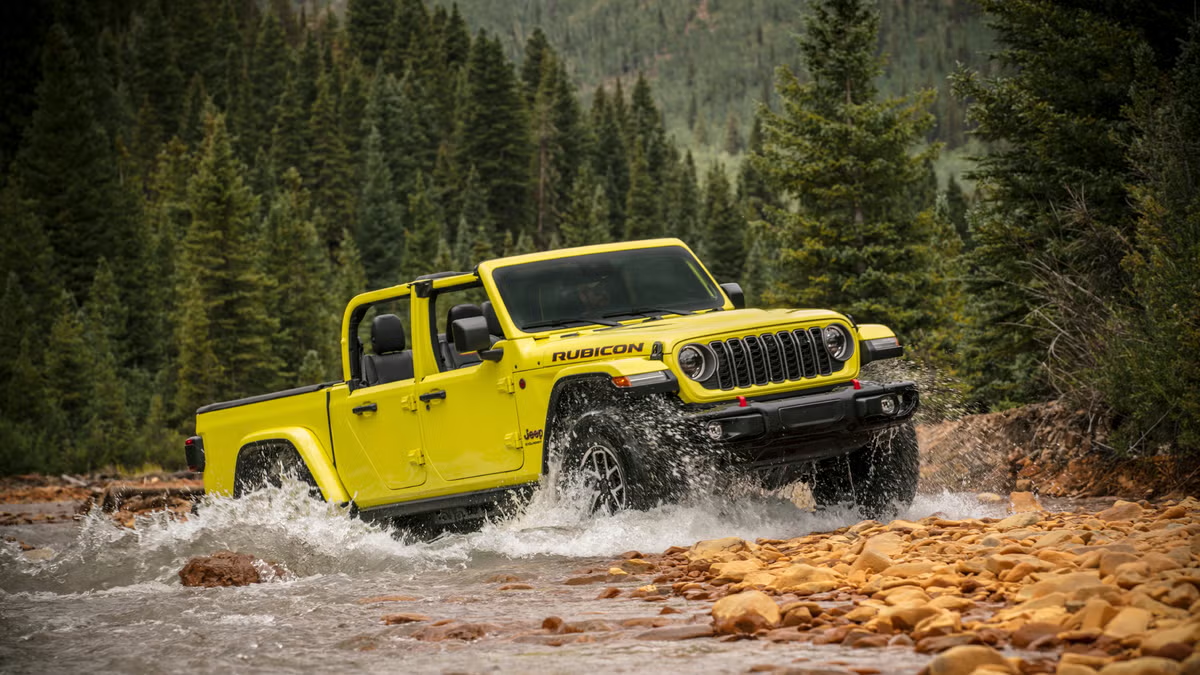
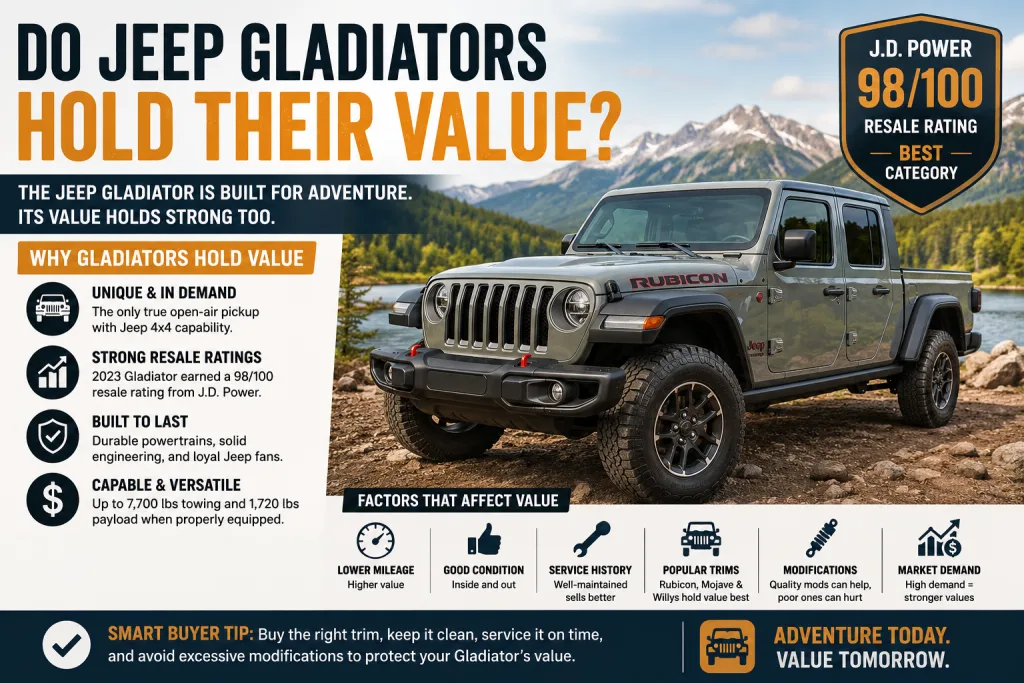
Do Jeep Gladiators Hold Their Value? The Jeep Gladiator usually holds its value better than many vehicles, especially because it combines two things buyers continue to want: Jeep 4x4 capability and pickup truck utility. It is not a normal midsize truck, and that is exactly why resale value can stay strong when the right buyer is looking. The short answer is yes, Jeep Gladiators can hold their value well, but not every Gladiator holds value the same way. Trim level, mileage, condition, modifications, market demand, and whether the truck was bought new or used all matter. A clean Rubicon, Mojave, or Willys with the right options can be more desirable than a heavily modified or high-mileage base model. Why the Jeep Gladiator Holds Value The Gladiator is different from most midsize pickups because it is both a truck and a Jeep. It offers four-wheel drive capability, removable roof panels, removable doors, trail-focused trims, and a pickup bed. That combination gives it a niche that competitors like the Toyota Tacoma, Ford Ranger, Chevrolet Colorado, and Nissan Frontier do not fully copy. That uniqueness helps resale value. Some buyers want a truck. Others want a Wrangler-style Jeep. The Gladiator appeals to both groups, especially shoppers who need bed space but still want open-air Jeep character. Jeep Canada lists the Gladiator with up to 7,700 pounds of towing capacity and 1,720 pounds of payload when properly equipped, which makes it useful beyond lifestyle driving. Those Jeep specs help explain why the Gladiator stays appealing to buyers who want fun and function in one vehicle. Resale Value Ratings Are Strong The Gladiator has performed well in resale and depreciation rankings. J.D. Power gave the 2023 Jeep Gladiator a resale rating of 98 out of 100, which falls into its “Best” category. That is a strong signal that the Gladiator is expected to retain value well compared with many other vehicles. Depreciation estimates also show the Gladiator performing respectably. CarEdge estimates that a Jeep Gladiator depreciates about 37% after five years, leaving a five-year resale value around $29,578 based on its assumptions. That means it may retain roughly 63% of its value after five years, depending on purchase price, mileage, condition, and market conditions. That is good for a vehicle that is still relatively expensive when new. New vs. Used Gladiator Value The biggest value question is whether you buy new or used. A new Gladiator gives you full warranty coverage, the latest features, and the exact trim you want. But like most vehicles, it will still take its largest depreciation hit in the early years. A used Gladiator can be the smarter value play because someone else may have already absorbed part of that early depreciation. This is especially true if you find a clean, low-mileage Gladiator with the right trim and service history. According to Edmunds, 2025 Jeep Gladiator trade-in values can vary widely depending on trim and condition, with estimates ranging from the high $20,000s to the mid-$40,000s. That wide range shows why trim, mileage, and equipment matter so much. Which Jeep Gladiator Trims Hold Value Best? The trims that tend to hold value best are usually the ones with clear buyer appeal. Rubicon and Mojave models often get the most attention because they have stronger off-road identity and more specialized hardware. The Gladiator Rubicon is built for rock crawling and trail use. It is the one many Jeep buyers recognize immediately because of its off-road reputation. The Mojave is designed more for desert running and higher-speed off-road driving. Both trims have a stronger enthusiast following than basic versions. Willys models can also be desirable because they offer a rugged look and useful off-road upgrades without the price of a Rubicon or Mojave. Sport and Sport S models can still hold value, but their resale strength depends more heavily on price, condition, mileage, and options. Mileage Still Matters Even though the Gladiator has strong Jeep appeal, mileage still affects value. A low-mileage Gladiator will usually be worth more than a high-mileage one with the same trim and equipment. Mileage is especially important on trucks because buyers want to know how the vehicle was used. A Gladiator that spent most of its life commuting is different from one that towed heavy trailers, ran trails every weekend, or carried jobsite equipment every day. A high-mileage Gladiator can still be a good buy if it has strong service records and no major issues. But for resale value, lower mileage almost always helps. Condition Is a Big Deal Condition can make or break the value of any used Gladiator. Because the Gladiator is popular with off-road buyers, shoppers will often look carefully for signs of hard use. Scraped skid plates, frame damage, suspension wear, mismatched tires, rust, body dents, water leaks, or poorly installed aftermarket parts can all hurt value. Even if the truck looks good from a distance, a buyer or dealer may discount it if it looks abused underneath. A clean Gladiator with original parts, good tires, a clean interior, and no accident history will usually be easier to sell and worth more. Modifications Can Help or Hurt Jeep owners love modifying their vehicles, but modifications do not always increase resale value. Some upgrades may make the truck more attractive to a specific buyer, but they can also narrow the market. A quality lift kit, good tires, proper wheels, steel bumpers, or tasteful off-road accessories may help if they were installed correctly. But cheap parts, extreme lifts, poor wiring, loud exhausts, rough DIY work, or missing factory parts can lower value. Most dealers and buyers prefer clean, well-documented upgrades. If you modify a Gladiator, keep receipts and keep the factory parts when possible. Market Demand Matters The Gladiator’s resale value also depends on the market. When truck demand is strong, used Gladiator values can benefit. When new vehicle incentives increase or used inventory grows, resale values can soften. This is why the purchase price matters. A Gladiator bought with a strong discount may hold value better from the buyer’s perspective than one purchased at full sticker. Paying too much upfront can make depreciation feel worse even if the vehicle is still strong compared with competitors. Local demand matters too. In areas where buyers love off-roading, camping, trails, and outdoor lifestyle vehicles, Gladiators may be easier to sell. In areas where buyers mainly want fuel economy or maximum towing, demand may be more limited. How the Gladiator Compares to Other Trucks The Gladiator competes with midsize trucks like the Toyota Tacoma, Ford Ranger, Chevrolet Colorado, GMC Canyon, and Nissan Frontier. The Tacoma is usually the resale-value benchmark in this class, but the Gladiator has its own advantage because it offers Jeep character that those trucks do not. The Gladiator may not be the cheapest truck to buy, and it is not the smoothest or most fuel-efficient midsize pickup. But its removable roof, removable doors, 4x4 capability, and Jeep styling make it more unique. That uniqueness helps it avoid becoming just another used truck on the lot. Do Gladiators Depreciate? Yes, Jeep Gladiators still depreciate. Every vehicle loses value over time, and the Gladiator is no exception. The strongest resale vehicles still drop in value as mileage rises, condition changes, and newer models arrive. The better question is whether Gladiators depreciate less than many other vehicles. In many cases, yes. Strong resale ratings, Jeep brand loyalty, truck demand, and off-road appeal all help. Still, buyers should be realistic. A Gladiator bought new at a high price with lots of options may lose more actual dollars than a used Gladiator bought after the first major depreciation hit. How to Protect Gladiator Resale Value The best way to protect value is to keep the truck clean, serviced, and close to factory condition. Regular oil changes, tire rotations, brake service, fluid checks, and documented maintenance all help. Avoid cheap modifications and rough off-road damage. Keep the interior clean, fix small issues early, and save service records. If you use the Gladiator off-road, wash the underbody after mud, salt, sand, or trail use. Also be smart when buying. Choose a desirable trim, useful options, good color, and fair purchase price. Resale value starts the day you buy the truck, not the day you sell it. Is a Jeep Gladiator a Good Used Buy? A used Jeep Gladiator can be a very good buy if you choose carefully. It gives you pickup utility, real 4x4 capability, and Wrangler-style personality in one package. The best used Gladiators are clean, well-maintained, reasonably priced, and not heavily abused off-road. Rubicon, Mojave, and Willys trims can be especially attractive because they have stronger identity and buyer demand. Before buying, check the vehicle history, inspect the underside, review maintenance records, look for signs of poor modifications, and test all roof and door seals. A Gladiator is fun, but condition still matters. Find a Jeep Gladiator That Holds Its Value Jeep Gladiators can hold their value well, especially when they are clean, properly maintained, reasonably priced, and equipped with desirable trims or options. Strong resale ratings, Jeep brand loyalty, truck practicality, and off-road capability all help the Gladiator stand out in the used market. The smartest move is to buy the right Gladiator at the right price. A clean used model may offer better long-term value than paying top dollar for a new one, while a well-equipped new Gladiator can still make sense if you plan to keep it for years. Visit Simi Valley Chrysler Dodge Jeep Ram to browse new inventory, compare used inventory, check your trade-in value, or apply for financing before choosing your next Jeep Gladiator.

Is a 6.7 better than 5.9 Cummins

Is a 6.7 better than 5.9 Cummins?

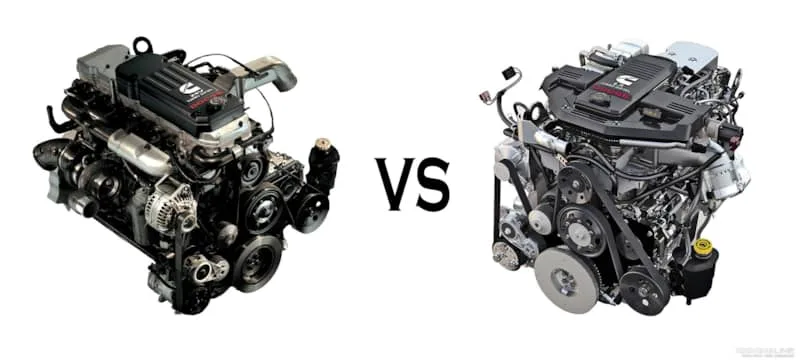
If you’ve been around diesel trucks for any length of time, chances are you've heard debates between fans of the 5.9L Cummins and the newer 6.7L Cummins engines. Both powerplants have made their mark under the hood of Dodge/RAM trucks, and both have legions of loyal supporters. But which one is actually better? Browse Ram 2500 In this in-depth article, we’ll explore the key differences, strengths, and weaknesses between the 5.9 Cummins (1989–2007) and the 6.7 Cummins (2007–present). Whether you’re looking to buy used, swap an engine, or simply understand why enthusiasts hold one over the other, this breakdown will help you make an informed decision. Engine Overview Engine Production Years Displacement Horsepower Range Torque Range 5.9L Cummins 1989–2007 5.9L (359 cu in) 160–325 hp 400–610 lb-ft 6.7L Cummins 2007–present 6.7L (408 cu in) 350–420 hp 610–1,075 lb-ft The 5.9 was beloved for its simplicity and mechanical reliability, while the 6.7 introduced modern emissions systems, higher output, and new technology to meet changing regulations and consumer demands. Power and Performance Winner: 6.7 Cummins The 6.7L Cummins clearly delivers more horsepower and torque than any 5.9 variant ever did. It’s designed to move heavier loads with ease and is better suited for modern towing demands. However, some diesel purists argue that the older 5.9 "feels" more responsive, especially in manual transmission setups due to less computer interference. Emissions and Tuning Potential Winner: 5.9 Cummins (for tuners) Winner: 6.7 Cummins (for compliance and modern tech) The 6.7 was introduced to meet new EPA standards. As a result, it includes: EGR (Exhaust Gas Recirculation) DPF (Diesel Particulate Filter) DEF (Diesel Exhaust Fluid in newer models) While these systems reduce harmful emissions, they also increase complexity and potential maintenance. Many 5.9 owners enjoy the pre-emissions simplicity, making it a favorite for tuning, swaps, and off-road builds. That said, the 6.7’s ECM is more advanced, allowing for more sophisticated tuning when done correctly—especially in newer models with improved reliability post-2013. Reliability Winner: 5.9 Cummins The 5.9 is legendary for its long-term durability, thanks in part to its simpler design: Fewer sensors No emissions systems (pre-2007) Robust inline-six design with iron block and head The 6.7 also uses an iron block and retains the inline-six architecture, but early models (2007.5–2012) were known for EGR, DPF, and turbo issues. Newer 6.7s have improved substantially, with many lasting well over 300,000 miles. If your priority is absolute mechanical simplicity, the 5.9 is still king. Transmission Compatibility Winner: 6.7 Cummins The 6.7 brought better factory transmission pairings, including: 68RFE automatic Aisin AS69RC (HD trucks) G56 6-speed manual (available through 2018) These options handle more torque than older transmissions like the 47RE and 48RE that came with the 5.9. As a result, you’re less likely to need an immediate transmission upgrade when modifying or towing with the 6.7. Fuel Economy Winner: 5.9 Cummins (lightweight trucks) Tie: depends on load and year Due to its smaller displacement and lighter trucks from its era, the 5.9 can deliver better MPG in unloaded, everyday driving. However, with newer tuning, gearing, and transmission tech, the 6.7 can achieve comparable or even superior fuel economy in newer RAM 2500/3500 trucks when towing. EPA estimates are not always published for HD trucks, but real-world owners report: Engine Unloaded MPG Towing MPG 5.9L 17–22 10–13 6.7L 15–20 9–12 Aftermarket Support Winner: Tie Both engines have massive aftermarket ecosystems: The 5.9 is popular for classic diesel swaps and budget builds. The 6.7 has a growing base of tuning, turbo, and emissions-compliant upgrades. In either case, you won’t struggle to find parts, forums, or tuning support. Common Issues 5.9 Cummins Killer Dowel Pin (early years) Lift pump failures (VP44 years) Transmission weakness in automatic setups 6.7 Cummins DPF and EGR clogging (2007.5–2012) Turbo actuator issues (especially in 2007–2014) Head gasket failures in high-boost builds Newer 6.7s (post-2019) have addressed many of the early bugs, and when maintained properly, these engines are extremely robust. Which One Should You Choose? Use Case Recommended Engine Budget build 5.9 Cummins Maximum towing 6.7 Cummins Simplified maintenance 5.9 Cummins New truck purchase 6.7 Cummins Emissions compliance 6.7 Cummins Diesel swap project 5.9 Cummins Best for tuning potential Tie (5.9 for simplicity, 6.7 for power) Final Verdict The 5.9 Cummins is a simpler, proven workhorse that remains beloved by diesel enthusiasts for good reason. Its mechanical reliability and ease of maintenance make it a favorite for older truck builds and performance projects. The 6.7 Cummins, on the other hand, is the future. It provides more power, better transmission support, and advanced technology for serious towing, hauling, and daily usability. While early emission-era versions had issues, newer models have evolved into some of the most capable and dependable diesel engines in the market. If you're looking for reliability and ease of ownership, the 5.9 still holds its ground. But for raw power, towing capacity, and modern features, the 6.7 is the better choice—especially from 2013 and onward. Let me know if you'd like a dealership-focused or off-road-builder version of this article. 5.9 Cummins vs 6.7 Cummins — Frequently Asked Questions Which engine is better: the 5.9 Cummins or the 6.7 Cummins? It depends on your priorities. The 5.9 is simpler and famed for mechanical reliability and easy maintenance. The 6.7 delivers higher factory power/torque, better transmission pairings, and modern tech for towing and daily usability—especially on 2013+ models. What years did the 5.9 and 6.7 Cummins run? The 5.9L Cummins was offered from 1989–2007. The 6.7L Cummins has been in production from 2007 to the present. How do power and torque compare? Typical ranges: 5.9L Cummins ~160–325 hp and ~400–610 lb-ft; 6.7L Cummins ~350–420 hp and ~610–1,075 lb-ft (varies by year/trim). The 6.7 is the clear winner for output and towing. Which is more reliable? The 5.9 has a reputation for bulletproof simplicity (fewer sensors, no factory DPF/DEF on pre-2007 trucks). The 6.7 is also durable—earlier emissions-era issues (2007.5–2012) improved markedly in later years. With proper maintenance, both can exceed 300k miles. How do emissions systems affect ownership? The 6.7 introduced EGR, DPF, and later DEF to meet EPA standards. These reduce emissions but add complexity and potential maintenance. The pre-emissions 5.9 is simpler to service but won’t meet newer compliance needs. Which engine is better for tuning? For simplicity and budget builds, the 5.9 is popular with tuners and swap projects. The 6.7’s newer ECMs enable sophisticated, emissions-compliant calibrations when done correctly—especially on later model years. What transmissions pair with each? The 5.9 commonly ran with 47RE/48RE automatics or manuals; these may need upgrades with higher power. The 6.7 pairs with stronger options like the 68RFE, Aisin AS69RC (HD), and the G56 manual (thru 2018), which handle torque better from stock. Which gets better fuel economy? Unloaded MPG often favors the 5.9 due to lighter trucks and smaller displacement (owners report ~17–22 mpg). The 6.7 can be similar or better under tow thanks to gearing, transmission logic, and later calibrations (e.g., ~15–20 mpg unloaded, ~9–12 towing—driver and setup dependent). What are common issues to watch for? 5.9: early “Killer Dowel Pin,” VP44-era lift pump failures, and weaker autos (47/48RE) if tuned or towed hard. 6.7: EGR/DPF clogging on early years (’07.5–’12), turbo actuator faults (’07–’14), and head gasket risk on high-boost builds. Later 6.7s address many early problems. Which should I choose for maximum towing? The 6.7 Cummins. It offers higher factory torque, stronger transmission options, and better integrated tow tech in newer RAM 2500/3500 trucks. Which is best for a budget or swap project? The 5.9 Cummins. Its simpler electronics and broad parts availability make it a favorite for swaps and cost-effective builds. Is a newer 6.7 (2013+) worth the premium? Often yes. Later 6.7 models benefit from improved emissions reliability, stronger driveline pairings, better cooling, and more refined factory calibrations. Where can I shop or test a current RAM 2500 with the 6.7? Browse Ram 2500 to see current availability, towing packages, and trim options.

is Jeep Discontinuing The Gladiator?

Is Jeep Discontinuing the Gladiator? Here's What You Need to Know Jeep fans are constantly keeping an eye on the brand's next move, and a frequent question that arises is whether Jeep will discontinue the Gladiator. Amazon Offers(Limited Stock) Short answer: Is Jeep Discontinuing the Gladiator? To put it simply: Jeep has no plans to stop producing the Gladiator anytime soon. In fact, the 2024 and 2025 Gladiator models showcase new updates, reinforcing its popularity among off-road enthusiasts.The likelihood of Jeep discontinuing the Gladiator in the near future is quite low, likely around 10-15%. This is based on the model's solid sales, popularity among off-road enthusiasts, and continuous updates. However, market conditions and Jeep's strategic shifts could influence this in the longer term. The Gladiator's Unique Place in Jeep's Lineup The Jeep Gladiator, a midsize pickup truck launched in 2019, is essentially a Jeep Wrangler with a truck bed, designed to combine the best of both worlds: off-road capability and utility. This blend has made the Gladiator a unique and appealing option for many drivers, especially those who want a rugged vehicle that can also handle the demands of hauling and towing. Jeep continues to prioritize the Gladiator, not just as an extension of the Wrangler but as its own versatile workhorse. In the broader midsize truck segment, it competes against models like the Toyota Tacoma, Ford Ranger, and Chevrolet Colorado. Why the Gladiator Isn't Going Anywhere Despite the rumors, Jeep has shown no signs of discontinuing the Gladiator. Here's why: Strong Sales Figures: The Gladiator has maintained consistent sales since its launch. Its appeal to both off-road adventurers and those seeking utility makes it a favorite in its segment. Off-Road Heritage: Jeep is known for its off-road prowess, and the Gladiator is no exception. With the legendary Trail Rated badge, it continues to offer best-in-class off-road features like heavy-duty axles, locking differentials, and front and rear skid plates. Ongoing Updates: Jeep continues to enhance the Gladiator with new features and trim levels. The latest models offer tech upgrades like advanced infotainment systems, off-road cameras, and new driver assistance features. The 2025 model even hints at electrification with hybrid versions in the pipeline. Niche Aspects That Keep the Gladiator Thriving The Jeep Gladiator stands out due to several key factors that solidify its presence in the market: Customization Options: Like the Wrangler, the Gladiator is highly customizable. Jeep offers a vast array of aftermarket accessories, including off-road tires, LED lighting kits, and lift kits, allowing owners to tailor their vehicle for any adventure. Open-Air Driving: The Gladiator is the only pickup truck that allows for full open-air experiences, with removable doors and roof, offering an experience you can't get from any other truck. Towing Capacity: With a towing capacity of up to 7,650 pounds, the Gladiator outperforms many other midsize trucks in its class, making it a practical choice for drivers needing a balance of off-road capability and work-ready power. Electrification Potential: Jeep has been actively moving toward electrifying its lineup. Although there’s no full-electric Gladiator on the market yet, Jeep has signaled that hybrid and plug-in versions of its models are in development. This includes the Gladiator, which could soon have a more eco-friendly, electrified version. Performance and Powertrain The 2024–2025 Gladiator lineup continues to offer a proven engine setup designed for reliability and versatility: Engine Displacement Horsepower Torque Transmission Drivetrain 3.6L Pentastar V6 Gasoline 285 hp 260 lb-ft 6-speed manual / 8-speed auto 4x4 3.0L EcoDiesel V6 (discontinued after 2023) Diesel 260 hp 442 lb-ft 8-speed auto 4x4 While the EcoDiesel option was phased out, Jeep has hinted that the Gladiator’s future could include electrified powertrains, possibly following the brand’s 4xe hybrid system seen in the Wrangler. Conclusion Jeep remains committed to the Gladiator, consistently updating it and positioning it as a key model in their lineup. With its iconic styling, unbeatable off-road capabilities, and practical utility, the Gladiator is here to stay. The future of the Gladiator may even include electrified versions, keeping the model relevant for years to come. How the Gladiator Stacks Up Against the Competition Model Engine Horsepower Towing (Max) Unique Feature Jeep Gladiator 3.6L V6 285 hp 7,650 lbs Removable roof & doors Toyota Tacoma 2.4L Turbo I4 278 hp 6,500 lbs Off-road modes Ford Ranger 2.7L Turbo V6 315 hp 7,500 lbs Trail Control Chevrolet Colorado 2.7L Turbo I4 310 hp 7,700 lbs Multi-Stow tailgate Even with newer rivals entering the market, the Gladiator’s open-air design and legendary off-road DNA give it an identity no other pickup can match. Looking Toward the Future: The Possibility of an Electric Gladiator Jeep has already launched electrified versions of several models, including the Wrangler 4xe and Grand Cherokee 4xe. The next logical step is an electrified Gladiator, expected within the next few years. Potential features could include: Dual electric motors with instant torque Regenerative braking and one-pedal off-roading Silent trail operation for eco-friendly exploration Extended range using battery + gas hybrid systems These advancements would make the Gladiator even more appealing to a new generation of eco-conscious adventurers. Conclusion: The Jeep Gladiator Is Here to Stay Despite internet rumors, the Jeep Gladiator remains a cornerstone of the Jeep lineup. It continues to embody everything enthusiasts love about the brand — open-air freedom, 4x4 capability, and durable performance — now with a growing focus on technology and electrification. As long as drivers crave adventure and utility in one package, the Gladiator will continue to roll off production lines. Jeep’s commitment to evolving the model ensures that this trail-conquering pickup has a bright future ahead. FAQ Is Jeep planning to discontinue the Gladiator? No, Jeep has no current plans to discontinue the Gladiator. The 2024 and 2025 models feature updates, indicating continued production. How are Gladiator sales performing? The Gladiator has maintained consistent sales since its launch, appealing to both off-road enthusiasts and those seeking utility. Are there any major updates coming to the Gladiator? Yes, Jeep continues to enhance the Gladiator with new features, tech upgrades, and trim levels. The 2025 model hints at potential hybrid versions. How does the Gladiator compare to other midsize trucks? The Gladiator offers unique features like removable doors and roof, strong off-road capabilities, and competitive towing capacity, setting it apart in its segment. Will there be an electric version of the Gladiator? While there's no full-electric Gladiator yet, Jeep has signaled that hybrid and plug-in versions are in development as part of their electrification plans. What makes the Gladiator unique in Jeep's lineup? The Gladiator combines the off-road capability of a Wrangler with the utility of a pickup truck, offering a unique blend in the Jeep lineup. How customizable is the Gladiator? Like the Wrangler, the Gladiator is highly customizable with a vast array of aftermarket accessories available. What is the Gladiator's towing capacity? The Gladiator can tow up to 7,650 pounds, outperforming many other midsize trucks in its class. Does the Gladiator have Jeep's Trail Rated badge? Yes, the Gladiator carries Jeep's Trail Rated badge, indicating its strong off-road capabilities. Are there any special editions of the Gladiator planned? While specific special editions haven't been announced, Jeep typically offers various trim levels and limited editions for its popular models, including the Gladiator. Responsive Google Map: Simi Valley Chrysler Dodge Jeep Ram Find Us Simi Valley Chrysler Dodge Jeep Ram • 2350 First Street, Simi Valley, CA 93065 • Sales: 805-387-9755 Get Directions

Jeep Death Wobble

WARNING: Your Jeep's Hidden Killer - And How to Defeat It!

Taming the Jeep Death Wobble: Your Ultimate Guide to Diagnosis and Repair Jeep owners, particularly those who venture off-road trails, are familiar with the term "death wobble"—which evokes fear and frustration. This sudden, violent shaking of the front end can turn your thrilling ride into a nerve-wracking experience, making it difficult to control the vehicle. But don’t worry! This comprehensive guide will help you understand what the Jeep death wobble is, why it happens, and how to fix it so you can confidently continue your adventures. What Is the Death Wobble? The term “death wobble” is as dramatic as it sounds. It refers to the violent shaking that can occur in vehicles with a solid front axle, like the Jeep Wrangler. When triggered, this vibration often feels as though the entire front end is going to shake itself apart, which can be terrifying. However, while the death wobble can be unsettling, it’s usually not life-threatening if you stay calm and bring the vehicle to a controlled stop. The death wobble occurs when the front suspension and steering components begin to oscillate rapidly after hitting a bump or uneven road surface. This oscillation can be so extreme that it shakes the steering wheel and the vehicle itself, and it will continue until the driver slows down or stops the vehicle entirely. Why Does the Death Wobble Happen? Death wobble is not due to a single issue but is rather the result of several factors affecting the front suspension and steering systems. The Jeep Wrangler, with its solid front axle and high suspension articulation, is particularly prone to this problem when any component in the suspension, steering, or tires is worn, loose, or out of alignment. Several conditions can set off a death wobble, such as: Hitting a pothole Driving over rough terrain at speed Sudden bumps in the road Poorly maintained highways or dirt roads Common Causes of the Jeep Death Wobble Death wobble usually doesn’t have just one root cause. Instead, it's a combination of multiple factors that affect the suspension and steering. Here’s an in-depth look at the most common culprits: 1. Worn Suspension Components The most common cause of death wobble is worn or loose suspension parts. Over time, the constant stress of off-roading or even just everyday driving can cause parts like bushings, ball joints, and the track bar to wear out. Track Bar Bushings: The track bar, which helps keep the axle centered under the Jeep, is often the main cause. When the bushings on the track bar wear out or become loose, the front axle is allowed to move excessively, causing instability and eventually the death wobble. Control Arm Bushings: These bushings allow the control arms to move while maintaining control over the axle’s position. If they are worn or cracked, the control arms can move unpredictably. Ball Joints: Ball joints allow the wheels to move up and down while turning. If they become loose, they can cause excessive movement in the front suspension, contributing to death wobble. 2. Steering Components Loose or damaged steering components can also be a key cause. The tie rod, drag link, and other steering linkage parts should be checked regularly, as any play in these parts can cause oscillations in the front end. 3. Tire and Wheel Issues Tire pressure and balance also play a huge role. Unbalanced tires or uneven tire wear can create vibrations that exacerbate existing suspension or steering issues, leading to death wobble. Tire Pressure: Both under and over-inflated tires can trigger death wobble. Keeping your tires properly inflated can go a long way in preventing this issue. Tire Balance: Imbalanced tires will cause the vehicle to vibrate at certain speeds, which can contribute to or trigger a death wobble event. 4. Improper Alignment Lifting your Jeep without adjusting the suspension geometry can increase the risk of death wobble. Lifts, especially without proper caster and toe angle adjustments, can alter how the front axle aligns with the steering system. Caster Angle: The caster angle affects the vehicle's stability, especially at higher speeds. If this angle is off after a lift, it can make the Jeep more prone to wobble when hitting bumps. Toe-In Alignment: Incorrect toe alignment (whether toe-in or toe-out) can make the Jeep less stable and more likely to develop a wobble. 5. Steering Damper Issues While not the primary cause, a faulty steering damper (also known as a steering stabilizer) can worsen death wobble. The steering damper is designed to absorb shocks and vibrations in the steering system. A weak or damaged damper may fail to reduce the vibrations that initiate or sustain death wobble. Death Wobble After a Lift: The Risk for Jeep Owners Many Jeep enthusiasts install lift kits to give their vehicles more ground clearance for off-roading. However, it’s important to understand that lifting a Jeep can increase the risk of death wobble, especially if the lift isn’t properly installed. A death wobble after a 2.5-inch lift is common for Jeep JK owners. Lifting a Jeep affects the geometry of the suspension, steering, and alignment. Without proper adjustments—such as extending the track bar, correcting the caster angle, or upgrading certain components—the death wobble can occur more frequently. It’s important to check the following after lifting a Jeep: Ensure the track bar is re-aligned and torqued correctly Re-check the ball joints and control arms for excessive play Adjust the caster angle to ensure stability at higher speeds Diagnosing the Jeep Death Wobble One of the challenges of dealing with the death wobble is identifying the exact cause. Here’s a step-by-step guide to help you diagnose it: 1. Visual Inspection of Suspension Components Start with a visual inspection of all the suspension components. Check for any visible signs of wear or damage, such as: Cracked or worn-out bushings on the track bar or control arms Excessive play in ball joints Bent or damaged control arms Rust or corrosion on key components 2. Check for Play in the Steering System You can do this by jacking up the front of the Jeep and physically testing the steering system for play. Use a pry bar or shake the wheel by hand while the Jeep is lifted to see if the ball joints or tie rods move excessively. 3. Test the Steering Damper Remove the steering damper and check whether it has any resistance when compressing or extending. If the steering damper feels weak or doesn’t work as it should, consider replacing it. 4. Inspect Tire Balance and Wear Look at your tires for signs of uneven wear, which could indicate alignment or balance issues. If your tires are unevenly worn, they should be replaced, and the wheels should be rebalanced. 5. Verify Alignment Ensure that the Jeep’s caster, toe, and camber angles are within the correct specifications. If your vehicle is lifted, it may require a professional alignment to fix geometry issues that occurred after the modification. How to Fix Jeep Death Wobble Once you’ve diagnosed the problem, it’s time to tackle the repairs. Here’s how to fix a death wobble and prevent it from happening again: 1. Tighten All Suspension Components Even if you don’t see any visible damage, loose components can be the cause of the death wobble. Tighten all suspension and steering parts, especially the track bar and control arms, to the manufacturer’s specifications. 2. Replace Worn Components If any bushings, joints, or rods are worn or damaged, replace them. This is especially important for the track bar, control arms, ball joints, and tie rod ends. Using high-quality aftermarket parts can sometimes help improve stability. 3. Realign the Front Suspension After replacing worn components, make sure to get a professional alignment to correct the caster angle and toe settings. Proper alignment is crucial, especially if you’ve lifted the Jeep. 4. Balance and Align Your Tires Unevenly worn or imbalanced tires can contribute to death wobble. Ensure that your tires are properly inflated, balanced, and aligned to minimize vibrations. 5. Upgrade Key Components Consider upgrading to heavy-duty suspension components if you’re frequently off-roading or have lifted your Jeep. Aftermarket track bars, control arms, and steering stabilizers can add strength to your suspension and prevent future death wobble incidents. The Jeep Death Wobble Fix: What Works Successfully fixing the Jeep death wobble requires attention to detail and patience. Here’s what has worked for many Jeep owners: Installing a Heavy-Duty Adjustable Track Bar: A stronger track bar can better resist the lateral forces that cause the axle to wobble. Upgrading Ball Joints: Aftermarket heavy-duty ball joints can handle the additional stresses placed on lifted Jeeps. Using a Dual Steering Stabilizer: While not a cure, upgrading to a dual steering stabilizer can help reduce the severity of death wobble, particularly on lifted Jeeps Preventing Death Wobble in the Future Preventing death wobble is largely about regular maintenance. Here are a few tips to keep your Jeep running smoothly: Regularly inspect suspension and steering components for signs of wear. Keep your tires properly inflated and balanced. Check your alignment after off-roading or installing modifications like a lift kit. Torque suspension parts to manufacturer specifications regularly, especially after hard off-roading trips. The Reddit Fix Comment by u/TheBaller_Bjj from discussion in Wrangler Conclusion: Keep Calm and Conquer the Death Wobble The Jeep death wobble might be intimidating, but with proper diagnosis and repair, it’s entirely manageable. Whether you’ve experienced a death wobble after a lift or are trying to prevent it in the future, taking care of your Jeep’s suspension, steering, and tires will help you enjoy smooth and safe driving experiences for years to come. Follow the steps outlined here to diagnose and fix your Jeep, and remember that regular maintenance is the key to preventing this issue from coming back. FAQs 1. Can the Jeep death wobble cause accidents? Death wobble can be frightening, but it rarely causes accidents as long as the driver maintains control. The key is to slow down and pull over safely when it happens. 2. How much does it cost to fix the death wobble? The cost can vary significantly depending on the cause. If it’s a simple alignment issue or a worn bushing, the repair could be inexpensive. However, if major components like the track bar or control arms need replacing, the cost could range from $200 to $1,000. 3. Can the death wobble return after being fixed? Yes, it can return if the underlying issue isn’t fully addressed or if new parts wear out. Regular inspections and maintenance are critical to preventing its recurrence. 4. Is death wobble unique to Jeeps? No, it can affect any vehicle with a solid front axle, but Jeeps are particularly prone to it because of their design and the stresses placed on their suspension during off-road use. 5. Will upgrading parts prevent the death wobble? Upgrading to heavy-duty suspension parts can significantly reduce the risk of death wobble, especially for lifted Jeeps or those that frequently go off-road. Additional FAQs: 6. What causes Jeep's death wobble? The death wobble is typically caused by issues with the Jeep's suspension or steering components. Worn-out bushings, loose track bars, unbalanced tires, and improper alignment are common culprits. It often occurs when these parts are not properly maintained or replaced over time. 7. How do you fix Jeep death wobble? To fix the Jeep death wobble, the root cause must be identified. Start by inspecting the suspension and steering components like the track bar, control arms, and bushings. Ensure proper tire balance and alignment. In severe cases, replacing worn-out parts may be required. 8. What is death wobble on a Jeep? Death wobble refers to a violent shaking or vibration that occurs in Jeeps, especially when driving at higher speeds or hitting a bump. It’s caused by a problem in the steering or suspension system, leading to a loss of control until the vehicle is slowed down. 9. Is death wobble covered by warranty? In many cases, Jeep warranties do not cover death wobble, as it is often seen as a result of wear and tear. However, if the wobble is caused by defective parts, it’s worth checking with your dealership to see if repairs can be covered under the warranty. 10. How do you stop Jeep's death wobble? To stop death wobble, pull over and come to a complete stop. Once the shaking ceases, inspect your suspension and steering components. Addressing the root cause—whether it’s unbalanced tires, loose track bars, or worn bushings—is crucial to preventing it from happening again. 11. Why do Jeeps experience death wobble more often? Jeeps, particularly models with solid front axles, are prone to death wobble due to their unique suspension design. Off-road use, modifications like lifting the vehicle, and heavier wear on components contribute to a higher likelihood of experiencing death wobble.

2024 jeep wrangler sport​

The Ultimate Guide to the Jeep Wrangler: A Timeless Off-Road Icon

The Ultimate Guide to the Jeep Wrangler: A Timeless Off-Road Icon The Jeep Wrangler is one of the few vehicles that still feels directly connected to its original purpose. It is rugged, removable-roof, body-on-frame-style, trail-focused, and instantly recognizable. The simple answer is this: the Jeep Wrangler is special because it is one of the last true off-road SUVs you can still buy new, with real 4x4 hardware, removable doors, open-air driving, strong resale appeal, and a design rooted in Jeep’s military and civilian heritage. Jeep’s official brand history ties the brand to more than 80 years of freedom, adventure, authenticity, and passion. The modern Wrangler continues that story with a shape and mission that still echo the early Willys-style Jeep formula. Why the Jeep Wrangler Became an Icon The Wrangler is not popular because it is the smoothest SUV, the quietest SUV, or the most fuel-efficient SUV. It is popular because it does something most modern SUVs stopped doing: it puts capability and character first. A Wrangler has the upright windshield, short overhangs, exposed hinges, removable roof options, available removable doors, real 4x4 systems, rugged axles, trail-focused trims, and a huge aftermarket. It looks different because it is different. That is why it has stayed relevant while so many other SUVs became softer, rounder, and more road-focused. Jeep Wrangler Heritage The Wrangler’s roots go back to the original military Jeep and the postwar civilian Jeep models that followed. That history matters because the Wrangler is not simply a retro-styled SUV. It is the modern continuation of a vehicle idea that started with utility, durability, mobility, and simplicity. The Wrangler name itself arrived later, but the concept is older: a compact 4x4 built to go places normal vehicles cannot. The Jeep history page shows how the brand evolved from early military-linked models into civilian 4x4s, CJs, and eventually the Wrangler family. That lineage is one reason Wrangler buyers are so loyal. They are buying into a vehicle with a story. What Makes a Wrangler Different From a Regular SUV? Most modern SUVs are car-based crossovers. They are built for comfort, fuel economy, quietness, and daily driving. The Wrangler is different. It is built around off-road capability and open-air driving. That means it can feel louder, firmer, and less refined than a normal crossover, but it also gives you capability and personality that a normal crossover cannot match. A Toyota RAV4, Honda CR-V, Mazda CX-5, or Ford Escape may be easier for commuting. A Wrangler is better when you care about trails, snow, mud, rocks, camping roads, beach driving, and the feeling of driving something with real mechanical character. Jeep Wrangler Body Styles The Wrangler is offered mainly in two body styles: 2-door and 4-door Unlimited. The 2-door Wrangler is the classic setup. It is shorter, lighter, easier to maneuver on tight trails, and closer to the original Jeep feel. It is best for drivers who want a simple, more agile off-road SUV. The 4-door Wrangler Unlimited is the practical choice. It gives you more rear-seat room, more cargo space, better highway stability, and more family usability. It is the better daily driver for most shoppers. If you want the purest Wrangler, choose the 2-door. If you need one vehicle for daily life, passengers, cargo, and road trips, choose the 4-door. Jeep Wrangler Engines Modern Wrangler engine options have varied by model year, but the core choices have included the 3.6L Pentastar V6, 2.0L turbocharged four-cylinder, Wrangler 4xe plug-in hybrid, and the 6.4L HEMI V8 in 392 models. The 3.6L V6 is the familiar all-around choice. It is simple by modern standards, widely used, and available with a manual transmission in some configurations. The 2.0L turbo gives strong low-end torque and can feel punchy in daily driving. The Wrangler 4xe adds plug-in hybrid capability, instant torque, and short-range electric driving. The Rubicon 392 adds the kind of V8 power that turns the Wrangler into something much more aggressive. Recent 392-based special editions continue to use the 6.4L HEMI V8 with 470 horsepower and 470 lb-ft of torque, according to Car and Driver. Jeep Wrangler 4x4 Systems Wrangler capability starts with its 4x4 systems. Jeep offers different systems depending on trim and configuration. Some are more traditional part-time 4WD systems, while others are more automatic or full-time-friendly. Jeep Canada’s 4x4 basics explains how Jeep systems like Selec-Trac can automatically manage traction in changing conditions. For most drivers, the key idea is simple: the Wrangler is built with real 4x4 hardware, not just light-duty AWD. That makes it stronger in low-traction, off-road, and rough-terrain situations. Wrangler Sport: The Simple Starting Point The Wrangler Sport is the basic Wrangler. It is the right choice if you want the lowest entry price, classic Jeep shape, removable roof and doors, and a strong starting point for customization. The Sport is not the fanciest trim, but that is part of the appeal. For owners who plan to build their Jeep with aftermarket wheels, tires, bumpers, lights, and suspension, the Sport can be a smart blank canvas. Wrangler Willys: Heritage Meets Capability The Willys trim leans into Jeep heritage and off-road style. It usually gives buyers a tougher look, more trail-oriented equipment than the base Sport, and a design that feels connected to Jeep’s military-inspired roots. A Willys is a good middle ground if you want more capability and personality without jumping all the way to Rubicon pricing. For many buyers, Willys is the sweet spot. Wrangler Sahara: The Daily-Driver Wrangler The Sahara is the more comfort-focused Wrangler. It is usually aimed at drivers who want Jeep style and open-air driving but spend most of their time on pavement. It often brings a more polished appearance, more comfort features, and a cleaner city-friendly feel. If your Wrangler will mostly be a daily driver, the Sahara may make more sense than a Rubicon. Wrangler Rubicon: The Factory Trail Machine The Rubicon is the serious off-road Wrangler. It is built for trails, rocks, ruts, and technical terrain. Depending on model year and configuration, Rubicon models can include locking differentials, Rock-Trac 4x4 hardware, heavy-duty axles, rock rails, off-road tires, and electronic sway bar disconnect. The Rubicon costs more because it includes hardware that many off-roaders would otherwise add later. Jeep’s Wrangler specs show how towing, drivetrain, and capability vary by configuration, which is why choosing the right trim matters. If you actually plan to off-road seriously, the Rubicon is the one to consider first. Wrangler 4xe: Plug-In Hybrid Jeep Capability The Wrangler 4xe is Jeep’s plug-in hybrid Wrangler. It combines gasoline power with electric assist, giving strong torque and the ability to drive short distances on electric power when charged. It is especially appealing for drivers who want Wrangler capability but also have a short commute or access to home charging. The important point is this: a 4xe only makes full sense if you plug it in regularly. If you never charge it, you are carrying extra hybrid weight without using the biggest benefit. Wrangler 392: The V8 Legend The Wrangler 392 is the wild one. It takes the Wrangler formula and adds a 6.4L HEMI V8. That gives it a completely different personality: louder, faster, more emotional, and more expensive. The 392 is not the practical Wrangler. It is the enthusiast Wrangler. It is for people who want a V8 Jeep before that kind of thing becomes even harder to find. How Much Can a Jeep Wrangler Tow? Wrangler towing depends on the exact model, body style, drivetrain, and equipment. Jeep’s official Wrangler specs list towing capacity by configuration, with some models rated at 2,000 pounds and higher-rated configurations going beyond that depending on setup. Some 2026 four-door Rubicon and Rubicon X configurations are widely listed with up to 5,000 pounds of towing capacity. For most Wrangler buyers, towing is useful but not the main reason to buy one. If towing is your top priority, a Jeep Gladiator or Ram truck may be a better fit. Is the Wrangler Good in Snow? Yes, the Wrangler can be excellent in snow, especially deep snow and unplowed roads. Its ground clearance, 4x4 systems, and rugged tires can make it very capable in winter conditions. But the real winter secret is tires. A Wrangler with proper winter tires will be much better than a Wrangler on worn all-seasons. 4x4 helps you move. Tires help you stop and turn. Is the Wrangler Comfortable? The Wrangler is more comfortable than it used to be, but it still feels like a Wrangler. Newer models have better interiors, improved infotainment, better seats, better technology, and more refinement than older versions. But road noise, tire noise, wind noise, and a more rugged ride are still part of the experience. If you want quiet luxury, buy a Grand Cherokee. If you want open-air adventure, buy a Wrangler. Is the Wrangler Reliable? The Wrangler can be reliable, but condition and maintenance matter. A Wrangler is built for rugged use, but many are modified, driven off-road, exposed to water, lifted, or used hard. That means used buyers should inspect service history, rust, suspension, steering, tires, leaks, 4x4 operation, and modification quality. A clean, mostly stock Wrangler with maintenance records is usually safer than a heavily modified one with unknown parts. Wrangler Resale Value The Wrangler is known for strong resale value. That is because demand stays high, the design ages slowly, and the Wrangler has one of the strongest enthusiast communities in the SUV market. Used Wranglers often remain desirable because buyers want the capability, look, and lifestyle even when shopping pre-owned. Color, trim, mileage, condition, roof type, tire setup, accident history, and modifications all affect value. Best Jeep Wrangler for Most Buyers For most buyers, the best Wrangler is a 4-door Sport S, Willys, or Sahara. Sport S gives you the Wrangler formula with more daily convenience than the base Sport. Willys gives you a stronger off-road look and more capability. Sahara gives you better comfort and a cleaner daily-driver feel. Rubicon is best if you actually need serious trail hardware. 4xe is best if you can charge regularly. 392 is best if you want the most emotional, V8-powered Wrangler. Used Wrangler Buying Tips When buying used, inspect the Wrangler carefully. Check for rust underneath, especially on frame areas, suspension mounts, skid plates, and body seams. Look for roof leaks, door seal issues, worn tires, uneven tire wear, steering wobble, suspension wear, and 4WD operation. Avoid poor-quality lift kits, bad wiring, cheap lights, mismatched tires, and unknown tune or drivetrain changes. For Southern California shoppers, compare used Jeep inventory by year, trim, mileage, engine, condition, and modification history. If you want new warranty coverage, review current new Jeep inventory. Wrangler vs Gladiator The Wrangler is the better SUV. The Gladiator is the better Jeep truck. The Gladiator gives you a pickup bed, longer wheelbase, and more utility for hauling gear. The Wrangler is easier to maneuver off-road, more iconic in shape, and better if you do not need a truck bed. If you want the classic Jeep experience, choose Wrangler. If you need pickup utility, choose Gladiator. Wrangler vs Bronco The Ford Bronco is the Wrangler’s closest modern rival. The Bronco is more road-friendly in some versions and has strong off-road trims of its own. The Wrangler still has deeper heritage, a stronger aftermarket, removable doors and roof tradition, and a more established off-road community. The Bronco is a serious competitor. The Wrangler is still the original icon. Who Should Buy a Jeep Wrangler? Buy a Wrangler if you want: Real off-road capability. Open-air driving. Removable doors. A huge aftermarket. Strong resale value. Rugged styling. Trail confidence. Jeep community culture. A vehicle with personality. Do not buy a Wrangler if your top priorities are quietness, fuel economy, soft ride quality, low wind noise, or luxury-crossover refinement. Final Thoughts: The Wrangler Still Deserves Its Icon Status The Jeep Wrangler is not perfect, and that is part of why people love it. It is louder, rougher, and less conventional than most SUVs. But it is also more capable, more customizable, more recognizable, and more connected to its heritage than almost anything else on the road. The Wrangler remains a timeless off-road icon because it has not forgotten what it is. It still gives drivers the open-air, go-anywhere, trail-ready experience that made Jeep famous in the first place.

Contact Us

Fill out this form below and we'll contact you shortly
*Required Fields