Simi Valley Chrysler Dodge Jeep Ram

Blog / Jeep

Do Jeep Gladiators Hold Their Value?

Do Jeep Gladiators Hold Their Value

Do Jeep Gladiators Hold Their Value?

The Jeep Gladiator usually holds its value better than many vehicles, especially because it combines two things buyers continue to want: Jeep 4x4 capability and pickup truck utility. It is not a normal midsize truck, and that is exactly why resale value can stay strong when the right buyer is looking.

The short answer is yes, Jeep Gladiators can hold their value well, but not every Gladiator holds value the same way. Trim level, mileage, condition, modifications, market demand, and whether the truck was bought new or used all matter. A clean Rubicon, Mojave, or Willys with the right options can be more desirable than a heavily modified or high-mileage base model.

Why the Jeep Gladiator Holds Value

The Gladiator is different from most midsize pickups because it is both a truck and a Jeep. It offers four-wheel drive capability, removable roof panels, removable doors, trail-focused trims, and a pickup bed. That combination gives it a niche that competitors like the Toyota Tacoma, Ford Ranger, Chevrolet Colorado, and Nissan Frontier do not fully copy.

That uniqueness helps resale value. Some buyers want a truck. Others want a Wrangler-style Jeep. The Gladiator appeals to both groups, especially shoppers who need bed space but still want open-air Jeep character.

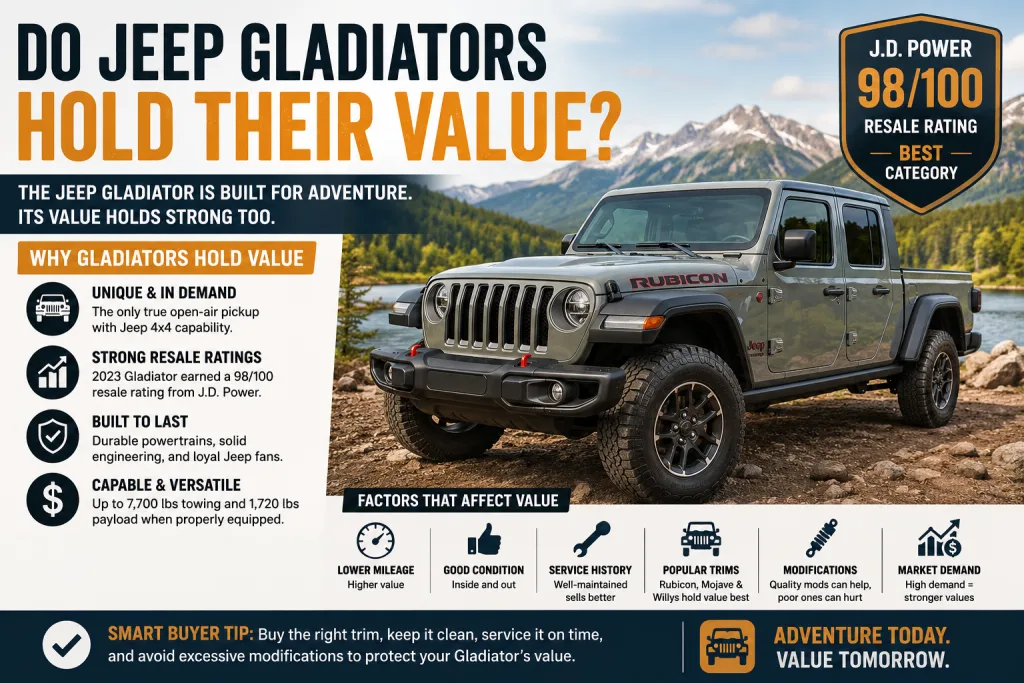
Jeep Canada lists the Gladiator with up to 7,700 pounds of towing capacity and 1,720 pounds of payload when properly equipped, which makes it useful beyond lifestyle driving. Those Jeep specs help explain why the Gladiator stays appealing to buyers who want fun and function in one vehicle.

Resale Value Ratings Are Strong

The Gladiator has performed well in resale and depreciation rankings. J.D. Power gave the 2023 Jeep Gladiator a resale rating of 98 out of 100, which falls into its “Best” category. That is a strong signal that the Gladiator is expected to retain value well compared with many other vehicles.

Depreciation estimates also show the Gladiator performing respectably. CarEdge estimates that a Jeep Gladiator depreciates about 37% after five years, leaving a five-year resale value around $29,578 based on its assumptions. That means it may retain roughly 63% of its value after five years, depending on purchase price, mileage, condition, and market conditions.

That is good for a vehicle that is still relatively expensive when new.

New vs. Used Gladiator Value

The biggest value question is whether you buy new or used. A new Gladiator gives you full warranty coverage, the latest features, and the exact trim you want. But like most vehicles, it will still take its largest depreciation hit in the early years.

A used Gladiator can be the smarter value play because someone else may have already absorbed part of that early depreciation. This is especially true if you find a clean, low-mileage Gladiator with the right trim and service history.

According to Edmunds, 2025 Jeep Gladiator trade-in values can vary widely depending on trim and condition, with estimates ranging from the high $20,000s to the mid-$40,000s. That wide range shows why trim, mileage, and equipment matter so much.

Which Jeep Gladiator Trims Hold Value Best?

The trims that tend to hold value best are usually the ones with clear buyer appeal. Rubicon and Mojave models often get the most attention because they have stronger off-road identity and more specialized hardware.

The Gladiator Rubicon is built for rock crawling and trail use. It is the one many Jeep buyers recognize immediately because of its off-road reputation. The Mojave is designed more for desert running and higher-speed off-road driving. Both trims have a stronger enthusiast following than basic versions.

Willys models can also be desirable because they offer a rugged look and useful off-road upgrades without the price of a Rubicon or Mojave. Sport and Sport S models can still hold value, but their resale strength depends more heavily on price, condition, mileage, and options.

Mileage Still Matters

Even though the Gladiator has strong Jeep appeal, mileage still affects value. A low-mileage Gladiator will usually be worth more than a high-mileage one with the same trim and equipment.

Mileage is especially important on trucks because buyers want to know how the vehicle was used. A Gladiator that spent most of its life commuting is different from one that towed heavy trailers, ran trails every weekend, or carried jobsite equipment every day.

A high-mileage Gladiator can still be a good buy if it has strong service records and no major issues. But for resale value, lower mileage almost always helps.

Condition Is a Big Deal

Condition can make or break the value of any used Gladiator. Because the Gladiator is popular with off-road buyers, shoppers will often look carefully for signs of hard use.

Scraped skid plates, frame damage, suspension wear, mismatched tires, rust, body dents, water leaks, or poorly installed aftermarket parts can all hurt value. Even if the truck looks good from a distance, a buyer or dealer may discount it if it looks abused underneath.

A clean Gladiator with original parts, good tires, a clean interior, and no accident history will usually be easier to sell and worth more.

Modifications Can Help or Hurt

Jeep owners love modifying their vehicles, but modifications do not always increase resale value. Some upgrades may make the truck more attractive to a specific buyer, but they can also narrow the market.

A quality lift kit, good tires, proper wheels, steel bumpers, or tasteful off-road accessories may help if they were installed correctly. But cheap parts, extreme lifts, poor wiring, loud exhausts, rough DIY work, or missing factory parts can lower value.

Most dealers and buyers prefer clean, well-documented upgrades. If you modify a Gladiator, keep receipts and keep the factory parts when possible.

Market Demand Matters

The Gladiator’s resale value also depends on the market. When truck demand is strong, used Gladiator values can benefit. When new vehicle incentives increase or used inventory grows, resale values can soften.

This is why the purchase price matters. A Gladiator bought with a strong discount may hold value better from the buyer’s perspective than one purchased at full sticker. Paying too much upfront can make depreciation feel worse even if the vehicle is still strong compared with competitors.

Local demand matters too. In areas where buyers love off-roading, camping, trails, and outdoor lifestyle vehicles, Gladiators may be easier to sell. In areas where buyers mainly want fuel economy or maximum towing, demand may be more limited.

How the Gladiator Compares to Other Trucks

The Gladiator competes with midsize trucks like the Toyota Tacoma, Ford Ranger, Chevrolet Colorado, GMC Canyon, and Nissan Frontier. The Tacoma is usually the resale-value benchmark in this class, but the Gladiator has its own advantage because it offers Jeep character that those trucks do not.

The Gladiator may not be the cheapest truck to buy, and it is not the smoothest or most fuel-efficient midsize pickup. But its removable roof, removable doors, 4x4 capability, and Jeep styling make it more unique.

That uniqueness helps it avoid becoming just another used truck on the lot.

Do Gladiators Depreciate?

Yes, Jeep Gladiators still depreciate. Every vehicle loses value over time, and the Gladiator is no exception. The strongest resale vehicles still drop in value as mileage rises, condition changes, and newer models arrive.

The better question is whether Gladiators depreciate less than many other vehicles. In many cases, yes. Strong resale ratings, Jeep brand loyalty, truck demand, and off-road appeal all help.

Still, buyers should be realistic. A Gladiator bought new at a high price with lots of options may lose more actual dollars than a used Gladiator bought after the first major depreciation hit.

How to Protect Gladiator Resale Value

The best way to protect value is to keep the truck clean, serviced, and close to factory condition. Regular oil changes, tire rotations, brake service, fluid checks, and documented maintenance all help.

Avoid cheap modifications and rough off-road damage. Keep the interior clean, fix small issues early, and save service records. If you use the Gladiator off-road, wash the underbody after mud, salt, sand, or trail use.

Also be smart when buying. Choose a desirable trim, useful options, good color, and fair purchase price. Resale value starts the day you buy the truck, not the day you sell it.

Is a Jeep Gladiator a Good Used Buy?

A used Jeep Gladiator can be a very good buy if you choose carefully. It gives you pickup utility, real 4x4 capability, and Wrangler-style personality in one package.

The best used Gladiators are clean, well-maintained, reasonably priced, and not heavily abused off-road. Rubicon, Mojave, and Willys trims can be especially attractive because they have stronger identity and buyer demand.

Before buying, check the vehicle history, inspect the underside, review maintenance records, look for signs of poor modifications, and test all roof and door seals. A Gladiator is fun, but condition still matters.

Find a Jeep Gladiator That Holds Its Value

Jeep Gladiators can hold their value well, especially when they are clean, properly maintained, reasonably priced, and equipped with desirable trims or options. Strong resale ratings, Jeep brand loyalty, truck practicality, and off-road capability all help the Gladiator stand out in the used market.

The smartest move is to buy the right Gladiator at the right price. A clean used model may offer better long-term value than paying top dollar for a new one, while a well-equipped new Gladiator can still make sense if you plan to keep it for years.

Visit Simi Valley Chrysler Dodge Jeep Ram to browse new inventory, compare used inventory, check your trade-in value, or apply for financing before choosing your next Jeep Gladiator.
Posted in:

Related Posts

CC26_JLJL74_2TB_PYC_APA_XXX_XXX_XXX.44595767d2e79008ad8cdbe55f250a44

How much do you have to pay a month for a Jeep Wrangler?

How Much Do You Have to Pay a Month for a Jeep Wrangler? A Jeep Wrangler monthly payment usually ranges from about $575 to $1,100+ per month, depending on the price, down payment, credit score, interest rate, loan term, taxes, fees, and trim. The simple answer is this: a lower-trim Jeep Wrangler Sport may land around $600 to $750 per month with normal financing, while a Wrangler Willys, Sahara, Rubicon, 4xe, or 392 can easily push payments into the $800 to $1,200+ range. Jeep lists the 2026 Wrangler starting at $36,035 MSRP, while higher trims like Sahara, Rubicon, and Rubicon X start much higher. Jeep Wrangler Quick Monthly Payment Estimate Here is a realistic estimate using a 72-month loan, about 7% APR, and roughly estimated taxes and fees. Actual payments can be higher or lower. $36,000 Wrangler: about $615 to $700/month $45,000 Wrangler: about $760 to $875/month $55,000 Wrangler: about $930 to $1,070/month $65,000 Wrangler: about $1,100 to $1,260/month $75,000+ Wrangler 392: about $1,275 to $1,500+/month This assumes little to moderate money down. A larger down payment or trade-in can lower the payment. A higher APR can raise it fast. Wrangler Price by Trim Jeep’s official 2026 Wrangler page lists starting MSRPs such as: Sport: from $36,035 Sport S: from $39,685 Willys: from $43,755 Sahara: from $48,910 Rubicon: from $45,815 Rubicon X: from $55,765 Jeep Wrangler Those are starting prices before taxes, registration, dealer fees, accessories, packages, and finance charges. A real Wrangler on the lot can cost much more once options are added. What Affects Your Jeep Wrangler Payment? The biggest factors are: Vehicle price: A Rubicon costs much more per month than a Sport. Down payment: More money down lowers the amount financed. Trade-in equity: Positive equity can reduce your payment. Credit score: Better credit usually means a lower APR. Loan term: Longer terms lower monthly payments but increase total interest. Taxes and fees: California taxes and registration can add thousands to the financed amount. Add-ons: Warranties, protection products, accessories, and lift packages can raise the payment. New vs Used Wrangler Monthly Payment A used Wrangler may not always be dramatically cheaper because Wranglers hold value well. A clean used Wrangler can still have a strong price, especially if it is a Rubicon, Willys, 4xe, or low-mileage Unlimited. That said, used can still be the better monthly-payment move if you choose the right year, mileage, and trim. For LA and Simi Valley shoppers, compare used Jeep inventory against new Jeep inventory before deciding. Sometimes the new-car incentives make a new Wrangler closer in payment than expected. Best Way to Lower the Payment The cleanest ways to lower a Wrangler payment are: Choose a lower trim like Sport, Sport S, or Willys. Put more money down. Use trade-in equity. Improve credit before applying. Avoid unnecessary add-ons. Compare new and used options. Choose a realistic loan term. A longer loan can make the payment look easier, but do not stretch the term too far just to afford a higher trim. The total cost matters. Final Answer Most Jeep Wrangler payments fall around $600 to $1,100 per month. A basic Wrangler Sport may be close to $600 to $750/month with typical financing. A Wrangler Willys, Sahara, Rubicon, or 4xe may be closer to $800 to $1,100/month. A Wrangler 392 or heavily optioned model can go well above $1,200/month. The only accurate number comes from the exact Wrangler, your credit, down payment, trade value, taxes, fees, and approved APR.

wrangler vs rubicon

Which Jeep is better, Rubicon or Wrangler?

Which Jeep is better, Rubicon or Wrangler? Which Jeep Is Better, Rubicon or Wrangler? The better choice depends on what you mean, because Rubicon is not a separate model from Wrangler. The Jeep Wrangler Rubicon is a trim level of the Jeep Wrangler. The simple answer is this: if you want the best Jeep for serious off-roading, the Rubicon is better. If you want the best Jeep for daily driving, price, comfort, or basic adventure use, another Wrangler trim may be better. A Wrangler Sport, Sport S, Willys, Sahara, or Rubicon all belong to the Wrangler family. The Rubicon is the factory-built trail specialist. Rubicon vs Wrangler: What’s the Difference? A Jeep Wrangler is the model. Rubicon is one version of it. Think of it like this: A Wrangler is the SUV. A Rubicon is the most off-road-focused Wrangler trim. The Wrangler lineup gives you the classic Jeep formula: removable roof, removable doors, available 4x4, rugged styling, and strong off-road heritage. The Rubicon takes that formula and adds hardware designed for more difficult trails. Jeep positions the Wrangler as its open-air 4x4 SUV, while Jeep Canada explains that the Rubicon’s Rock-Trac 4x4 system is built around a heavy-duty transfer case with a 4:1 low-range gear ratio for more controlled off-road torque. Why the Rubicon Is Better Off-Road The Rubicon is better off-road because it comes with equipment that standard Wrangler trims may not have. Depending on model year, a Rubicon can include: Tru-Lok electronic locking differentials. Rock-Trac 4x4 system. Lower crawl gearing. Heavy-duty axles. Electronic front sway bar disconnect. Rock rails. More aggressive off-road tires. Stronger trail protection. That equipment matters when you are climbing rocks, driving through ruts, crossing uneven ground, or crawling slowly over technical terrain. Stellantis has described Rubicon models with Rock-Trac 4x4, a 4:1 low-range ratio, Tru-Lok locking differentials, skid plates, and rear tow hooks as part of the Wrangler’s trail-focused capability. Why a Regular Wrangler May Be Better A regular Wrangler trim may be better if you do not need hardcore off-road equipment. For most people, a Wrangler Sport, Sport S, Willys, or Sahara is already capable enough for snow, dirt roads, camping trails, beach driving, light off-roading, and everyday adventure use. The Rubicon costs more because you are paying for serious trail hardware. If you never use lockers, sway bar disconnect, low-range crawl gearing, or rock rails, you may be spending money on features you do not need. For daily use, a Sahara or Sport S may make more sense because it can feel more practical, less expensive, and easier to live with. Rubicon vs Wrangler Sport The Wrangler Sport is usually the basic Wrangler. The Rubicon is the serious off-road Wrangler. Choose the Wrangler Sport if you want the lowest price, classic Jeep style, and a blank canvas for upgrades. Choose the Rubicon if you want factory off-road capability without building the Jeep yourself. The Sport is a good choice for daily driving and light trails. The Rubicon is the better choice for rock crawling and technical off-road driving. Rubicon vs Wrangler Sahara The Sahara is the comfort-focused Wrangler. The Rubicon is the trail-focused Wrangler. Choose the Sahara if you want a nicer daily driver, more comfort features, a polished look, and good road manners. Choose the Rubicon if you care more about off-road hardware than road comfort. A Sahara is better for pavement-heavy driving. A Rubicon is better for trail-heavy driving. Is the Rubicon Worth the Extra Money? Yes, the Rubicon is worth it if you actually use what it gives you. If you go off-road often, drive difficult trails, want stronger factory hardware, or plan to keep the Jeep long term, the Rubicon makes sense. It can also hold value well because off-road buyers recognize the equipment. If you mostly drive to work, run errands, and occasionally hit a gravel road, the Rubicon may be more Jeep than you need. For local shoppers, compare used Jeep inventory by trim, mileage, modifications, and service history. If you want newer Wrangler options with warranty coverage, check current new Jeep inventory. Final Answer: Which One Is Better? The Rubicon is the better Wrangler for serious off-roading. A regular Wrangler is better for buyers who want lower cost, daily comfort, and casual adventure capability. So the real answer is: Buy the Rubicon if you want the toughest factory trail setup. Buy another Wrangler trim if you want the Jeep look, open-air freedom, and 4x4 capability without paying extra for hardcore off-road equipment.

Jeep Compass 24

Jeep Compass Reliability

Jeep Compass Reliability The Jeep Compass is reasonably reliable, but it is not the top reliability pick in the compact SUV class. The simple answer is this: newer Jeep Compass models are generally average to slightly above average for reliability, while older Compass years, especially early first-generation models and some 2018 to 2020 models, need more careful inspection. RepairPal gives the Jeep Compass a 4.0 out of 5.0 reliability rating, ranking it 11th out of 26 compact SUVs, with an average annual repair cost of $526. J.D. Power gives the 2024 Compass a Quality & Reliability score of 81/100, while Consumer Reports describes the 2025 Compass as having about average reliability compared with other vehicles from the same model year. Is the Jeep Compass Reliable? Yes, the Jeep Compass can be reliable if it is maintained properly and you choose the right model year. It is not as proven as some compact SUVs like the Toyota RAV4, Honda CR-V, Mazda CX-5, or Subaru Forester, but it is also not a vehicle you should automatically avoid. The Compass makes the most sense for buyers who want Jeep styling, available 4x4 capability, compact size, and a lower price than larger Jeep models. The key is choosing carefully. A clean, newer Compass with service records is much safer than an older, neglected one with warning lights, transmission issues, or poor maintenance history. Best Jeep Compass Years for Reliability The safer Jeep Compass years are generally the newer models, especially 2021, 2022, 2023, 2024, and 2025. The 2024 and 2025 models are especially worth considering because they benefit from the newer 2.0L turbo engine and updated packaging. The 2024 Compass also earns a strong J.D. Power Quality & Reliability score of 81/100, which puts it in the “Great” range by J.D. Power’s scoring system. J.D. Power For used buyers, a 2021 to 2024 Compass with clean history, good maintenance records, no open recalls, and no transmission complaints is usually the best target. Jeep Compass Years to Be Careful With Be more careful with early Compass models and some 2018 to 2020 examples. CarComplaints lists 2007 as the worst Compass model year overall, with engine problems being the worst problem category. It also notes that the worst Compass years for engine complaints include 2018, 2016, and 2007. CarComplaints engine problems That does not mean every Compass from those years is bad. It means you should inspect them more carefully and avoid examples with poor service records, oil consumption issues, overheating history, rough shifting, stalling complaints, or unresolved recalls. Common Jeep Compass Problems Common Jeep Compass problems can include engine complaints, electrical issues, transmission concerns, infotainment glitches, suspension wear, and occasional oil or coolant-related problems depending on year. Some older models have more complaints than newer ones. Certain 2019 and 2020 Compass SUVs were also investigated for engine shutdown complaints. The Associated Press reported that NHTSA closed its investigation without a recall after finding the failure rate was low and that affected vehicles could usually be restarted immediately. AP News That kind of history is why a pre-purchase inspection matters, especially on used Compass models from the late 2010s. Is the Newer 2.0L Turbo Compass Better? The newer 2.0L turbocharged Compass is stronger and more competitive than the older 2.4L Compass. The old 2.4L engine was serviceable, but it was not especially exciting. The newer turbo engine gives the Compass better power and a more modern driving feel. Reliability data is still developing, but early ratings for recent Compass years are generally average to good, not alarming. If you are shopping newer, the 2024 or 2025 Compass is more appealing than many older versions because it feels more modern, quicker, and better equipped. Jeep Compass Maintenance Cost The Compass is not extremely expensive to maintain. RepairPal lists the average annual repair cost at $526, which is lower than many vehicles and reasonable for a compact SUV. RepairPal Normal ownership costs include oil changes, tires, brakes, battery, filters, fluids, wheel alignments, spark plugs, and occasional suspension or electrical repairs. Four-wheel-drive models may also need transfer case, rear differential, or drivetrain fluid service depending on use. The Compass is cheaper to maintain than a Wrangler or Grand Cherokee, but it still needs regular service. Is the Jeep Compass Good for High Mileage? A Jeep Compass can reach high mileage if maintained well, but it is not the compact SUV I would buy blindly at high mileage. A well-kept Compass can last 150,000 miles or more, but condition matters heavily. If the vehicle has skipped oil changes, transmission issues, coolant problems, electrical faults, or a rough idle, walk away. For high-mileage Compass shopping, focus on: Service records. Clean title. No overheating history. Smooth transmission behavior. No warning lights. No major oil leaks. Good tire wear. Completed recalls. Clean underbody. A cheaper Compass with poor maintenance is not a good deal. Jeep Compass vs Other Compact SUVs The Compass is better for buyers who want Jeep styling, available 4x4, and a compact SUV with rugged design cues. It is not the best choice if reliability is your only priority. A Toyota RAV4, Honda CR-V, Mazda CX-5, or Subaru Forester may be stronger choices for long-term dependability and resale value. But the Compass has its own appeal. It is smaller than the Grand Cherokee, more affordable than a Wrangler, easier to park than a Gladiator, and more Jeep-like than many regular crossovers. Used Jeep Compass Buying Tips Before buying a used Compass, check the VIN for recalls on the NHTSA recall lookup. NHTSA says recalls are issued when a manufacturer or NHTSA determines that a vehicle or equipment creates an unreasonable safety risk or fails to meet minimum safety standards. NHTSA Also test drive it carefully. Make sure the engine starts cleanly, idles smoothly, shifts properly, tracks straight, brakes evenly, and has no warning lights. Test the infotainment system, backup camera, heat, A/C, 4x4 system if equipped, and all power features. For local shoppers, compare available used Jeep inventory by year, trim, mileage, service history, and condition. If you want a newer Compass with warranty coverage, check current new Jeep inventory. Final Verdict: Is the Jeep Compass Reliable? The Jeep Compass is average to good for reliability, depending on year and condition. The best Compass models to buy are newer examples from 2021 to 2025, especially clean 2024 and 2025 models with warranty coverage and service records. Be more careful with older Compass years, especially 2007, 2016, 2018, 2019, and 2020, because complaint history and age-related issues become more important. The expert answer is simple: a newer, well-maintained Jeep Compass can be a solid compact SUV, but it is not the class leader for reliability. Buy based on condition, service history, recalls, and model year, not the Jeep badge alone.