




And Why Getting It Wrong Could Cost You Thousands)
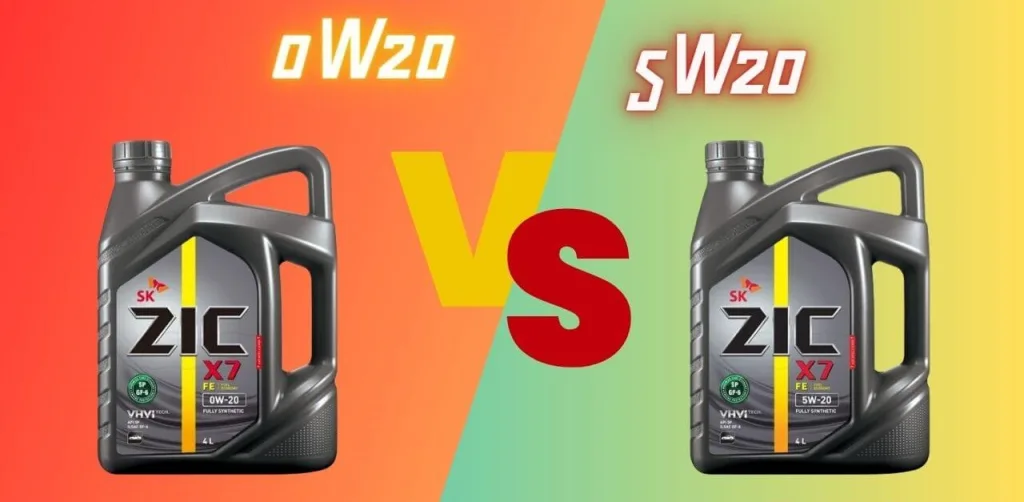
0W-20 vs. 5W-20 Motor Oil: Which One Does Your Engine Need?
The right choice is the oil listed in your owner’s manual. If your engine calls for 0W-20, use 0W-20. If it calls for 5W-20, use 5W-20 unless the manual or manufacturer allows 0W-20 as an alternative.
The simple answer is this: 0W-20 and 5W-20 behave similarly once the engine is fully warm, but 0W-20 flows better during cold starts. That makes 0W-20 the better choice for many newer engines and colder climates, while 5W-20 is still correct for many older engines designed around that grade.
Mobil 1 also gives the most practical rule: always check your owner’s manual for the manufacturer’s recommended oil viscosity grade, API service classification, and any required builder approval.
What Does 0W-20 Mean?
0W-20 is a multi-grade motor oil.
The 0W means the oil is designed to flow very well in cold temperatures. The 20 means it behaves like a 20-weight oil at normal engine operating temperature.
In plain English, 0W-20 is thin during cold starts and still provides the required 20-weight protection once the engine is hot.
That cold-start flow is the main reason many modern engines use 0W-20. Oil has to reach critical engine parts quickly after startup. In cold weather, thinner cold-flow oil can reduce startup wear and help the engine operate more efficiently.
Pennzoil explains that 0W oils are designed for modern engines and can help with fuel economy and extreme-temperature performance.
What Does 5W-20 Mean?
5W-20 is also a multi-grade motor oil.
The 5W means it flows well in cold temperatures, but not as easily as 0W-20 in extreme cold. The 20 means it has the same hot operating viscosity grade as 0W-20.
So the biggest difference is not what happens when the engine is fully warm. The biggest difference is cold-start behavior.
Both oils are 20-weight oils at operating temperature. But 0W-20 is designed to move more easily when cold.
0W-20 vs. 5W-20: The Main Difference
The main difference is cold-temperature flow.
0W-20 flows better at low temperatures than 5W-20. That means it can reach engine components faster when you start the vehicle in cold weather. This can matter in winter climates, short-trip driving, and engines designed for low-viscosity oil.
Once the engine is warm, both oils operate as a 20-weight oil. That is why people sometimes think they are interchangeable.
But “similar when hot” does not mean “always interchangeable.” Modern engines are designed around specific oil viscosity, oil pressure, variable valve timing behavior, fuel economy targets, and emissions requirements.
Can You Use 0W-20 Instead of 5W-20?
Sometimes, yes, but only if the oil meets your vehicle’s requirements.
Mobil 1 says that if a car manufacturer recommends SAE 5W-20 ILSAC oil, Mobil recommends either Mobil 1 5W-20 or Mobil 1 0W-20 Advanced Fuel Economy. Mobil also states that Mobil 1 0W-20 Advanced Fuel Economy will not void new-car warranties where SAE 5W-20 is recommended.
That does not mean every 0W-20 can replace every 5W-20 in every engine. It means some 0W-20 oils are formulated and approved for engines that call for 5W-20.
The safe rule: if the bottle and oil maker say it meets the requirement, and your manual allows it, 0W-20 may be acceptable in a 5W-20 engine.
Can You Use 5W-20 Instead of 0W-20?
Usually, you should not use 5W-20 instead of 0W-20 unless your owner’s manual allows it.
Many newer engines specify 0W-20 for a reason. The engine may be designed around faster cold-flow performance, fuel economy requirements, oil pump behavior, and tighter tolerances.
Using 5W-20 in an engine that requires 0W-20 may not instantly destroy the engine, but it may reduce cold-start performance and could affect warranty compliance if the manufacturer does not allow it.
If the oil cap says 0W-20 and the manual says 0W-20 only, use 0W-20.
Which Oil Is Better for Cold Weather?
0W-20 is better for cold weather.
That is the whole point of the lower winter rating. It flows more easily at startup when temperatures are low. If you live somewhere with freezing winters, mountain driving, cold mornings, short commutes, or long outdoor parking, 0W-20 has the advantage.
5W-20 is still a good cold-weather oil compared with heavier grades, but 0W-20 is better in very cold starts.
Which Oil Is Better for Hot Weather?
For normal engines that require a 20-weight oil, both 0W-20 and 5W-20 are similar once hot.
The second number is 20 in both oils, so both are designed to provide a 20-weight viscosity at operating temperature.
Do not assume 5W-20 is better for hot weather just because the first number is higher. The first number mainly refers to cold-start performance. If your engine needs more high-temperature viscosity, the manual would usually specify something like 5W-30, 0W-30, 5W-40, or another grade.
Which Oil Gives Better Fuel Economy?
0W-20 may offer a small fuel economy advantage, especially during cold starts.
Because 0W-20 flows more easily when cold, the engine may use slightly less energy moving oil during startup and warm-up. That is one reason automakers moved toward lower-viscosity oils in modern engines.
The difference may not be huge for every driver, but it can matter across millions of vehicles and regulatory fuel-economy testing.
Which Oil Protects Better?
The oil that protects better is the one your engine was designed to use.
Some people assume thicker oil always protects better. That is not always true. Modern engines need the correct oil flow, pressure, additive package, and specification.
A correct 0W-20 synthetic oil can protect a modern engine extremely well. A correct 5W-20 synthetic oil can also protect an engine designed for 5W-20 very well.
The real mistake is using the wrong spec, not choosing between two quality oils correctly matched to the engine.
What About API SQ and ILSAC GF-7?
For 2026, API SQ and ILSAC GF-7 are important standards to know.
These newer standards started entering the market in 2025 and are designed for modern gasoline engines. Petro-Canada Lubricants explains that API SQ is the newest API engine oil performance standard and is backward compatible with previous API service categories.
Mobil says the GF-7 category became effective on March 31, 2025, and that new ILSAC standard levels are backward compatible with previous generations.
That means a properly approved API SQ or ILSAC GF-7 oil can be a strong choice if it matches your required viscosity and manufacturer approval.
0W-20 vs. 5W-20 for Older Cars
Older cars should follow the owner’s manual.
If your older vehicle was designed for 5W-20, 5W-20 is usually the safest choice. Some oil brands may allow 0W-20 as a substitute, but you should verify the exact product and requirement.
If the engine has high mileage, oil consumption, leaks, or worn seals, do not randomly switch viscosity without understanding the issue. A high-mileage oil in the correct grade may be smarter than changing grades.
0W-20 vs. 5W-20 for Newer Cars
Newer cars often call for 0W-20.
That is especially common in modern Toyota, Honda, Mazda, Subaru, Ford, Chrysler, Hyundai, Kia, and GM engines, depending on the model and year.
If your newer vehicle requires 0W-20, use 0W-20. It is not just about cold weather. It may be tied to the engine’s design, fuel economy, emissions calibration, and warranty requirements.
0W-20 vs. 5W-20 for Trucks and SUVs
Many trucks and SUVs have used 5W-20, while newer ones may use 0W-20.
For example, some older Ford, Chrysler, Dodge, Jeep, and Ram gas engines may call for 5W-20. Some newer engines may require 0W-20 or even lower-viscosity oils.
If you tow, idle often, drive in extreme heat, or do severe-duty driving, do not guess. Check the severe service section of the manual. Some manufacturers allow different oils under certain conditions, while others do not.
The right answer depends on the exact engine, not the vehicle size.
Is Synthetic Better for 0W-20 and 5W-20?
Yes, full synthetic is usually the smarter choice for both 0W-20 and 5W-20.
Low-viscosity oils are often used in modern engines with tighter tolerances, turbocharging, direct injection, stop-start systems, and advanced emissions controls. Synthetic oil generally handles heat, oxidation, cold starts, and deposit control better than conventional oil.
If your engine calls for 0W-20, it is very likely that synthetic oil is the correct choice. If your engine calls for 5W-20, synthetic is still a strong upgrade when it meets the required specification.
What If You Accidentally Used the Wrong One?
If you accidentally used 0W-20 in a 5W-20 engine, it may be fine if the oil meets the required specification. Some oil brands explicitly allow that substitution for certain 5W-20 applications.
If you accidentally used 5W-20 in a 0W-20 engine, check the manual. If the manual does not allow 5W-20, replace it with the correct 0W-20 at the next reasonable opportunity, especially if the vehicle is under warranty or you drive in cold weather.
If the engine sounds abnormal, oil pressure warning appears, or the vehicle is under warranty, do not wait. Correct it.
How Often Should You Change 0W-20 or 5W-20 Oil?
Follow the owner’s manual or oil-life monitor.
Many modern vehicles using synthetic oil fall somewhere around 5,000 to 10,000 miles, but the correct interval depends on the engine, oil spec, driving conditions, climate, and warranty requirements.
Shorten the interval if you do frequent short trips, towing, stop-and-go driving, long idling, dusty roads, extreme heat, or extreme cold.
A good oil changed too late is worse than a slightly cheaper approved oil changed on time.
Best Rule for Choosing Between 0W-20 and 5W-20
Use this simple rule:
If the oil cap or owner’s manual says 0W-20, use 0W-20.
If it says 5W-20, use 5W-20 unless the manual or oil manufacturer clearly allows 0W-20.
If both are allowed, use 0W-20 for colder weather and better cold-start flow, and use whichever approved option best matches your driving conditions, budget, and warranty requirements.
If your vehicle is still under warranty, do not experiment. Use the exact recommended oil grade and specification.
FAQs About 0W-20 vs. 5W-20
Is 0W-20 better than 5W-20?
0W-20 is better for cold starts because it flows more easily in low temperatures. Once the engine is warm, both oils operate as 20-weight oils. The better oil is the one your engine requires.
Can I use 0W-20 instead of 5W-20?
Sometimes. Some oil manufacturers allow 0W-20 as a replacement for certain 5W-20 applications if the oil meets the required ILSAC and API specs. Always check your owner’s manual first.
Can I use 5W-20 instead of 0W-20?
Usually not unless your owner’s manual allows it. If your engine requires 0W-20, use 0W-20.
Is 0W-20 good for hot weather?
Yes, if your engine requires 0W-20. The “20” rating means it is designed to provide 20-weight viscosity at operating temperature.
Is 5W-20 better for older engines?
Not automatically. Older engines should use the oil grade listed in the owner’s manual. If the engine has leaks or oil consumption, consider a high-mileage oil in the correct viscosity.
Do 0W-20 and 5W-20 protect the same when hot?
They are both 20-weight oils at operating temperature, but protection also depends on the oil’s additive package, API/ILSAC rating, and manufacturer approvals.
What happens if I mix 0W-20 and 5W-20?
Mixing small amounts in an emergency is usually not a disaster if both oils meet the required specification, but it is better to use one correct oil consistently.
Final Thoughts: Use the Oil Your Engine Was Built For
0W-20 and 5W-20 are close, but they are not always interchangeable.
0W-20 flows better in cold weather and is common in newer engines. 5W-20 is still correct for many engines designed around it. Once hot, both behave as 20-weight oils, but the owner’s manual still decides what your engine needs.
The safest answer is simple: use the viscosity and specification your manufacturer recommends, choose a quality synthetic oil, and change it on time.