



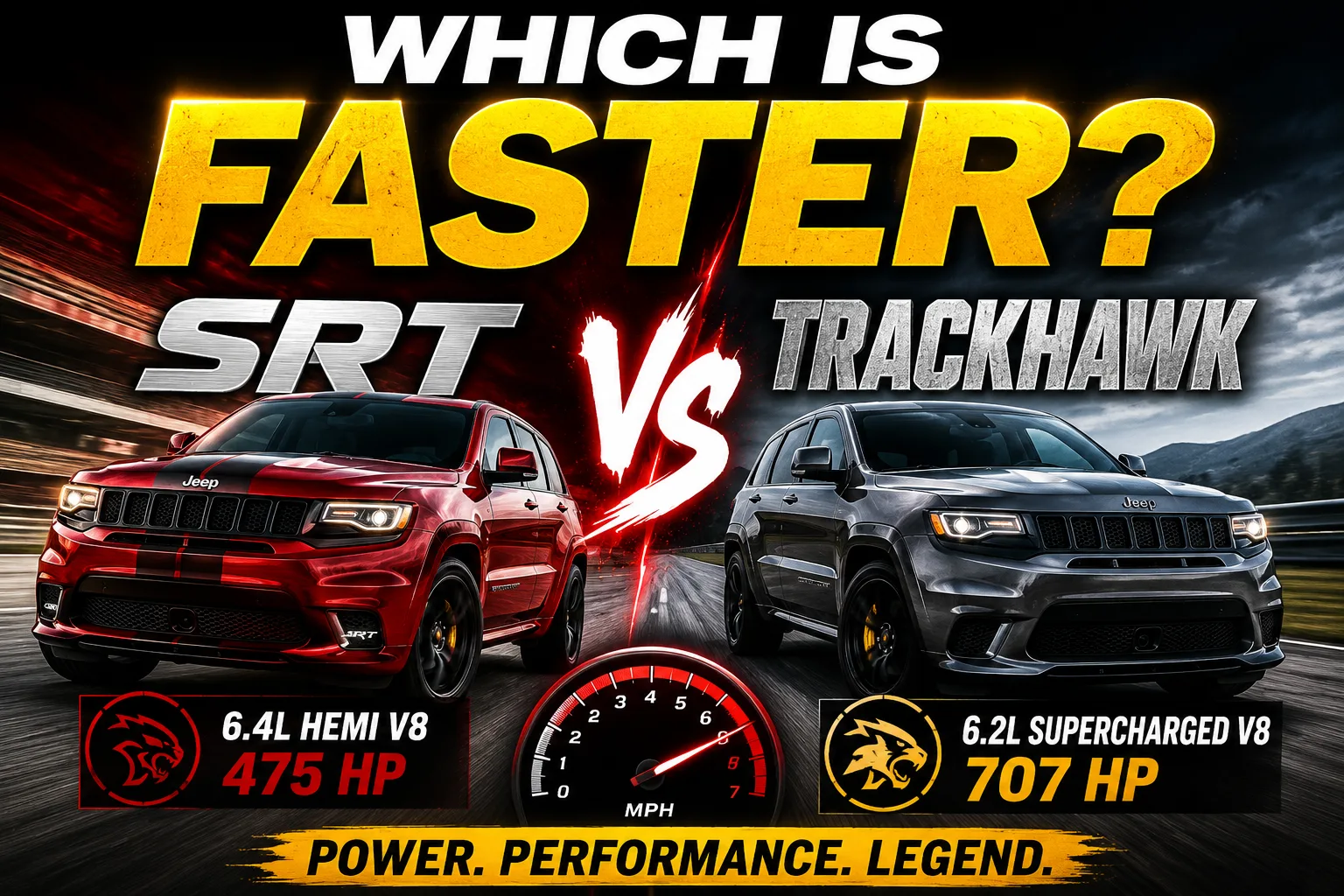
The Jeep Grand Cherokee SRT and Jeep Grand Cherokee Trackhawk look similar at a glance, but they are not close when the road opens up. One is a naturally aspirated V8 performance SUV. The other is a supercharged Hellcat-powered monster built to embarrass sports cars.
The question is simple: which is faster, the Jeep Grand Cherokee SRT or the Jeep Grand Cherokee Trackhawk? The answer is also simple. The Trackhawk is faster in nearly every measurable performance category, including horsepower, torque, 0 to 60 mph acceleration, quarter-mile time, and top speed.
But that does not mean the Grand Cherokee SRT is weak. Far from it. The SRT is still one of the most exciting naturally aspirated SUVs Jeep ever built, with a 6.4-liter HEMI V8, aggressive throttle response, a performance-tuned all-wheel-drive system, and the kind of sound that makes every on-ramp feel like a private drag strip.
Quick Answer: The Jeep Grand Cherokee Trackhawk is faster than the Grand Cherokee SRT. The SRT uses a 6.4-liter HEMI V8 with 475 horsepower and 470 lb-ft of torque, while the Trackhawk uses a supercharged 6.2-liter V8 with 707 horsepower and 645 lb-ft of torque. In testing, the Trackhawk can reach 60 mph in the mid-3-second range, while the SRT is typically closer to the mid-4-second range.
SRT vs Trackhawk: The Basic Difference
The Jeep Grand Cherokee SRT and Trackhawk both came from the WK2-generation Grand Cherokee lineup, but they were built with different performance missions. The SRT was the high-performance V8 version for drivers who wanted a fast, powerful, naturally aspirated SUV. The Trackhawk was the extreme version, using the same general Hellcat engine family that made Dodge muscle cars famous.
The SRT feels muscular, loud, and immediate. The Trackhawk feels violent. That is the easiest way to understand the difference. The SRT is fast for an SUV. The Trackhawk is fast, period.
| Category | Jeep Grand Cherokee SRT | Jeep Grand Cherokee Trackhawk |
|---|---|---|
| Engine | 6.4-liter HEMI V8 | Supercharged 6.2-liter V8 |
| Horsepower | 475 hp | 707 hp |
| Torque | 470 lb-ft | 645 lb-ft |
| Transmission | 8-speed automatic | 8-speed automatic |
| Drivetrain | Performance AWD | Performance AWD |
| Personality | Big naturally aspirated muscle SUV | Hellcat-powered super SUV |
Which Has More Horsepower?
The Trackhawk wins by a massive margin. The Grand Cherokee SRT makes 475 horsepower from its 6.4-liter HEMI V8. That is already serious output for a family-sized SUV. The Trackhawk, however, jumps to 707 horsepower from a supercharged 6.2-liter V8.
That 232-horsepower difference completely changes the character of the vehicle. In the SRT, power builds with the naturally aspirated V8’s revs. In the Trackhawk, power arrives with a hard supercharged shove that feels almost excessive for an SUV body.
| Power Metric | Grand Cherokee SRT | Grand Cherokee Trackhawk | Winner |
|---|---|---|---|
| Horsepower | 475 hp | 707 hp | Trackhawk |
| Torque | 470 lb-ft | 645 lb-ft | Trackhawk |
| Forced induction | No | Yes, supercharged | Trackhawk |
MotorTrend lists the Grand Cherokee SRT at 475 horsepower and 470 lb-ft of torque, while the Trackhawk uses a supercharged 6.2-liter V8 with 707 horsepower and 645 lb-ft of torque. MotorTrend also recorded a 3.3-second 0 to 60 mph time for the Trackhawk in testing. Source: MotorTrend
Which Is Faster From 0 to 60 MPH?
The Trackhawk is dramatically faster from 0 to 60 mph. The difference is not just horsepower. It is traction, torque, launch control, gearing, and the way the supercharged engine floods the drivetrain with power.
The Grand Cherokee SRT is quick enough to feel aggressive in daily driving. It can surprise people because it does not look like a lightweight performance car. Still, once the Trackhawk launches, the SRT cannot keep up.
| Performance Test | Grand Cherokee SRT | Grand Cherokee Trackhawk |
|---|---|---|
| 0 to 60 mph | Typically mid-4-second range | Approximately 3.3 to 3.5 seconds in major tests |
| Quarter mile | Typically low-to-mid 13-second range | Factory claim around 11.6 seconds |
| Top speed | Lower than Trackhawk | Up to 180 mph factory claimed |
Car and Driver reported a 3.5-second 0 to 60 mph test result for the Grand Cherokee Trackhawk, while Automobile Catalog lists factory-claimed Trackhawk performance at 0 to 60 mph in 3.5 seconds, a quarter mile in 11.6 seconds, and a top speed of 180 mph. Source: Car and Driver | Source: Automobile Catalog
Why the Trackhawk Is So Much Faster
The Trackhawk is faster because it was engineered around extreme power. Its 6.2-liter supercharged V8 delivers huge torque, and because the Grand Cherokee platform uses all-wheel drive, that power can be put down more effectively than it could in many rear-wheel-drive vehicles.
In simple terms, the SRT has a big engine. The Trackhawk has a bigger performance system. The engine, transmission calibration, all-wheel-drive tuning, cooling, brakes, suspension setup, launch control, and tires are all working together to manage Hellcat-level output.
Key reasons the Trackhawk wins
| Advantage | Why It Matters |
|---|---|
| Supercharger | Forces more air into the engine, helping create far more horsepower and torque. |
| 645 lb-ft of torque | Gives the Trackhawk a harder launch and stronger acceleration at speed. |
| Performance AWD | Helps the SUV put huge power to the ground instead of wasting it in wheelspin. |
| Launch control | Helps deliver repeatable, aggressive standing-start acceleration. |
| Upgraded cooling and braking | Supports repeated high-performance driving better than a standard SUV setup. |
Does the SRT Still Feel Fast?
Yes. The Grand Cherokee SRT still feels genuinely fast. A 475-horsepower SUV is not slow by any normal standard. The naturally aspirated 6.4-liter HEMI gives it instant throttle response, a deep exhaust note, and a more mechanical muscle-car feel than the Trackhawk.
Some drivers may actually prefer the SRT because it feels simpler and more traditional. There is no supercharger whine, no 707-horsepower shock factor, and no sense that the vehicle is constantly trying to overpower the road. The SRT is still dramatic, but it is more usable and less outrageous.
Best way to think about it: The Grand Cherokee SRT is the more balanced performance SUV. The Trackhawk is the one you buy when you want the fastest, wildest version possible.
Which One Sounds Better?
This is more subjective. The SRT’s 6.4-liter HEMI has a deep, old-school V8 sound. It is raw, heavy, and muscular. Because it is naturally aspirated, the engine note feels direct and traditional.
The Trackhawk adds a different layer. You still get V8 sound, but you also get supercharger whine. For some drivers, that makes the Trackhawk more exciting. For others, the SRT’s simpler HEMI soundtrack is cleaner and more satisfying.
If you want classic American V8 drama, the SRT is excellent. If you want a supercharged soundtrack that makes the SUV feel like a Hellcat in hiking boots, the Trackhawk wins.
Which One Is Better for Daily Driving?
The SRT may be the better daily driver for many people. It is still powerful, still aggressive, and still fun, but it does not carry the same fuel thirst, tire wear, brake demands, and overall intensity as the Trackhawk.
The Trackhawk is usable every day, but it is also extreme. Fuel economy is poor, maintenance can be more expensive, and insurance costs may be higher. It is a vehicle that rewards restraint, because the power is always there.
| Daily Driving Category | Better Choice | Why |
|---|---|---|
| Fuel economy | SRT | Still thirsty, but less extreme than the Trackhawk. |
| Maintenance cost | SRT | Less complex than the supercharged Trackhawk. |
| Power and acceleration | Trackhawk | Far more horsepower and torque. |
| Sound | Tie | SRT has classic HEMI tone; Trackhawk adds supercharger whine. |
| Collectibility | Trackhawk | More extreme, rarer, and tied to the Hellcat era. |
Which One Is Better for Towing and Utility?
Both vehicles are still Grand Cherokees, which means they retain SUV practicality. They have real passenger space, cargo room, all-weather capability, and towing usefulness. However, most shoppers looking at an SRT or Trackhawk are not buying them only for towing. They are buying performance first.
The SRT may make more sense if you want a strong V8 SUV that can handle family duty, weekend trips, and occasional towing without the full cost and intensity of the Trackhawk. The Trackhawk is more about maximum performance with SUV practicality attached.
Which One Holds Value Better?
The Trackhawk has stronger collector appeal because it represents one of the most extreme factory SUVs ever sold by Jeep. The Hellcat-powered Jeep era created a vehicle that feels unlikely to be repeated in the same way, especially as brands continue moving toward electrification, hybrids, and smaller-displacement engines.
The SRT also has value because naturally aspirated V8 SUVs are becoming less common. However, the Trackhawk’s 707-horsepower identity gives it a more obvious enthusiast hook.
Condition, mileage, accident history, service records, ownership history, tires, brakes, and modifications matter heavily for both vehicles. A clean, stock, well-maintained SRT may be a smarter buy than a neglected Trackhawk.
Looking for a performance SUV near Los Angeles?
Browse used Jeep, Dodge, Chrysler, and Ram inventory at Simi Valley Chrysler Dodge Jeep Ram. Availability changes often, especially for performance models.
Should You Buy the SRT or the Trackhawk?
Buy the Grand Cherokee SRT if you want a loud, fast, naturally aspirated V8 SUV that feels muscular without being completely outrageous. It gives you serious performance, all-wheel-drive grip, and daily usability in a package that is easier to live with than the Trackhawk.
Buy the Grand Cherokee Trackhawk if you want the fastest version, the most horsepower, the strongest acceleration, and the biggest bragging rights. It is not subtle. It is not efficient. It is not rational in the traditional family SUV sense. That is exactly why people love it.
| You Should Choose | If You Want |
|---|---|
| Grand Cherokee SRT | A powerful naturally aspirated V8 SUV with strong performance and better everyday balance. |
| Grand Cherokee Trackhawk | The fastest, most extreme, Hellcat-powered Grand Cherokee with supercar-like acceleration. |
Final Verdict: Which Is Faster?
The Jeep Grand Cherokee Trackhawk is faster than the Grand Cherokee SRT. It has more horsepower, more torque, quicker acceleration, a faster quarter-mile time, and a higher top-speed ceiling. The SRT is still a serious performance SUV, but the Trackhawk belongs in another category.
The SRT is the one for drivers who want traditional HEMI power and a more balanced performance SUV. The Trackhawk is the one for drivers who want the answer to be obvious before the race even starts.
Bottom line: SRT is fast. Trackhawk is faster. If the question is pure speed, the Trackhawk wins decisively.
SRT vs Trackhawk FAQs
Is the Trackhawk faster than the SRT?
Yes. The Trackhawk is faster than the Grand Cherokee SRT because it has a supercharged 6.2-liter V8 with 707 horsepower and 645 lb-ft of torque. The SRT has a naturally aspirated 6.4-liter V8 with 475 horsepower and 470 lb-ft of torque.
How fast is the Jeep Grand Cherokee Trackhawk from 0 to 60?
The Trackhawk is commonly tested in the mid-3-second range from 0 to 60 mph. Car and Driver reported 3.5 seconds, while MotorTrend recorded 3.3 seconds in testing.
How much horsepower does the Grand Cherokee SRT have?
The Jeep Grand Cherokee SRT has a 6.4-liter HEMI V8 rated at 475 horsepower and 470 lb-ft of torque.
How much horsepower does the Trackhawk have?
The Jeep Grand Cherokee Trackhawk has a supercharged 6.2-liter V8 rated at 707 horsepower and 645 lb-ft of torque.
Is the SRT better than the Trackhawk for daily driving?
For many drivers, yes. The SRT is still powerful and exciting, but it is less extreme than the Trackhawk. The Trackhawk is faster, but it can also cost more to fuel, maintain, insure, and own.
Is the Trackhawk collectible?
The Trackhawk has strong enthusiast appeal because it combines Jeep SUV practicality with a Hellcat-derived supercharged V8. Clean, low-mileage, unmodified examples are especially desirable among performance SUV shoppers.
Shop Jeep and performance SUV inventory
Visit Simi Valley Chrysler Dodge Jeep Ram for used SUVs, Jeep models, Ram trucks, trade-in support, and financing options near Simi Valley, Van Nuys, Thousand Oaks, and Los Angeles.
Sources: Performance figures were cross-checked using MotorTrend, Car and Driver, and Automobile Catalog data for the Jeep Grand Cherokee SRT and Trackhawk. Always verify exact specifications by model year, trim, condition, and vehicle history before purchase.
Which Is Faster, SRT or Trackhawk?
The Jeep Grand Cherokee Trackhawk is faster than the Jeep Grand Cherokee SRT.
The simple answer is this: the SRT is fast, but the Trackhawk is on another level. The Grand Cherokee SRT uses a naturally aspirated 6.4L HEMI V8 with about 475 horsepower, while the Trackhawk uses a supercharged 6.2L V8 with 707 horsepower.
Car and Driver lists the Grand Cherokee SRT at 475 horsepower and 470 lb-ft of torque, while the Trackhawk’s supercharged V8 is rated at 707 horsepower. MotorTrend tested the Trackhawk at 0 to 60 mph in 3.3 seconds and the quarter-mile in 11.7 seconds at 116.2 mph.
Quick Answer: Trackhawk Wins
The Trackhawk is faster in almost every performance category.
It has more horsepower.
It has more torque.
It has a supercharged engine.
It accelerates harder.
It has better straight-line speed.
It was built to be the most extreme performance version of the Grand Cherokee.
The SRT is still quick, but the Trackhawk is the monster.
Jeep Grand Cherokee SRT Performance
The Grand Cherokee SRT is powered by a 6.4L HEMI V8.
It makes around 475 horsepower and 470 lb-ft of torque, which is serious power for an SUV. Car and Driver tested the Grand Cherokee SRT at 0 to 60 mph in 4.4 seconds, which is still extremely quick for a family-sized SUV.
The SRT feels muscular, loud, and responsive. It gives you the HEMI sound, strong acceleration, all-wheel-drive grip, and a more usable performance SUV setup than many people expect.
For most drivers, the SRT is already more than fast enough.
Jeep Grand Cherokee Trackhawk Performance
The Trackhawk takes the SRT formula and turns it into something wild.
Instead of the 6.4L naturally aspirated HEMI, it uses a supercharged 6.2L V8. Jeep’s Grand Cherokee Trackhawk performance page lists the Trackhawk at 707 horsepower, 645 lb-ft of torque, and 0 to 60 mph in 3.5 seconds.
That makes it one of the fastest SUVs of its era.
The Trackhawk is not just slightly quicker than the SRT. It is dramatically faster, especially from a launch.
Why the Trackhawk Is Faster
The Trackhawk is faster because of one major difference: the supercharger.
A naturally aspirated engine depends on atmospheric pressure to pull air into the engine. A supercharged engine forces more air into the engine, allowing it to burn more fuel and make much more power.
That is why the Trackhawk jumps from the SRT’s 475 horsepower to 707 horsepower.
The all-wheel-drive system also helps. With that much power, traction matters. The Trackhawk can launch hard because it sends power to all four wheels instead of just spinning tires.
SRT vs Trackhawk 0 to 60
The SRT usually runs 0 to 60 mph in about 4.4 seconds.
The Trackhawk can run 0 to 60 mph in about 3.3 to 3.5 seconds, depending on test conditions.
That is a huge difference. In performance terms, a full second from 0 to 60 is massive.
The SRT feels fast. The Trackhawk feels violent.
SRT vs Trackhawk Quarter-Mile
The quarter-mile gap is even clearer.
Car and Driver tested the Grand Cherokee SRT at 13.0 seconds in the quarter-mile, while MotorTrend tested the Trackhawk at 11.7 seconds.
That means the Trackhawk is not only quicker off the line, but it keeps pulling harder as speed builds.
Is the SRT Still Worth It?
Yes, the SRT is still worth it if you want a fast Jeep without Trackhawk-level cost.
The SRT gives you a big naturally aspirated HEMI V8, strong acceleration, performance brakes, aggressive styling, and a more affordable used-market price than the Trackhawk.
It is also less extreme. That can be a good thing if you want a performance SUV that is easier to live with, less expensive to insure, and less costly to maintain.
The SRT is the smarter performance Jeep for many buyers. The Trackhawk is the faster one.
Is the Trackhawk Worth the Extra Money?
The Trackhawk is worth it if you want the fastest, most collectible version of the Grand Cherokee performance SUV.
It is rarer, more powerful, and more memorable. It has the Hellcat-style supercharged V8, and that makes it special.
But it also costs more to buy and own. Tires, brakes, fuel, insurance, maintenance, and repairs can all be expensive. A used Trackhawk should be inspected carefully, especially if it has been modified or tuned.
Which One Should You Buy?
Buy the SRT if you want a fast V8 Jeep with lower cost and simpler ownership.
Buy the Trackhawk if you want the fastest Grand Cherokee, the supercharged V8, and the most extreme factory performance Jeep.
For local shoppers, compare available used Jeep inventory by trim, mileage, service history, accident history, and modification status. If you want newer Jeep options, review current new Jeep inventory.
FAQs About SRT vs Trackhawk
Is the Trackhawk faster than the SRT?
Yes. The Trackhawk is much faster than the Grand Cherokee SRT because it has a 707-horsepower supercharged V8.
How much horsepower does the Jeep SRT have?
The Grand Cherokee SRT has about 475 horsepower and 470 lb-ft of torque from a 6.4L HEMI V8.
How much horsepower does the Trackhawk have?
The Grand Cherokee Trackhawk has 707 horsepower and 645 lb-ft of torque from a supercharged 6.2L V8.
What is faster, SRT or Trackhawk 0 to 60?
The Trackhawk is faster. The SRT is around 4.4 seconds, while the Trackhawk can run around 3.3 to 3.5 seconds.
Is the Trackhawk a Hellcat Jeep?
Yes, people often call the Trackhawk the Hellcat Jeep because it uses a supercharged 6.2L V8 from the Hellcat engine family.
Final Thoughts: SRT Is Fast, Trackhawk Is the Beast
The Jeep Grand Cherokee SRT is fast. The Trackhawk is faster.
The SRT gives you 6.4L HEMI power and strong SUV performance. The Trackhawk adds a supercharger, 707 horsepower, and acceleration that still feels ridiculous today.
So if the question is which one is faster, the answer is clear: Trackhawk wins.
Connect with us


