





What Can a 2017 Jeep Grand Cherokee Tow?
A 2017 Jeep Grand Cherokee can tow up to 7,400 pounds when properly equipped, but the exact number depends on the engine, drivetrain, and factory towing equipment.
The simple answer is this: the 3.6L V6 can tow up to 6,200 pounds, while the 5.7L HEMI V8 and 3.0L EcoDiesel can tow up to 7,200 pounds with 4WD or up to 7,400 pounds with 2WD. Edmunds notes that the EcoDiesel and HEMI V8 4×4 models are rated at 7,200 pounds, two-wheel-drive models can tow 7,400 pounds, and gasoline V6 models can tow 6,200 pounds. Edmunds
2017 Jeep Grand Cherokee Towing Capacity by Engine
The 2017 Grand Cherokee had several engine choices, and towing capacity changes by engine.
3.6L Pentastar V6: up to 6,200 pounds
5.7L HEMI V8: up to 7,200 pounds 4WD or 7,400 pounds 2WD
3.0L EcoDiesel V6: up to 7,200 pounds 4WD or 7,400 pounds 2WD
6.4L SRT V8: commonly rated around 7,200 pounds
The official FCA Canada specification sheet for the 2017 Grand Cherokee lists towing by engine and axle ratio, confirming the V6 and V8/EcoDiesel tow-rating split. FCA 2017 Grand Cherokee specifications
What Can the 3.6L V6 Grand Cherokee Tow?
The 3.6L V6 Grand Cherokee can tow up to 6,200 pounds when properly equipped.
That is enough for many midsize trailers, small campers, utility trailers, motorcycles, ATVs, small boats, and lightweight travel trailers. The V6 is the most common engine in the 2017 Grand Cherokee, so this is the number many used shoppers should pay attention to.
Do not assume every V6 Grand Cherokee is ready for 6,200 pounds. You still need the correct hitch, wiring, cooling setup, trailer brakes, payload capacity, and properly loaded trailer.
What Can the 5.7L HEMI Grand Cherokee Tow?
The 5.7L HEMI V8 is the stronger towing choice.
A properly equipped 2017 Grand Cherokee with the HEMI V8 can tow up to 7,200 pounds in 4WD form and up to 7,400 pounds in 2WD form, depending on configuration.
The HEMI gives you more torque, easier acceleration with a trailer, and better confidence when towing heavier loads. If you regularly tow near the upper end of the Grand Cherokee’s rating, the V8 is usually the smarter choice than the V6.
What Can the EcoDiesel Grand Cherokee Tow?
The 3.0L EcoDiesel V6 is also a strong towing engine.
Like the HEMI, properly equipped EcoDiesel models can tow up to 7,200 pounds with 4WD or 7,400 pounds with 2WD. The diesel’s biggest advantage is torque and highway efficiency under load.
The tradeoff is complexity. Used EcoDiesel buyers should inspect emissions-system history, service records, fuel-system condition, recall completion, oil-change history, and repair records carefully.
What Can the Grand Cherokee SRT Tow?
The 2017 Grand Cherokee SRT with the 6.4L V8 is commonly rated around 7,200 pounds.
It has plenty of power, but it is not the most practical towing-focused Grand Cherokee because it is performance-oriented. Tires, brakes, suspension setup, fuel cost, and vehicle condition matter a lot.
If towing is the main priority, the HEMI V8 or EcoDiesel Grand Cherokee is usually the cleaner choice. If you want performance first and occasional towing second, the SRT can still be capable.
Does Every 2017 Grand Cherokee Tow the Same?
No. Trim alone does not decide towing capacity.
A Laredo, Limited, Trailhawk, Overland, Summit, or SRT can have different tow ratings depending on engine, drivetrain, equipment, and factory towing package.
For example, Edmunds lists a 2017 Grand Cherokee Summit with the 3.6L V6 at up to 6,200 pounds of towing capacity. Edmunds Summit specs
That is why you should check the specific vehicle, not just the model name.
What Equipment Do You Need to Tow Safely?
To use the full towing capacity, the Grand Cherokee needs the correct towing equipment.
That can include:
Factory trailer tow package.
Class IV receiver hitch.
Trailer wiring.
Transmission cooling.
Engine cooling.
Trailer brake controller for heavier trailers.
Proper ball mount and hitch rating.
Correct tire pressure.
Trailer brakes when required.
Weight-distribution equipment when appropriate.
The tow rating is not just about engine power. It is about the whole setup.
Payload Matters Too
Payload is where many people make mistakes.
Payload includes passengers, cargo, hitch weight, tools, luggage, pets, accessories, and anything else added to the vehicle. Trailer tongue weight also counts against payload.
A trailer may be under the tow rating but still overload the Grand Cherokee if the tongue weight is too high or the cabin is full of passengers and gear.
Check the driver-side door sticker for the exact payload rating of your specific vehicle.
What Trailer Size Makes Sense?
For a V6 Grand Cherokee, staying well below the 6,200-pound maximum is usually smarter for comfort and safety.
For regular towing, a loaded trailer in the 3,500 to 5,000-pound range is a more comfortable zone for many V6 models.
For HEMI or EcoDiesel models, towing in the 5,000 to 6,500-pound range can be more comfortable, assuming the vehicle is properly equipped and the trailer is loaded correctly.
Max tow ratings are best treated as limits, not targets.
Can a 2017 Grand Cherokee Tow a Camper?
Yes, a 2017 Jeep Grand Cherokee can tow many campers.
A V6 model can handle lightweight travel trailers, pop-up campers, and smaller campers if properly equipped. A HEMI or EcoDiesel model can handle heavier campers, but you still need to check loaded trailer weight, tongue weight, payload, and brake requirements.
Do not use dry trailer weight alone. Campers get heavier when loaded with propane, water, batteries, food, gear, and accessories.
Can It Tow a Boat?
Yes. The 2017 Grand Cherokee can tow many small and midsize boats.
A V6 model can handle many fishing boats, personal watercraft trailers, and smaller bowriders. HEMI and EcoDiesel models are better for heavier boats.
Remember to include trailer weight, fuel, gear, and equipment when calculating total towing weight.
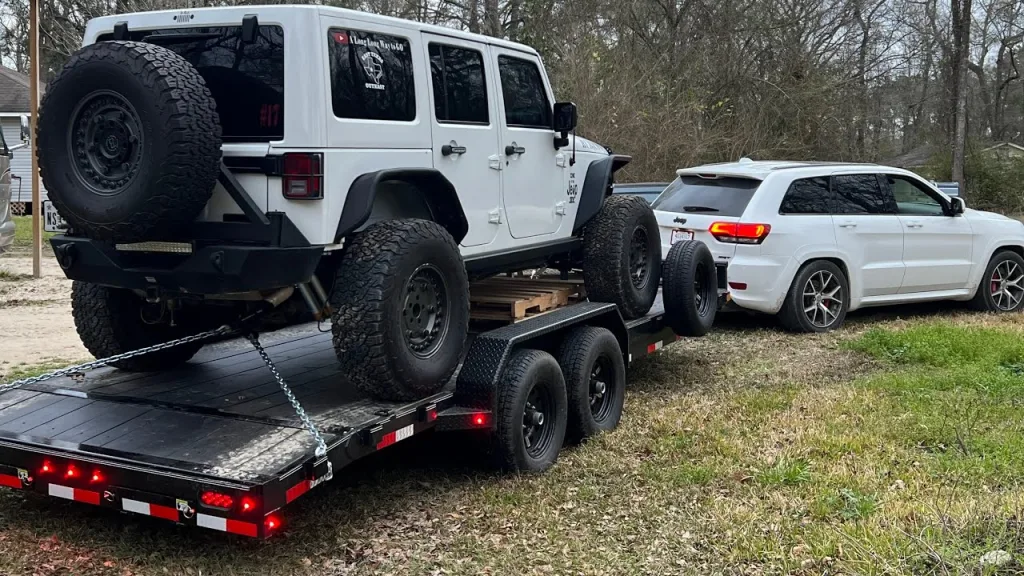
Can It Tow a Car Trailer?
Sometimes, but be careful.
A full car trailer plus a vehicle can quickly exceed the Grand Cherokee’s practical limits. A small lightweight trailer with a small car may fit within the rating, but many car-hauler setups are too heavy once loaded.
If you are towing vehicles regularly, a Ram 1500 or Ram 2500 is usually a better tool.
Final Answer
A 2017 Jeep Grand Cherokee can tow between 6,200 and 7,400 pounds, depending on engine and drivetrain.
The 3.6L V6 can tow up to 6,200 pounds.
The 5.7L HEMI V8 and 3.0L EcoDiesel can tow up to 7,200 pounds with 4WD or 7,400 pounds with 2WD when properly equipped.
The SRT is commonly rated around 7,200 pounds.
For the safest answer, check the VIN, factory tow package, door sticker, hitch rating, payload, and owner’s manual before towing.
Connect with us


