




What Does a Jeep Wagoneer Cost?
What Does a Jeep Wagoneer Cost?
The Jeep Wagoneer is one of the largest and most premium SUVs in the Jeep lineup. It is built for drivers who want three-row space, strong towing ability, upscale comfort, and serious road-trip capability. Because of that, it costs more than a typical midsize SUV or basic family crossover.
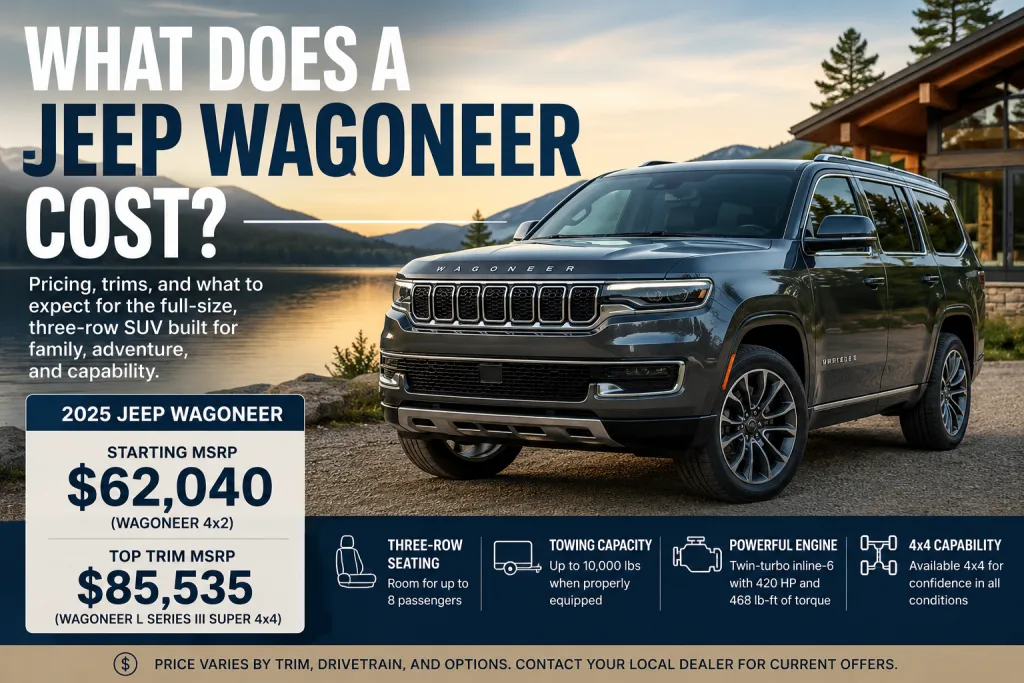
For 2025, the Jeep Wagoneer started at about $62,040, while higher trims moved into the $70,000 and $80,000 range depending on equipment. Car and Driver lists the 2025 Wagoneer range from $62,040 to $82,535, before extra options, taxes, fees, and dealer charges. That makes the Wagoneer a premium full-size SUV, but still below the ultra-luxury pricing of some full-size competitors.
Jeep Wagoneer Starting Price
The 2025 Jeep Wagoneer started around $62,040 for the base model. That price gave buyers a large three-row SUV with a powerful twin-turbo inline-six engine, a spacious cabin, and the capability expected from a large Jeep SUV.
Four-wheel-drive versions cost more than two-wheel-drive models. That matters because many Wagoneer shoppers want 4×4 capability for bad weather, towing, road trips, dirt roads, or family travel. If you live somewhere with snow, rain, hills, or rougher roads, the extra cost of 4×4 may be worth it.
How Much Do Higher Wagoneer Trims Cost?
The Wagoneer gets more expensive as you move into better-equipped trims. Series II, Carbide, Overland, Series III, and long-wheelbase Wagoneer L models can push the price well above the base model.
Most shoppers should expect a well-equipped Wagoneer to land somewhere in the $70,000 range, while upper versions can move into the low-to-mid $80,000 range. Edmunds shows current market pricing can vary by trim, location, and available inventory, so the final number depends on the specific SUV you choose.
This is why it is important to compare the exact vehicle, not just the model name. A base Wagoneer and a fully loaded Wagoneer can feel very different in features, comfort, and final price.
Wagoneer vs. Wagoneer L Cost
The Wagoneer L is the longer version of the Wagoneer. It costs more because it gives you more overall length and more cargo room, especially behind the third row.
That extra space is useful for families who travel with passengers and luggage at the same time. A regular three-row SUV may have enough seats, but cargo room can get tight when every seat is being used. The Wagoneer L helps solve that problem with more room for bags, sports gear, strollers, coolers, and road-trip equipment.
If you mostly drive around town and rarely pack the vehicle full, the standard Wagoneer may be enough. If you take long trips, carry a full family, or need space behind the third row, the Wagoneer L may justify the extra cost.
How Much Is a Used Jeep Wagoneer?
A used Jeep Wagoneer can cost much less than a new one. Pricing depends on model year, mileage, trim, condition, accident history, service records, and local demand.
Because the Wagoneer has a high original MSRP, used models can be attractive for shoppers who want a large premium SUV without paying full new-vehicle pricing. A used Series II or Series III may give you more features for the money compared with buying a new base model.
Before buying used, check the mileage, vehicle history, tire condition, brake condition, warranty status, and service records. A used Wagoneer with clean history and good maintenance can be a strong value. A cheaper one with accident history or neglected maintenance may cost more later.
What Affects the Cost of a Jeep Wagoneer?
The price of a Wagoneer is affected by trim, drivetrain, body length, features, mileage, and condition. New models are priced mainly by equipment and options, while used models depend more heavily on mileage, history, and market demand.
A Wagoneer with 4×4, premium interior features, larger wheels, advanced safety technology, towing equipment, and upgraded audio will cost more than a basic model. A Wagoneer L will usually cost more than a standard-length Wagoneer because of the added space.
For used Wagoneers, mileage and condition matter heavily. A low-mileage, well-kept SUV with clean history will usually cost more than a higher-mileage model with damage, worn tires, or incomplete service records.
Engine and Performance
The 2025 Jeep Wagoneer uses a twin-turbocharged inline-six engine. Edmunds lists the 2025 Wagoneer at 420 horsepower and 468 lb-ft of torque, giving it the strength needed for a full-size SUV.
That power matters because the Wagoneer is a large vehicle. It needs enough engine strength to move confidently with passengers, cargo, and a trailer. The engine also helps the Wagoneer feel smoother on highways, hills, and long-distance drives.
This is one reason the Wagoneer costs more than smaller SUVs. You are paying for size, power, towing ability, and a more premium driving experience.
Towing Capacity
Towing ability is one of the biggest reasons buyers consider the Wagoneer. When properly equipped, the 2025 Wagoneer can tow up to 10,000 pounds. Edmunds lists that maximum towing figure, which puts the Wagoneer among the stronger full-size SUVs in its class.
That kind of capability makes it useful for campers, boats, utility trailers, small equipment, and family adventure gear. If you only need a vehicle for commuting, that towing capacity may not matter much. But if you tow regularly, it can help justify the price.
Interior Space and Family Use
The Wagoneer is expensive because it is designed to carry people and cargo comfortably. It offers three rows of seating, a wide cabin, and a more upscale interior than many mainstream SUVs.
For families, the value is in the space. The Wagoneer gives passengers more room than many smaller three-row SUVs. It also works well for road trips because it has the size and comfort needed for long drives.
The regular Wagoneer is already large, but the Wagoneer L is better if cargo space is a major priority. Families who travel with luggage, sports equipment, or pets may find the longer version more practical.
Is the Wagoneer Still Available New?
The standard Jeep Wagoneer changed after the 2025 model year. For 2026, Jeep moved the focus to the Grand Wagoneer name. The official Jeep Grand Wagoneer page now presents the 2026 Grand Wagoneer as the brand’s full-size premium SUV, with MSRP starting at just under $67,000.
That means shoppers looking for a Wagoneer may be looking at remaining 2025 inventory, used Wagoneer models, or the newer Grand Wagoneer lineup. Availability will depend on dealer inventory and local market conditions.
Jeep Wagoneer vs. Grand Wagoneer Cost
The Grand Wagoneer has traditionally been the more luxurious version of the Wagoneer family. It usually costs more because it adds more premium materials, more technology, more comfort features, and a higher-end interior feel.
For 2026, Jeep adjusted the lineup and pricing. The new Grand Wagoneer starts closer to where the older Wagoneer sat, which may make it more appealing to shoppers who want a premium full-size Jeep SUV without moving too far into luxury-brand pricing.
If you are comparing both, focus on equipment, not just the name. A used Wagoneer Series III may offer excellent value, while a new Grand Wagoneer may give you the latest design, features, and warranty coverage.
Is the Jeep Wagoneer Worth the Price?
The Jeep Wagoneer makes sense if you need a true full-size SUV. It is not the cheapest three-row vehicle, but it offers more size, more towing strength, and more premium comfort than many smaller SUVs.
It is a good fit for families who need space, drivers who tow, and shoppers who want a large SUV that feels more upscale than a basic utility vehicle. It can handle daily driving, road trips, weekend travel, towing, and family hauling in one package.
The downside is cost. The purchase price is high, and ownership costs such as fuel, insurance, tires, and maintenance should also be considered. If you want the best value, a used Wagoneer may be worth comparing against a new one.
How to Get the Best Price on a Jeep Wagoneer
The best way to shop for a Wagoneer is to compare new, used, and remaining previous-year inventory. Pricing can change based on trim, mileage, incentives, dealer inventory, and local demand.
Start by deciding whether you need 4×4. Then decide whether the standard Wagoneer gives you enough space or if the Wagoneer L is a better fit. After that, compare trims based on the features you actually want.
Also check your trade-in value before shopping. A strong trade-in can reduce the amount you need to finance and make a higher-trim Wagoneer more realistic.
You can browse new inventory, compare used inventory, or get your trade-in value before making a decision.
Find the Right Jeep Wagoneer for Your Budget
A Jeep Wagoneer cost depends on the year, trim, drivetrain, body length, mileage, condition, and market availability. A 2025 Wagoneer started around $62,040 and could move into the $80,000 range in higher trims, while the newer 2026 Grand Wagoneer starts just under $67,000 before taxes, fees, and options.
For shoppers who want a large three-row SUV with strong towing ability, premium comfort, and Jeep capability, the Wagoneer can be worth the price. For buyers focused on value, comparing used Wagoneer models with new Grand Wagoneer inventory is the smartest move.
Visit Simi Valley Chrysler Dodge Jeep Ram to explore available Jeep Wagoneer and Grand Wagoneer options, compare pricing, and find the full-size SUV that fits your family, lifestyle, and budget.

Jeep Rubicon Lifespan Revealed: How Many Miles Can It Really Last?
A Jeep Wrangler Rubicon can usually last 150,000 to 200,000 miles with proper maintenance, and clean, well-cared-for examples can go beyond 250,000 miles.
The real answer is this: a Rubicon can last just as long as a regular Wrangler, but it is more likely to be used harder off-road, modified, lifted, or driven on oversized tires. That means condition, maintenance, rust, suspension setup, and previous owner habits matter more than the Rubicon badge itself.
RepairPal gives the Jeep Wrangler a 3.5 out of 5.0 reliability rating and lists average annual repair cost at $694. That does not make the Wrangler the cheapest SUV to own, but it does show that long-term ownership is realistic when the vehicle is maintained properly.
What Makes a Rubicon Different?
The Rubicon is the off-road-focused Wrangler.
Compared with lower Wrangler trims, the Rubicon usually adds serious trail hardware such as locking differentials, more aggressive gearing, upgraded axles, rock rails, off-road tires, and an electronic front sway bar disconnect depending on model year.
That equipment is why people want it. A Rubicon is built to handle harder trails than a Sport, Willys, Sahara, or many other Wrangler trims.
But there is a catch. Because Rubicons are more capable, many owners actually use them harder. That can affect lifespan if the Jeep is not maintained after trail use.
How Many Miles Can a Jeep Rubicon Last?
A Jeep Rubicon can realistically last 150,000 to 200,000 miles.
That is the normal high-mileage range for a well-maintained Wrangler. Some Rubicons can go past 250,000 miles, but that usually requires consistent service, clean fluids, rust prevention, careful driving, and repairs along the way.
iSeeCars estimates the Jeep Wrangler’s average lifespan at 136,692 miles and gives it a 9.5% chance of reaching at least 200,000 miles. That number includes Wranglers broadly, not only Rubicons, but it is useful because the Rubicon is part of the same Wrangler family.
In real life, a stock Rubicon with good records can last longer than a modified Rubicon with no records, even if the modified one has lower mileage.
Is 100,000 Miles a Lot for a Rubicon?
No, 100,000 miles is not automatically a lot for a Jeep Rubicon.
At 100,000 miles, a Rubicon can still have a lot of life left if the engine, transmission, transfer case, axles, suspension, frame, and cooling system are in good condition.
But this is where inspection becomes critical. A Rubicon with 100,000 highway miles is very different from a Rubicon with 100,000 miles of trails, mud, water crossings, oversized tires, and poor maintenance.
At 100,000 miles, check for oil leaks, coolant leaks, rust, suspension wear, axle leaks, steering looseness, transmission behavior, 4×4 operation, and signs of overheating.
Is 200,000 Miles Too Much for a Rubicon?
A 200,000-mile Rubicon is high mileage, but not automatically finished.
At that mileage, you should expect repairs. The engine may still be healthy, but suspension parts, steering components, wheel bearings, axle seals, driveshaft joints, cooling system parts, sensors, bushings, brakes, and electrical items may need attention.
A 200,000-mile Rubicon can still be worth buying if it is rust-free, stock or properly modified, well maintained, and priced correctly. But it should never be bought without a pre-purchase inspection.
If the frame is rusty, the transmission shifts poorly, the 4×4 system does not engage properly, or the Jeep has bad modifications, walk away.
Best Rubicon Engine for Long Life
For most used Rubicon buyers, the 3.6L Pentastar V6 is the safest engine choice.
It is common, widely serviced, and used across many Jeep, Dodge, Chrysler, and Ram vehicles. That helps with parts availability and repair knowledge. It also gives enough power for daily driving, trail use, and highway trips.
The older 3.8L V6 in early JK Wranglers can last, but it is weaker and now found in older vehicles with more age-related wear.
The 2.0L turbo can be good, but it needs disciplined oil changes because turbo engines run hotter and are more sensitive to maintenance.
The Rubicon 4xe is powerful and efficient when charged, but it is more complex. NHTSA says Chrysler recalled 320,065 Jeep plug-in hybrid vehicles, including 2020 to 2025 Wrangler 4xe models, because of a fire risk tied to the high-voltage battery. If you are buying a used Rubicon 4xe, recall completion and warranty status are not optional checks.
Rubicon 4xe Lifespan: What to Know
The Rubicon 4xe can last a long time, but it should not be judged like a regular gas Rubicon.
It has a gas engine, electric motors, high-voltage battery, charging system, hybrid controls, cooling systems, and more software. That means long-term reliability depends on more than just engine mileage.
The 4xe can be a great fit if you charge regularly and your daily driving includes short trips. But if you want the simplest long-term Rubicon, the gas-only 3.6L V6 is usually easier to recommend.
Before buying a used Rubicon 4xe, check the VIN through the NHTSA recall lookup, confirm charging behavior, verify battery warranty coverage, and make sure all recall repairs are complete.
What Shortens a Rubicon’s Lifespan?
The biggest Rubicon lifespan killers are neglect, rust, overheating, bad modifications, and hard off-road use without proper maintenance.
Off-roading itself is not the problem. The Rubicon is built for it. The problem is when the Jeep is driven through mud, water, rocks, and sand, then parked without cleaning, inspecting, or servicing anything.
Common lifespan killers include skipped oil changes, dirty air filters, coolant leaks, overheating, deep water ingestion, poor lift kits, oversized tires without proper gearing, cheap aftermarket wiring, ignored axle leaks, and frame rust.
A Rubicon can take abuse, but it still needs maintenance.
Modified Rubicons: Be Careful
A modified Rubicon can be great or terrible.
Good modifications can improve capability. Bad modifications can ruin reliability.
Be careful with lifted Rubicons, oversized tires, cheap control arms, poor steering geometry, bad alignments, hacked wiring, poorly installed lights, low-quality bumpers, and unbalanced wheel-and-tire setups.
Large tires add stress to axles, ball joints, steering components, brakes, wheel bearings, transmission, and gearing. If the Jeep was lifted but not properly aligned or re-geared, it may drive poorly and wear parts faster.
A stock Rubicon with records is usually safer than a heavily modified Rubicon with unknown work.
Best Rubicon Years for Longevity
For used Rubicon buyers, some of the safest years are 2015, 2016, 2017, 2019, 2020, 2021, and 2023.
The 2015 to 2017 Rubicon JK models are popular because they came late in the JK generation and use the 3.6L Pentastar V6. They are simpler than newer models and have strong parts support.
The 2019 to 2021 Rubicon JL models are more refined and better as daily drivers. They have better interiors, improved technology, and more modern road manners.
J.D. Power gives the 2023 Jeep Wrangler a Quality & Reliability score of 84 out of 100, which falls into its “Great” range.
The best year is not always the newest year. The best Rubicon is the one with clean records, no serious rust, no overheating history, and quality maintenance.
Used Rubicon Buying Checklist
Before buying a used Rubicon, inspect it like an off-road vehicle, not a normal SUV.
Check the frame for rust. Look for bent skid plates. Inspect the axles for leaks. Test the lockers. Test 4Low. Check the electronic sway bar disconnect if equipped. Look for water inside the cabin. Check carpets for dampness. Inspect the roof seals and door seals.
Listen for suspension clunks. Check steering wander. Look for uneven tire wear. Test the brakes. Inspect the cooling system. Look underneath for impact damage. Check for aftermarket wiring. Run the VIN for recalls.
A Rubicon can be expensive to fix if it has been abused. A pre-purchase inspection is worth the money.
Can a Rubicon Last 300,000 Miles?
Yes, a Rubicon can reach 300,000 miles, but that is not the normal expectation.
Getting there usually requires excellent maintenance, careful ownership, rust prevention, timely repairs, and probably replacement of many supporting parts along the way.
At 300,000 miles, the engine might still run, but the Jeep will likely have needed suspension, steering, cooling system, seals, sensors, brakes, driveline parts, and electrical repairs over time.
A 300,000-mile Rubicon is possible. It is not something to assume.
How to Make a Rubicon Last Longer
Change the oil on time.
Use the correct fluids.
Service the transmission, transfer case, and differentials.
Keep the air filter clean.
Fix coolant leaks immediately.
Never ignore overheating.
Clean the underbody after mud, salt, or trail use.
Inspect axle seals after off-roading.
Avoid cheap lift kits.
Use proper gearing for larger tires.
Fix steering vibration early.
Check roof and door seals.
Keep electrical modifications clean and fused.
Run recall checks by VIN.
Keep service records.
The Rubicon rewards owners who maintain it like a serious 4×4. It punishes owners who treat it like a toy and skip the basics.
Is a Rubicon Worth It for Long-Term Ownership?
Yes, a Rubicon can be worth it if you actually use the off-road hardware or want the strongest factory Wrangler setup.
It holds value well, has excellent aftermarket support, and offers trail capability that many SUVs cannot touch. But if you only drive on pavement, a Sahara, Willys, or Sport may be cheaper and easier to own.
The Rubicon makes the most sense for buyers who want real off-road ability from the factory. It makes less sense for buyers who just want the look and never use the capability.
For local shoppers, compare used Jeep inventory by year, mileage, engine, modifications, service history, and frame condition. If you want a newer Rubicon with warranty coverage, check available new Jeep inventory.
FAQs About Jeep Rubicon Lifespan
How many miles can a Jeep Rubicon last?
A Jeep Rubicon can usually last 150,000 to 200,000 miles, and well-maintained examples can go beyond 250,000 miles.
Is 100,000 miles a lot for a Rubicon?
No. A 100,000-mile Rubicon can still be a good buy if it has service records, no major rust, no overheating history, and no poor modifications.
Can a Rubicon last 300,000 miles?
Yes, some Rubicons can reach 300,000 miles, but that is not average. It requires excellent maintenance, rust prevention, and repairs along the way.
What is the best Rubicon engine for longevity?
The 3.6L Pentastar V6 is usually the safest long-term engine choice because it is common, durable, and widely serviced.
Is the Rubicon 4xe reliable long term?
The Rubicon 4xe is more complex than a gas Rubicon. It can be a good vehicle, but buyers should check recall completion, battery warranty, charging behavior, and service records carefully.
Are modified Rubicons less reliable?
They can be. Quality modifications can be fine, but cheap lift kits, oversized tires, bad steering geometry, poor wiring, and hard off-road abuse can shorten lifespan.
Final Thoughts: A Rubicon Can Last, But Only If It Was Treated Right
A Jeep Rubicon can realistically last 150,000 to 200,000 miles, and some can go well beyond that.
The engine is usually not the only deciding factor. Rust, modifications, off-road use, cooling system health, axle condition, suspension wear, and maintenance records matter just as much.
The safest used Rubicon is a clean, mostly stock, well-maintained 3.6L V6 model with no major rust and no bad modifications. Buy one like that, maintain it properly, and a Rubicon can be one of the most durable and rewarding 4x4s you can own.
Is the Jeep Wrangler a Good Choice?

Is the Jeep Wrangler a Good Choice?
The Jeep Wrangler is a name synonymous with rugged off-road capability and adventurous spirit. Since its inception, it has carved out a niche for itself as the go-to vehicle for outdoor enthusiasts and those seeking a versatile SUV that can handle both urban and off-road environments. But is the Jeep Wrangler a good choice for you? Let’s dive into the factors that make the Wrangler a compelling option and some considerations to keep in mind.
1. Iconic Design and Heritage
The Jeep Wrangler’s design is a direct homage to its military roots. Its boxy shape, round headlights, and signature seven-slot grille make it instantly recognizable. This iconic look has been a staple of the Wrangler since its military predecessor, the Willys MB, which was used during World War II. For many, the Wrangler’s design isn’t just about aesthetics; it’s a symbol of adventure and freedom.
2. Unmatched Off-Road Capability
One of the primary reasons people choose the Jeep Wrangler is its legendary off-road capability. The Wrangler is built to tackle challenging terrains with features like:
- 4WD Systems: The Wrangler comes with various four-wheel-drive systems, including the Command-Trac and Rock-Trac, which are designed for different levels of off-road prowess.
- Solid Axles: Front and rear solid axles contribute to the Wrangler’s durability and ability to handle rough trails.
- High Ground Clearance: The Wrangler’s generous ground clearance helps it clear obstacles and navigate uneven terrain.
- Trail Rated Badge: Many Wranglers come with the Trail Rated badge, signifying their ability to handle off-road challenges like traction, ground clearance, maneuverability, and water fording.
Whether you’re planning a cross-country adventure or simply enjoy weekend trail rides, the Wrangler is equipped to handle it.
3. Customization Options
The Jeep Wrangler stands out for its extensive customization options. From different trims to a plethora of aftermarket parts, you can tailor the Wrangler to suit your personal style and needs. Popular customization options include:
- Removable Doors and Roof: The Wrangler’s design allows for the removal of both doors and the roof, giving you an open-air experience that few other SUVs can offer.
- Aftermarket Accessories: A vast array of aftermarket accessories lets you enhance your Wrangler’s off-road capability, style, and functionality, including lift kits, winches, and custom wheels.
- Trim Levels: Various trims like the Sport, Sahara, and Rubicon offer different levels of luxury and performance features, so you can choose a model that fits your lifestyle.
4. Interior Comfort and Technology
While the Wrangler is primarily known for its off-road prowess, it has also made strides in interior comfort and technology. Recent models come with:
- Modern Infotainment Systems: The latest Uconnect system with a touchscreen interface, smartphone integration, and available navigation keeps you connected on the go.
- Comfort Features: Air conditioning, heated seats, and premium upholstery options are available to enhance comfort during daily drives.
- Cargo Space: Despite its compact exterior, the Wrangler offers a reasonable amount of cargo space for gear and supplies.
However, it’s worth noting that the Wrangler’s ride quality and noise levels can be less refined compared to other SUVs, given its off-road focus.
5. Performance and Engine Options
The Jeep Wrangler offers several engine choices, catering to different performance needs:
- 3.6L V6 Engine: The standard engine option delivers a balance of power and efficiency, making it suitable for most driving conditions.
- 2.0L Turbocharged 4-Cylinder: This engine provides improved fuel efficiency and is ideal for those who prioritize economy without sacrificing too much power.
- 3.0L EcoDiesel V6: For those who need even more torque and better towing capabilities, the EcoDiesel engine is available, offering excellent performance for off-road and heavy-duty tasks.
- 4xe Plug-In Hybrid: The Wrangler 4xe combines off-road capability with hybrid technology, offering electric-only driving for short distances and improved fuel efficiency.
6. Safety and Reliability
The Jeep Wrangler is generally reliable and holds up well under tough conditions. It also includes several safety features, although it may not be as advanced as some competitors in the segment. Standard safety features include:
- Front and Side Airbags
- Anti-lock Braking System (ABS)
- Stability Control
- Traction Control
While newer models have introduced more advanced safety technologies, such as adaptive cruise control and lane-keeping assist, it’s important to check the availability of these features depending on the trim level and options.
7. Pros and Cons
Pros:
- Exceptional Off-Road Capability: The Wrangler excels in off-road environments with its rugged design and specialized features.
- Customization: Extensive options for personalization and aftermarket modifications.
- Iconic Design: The classic Jeep look and feel appeal to many buyers.
Cons:
- Ride Quality: The Wrangler’s ride can be less smooth compared to more road-oriented SUVs.
- Interior Noise: Road and wind noise can be more pronounced due to its design.
- Fuel Efficiency: Depending on the engine choice and driving conditions, fuel efficiency might be lower than some competitors.
8. Conclusion: Is the Jeep Wrangler a Good Choice?
The Jeep Wrangler is a fantastic choice if you value off-road capability, iconic design, and customization. It’s ideal for those who enjoy adventurous driving and seek a vehicle that can handle both rugged trails and daily commutes. While it may not be the smoothest ride or the most fuel-efficient SUV on the market, its unique features and off-road prowess make it a standout choice for enthusiasts and adventurers alike.
If you’re considering a Jeep Wrangler, think about your primary use cases and whether its strengths align with your needs. For those who love the outdoors and want a vehicle that stands out, the Wrangler is a proven choice that combines practicality with adventure-ready capabilities.
Edmunds: 2024 Jeep Wrangler Review
- Comprehensive review including features, performance, and pricing.
Kelley Blue Book: 2024 Jeep Wrangler
- Offers expert reviews, pricing, and detailed specs for the latest Wrangler models.
Car and Driver: 2024 Jeep Wrangler
- In-depth review with performance metrics, pros and cons, and comparisons.
MotorTrend: 2024 Jeep Wrangler Review
- Full review, including test drive results and expert opinions.
Autotrader: Jeep Wrangler Buying Guide
- Detailed buying guide and reviews for prospective Jeep Wrangler buyers.
How Long Can a Jeep Wrangler Survive?
If you’re eyeing a Jeep Wrangler and wondering how long will a Jeep Wrangler last, you’re not alone. This iconic vehicle is famous for its rugged design and off-road capabilities, but how long can it truly last?
Let’s dive into what you can expect in terms of lifespan, mileage, and the factors that influence how long your Wrangler will serve you well.
How Long Can a Jeep Wrangler Last?
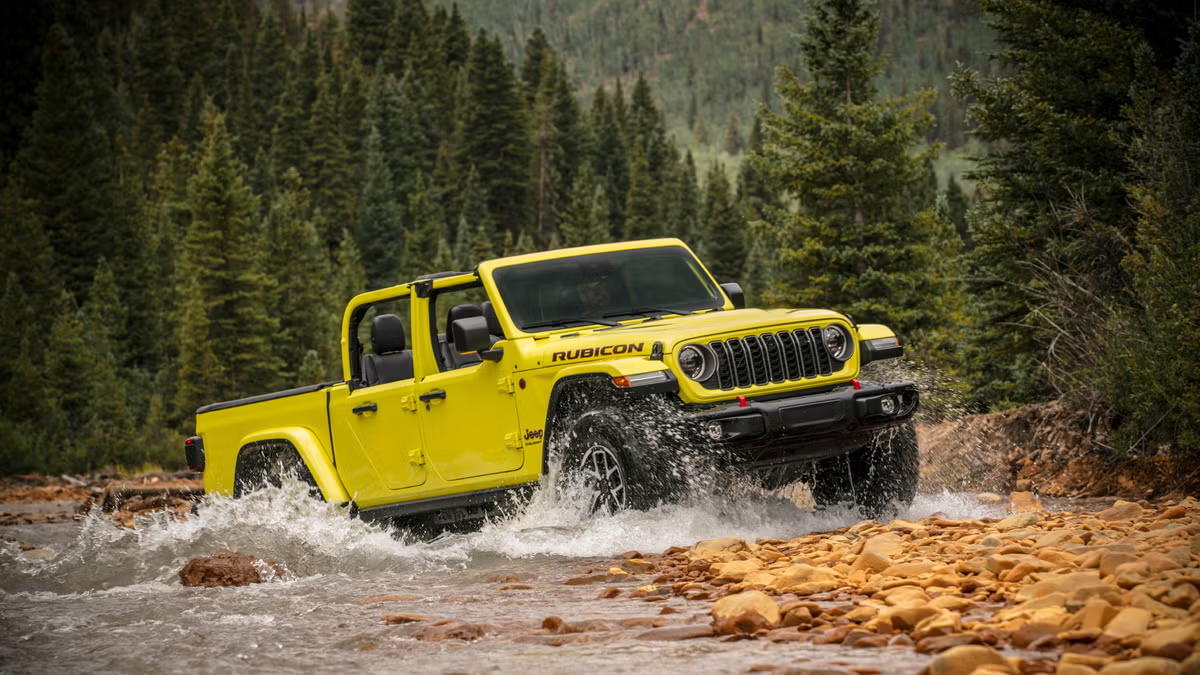
Years: On average, a well-maintained Jeep Wrangler can last between 15 to 20 years. That’s not just a ballpark figure—many Wranglers are still going strong well past the 15-year mark, especially if they’ve been taken care of. Some owners have even reported their Wranglers running well into their 20s with proper maintenance.
Mileage: When it comes to mileage, you’re looking at around 200,000 to 300,000 miles or more. That’s a pretty impressive range, considering the Wrangler’s off-road capabilities and the kind of wear it might see. With good care, it’s not unusual for a Wrangler to keep running strong well beyond this range.
What Affects the Lifespan of a Jeep Wrangler?
The longevity of your Wrangler isn’t just about its build quality; several factors play a role in how long it will last.
1. Maintenance and Care
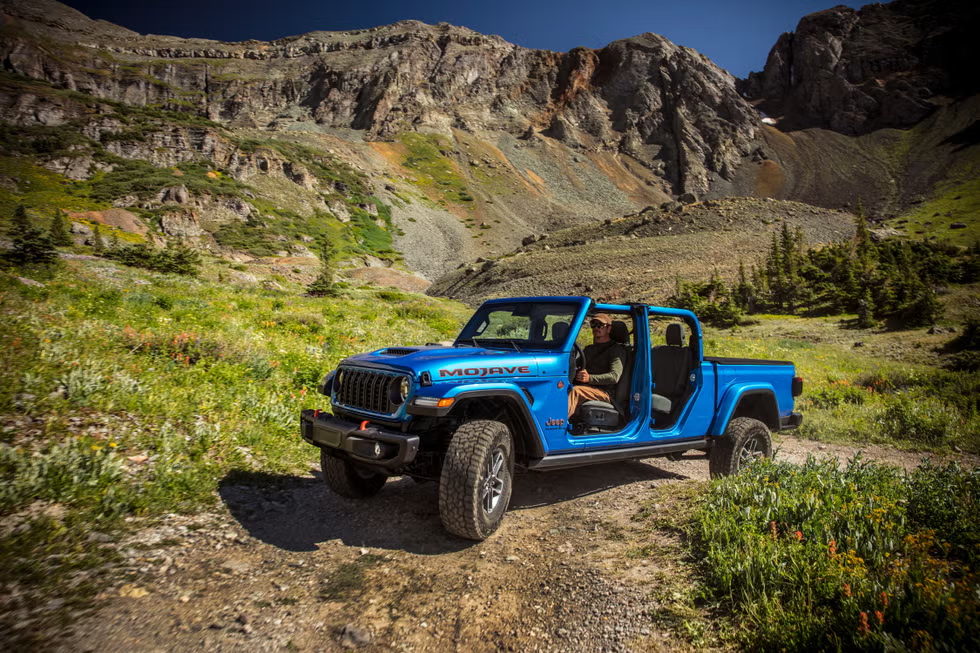
This is where you really have control over your Wrangler’s lifespan. Regular maintenance is crucial:
- Oil Changes: Stick to regular oil changes—typically every 3,000 to 5,000 miles. This keeps your engine in top shape.
- Fluid Checks: Don’t forget about transmission fluid, brake fluid, and coolant. Keeping these topped off helps prevent bigger problems down the road.
- Tire Care: Rotate your tires regularly and keep an eye on alignment. It’s a simple way to ensure even wear and longer tire life.
- Inspection: Regularly inspect for rust, especially if you’re often off-roading or live in a salt-heavy environment. Catching rust early can save you from more serious issues later.
2. Driving Conditions
The way you drive and where you drive can make a big difference:
- Off-Roading: If you’re regularly taking your Wrangler off the beaten path, you’re putting it through more stress. That said, the Wrangler is built for it, so it can handle more rugged use better than many other SUVs.
- Climate: Extreme temperatures, salt, and moisture can accelerate wear and tear. For example, if you’re driving in coastal areas, rust can become a concern, so keep an eye out for it and take preventive measures.
3. Model Year and Updates
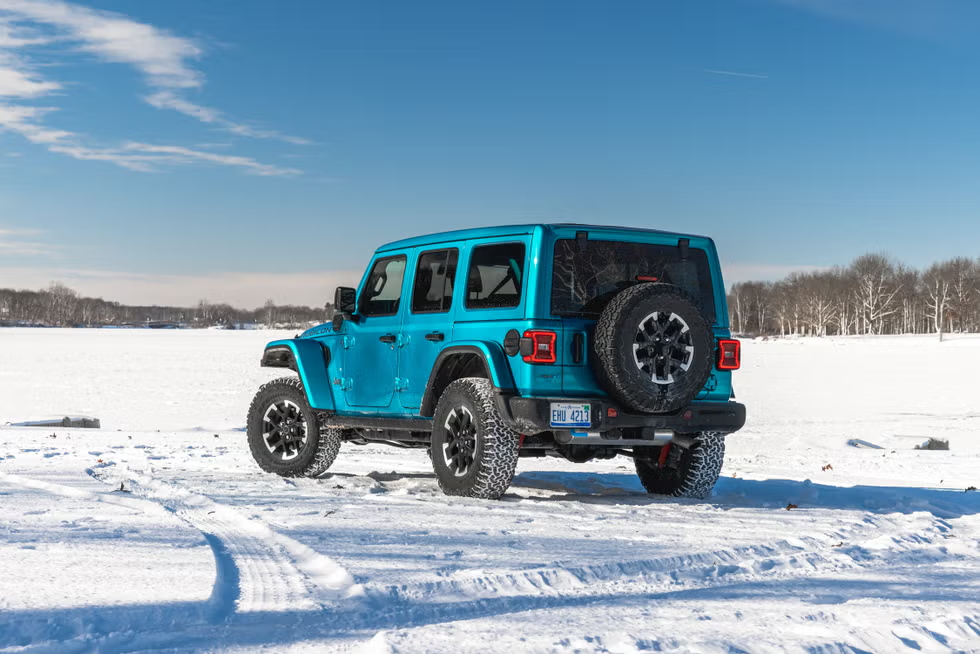
The Wrangler has evolved significantly over the years:
- Older Models (Pre-2007): Older models like the TJ and YJ are durable but might be more prone to issues like rust and outdated technology. With proper care, though, they can still serve you well.
- Newer Models (2007-Present): The JK, JL, and JLU models come with modern updates that improve durability and performance. These newer models have better technology and are generally more refined, which can contribute to a longer lifespan.
In Summary
If you’re thinking about buying a Jeep Wrangler, rest assured that it can be a long-lasting investment. With an average lifespan of 15 to 20 years and the potential to rack up 200,000 to 300,000 miles, the Wrangler is built to endure. Regular maintenance, mindful driving, and staying on top of model-specific issues will help you get the most out of your Wrangler. Whether you’re tackling tough trails or just cruising around town, with the right care, your Jeep Wrangler can be a reliable companion for many years to come.
- Comprehensive review including features, pricing, and performance details.
Kelley Blue Book: Jeep Wrangler
- Expert reviews, pricing, and detailed specifications for the Jeep Wrangler.
- In-depth review, including test drive results and pros and cons.
MotorTrend: Jeep Wrangler Review
- Detailed review, test drive impressions, and expert opinions on the Wrangler.
Autotrader: Jeep Wrangler Buying Guide
- Buying guide with tips, expert reviews, and available models.
How Much Is a Fully Loaded 2023 Jeep Wrangler?

How Much Is a Fully Loaded 2023 Jeep Wrangler?
The 2023 Jeep Wrangler stands out as a symbol of rugged off-road capability and versatile design. Known for its iconic look and robust performance, the Wrangler also offers various trims and options that can significantly influence its final price. If you’re considering a fully loaded 2023 Jeep Wrangler, it’s essential to understand the cost and what comes with the top-tier models.
Base Price of the 2023 Jeep Wrangler
The base price of the 2023 Jeep Wrangler starts around $33,000 for the entry-level Sport trim. However, as you move up through the trims and add options, the price increases substantially. To get a fully loaded Wrangler, you’ll need to look at the higher trims and add several premium features and packages.

Top Trims and Their Costs
For a fully loaded 2023 Jeep Wrangler, you’ll typically be looking at the higher trims. Here’s a breakdown of the top trims and their approximate costs:
- Rubicon 392: The Rubicon 392 is one of the highest trims available and starts at about $81,000. It features a powerful 6.4-liter V8 engine, unique off-road capabilities, and premium features. Adding extra options and packages can push the price even higher.
- High Altitude: The High Altitude trim, known for its luxury-oriented features, starts around $58,000. It includes high-end amenities, leather-trimmed seats, and advanced technology. Fully loading this trim with additional options can push the price up to $65,000 or more.
- Rubicon: The Rubicon trim, which balances off-road performance with luxury, starts at approximately $53,000. Fully loaded versions of this trim, with added options like premium audio systems, advanced safety features, and custom packages, can reach around $60,000.
Premium Packages and Add-Ons
To achieve a fully loaded Wrangler, consider adding these premium packages and features:
- Technology Group: This package includes advanced safety features like adaptive cruise control, blind-spot monitoring, and rear cross-traffic alert. It typically costs around $1,500.
- Cold Weather Group: For those in colder climates, this package offers features like heated seats, a heated steering wheel, and remote start. It’s priced at about $995.
- Luxury Group: This package enhances the interior with leather-trimmed seats, a premium audio system, and upgraded trim materials. It usually costs around $2,000.
- Advanced Safety Group: This package includes additional driver assistance technologies, such as automatic emergency braking and lane departure warning, and is priced around $1,200.
- Mopar Accessories: Adding Mopar accessories such as upgraded wheels, off-road lights, and custom exterior trim can add several thousand dollars to the final price.
Final Cost of a Fully Loaded 2023 Jeep Wrangler
When fully loaded with all the premium options and packages, the price of the 2023 Jeep Wrangler can vary depending on the chosen trim and additional features. Here’s a rough estimate for a fully loaded Wrangler:
- Rubicon 392: Up to $85,000 with all available options and accessories.
- High Altitude: Approximately $65,000 to $70,000 when fully equipped.
- Rubicon: Around $60,000 with added premium features and options.
Conclusion
A fully loaded 2023 Jeep Wrangler represents a significant investment, reflecting its premium features, top-tier performance, and customization options. Whether you opt for the powerful Rubicon 392, the luxurious High Altitude, or a well-equipped Rubicon, you’ll be getting a vehicle that combines off-road prowess with a range of high-end amenities. With a price range from about $60,000 to $85,000 depending on the trim and options, a fully loaded Wrangler is a substantial purchase that offers a unique blend of capability, comfort, and style.
- Edmunds: 2023 Jeep Wrangler Review
- Offers a comprehensive review including features, pricing, and performance details.
- Kelley Blue Book: 2023 Jeep Wrangler
- Features expert reviews, pricing, and detailed specifications.
- Car and Driver: 2023 Jeep Wrangler
- Provides an in-depth review, test drive results, and pros and cons.
- MotorTrend: 2023 Jeep Wrangler Review
- Includes a detailed review, test drive impressions, and expert opinions.
- Autotrader: Jeep Wrangler Buying Guide
- Offers a buying guide with tips, expert reviews, and available models.
These links will give you a thorough understanding of the 2023 Jeep Wrangler, including its features, pricing, and expert reviews.
Is a Dodge Charger Hellcat Fast?
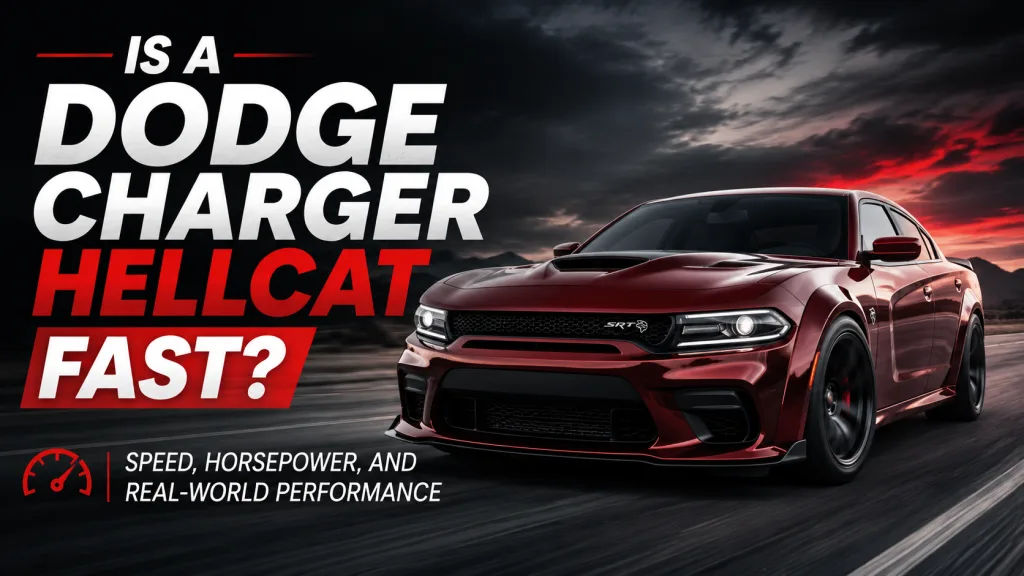
Is a Dodge Charger Hellcat Fast?
The Dodge Charger Hellcat is not just fast for a sedan. It is fast by almost any normal road-car standard. It took a large four-door family car, added a supercharged V8, and turned it into one of the most outrageous performance sedans ever sold.
The final gas-powered Charger Hellcat models used a supercharged 6.2L HEMI V8. The standard Charger SRT Hellcat Widebody made 717 horsepower, while the Charger SRT Hellcat Redeye pushed output to 797 horsepower. Dodge called the Hellcat Redeye the world’s most powerful mass-produced muscle car, and that claim explains why the car still gets so much attention.
How Fast Is the Dodge Charger Hellcat?
The Dodge Charger Hellcat is seriously quick. In testing, Car and Driver recorded a 0 to 60 mph time of 3.5 seconds and a quarter-mile time of 11.5 seconds at 126 mph for the Charger SRT Hellcat Widebody. That is sports-car speed from a full-size four-door sedan.
Top speed is just as impressive. Car and Driver also listed Dodge’s manufacturer-claimed top speed at 203 mph for the Charger SRT Hellcat. That number puts it in rare company, especially for a sedan with a big back seat and a usable trunk.
For most drivers, the answer is simple: yes, the Dodge Charger Hellcat is extremely fast.
Charger Hellcat Horsepower
The regular Charger SRT Hellcat Widebody produced 717 horsepower and 650 lb-ft of torque. The Charger SRT Hellcat Redeye raised output to 797 horsepower and 707 lb-ft of torque.
Those numbers are what make the car feel so wild. Many performance sedans feel quick because they launch hard from a stop. The Hellcat feels fast because it keeps pulling at higher speeds, too.
The supercharged V8 gives it a loud, aggressive, old-school muscle-car personality. It does not feel like a quiet luxury sport sedan. It feels like a Dodge muscle car that happens to have four doors.
Charger Hellcat Redeye Speed
The Charger Hellcat Redeye is the more extreme version. It uses the same basic supercharged 6.2L HEMI V8 idea, but with more power and stronger performance hardware.
The Redeye’s 797 horsepower makes it one of the most powerful sedans ever sold from the factory. Kelley Blue Book notes that the Charger and Challenger Hellcat Redeye models had a top speed of 203 mph, which is an absurd number for a street-legal muscle car.
That speed is not something most owners will ever use legally, but it shows how serious the Hellcat platform really is.
0 to 60 MPH
A Dodge Charger Hellcat can run from 0 to 60 mph in the mid-3-second range when conditions are right. Car and Driver tested the Charger SRT Hellcat Widebody at 3.5 seconds to 60 mph.
That is extremely fast, but the number does not tell the whole story. The Hellcat is rear-wheel drive, heavy, and extremely powerful. Getting a perfect launch takes the right tires, road surface, temperature, and driver technique.
On the street, the Hellcat’s power can overwhelm the rear tires if you are not careful. That is part of the personality. It is fast, but it also demands respect.
Quarter-Mile Performance
The quarter-mile is where the Charger Hellcat feels like a true muscle car. Car and Driver’s test result of 11.5 seconds at 126 mph shows how hard the car pulls once it hooks up.
Other versions can vary depending on tires, weather, driver, and track prep. MotorTrend tested a Charger Hellcat Redeye at 11.9 seconds in the quarter mile at 126.6 mph, which shows how much traction and conditions matter with this much power.
That is the key with any Hellcat. The engine is not the problem. Getting all that power to the pavement is the challenge.
Top Speed
The Charger Hellcat’s top speed is one of its most shocking numbers. A manufacturer-claimed 203 mph top speed puts it far beyond what most muscle sedans can reach.
Top speed is not just about horsepower. It also depends on gearing, aerodynamics, tires, cooling, and stability. The Charger is a big sedan, but the Hellcat has enough power to overcome its size and weight.
That does not mean anyone should try to reach those speeds on public roads. This kind of performance belongs on a closed course with the right safety conditions.
Is the Charger Hellcat Faster Than a Scat Pack?
Yes, the Charger Hellcat is much faster than a Charger Scat Pack. The Scat Pack is still quick, especially with its 6.4L HEMI V8, but the Hellcat is in a different performance class.
The difference is the supercharger. The Scat Pack is naturally aspirated, while the Hellcat uses forced induction to make far more power. That extra power shows up most clearly at higher speeds and in hard acceleration.
A Scat Pack is a strong muscle sedan. A Hellcat is the one you buy when you want the most extreme gas-powered Charger experience.
Is the Charger Hellcat Faster Than Most Sports Cars?
In a straight line, yes. A Charger Hellcat can outrun many sports cars, especially from a roll or in the quarter mile. It has more power than many cars that cost much more.
But speed is not only about acceleration. A smaller, lighter sports car may feel sharper in corners, brake more consistently on a road course, and be easier to place on tight roads.
The Hellcat is a straight-line monster first. It can handle better than people expect, especially in Widebody form, but its main personality is power, noise, and acceleration.
Is the Charger Hellcat Good for Daily Driving?
The Charger Hellcat is surprisingly usable for something this powerful. It has four doors, a roomy cabin, a real trunk, and enough comfort for daily use.
That is part of what made it so special. It could act like a practical sedan when driven calmly, then turn into a tire-smoking muscle car when you wanted power.
The downside is fuel economy, tire wear, insurance cost, and maintenance. Car and Driver listed EPA fuel economy for the 2023 Charger SRT Hellcat at 12 mpg city, 21 mpg highway, and 15 mpg combined. That is expected from a supercharged V8 sedan, but it is still something buyers should consider.
Is the Dodge Charger Hellcat Still Made?
The gas-powered Dodge Charger Hellcat is no longer in production as a new 2024 or 2025 model. The final gas Charger ended after the 2023 model year as Dodge moved into the new Charger generation.
That makes used Charger Hellcat models more important for shoppers. If you want the supercharged V8 sedan experience, you will likely be looking at pre-owned inventory, collector-grade examples, or remaining specialty listings.
Because the Hellcat has a strong following, clean examples can hold value well, especially rare trims, Jailbreak models, Redeye versions, and low-mileage cars.
Should You Buy a Dodge Charger Hellcat?
A Dodge Charger Hellcat makes sense if you want a four-door muscle car with extreme power. It is not the cheapest sedan to own, and it is not the most fuel-efficient choice, but it delivers a driving experience that few cars can match.
It is best for buyers who value horsepower, sound, straight-line speed, and rarity. It also makes sense if you want something practical enough to carry passengers but wild enough to feel special every time you start it.
If you want low running costs, quiet luxury, or maximum fuel efficiency, the Hellcat is probably not the right car. If you want one of the fastest and most memorable American sedans ever built, it absolutely is.
Find a Dodge Charger Hellcat for Sale
The Dodge Charger Hellcat is fast because it was built around one simple idea: put supercar-level horsepower into a large American sedan and let drivers enjoy it. With up to 797 horsepower, a 0 to 60 mph time around 3.5 seconds, quarter-mile times in the 11-second range, and a top speed of up to 203 mph, the Hellcat is more than quick. It is one of the most aggressive factory muscle sedans ever made.
If you are shopping for one, focus on condition, mileage, service history, tire condition, accident history, modifications, and ownership records. A clean Hellcat is not just about power. It is about finding the right example.
Visit Simi Valley Chrysler Dodge Jeep Ram to browse used inventory, check your trade-in value, or apply for financing before choosing your next performance car.

Short answer: For those seeking the pinnacle of power and performance, the Next-Gen Charger Daytona Scat Pack offers a staggering 670 horsepower, setting a new standard in high-performance muscle cars. Alternatively, the 496-horsepower Charger R/T provides a thrilling driving experience with a focus on both performance and innovation. Notably, the Charger Daytona Scat Pack is part of Dodge’s foray into electric vehicles, making it the world’s first and only electric muscle car.
The new lineup will feature two-door models available in late 2024, catering to enthusiasts who appreciate the classic coupe design. Four-door models, offering more practicality without compromising performance, are scheduled for release in early 2025. This updated range highlights Dodge’s commitment to blending cutting-edge technology with its storied muscle car heritage.
What is the life Expectancy of a Dodge Charger?
The life expectancy of a Dodge Charger typically ranges between 150,000 to 200,000 miles with proper maintenance and care. Like many modern vehicles, the Charger’s longevity depends significantly on factors such as driving habits, regular maintenance, and adherence to service schedules. Regular oil changes, timely repairs, and careful driving can help extend its lifespan. While the Charger is known for its durability and performance, ensuring that it receives consistent care is crucial to reaching or even surpassing the upper end of this mileage range. With good maintenance, it’s not uncommon for a well-cared-for Dodge Charger to continue performing reliably well into its second decade of use.
What car is equivalent to a Dodge Charger?
Several cars are considered equivalents to the Dodge Charger, especially in terms of performance, size, and style. Here are some notable alternatives:
- Ford Mustang: Known for its powerful engine options and muscle car heritage, the Mustang offers comparable performance with a range of trims and engines.
- Chevrolet Camaro: A direct competitor in the muscle car segment, the Camaro provides similar performance capabilities and aggressive styling.
- Chrysler 300: As a close relative to the Charger, the Chrysler 300 offers similar performance and features but with a more luxurious and refined approach.
- Nissan Maxima: Although not a muscle car, the Maxima provides strong performance, a stylish design, and a comfortable ride, appealing to those who might consider the Charger’s size and performance.
- Toyota Avalon: A full-size sedan offering a spacious interior, powerful engine options, and premium features, making it a strong competitor in the same segment.
These vehicles provide alternatives to the Dodge Charger with various strengths in performance, luxury, and style.
How much is the 2025 Dodge Charger Daytona?
As of now, the exact pricing for the 2025 Dodge Charger Daytona has not been officially released, as the vehicle is still in development and slated for release in the future. However, industry insiders and automotive experts estimate that the base model of the Charger Daytona could start around $40,000 to $50,000, with higher trims and performance versions potentially exceeding $70,000. The Charger Daytona is anticipated to be a groundbreaking model, combining classic muscle car aesthetics with modern electric vehicle technology, which may influence its final pricing. For the most accurate and up-to-date information, prospective buyers should keep an eye on official announcements from Dodge as the release date approaches.
The Dodge Charger is generally considered a reliable vehicle, but its reliability can vary depending on the model year, trim level, and how well the car has been maintained. Here’s a detailed overview of the Charger’s reliability:
General Reliability
- Durability: The Dodge Charger, known for its performance and robust build, tends to have good durability. Models with larger engines and higher trims often have strong performance records, reflecting well on their long-term reliability.
- Consumer Reviews: Many owners report high satisfaction with the Charger’s reliability, especially for models with regular maintenance. Issues are often related to specific components or electronics, but overall, the Charger has a solid reputation among performance sedans.
- Common Issues: Some owners have reported issues with electrical components and infotainment systems, as well as occasional transmission concerns. However, these problems are not universal and can often be managed with regular servicing.
- Maintenance and Care: Like any vehicle, the Charger’s reliability heavily depends on proper maintenance. Regular oil changes, timely repairs, and adherence to the manufacturer’s service recommendations contribute to a longer-lasting vehicle.
Reliability Ratings
- J.D. Power: The Dodge Charger typically receives average to above-average ratings in J.D. Power’s vehicle dependability studies, reflecting its overall reliability.
- Consumer Reports: Reliability ratings from Consumer Reports can vary by model year, with some years showing higher reliability than others. Generally, newer models tend to have better ratings due to improvements and updates.
Warranty and Support
Dodge offers a standard warranty on the Charger, including a 3-year/36,000-mile basic warranty and a 5-year/60,000-mile powertrain warranty. This warranty coverage supports the vehicle’s reliability and provides peace of mind for owners.
In summary, the Dodge Charger is considered a reliable vehicle overall, particularly when it is well-maintained. While there may be occasional issues reported by some owners, the Charger’s robust design and strong performance contribute to its reputation as a dependable sedan.
What is the Price of a Dodge Charger?
The price of a Dodge Charger varies based on the model year, trim level, and optional features. As of 2023, the starting price for a base model Dodge Charger SXT is around $34,000, while higher-performance trims like the Dodge Charger Scat Pack or Hellcat can range from $45,000 to over $80,000, depending on options and features.
If you’re looking at special editions or high-performance models like the Charger Hellcat Redeye, the price can exceed $90,000. These prices can also fluctuate depending on dealership location, added customizations, or promotions available at the time of purchase.
What is the price of a Dodge Charger?
The price of a Dodge Charger varies depending on the model, trim level, and added features. As of 2023, the base model Dodge Charger SXT starts at around $34,000, offering a solid entry-level option for those seeking a powerful sedan. For those interested in more performance-focused versions, the Charger R/T starts around $42,000, while the high-performance Scat Pack trim begins at about $50,000. If you’re looking for top-tier performance, the Charger Hellcat can reach upwards of $80,000 or more, with special editions like the Hellcat Redeye surpassing $90,000. Prices can vary based on location, available promotions, and optional features like upgraded engines, technology packages, and customizations.
Is Dodge making a 2024 Charger?
Yes, Dodge is making a 2024 Charger, continuing its legacy as a high-performance sedan. While Dodge has been transitioning toward electric vehicles, the 2024 Charger is expected to be one of the last gasoline-powered models in its lineup before moving fully into electric muscle cars. The 2024 Charger will maintain its iconic design, offering various trim levels, including powerful options like the Hellcat and Scat Pack, with impressive engine choices. Dodge enthusiasts can expect both two-door and four-door versions of the Charger to hit the market, with the possibility of advanced features and upgraded technology to complement its performance. The upcoming model year marks a pivotal moment for Dodge as they prepare for a new era in muscle cars
How much will the 2024 Charger Cost?
The cost of the 2024 Dodge Charger will vary depending on the trim level and options chosen. The base model, likely the Charger SXT, is expected to start around $35,000, offering an affordable entry into the iconic muscle car lineup. Mid-level trims such as the R/T and Scat Pack will likely range from $45,000 to $55,000, providing enhanced performance with larger engines and additional features. For those seeking top-tier power, the high-performance Charger Hellcat and potential Hellcat Redeye models could exceed $80,000, particularly with added customizations. The 2024 model is expected to carry on Dodge’s tradition of blending performance, style, and cutting-edge technology, with prices varying based on features like engine upgrades, interior packages, and new tech options.
Is the Dodge Charger coming to an end?
Yes, Dodge has announced that the current generation of gas-powered Dodge Chargers is coming to an end. The 2023 model year marks the final run for the gasoline-powered Charger as Dodge shifts focus toward electric vehicles. This transition is part of Dodge’s broader move to embrace electrification in its lineup, with plans to release electric muscle cars in the near future. However, this doesn’t mean the Charger name is going away entirely—future versions of the Charger are expected to be all-electric, continuing the legacy with a new era of performance focused on sustainability.
What does 345 mean on a Charger?
SRT stands for Street and Racing Technology, a high-performance division of Dodge, Chrysler, and Jeep. SRT focuses on enhancing the performance, handling, and power of select vehicles in the lineup. Originally created to design and build performance vehicles, SRT models are known for their powerful engines, aggressive styling, and track-ready capabilities. Cars like the Dodge Charger SRT Hellcat and the Jeep Grand Cherokee SRT showcase the division’s focus on maximizing horsepower, acceleration, and driving dynamics. Whether for daily driving or high-speed performance on the track, SRT vehicles are built for enthusiasts who crave both speed and precision.
Key highlights include the potential for three different powertrain options: a single-motor base model with 402 horsepower, a twin-motor version producing 670 hp, and a top-tier model expected to deliver up to 885 hp. In addition to these EV models, some rumors suggest that a Hurricane inline-six engine may be available in hybrid form(
Yahoo Autos) (Carscoops).
The Next-Gen Dodge Charger2025 Dodge Charger: Full DetailsMotor Authority – 2025 Dodge ChargerTop Speed – 2025 Charger Daytona EVAutoGuide – 2025 Dodge Charger Daytona SRT
Best Family Cars for 2024 and 2025

Best Family Cars for 2024 and 2025
Chrysler, Dodge, Jeep, and Ram (CDJR) have consistently produced vehicles known for their reliability, performance, and family-friendly features. Whether you’re looking for an SUV with off-road capability, a minivan for ultimate comfort, or a robust truck for weekend adventures, CDJR offers something for every type of family. Let’s explore some of the best CDJR family cars for 2024 and 2025.

1. 2024 Chrysler Pacifica
The Chrysler Pacifica has been a top contender for family vehicles for years, and the 2024 model keeps up that tradition. This minivan is packed with features designed to make family travel easy and enjoyable.
- Seating capacity: Up to 8 passengers
- Notable features: Stow ‘n Go seating, rear entertainment system, and available AWD for extra peace of mind in all weather.
- Why it’s great for families: The Pacifica’s spacious interior and easy-to-fold seats make it ideal for larger families or those who need plenty of cargo space. It’s also one of the few minivans offering an all-wheel-drive option, adding extra safety for those who live in areas with challenging weather.

2. 2024 Jeep Grand Cherokee
The 2024 Jeep Grand Cherokee offers a premium blend of ruggedness and luxury, making it a fantastic family SUV for those who love both the city and outdoor adventures.
- Seating capacity: 5 to 7 passengers (with the Grand Cherokee L model)
- Notable features: Advanced safety features like blind-spot monitoring and adaptive cruise control, plus luxurious interiors with premium materials.
- Why it’s great for families: The Grand Cherokee provides plenty of room for kids and adults alike, especially in the Grand Cherokee L model, which adds third-row seating. Its off-road capability also makes it perfect for family trips to national parks or camping.
3. 2024 Dodge Durango
The 2024 Dodge Durango blends muscle-car performance with family-friendly practicality. Known for its powerful engine options, the Durango is perfect for families who need a bit of speed and excitement in their daily drives.
- Seating capacity: 7 passengers
- Notable features: Available V8 engine, towing capacity of up to 8,700 pounds, and user-friendly infotainment system.
- Why it’s great for families: The Durango offers an impressive combination of power and versatility. Whether you’re hauling a boat for a family vacation or simply commuting, the Durango can handle it all while keeping your family comfortable.
4. 2024 Jeep Wagoneer
For those who want full-size luxury, the 2024 Jeep Wagoneer is an excellent choice. It combines premium features with an expansive interior, making it one of the most accommodating family vehicles.
- Seating capacity: 8 passengers
- Notable features: Top-tier interior finishes, a suite of driver-assistance features, and rear-seat entertainment options.
- Why it’s great for families: The Wagoneer offers ample space for large families, with its cavernous interior and advanced infotainment system. The powerful engine options also ensure a smooth and strong ride, even when fully loaded with passengers and gear.
5. 2025 Ram 1500
While trucks may not traditionally be considered family vehicles, the 2025 Ram 1500 breaks the mold by offering spacious interiors, comfortable seating, and impressive towing capabilities. It’s a great choice for families who need a versatile vehicle for both everyday life and weekend adventures.
- Seating capacity: 5 passengers
- Notable features: Available RamBox cargo management system, Uconnect infotainment, and luxurious interior options with the Laramie and Limited trims.
- Why it’s great for families: The Ram 1500’s spacious crew cab provides more than enough room for families, while its impressive towing and payload capacities make it perfect for road trips, camping, or even moving house. The rear seats are also notably comfortable, making long drives a breeze.
6. 2025 Jeep Grand Cherokee L
For families that need even more space than the standard Grand Cherokee, the 2025 Grand Cherokee L is a fantastic option. This three-row SUV is designed with large families in mind, offering premium comfort without sacrificing Jeep’s legendary off-road performance.
- Seating capacity: 6 to 7 passengers
- Notable features: Three-row seating, Quadra-Lift air suspension, and a full suite of safety features like lane-keeping assist and forward-collision warning.
- Why it’s great for families: The extra row of seating is a game-changer for larger families, and the advanced safety features provide peace of mind. Plus, it maintains Jeep’s ruggedness, so it’s ideal for families who enjoy outdoor adventures.
Final Thoughts
Whether you’re a family that needs a capable SUV for off-roading, a minivan with the latest tech, or even a powerful truck, CDJR offers a variety of options for 2024 and 2025. Each vehicle is designed to cater to modern family needs with spacious interiors, advanced safety features, and plenty of comfort to make every journey enjoyable. No matter your lifestyle, one of these CDJR models will likely be a perfect fit for your family’s next adventure.
Can a Jeep 4xe Charge at a Tesla Station?

With the rise of electric vehicles (EVs) and plug-in hybrids (PHEVs) like the Jeep Wrangler 4xe, the availability and accessibility of charging stations has become a key concern for drivers. One common question for Jeep 4xe owners is whether they can use Tesla’s extensive network of charging stations to power up their vehicle. Tesla has one of the largest EV charging networks in the world, so it’s natural to wonder if Jeep 4xe drivers can tap into this infrastructure.
In this article, we’ll break down how charging works for the Jeep Wrangler 4xe, whether it’s compatible with Tesla charging stations, and what other charging options are available.
Understanding the Jeep Wrangler 4xe’s Charging System
The Jeep Wrangler 4xe is a plug-in hybrid electric vehicle (PHEV), which means it runs on both gasoline and electric power. Unlike fully electric vehicles, which rely entirely on batteries, the 4xe uses a combination of electric motors and a gasoline engine to offer a blend of efficiency and performance. When charged, it can operate in all-electric mode for up to 22 miles, perfect for short commutes or urban driving.
The Jeep Wrangler 4xe comes with a Level 1 charger that can be plugged into a standard household outlet (120V) for overnight charging. For faster charging, owners can use a Level 2 charger, which requires a 240V outlet. These faster chargers can typically be installed at home or found at public charging stations.
Now, let’s explore the question of using a Tesla charging station.
Are Tesla Charging Stations Compatible with the Jeep 4xe?
The short answer is: no, the Jeep Wrangler 4xe cannot directly charge at a Tesla Supercharger or Destination Charger without an adapter. Tesla has developed its own proprietary charging connector, which differs from the standard connectors used by most other electric vehicles in North America.
There are two main types of Tesla charging stations:
- Tesla Superchargers: These are high-speed charging stations designed to rapidly charge Tesla vehicles. They are incompatible with non-Tesla vehicles, including the Jeep 4xe, due to their unique connector and software restrictions. Additionally, even if you could physically connect a Jeep 4xe to a Tesla Supercharger (with an adapter), the 4xe would not be able to take full advantage of the Supercharger’s speed, as it is not built for high-powered charging.
- Tesla Destination Chargers: These are Level 2 chargers typically found at hotels, restaurants, or shopping centers. Some of these chargers have been opened up for use by non-Tesla vehicles, but this is still relatively rare. Again, an adapter would be required to connect a Jeep 4xe to these chargers, but even with an adapter, charging speeds would be similar to other public Level 2 chargers.
Using Adapters for Charging at Tesla Stations
In theory, it is possible to use a Tesla to J1772 adapter for some Tesla Destination Chargers. This adapter allows non-Tesla EVs, including the Jeep Wrangler 4xe, to use certain Tesla charging stations. However, this only applies to Tesla Destination Chargers and not Superchargers, which are exclusive to Tesla vehicles.
It’s important to note that Tesla Destination Chargers are slower (Level 2), so they won’t provide the rapid charging that Superchargers offer to Tesla owners. Still, for Jeep 4xe owners who may find themselves near a Tesla Destination Charger with an adapter, it could be a convenient option for topping up their battery.
Alternatives to Tesla Charging Stations
Fortunately, Jeep Wrangler 4xe owners have access to a wide range of other charging networks that are fully compatible with their vehicle, without the need for any special adapters. Here are a few options:
- Public Charging Networks: Many public charging networks, like ChargePoint, EVgo, and Electrify America, offer Level 2 charging stations that are compatible with the Jeep Wrangler 4xe’s J1772 connector. These networks are widespread and can be found at shopping malls, grocery stores, and other public spaces.
- Home Charging Stations: Many Jeep 4xe owners choose to install a Level 2 charger at home, which can fully charge the 4xe’s battery in around 2 hours. This is the most convenient and cost-effective way to keep your vehicle charged and ready for both city and off-road adventures.
- Jeep Branded Charging Stations: Jeep has partnered with Electrify America to create the Jeep 4xe Charging Network, a series of charging stations located near popular off-road trails. These stations are strategically placed to give Jeep enthusiasts the ability to recharge their 4xe while exploring remote areas.
- Level 1 Charging: For those who don’t need to charge quickly, the Wrangler 4xe comes with a Level 1 charger that plugs into a standard household outlet. This is a slower option (around 12 hours for a full charge), but it’s a convenient way to charge overnight if faster charging options aren’t available.
Conclusion
While the Jeep Wrangler 4xe cannot charge at Tesla Superchargers, it is possible to use Tesla Destination Chargers with the right adapter. However, there are many other more accessible and convenient charging options available for 4xe owners, including public charging networks and home charging stations.
With its plug-in hybrid capabilities, the Jeep Wrangler 4xe offers drivers the flexibility to enjoy both electric and gasoline power, ensuring that you’re never left without options, whether you’re in the city or hitting the trails. Charging may require a bit of planning, but with the ever-expanding charging infrastructure, including Jeep’s own network near off-road trails, finding a compatible station is easier than ever.
So, while you may not be able to use Tesla’s Supercharger network, there are plenty of charging alternatives that will keep your Jeep 4xe ready for any adventure.
Charging a Jeep 4xe at a Tesla station is possible, but there are limitations. Tesla Superchargers, which offer fast charging, are generally not compatible with non-Tesla vehicles unless using a specific adapter, and even then, results can vary. However, Jeep 4xe owners can use Tesla Destination Chargers (typically Level 2) with a compatible adapter like the TeslaTap. These chargers are often found at hotels or other locations and can be set to allow non-Tesla vehicles to charge(
4XE Forums)(
For more consistent charging, you may need to ensure the Tesla charger is correctly configured, and some adapters work better than others(
4XE Forums). If you’re planning to use this regularly, an adapter like the TeslaTap is recommended for home or public use(
What is the Sahara Package on a Jeep Wrangler?
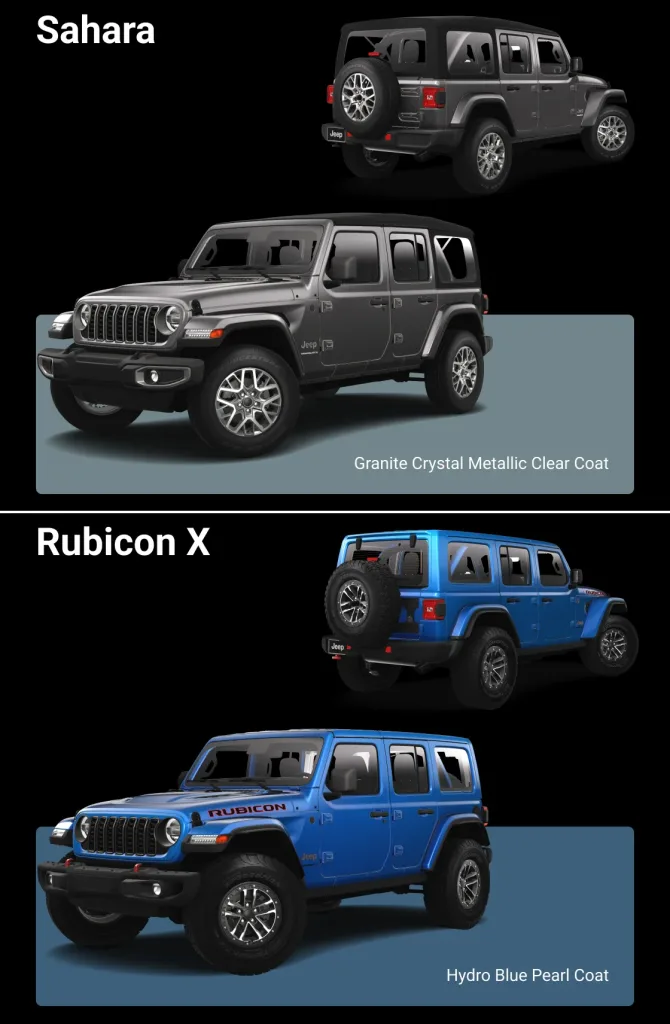
What Is the Sahara Package on a Jeep Wrangler?
The Sahara package on a Jeep Wrangler is the comfort-focused Wrangler trim. It gives you the Wrangler’s classic 4×4 capability, removable roof and doors, and open-air Jeep character, but adds more daily-driver comfort, nicer styling, and more convenience features than the base Sport trims.
The simple answer is this: the Wrangler Sahara is the more refined, road-friendly version of the Wrangler. It is not as extreme off-road as the Rubicon, and it is not as basic as the Sport. It sits in the middle as the Wrangler for buyers who want Jeep capability with more comfort, better technology, and a more polished look.
For 2026, Jeep Canada lists the Wrangler Sahara with features like a Black Freedom Top hardtop, 18-inch machined-face aluminum wheels, an AWD Plus 4×4 system, heated front seats and steering wheel, and remote start. Jeep Canada
Is Sahara a Package or a Trim?
Most people call it the “Sahara package,” but technically, Sahara is a Wrangler trim level.
That means it is not just one add-on package like a cold weather package or towing package. Sahara is a specific version of the Jeep Wrangler with its own standard features, styling, equipment, and available options.
You may still see people say “Sahara package” because the name has been around for years and buyers often use “package” casually. But when shopping, you will usually see it listed as Jeep Wrangler Sahara or Wrangler Unlimited Sahara.
What Comes With the Jeep Wrangler Sahara?
The Sahara usually adds comfort and style features that make the Wrangler easier to live with every day.
Depending on model year, market, and options, Sahara models commonly include things like larger alloy wheels, body-color exterior accents, upgraded interior trim, better infotainment, available leather, heated seats, heated steering wheel, remote start, automatic climate control, and a hardtop or premium roof option.
On newer models, Jeep’s official Wrangler page highlights the 2026 Wrangler as having advanced infotainment and safety features, with the 2026 Wrangler lineup using modern Uconnect technology and available driver-assistance equipment. Jeep USA
The Sahara is built for the buyer who wants a Wrangler that still feels like a Jeep, but does not feel stripped down.
Sahara vs Sport: What Is the Difference?
The Wrangler Sport is the more basic version. The Sahara is the more comfortable and better-equipped version.
A Wrangler Sport is usually better if you want the lowest price, a simpler build, or a blank canvas for modifications. It gives you the essential Wrangler formula without as many comfort upgrades.
The Sahara usually adds more appearance and convenience features. It feels more finished from the factory. If you are using your Wrangler for commuting, highway driving, family use, winter driving, or weekend adventure, Sahara is often easier to live with than a base Sport.
In plain terms: Sport is the simple Wrangler. Sahara is the nicer everyday Wrangler.
Sahara vs Rubicon: Which One Is Better?
The Rubicon is better for serious off-roading. The Sahara is better for daily driving and comfort.
A Wrangler Rubicon usually adds more aggressive off-road hardware, such as stronger axles, locking differentials, lower gearing, electronic sway bar disconnect, more trail-focused tires, and specialized 4×4 equipment depending on the year.
The Sahara focuses more on comfort, styling, and road use. It is still capable off-road, but it is not the most extreme Wrangler trim.
If you drive mostly on pavement and want a Wrangler that looks good, feels comfortable, and handles snow, dirt roads, beach trips, light trails, and weekend adventures, the Sahara makes sense.
If you plan to crawl rocks, tackle difficult trails, lift the Jeep, and use serious off-road gear, the Rubicon is the better fit.
Is the Jeep Wrangler Sahara Good Off-Road?
Yes, the Wrangler Sahara is still good off-road.
It is a real Jeep Wrangler, not a soft crossover. It has 4×4 capability, high ground clearance, a strong SUV structure, removable roof options, and trail-friendly engineering.
But the Sahara is not designed to be the most hardcore Wrangler. It is better for light-to-moderate off-roading, snow, gravel roads, forest roads, beach driving, camping access roads, and rough weather.
If your idea of off-roading is occasional trails and outdoor weekends, Sahara is more than enough. If your idea of off-roading is rock crawling, deep ruts, heavy articulation, and advanced trail work, Rubicon is the better choice.
Is Sahara Only Available as a Four-Door?
In recent Wrangler lineups, the Sahara has commonly been offered as a four-door Unlimited model in many markets.
That matters because many shoppers looking for a Sahara are also looking for a more practical Wrangler. The four-door body gives you more rear-seat room, more cargo space, easier family use, and better daily practicality than the two-door Wrangler.
If you want a two-door Wrangler, you will usually be looking at other trims. If you want the Sahara’s comfort-focused setup, expect to shop mostly four-door models.
What Engine Does the Wrangler Sahara Have?
The Wrangler Sahara engine depends on the model year and market.
Newer Sahara models commonly use Jeep’s turbocharged 2.0L four-cylinder engine or available V6 powertrains depending on configuration and market. Jeep Canada lists the 2026 Wrangler Sahara with a 2.0L DOHC I-4 turbocharged engine and an 8-speed automatic transmission. Jeep Canada
Some special-edition 2026 Wrangler models based on Sahara and Rubicon can be equipped with either the 270-hp turbocharged 2.0L four-cylinder or the 285-hp 3.6L V6, according to Car and Driver’s coverage of the 2026 Wrangler Whitecap edition. Car and Driver
If you are buying used, always check the exact window sticker, VIN, or build sheet. Sahara engine availability has changed over the years.
Why Buyers Like the Sahara Package
The Sahara is popular because it gives the Wrangler a more premium feel without going all the way to a Rubicon.
Many Wrangler buyers are not trying to build a rock crawler. They want the Jeep look, open-air freedom, four-wheel drive, and the ability to handle bad weather or weekend trails. But they also want heated seats, a better interior, nicer wheels, body-color details, and more comfort.
That is where Sahara fits perfectly.
It is the Wrangler for someone who wants capability, but also has to commute, run errands, drive on highways, carry passengers, and live with the vehicle every day.
Is the Sahara Worth It?
Yes, the Sahara is worth it if you want a Wrangler that feels more complete from the factory.
It makes the most sense if you care about comfort, appearance, daily drivability, and technology. It is especially good for buyers who want a Wrangler as their main vehicle instead of a weekend toy.
It may not be worth it if you want the cheapest Wrangler possible or if you plan to modify everything anyway. If you are going to replace the wheels, tires, suspension, bumpers, roof, and interior parts, a cheaper Sport might be a better starting point.
It may also not be the best choice if you want maximum off-road ability. In that case, Rubicon is usually worth the extra money.
Used Jeep Wrangler Sahara: What to Check
A used Wrangler Sahara can be a great buy, but condition matters.
Check the roof seals for leaks. Inspect the carpets for dampness. Test the 4×4 system. Look for rust underneath. Check the tires, suspension, steering, brakes, and alignment. Make sure the electronics, windows, climate control, heated seats, touchscreen, and backup camera work properly.
Also watch for poor modifications. Some Sahara owners add lifts, big tires, lights, bumpers, and aftermarket accessories. Good upgrades can add value. Cheap or poorly installed upgrades can create problems.
If you are comparing options locally, start with available used Jeep inventory and compare each Wrangler by year, mileage, trim, engine, roof type, drivetrain, and service history.
Sahara 4xe: What Is Different?
Some Wrangler Sahara models are available with the 4xe plug-in hybrid powertrain, depending on year and market.
The Sahara 4xe keeps the comfort-focused Sahara personality but adds plug-in hybrid power. It can deliver strong torque and short-distance electric driving when charged regularly.
The 4xe can be appealing, but it is more complex than a gas-only Sahara. If buying used, check battery warranty, charging behavior, recall completion, service history, and whether the previous owner actually charged it.
A gas Sahara is usually simpler. A Sahara 4xe is better if your driving habits fit plug-in hybrid ownership.
Who Should Buy a Jeep Wrangler Sahara?
The Wrangler Sahara is best for someone who wants a Jeep Wrangler as a daily driver.
It is a strong fit for buyers who want:
A more comfortable Wrangler.
Four-door practicality.
A nicer interior than Sport.
Better factory styling.
Real 4×4 capability.
Open-air driving.
Snow and rain confidence.
Weekend trail ability.
A Jeep that feels less basic.
It is not the best choice for someone who only wants the lowest price or the most aggressive off-road hardware.
FAQs About the Jeep Wrangler Sahara Package
What is the Sahara package on a Jeep Wrangler?
The Sahara package is commonly used to describe the Jeep Wrangler Sahara trim, which adds more comfort, style, technology, and daily-driver features compared with basic Wrangler trims.
Is Jeep Sahara better than Rubicon?
Not for serious off-roading. Rubicon is better for difficult trails and rock crawling. Sahara is better for comfort, style, and daily driving.
Is Jeep Sahara better than Sport?
Yes, if you want more features and refinement. Sport is cheaper and simpler, while Sahara adds more comfort and appearance upgrades.
Is the Wrangler Sahara good off-road?
Yes, the Sahara is still a capable 4×4 Wrangler. It is good for light-to-moderate off-roading, snow, dirt roads, camping trails, and bad weather, but Rubicon is better for extreme trails.
Does the Sahara come with a hardtop?
Many Sahara models include or offer a hardtop, depending on the year and market. Jeep Canada lists the 2026 Sahara with a Black Freedom Top hardtop. Jeep Canada
Is Sahara a luxury Wrangler?
Sahara is not a luxury vehicle, but it is one of the more comfort-focused Wrangler trims. It feels more upscale than Sport, but less extreme than Rubicon and less premium than some High Altitude-style trims.
Final Thoughts: Sahara Is the Daily-Driver Wrangler
The Jeep Wrangler Sahara is the Wrangler for buyers who want capability without giving up comfort.
It keeps the Wrangler’s real Jeep personality, 4×4 capability, removable roof and doors, and adventure-ready image. But it adds the comfort, styling, and convenience features that make it easier to live with every day.
If you want the cheapest Wrangler, buy a Sport. If you want the most off-road-focused Wrangler, buy a Rubicon. If you want the best balance of Jeep style, everyday comfort, and useful capability, the Sahara is often the sweet spot.
Connect with us


