




How to Register a Car in California: Complete Process
To register a car in California, you need proof of ownership, proof of insurance, a DMV title or registration application, payment for taxes and fees, and a smog certificate if the vehicle requires one.
The exact process depends on how you got the car. A vehicle bought from a California dealership is usually handled by the dealer. A car bought from a private seller, brought from another state, or imported from another country usually requires more DMV work from you.
The simple answer is this: if you buy from a California dealer, the dealer usually processes registration. If you buy from a private seller or bring a car into California, you must handle the title transfer, registration, fees, smog, and paperwork through the California DMV.
What You Need to Register a Car in California
Most California vehicle registrations require a few basic items.
You will usually need the vehicle title or ownership document, a completed Application for Title or Registration, proof of insurance, odometer mileage if required, a smog certificate if required, and payment for taxes and DMV fees.
California DMV says registration fees are based on things like the vehicle type, purchase price or declared value, purchase date, city or county, vehicle weight, number of axles, special plates, and unpaid parking or toll violations. DMV also lists common fees such as registration fee, CHP fee, Vehicle License Fee, Transportation Improvement Fee, and county or district fees. You can review this on the official registration fees page.
Before you go to the DMV, make sure your paperwork is complete. Missing signatures, no smog certificate, wrong title information, or missing insurance can delay the process.
Registering a Car Bought From a California Dealer
If you buy a car from a licensed California dealership, registration is usually the easiest.
The dealer normally collects the required taxes and fees, submits the title and registration paperwork, and gives you temporary registration until your permanent registration, plates, or stickers arrive.
California DMV says dealer-purchased vehicles may involve title transfer fees and use tax, and that use tax can range from 7.25% to 10.25%, depending on the new registered owner’s city and county of residence. DMV also notes that transfer fees must be paid within 10 days of the sale, with late penalties after 30 days. California DMV
Even when the dealer handles the registration, you should still review your paperwork. Check your name, address, VIN, purchase price, tax, fees, lienholder, and registration details before leaving.
If you are still shopping, compare available new vehicles or used inventory and ask for the full out-the-door price before signing.
Registering a Car Bought From a Private Seller
If you buy a car from a private seller in California, you are responsible for transferring ownership and registering the vehicle.
California DMV says buyers have 10 days after purchasing a vehicle from a private party to transfer ownership, while sellers have 5 days after the sale to report the transfer to DMV. California DMV
For a private-party purchase, you usually need the signed title, odometer mileage if required, smog certification, applicable fees, and use tax.
Make sure the title is signed correctly by the seller. If the seller is not the person listed on the title, DMV may require a Bill of Sale signed by both the seller and the owner listed on the title. If the title is missing, stolen, or damaged, DMV says you may need an Application for Replacement or Transfer of Title, also known as REG 227. California DMV
Do not buy a private-party vehicle casually if the title is missing, the seller’s name does not match, or the vehicle cannot pass smog.
How Long Do You Have to Register a Car in California?
If you buy a vehicle, California DMV says you have 10 days to transfer ownership into your name.
If you sell a vehicle, the seller must notify DMV within 5 days by completing a Notice of Transfer and Release of Liability. If you move to California or get a job in California, DMV says you have 20 days to register your vehicle after becoming a resident or getting a job in the state. California DMV
These deadlines matter because late fees and penalties can apply. Do not wait until the last minute, especially if the vehicle needs a smog check, VIN verification, or missing title paperwork.
Registering an Out-of-State Car in California
Registering an out-of-state car in California takes more steps than registering a car already titled in California.
You usually need the out-of-state title, out-of-state registration, proof of insurance, a completed California title or registration application, smog certification if required, VIN verification, and payment for taxes and fees.
California DMV says out-of-state vehicles must meet California requirements, including emission-control requirements. DMV also says it cannot register a vehicle if it does not qualify. California DMV
This is especially important if you bought a vehicle from another state. Do not assume that a truck, SUV, or car bought in Texas, Arizona, Nevada, Oregon, or another state can be registered in California without extra checks.
New California Residents: Registering Your Car
If you move to California with a vehicle from another state, you generally have 20 days to register it after becoming a California resident or getting a job in California.
You may need a smog inspection, VIN verification, proof of ownership, proof of insurance, and payment for California registration fees. If the car does not meet California emissions standards, registration can become difficult or impossible.
If you are a new resident, do not wait for your old state registration to expire. California’s deadline is based on residency or employment status, not just the expiration date on your old plates.
Do You Need a Smog Check to Register a Car in California?
Often, yes.
Many used vehicles and out-of-state vehicles need a smog inspection before they can be registered in California. DMV says that for private-party purchases, a smog certification is one of the items required to transfer ownership. California DMV
Smog requirements vary by model year, fuel type, and transaction type. Electric vehicles are generally treated differently than gasoline vehicles. Newer vehicles may be exempt from a regular smog inspection for a period of time but may still have fees. Out-of-state vehicles often require closer attention.
Before buying a used car, ask whether it has a valid smog certificate. In many California sales, the seller is responsible for providing smog certification unless an exemption applies.
What Does California Registration Cost?
California registration cost varies by vehicle.
There is no single flat number that applies to every buyer. DMV says registration fees depend on the vehicle type, purchase price or value, purchase or entry date, city or county, business location if applicable, vehicle weight, number of axles, special plates, and unpaid parking or toll violations. California DMV
Most registrations may include a registration fee, CHP fee, Vehicle License Fee, Transportation Improvement Fee, county or district fees, use tax, and possibly weight fees or other charges.
The Vehicle License Fee is important because DMV lists it as 0.65% of the purchase price or vehicle value for most vehicles. California DMV
The most accurate way to estimate your cost is to use the California DMV fee calculator.
Use the California DMV Fee Calculator
Do not guess your California registration cost.
The DMV provides official fee calculators for new vehicles, used vehicles, registration renewals, and vehicles brought into California. This is the best way to estimate your total cost before going to the DMV or buying a vehicle.
Use the DMV’s vehicle registration fee calculator to get a more realistic estimate.
This is especially useful if you are buying a used car privately, bringing in an out-of-state car, or comparing two vehicles with different prices and weights.
Do You Need Insurance Before Registering a Car?
Yes, you usually need proof of insurance or financial responsibility to register and legally operate a vehicle in California.
If you buy from a dealership, the dealer or lender may require proof of insurance before you leave with the car. If you buy from a private seller, arrange insurance before driving the vehicle.
Do not assume the seller’s insurance covers you. Once you take ownership, you need your own coverage.
Title Transfer vs Registration
Title and registration are not the same thing.
The title proves ownership. Registration allows the vehicle to be legally operated on California roads.
When you buy a car, you need the title transferred into your name. If you plan to drive it, you also need proper registration, insurance, and valid plates or temporary operating authority.
If there is a lienholder, such as a bank or credit union, the title may show the lender’s interest until the loan is paid off.
What If the Title Is Missing?
Be careful with any vehicle that has no title.
A missing title can delay registration and may signal ownership problems, lien issues, or title history concerns. DMV says that if the title has been lost, stolen, or damaged in a private-party purchase, an Application for Replacement or Transfer of Title may be required. California DMV
For most buyers, the safest move is simple: do not pay for a vehicle until the ownership documents are clear.
Can You Register a Car Online in California?
Some DMV registration and title services can be started online, but not every situation can be finished online.
Dealer purchases are often handled by the dealer. Renewals can often be completed online. Some title transfers may be started online. But out-of-state vehicles, VIN verification, missing title issues, smog problems, imported vehicles, and complex ownership transfers may require additional steps or in-person processing.
Start with the official DMV vehicle registration page and follow the path that matches your situation.
Registering an Imported Vehicle in California
An imported vehicle is different from a normal out-of-state vehicle.
If the vehicle was imported directly from another country, DMV says you may need proof of ownership, customs clearance documents, a weight certificate for imported trucks or pickups, applicable fees, and forms such as REG 343, REG 31, REG 166 if applicable, REG 256, REG 4008, and REG 262. DMV also says imported vehicles may need evidence that they meet U.S. Federal Motor Vehicle Safety Standards, EPA requirements, and California emissions standards. California DMV
Imported-vehicle registration can be complicated. If you are buying an imported car, confirm California eligibility before you buy it.
Common Registration Mistakes to Avoid
The biggest mistake is waiting too long.
Other common mistakes include buying a car without a clean title, failing to get smog certification, not checking the VIN, ignoring unpaid registration fees, forgetting proof of insurance, or assuming the seller has handled everything.
Out-of-state buyers often make another mistake: they assume buying in another state avoids California taxes or emissions requirements. It usually does not.
If the vehicle will be registered and used in California, California rules matter.
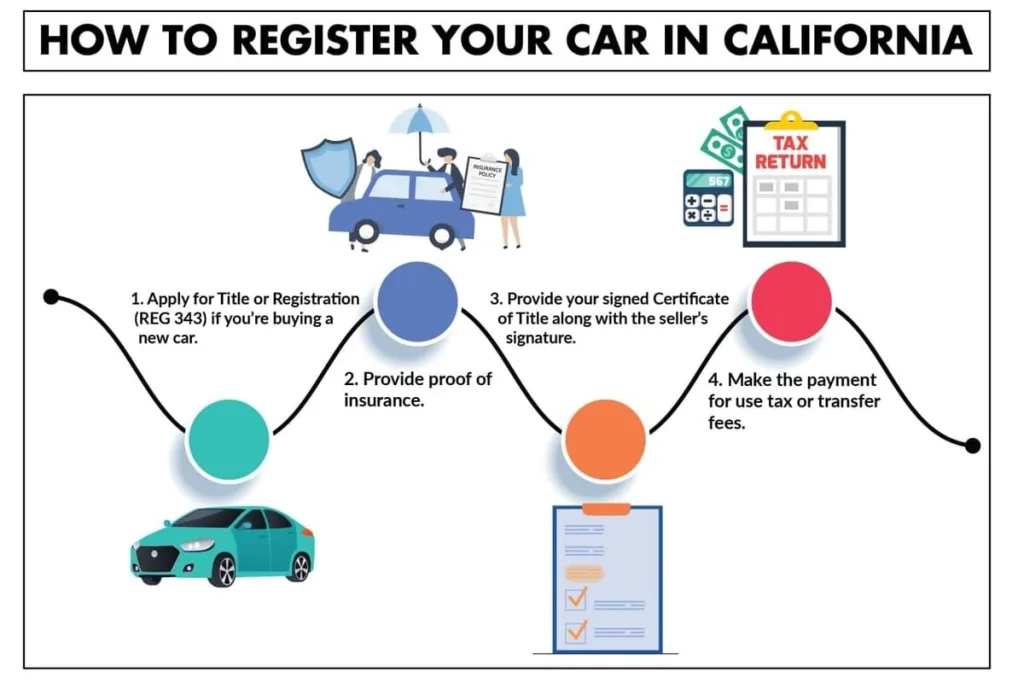
Step-by-Step California Car Registration Process
First, figure out your situation. Did you buy from a dealer, buy from a private seller, move from another state, or import the vehicle?
Second, gather your ownership documents. This may include a California title, out-of-state title, dealer documents, registration card, lien release, or customs documents.
Third, get California insurance or make sure your insurance meets California requirements.
Fourth, complete the required DMV application, usually the Application for Title or Registration.
Fifth, complete smog if required.
Sixth, complete VIN verification if the vehicle is from out of state or DMV requires it.
Seventh, calculate and pay DMV fees, taxes, and any penalties.
Eighth, submit everything to DMV, a qualified business partner, AAA if eligible, or let the dealer process it if the vehicle was dealer-purchased.
Ninth, keep your temporary registration and paperwork until the permanent registration, plates, stickers, or title arrive.
FAQs About Registering a Car in California
How do I register a car in California?
To register a car in California, you generally need proof of ownership, proof of insurance, a completed DMV application, smog certification if required, and payment for taxes and registration fees. Dealer purchases are usually handled by the dealer, while private-party and out-of-state vehicles usually require DMV processing.
How long do I have to register a car in California?
If you buy a vehicle, you have 10 days to transfer ownership into your name. If you become a California resident or get a job in California, you have 20 days to register your out-of-state vehicle. California DMV
Do I need a smog check to register a car in California?
Often, yes. Many used vehicles and out-of-state vehicles require a smog certificate before registration. Requirements depend on vehicle age, fuel type, and transaction type.
How much does it cost to register a car in California?
The cost depends on the vehicle type, value, purchase date, city or county, weight, axles, unpaid violations, and other factors. DMV provides an official fee calculator to estimate costs. California DMV
Can I register an out-of-state car in California?
Yes, but the vehicle must meet California requirements. You may need the out-of-state title, proof of insurance, smog certificate, VIN verification, and payment for fees and taxes.
Does a dealer register my car for me in California?
Usually, yes. A licensed California dealer typically processes title and registration paperwork, collects taxes and fees, and gives you temporary registration while permanent documents are processed.
What happens if I register late?
Late registration or late title transfer can lead to penalties. DMV notes that transfer fees must be paid within 10 days of sale, with late penalties after 30 days for dealer-purchased vehicle transfers. California DMV
Final Thoughts: California Car Registration Is Easy When the Paperwork Is Clean
Registering a car in California is straightforward when you know which process applies to your situation.
Dealer purchases are usually the easiest because the dealership handles most of the paperwork. Private-party purchases require you to transfer title within 10 days. Out-of-state vehicles may require smog, VIN verification, California fees, and emissions compliance. Imported vehicles can require even more documentation.
The safest move is to verify the title, confirm smog requirements, arrange insurance, calculate fees, and submit the paperwork before deadlines pass. For Southern California shoppers, comparing new inventory, used inventory, and financing options before purchase can make the registration process much smoother.