





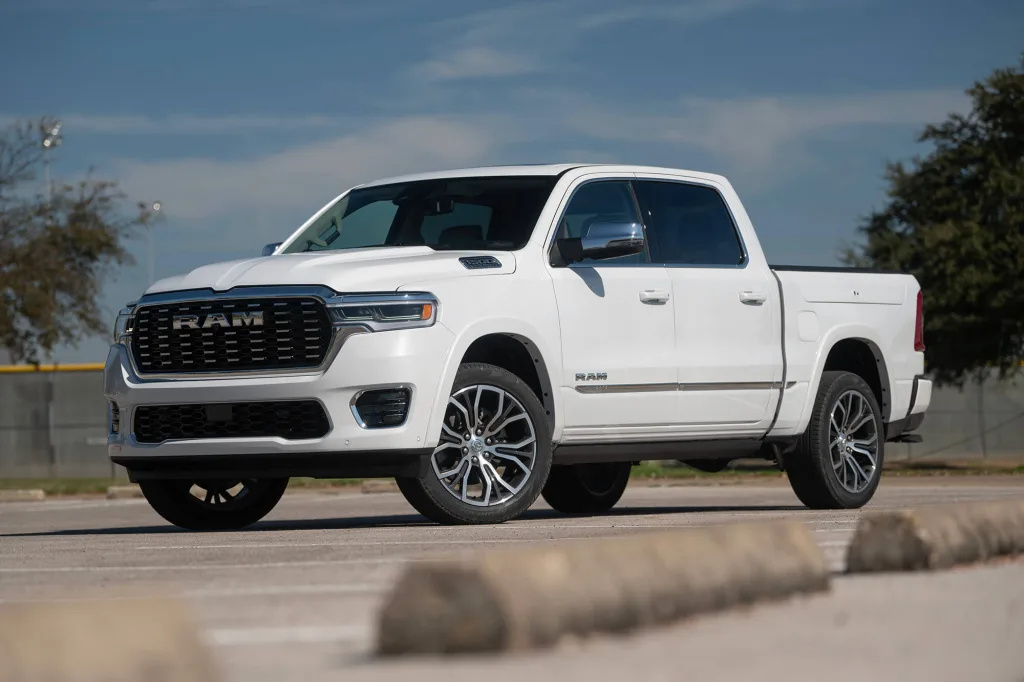
How Fuel-Efficient Is the Ram 1500?
The Ram 1500 is not a small truck, so fuel economy depends heavily on the engine, drivetrain, trim, tires, and how you drive it. A rear-wheel-drive Ram 1500 with the right engine can be surprisingly efficient for a full-size pickup, while a 4×4 model with more power, off-road tires, or a high-output engine will use more fuel.
For 2026, the Ram 1500 lineup includes the 3.6L Pentastar V6 with eTorque, the 3.0L Hurricane twin-turbo inline-six, the High-Output Hurricane, and the returning HEMI V8 on select models. According to FuelEconomy.gov, the most efficient 2026 Ram 1500 ratings reach up to 21 mpg combined, depending on configuration. (Fuel Economy)
Best Ram 1500 Fuel Economy
The best fuel economy usually comes from the V6 or standard-output Hurricane engine in a lighter, less aggressive configuration. In 2026 Ram 1500 listings, Edmunds shows several trims around 20 to 21 mpg combined, with some configurations rated at 18 to 25 mpg depending on city or highway driving. (Edmunds)
That is good for a full-size pickup, especially one that can still tow, haul, and handle daily truck duties. If your goal is the lowest fuel cost, avoid oversized tires, heavy off-road packages, unnecessary 4×4 equipment, and the highest-output engine choices.
Ram 1500 V6 Fuel Economy
The 3.6L Pentastar V6 with eTorque is usually the fuel-saving choice for Ram 1500 shoppers. It is not the most powerful engine in the lineup, but it gives many drivers the best balance of efficiency, price, and everyday usability.
Some dealer MPG guides list the V6 eTorque around 20 mpg city, 26 mpg highway, and 23 mpg combined in 2WD form, while 4WD versions are closer to 19 mpg city, 24 mpg highway, and 21 mpg combined. Those figures can vary by model year and configuration, so always check the exact window sticker before buying. (Bomnin Chrysler Dodge Jeep RAM)
The V6 is best for drivers who use their truck for commuting, light towing, weekend hauling, and general daily driving. If you do not need maximum torque, it is usually the most practical fuel-economy choice.
Ram 1500 Hurricane Fuel Economy
The 3.0L Hurricane twin-turbo inline-six is the newer performance-focused engine in the Ram 1500 lineup. It gives the truck much stronger power than the V6 while still returning respectable fuel economy for a full-size pickup.
For the 2025 Ram 1500, FuelEconomy.gov listed the 3.0L turbo 2WD model at 18 city, 25 highway, and 21 combined mpg. The 4WD version was rated at 17 city, 24 highway, and 19 combined mpg. (Fuel Economy)
That makes the standard Hurricane a strong choice if you want more power without taking a huge fuel economy hit. It is especially appealing for drivers who tow sometimes but still use the truck every day.
High-Output Hurricane Fuel Economy
The High-Output Hurricane is built for drivers who want serious performance. It delivers more power, but fuel economy drops compared with the regular Hurricane.
For 2025, FuelEconomy.gov showed the Ram 1500 HO 4WD at 15 city, 21 highway, and 17 combined mpg. That is still reasonable for a high-output full-size truck, but it is not the engine to choose if fuel savings are your top priority. (Fuel Economy)
The High-Output version makes sense if you want strong acceleration, premium trims, or more performance from your truck. If you mostly care about saving fuel, the V6 or standard Hurricane will make more sense.
What About the HEMI V8?
The HEMI V8 returned to the Ram 1500 lineup for 2026 on select models. It gives buyers the classic V8 sound and feel many Ram fans still want, but it is not the most efficient option.
In a 2026 comparison, MotorTrend listed the HEMI at 16 city, 20 highway, and 18 combined mpg, while the Hurricane version in the same comparison was listed at 17 city, 24 highway, and 19 combined mpg. (MotorTrend)
The HEMI is for buyers who care about V8 character. The Hurricane is usually the better choice for drivers who want more modern power with slightly better fuel economy.
2WD vs. 4WD Fuel Economy
A 2WD Ram 1500 usually gets better fuel economy than a 4WD model because it has less weight and fewer drivetrain losses. For drivers who mostly stay on paved roads and do not need extra traction, 2WD can be the more efficient choice.
A 4WD Ram 1500 is better if you deal with snow, rain, dirt roads, worksites, boat ramps, or off-road trails. It usually costs more and uses more fuel, but the added traction can be worth it depending on how you use the truck.
For many truck buyers, the small fuel economy loss is acceptable because 4WD adds confidence and resale appeal.
City vs. Highway MPG
The Ram 1500 is usually more efficient on the highway than in the city. That is normal for a full-size pickup because stop-and-go driving uses more fuel, especially with a heavy vehicle.
City driving burns more gas because the truck is constantly accelerating from low speeds. Highway driving is easier on fuel because the engine can settle into a steady rhythm.
If most of your driving is highway commuting, you may get closer to the higher EPA number. If most of your driving is short city trips, expect lower real-world MPG.
Towing and Fuel Economy
Towing will reduce fuel economy in any Ram 1500. The heavier and taller the trailer, the more fuel the truck will use. Wind resistance also matters, which is why a tall camper can reduce MPG more than a low utility trailer of similar weight.
If you tow often, do not choose an engine based only on MPG. Choose the one that can handle your trailer comfortably. A stronger engine may use more fuel, but it can feel safer and more relaxed under load.
The standard Hurricane is a strong middle-ground choice for many shoppers because it offers more torque than the V6 while still keeping fuel economy reasonable.
How to Improve Ram 1500 Fuel Economy
The easiest way to improve Ram 1500 fuel economy is to drive smoothly. Hard acceleration, high speeds, heavy braking, and aggressive driving can reduce MPG quickly.
Keeping tires properly inflated also helps. So does removing unnecessary cargo, avoiding oversized tires if you do not need them, and staying current on maintenance.
If you tow, make sure your trailer is loaded correctly. Poor trailer balance, extra weight, and high speeds can all reduce fuel economy.
Is the Ram 1500 Good on Gas?
For a full-size pickup, the Ram 1500 can be good on gas when equipped properly. The most efficient configurations can reach around 20 to 21 mpg combined, while higher-output, 4WD, off-road, and V8 models will be lower.
The best choice depends on how you use the truck. If fuel economy matters most, look at the V6 eTorque or standard-output Hurricane. If you want performance, towing strength, or V8 character, expect to trade some MPG for capability.
Find the Right Ram 1500 for Your Driving Needs
The Ram 1500 can be fuel-efficient for a full-size truck, but the final number depends on the exact engine and configuration. A V6 or standard Hurricane model will usually be the most efficient, while the High-Output Hurricane and HEMI V8 trade some MPG for more power and personality.
Before buying, compare the exact window sticker, drivetrain, axle ratio, tires, trim, and towing equipment. The right Ram 1500 should match the way you actually drive.
Visit Simi Valley Chrysler Dodge Jeep Ram to browse new inventory, compare used inventory, get your trade-in value, or apply for financing before choosing your next truck.
Connect with us


