





If you search how do hybrid cars work, you are usually not looking for the kindergarten version. You want to know what the battery actually does, whether the car ever runs only on electricity, when the gas engine turns on, whether you need to plug it in, and why hybrids can get better fuel economy without feeling completely different to drive.
Hidden Automotive DiscountsThat is the real question behind the search. Not just “what is a hybrid,” but how the system actually works in daily driving.
The short answer is this: a hybrid car combines a gasoline engine with one or more electric motors and a battery so the vehicle can use energy more efficiently than a normal gas-only car. In many cases, the hybrid system captures energy during braking, stores it in the battery, and then uses that electricity to help move the car or reduce how hard the gasoline engine has to work. The U.S. government’s FuelEconomy.gov hybrid guide explains that hybrids use an internal combustion engine plus electric drive components to improve efficiency, and that they recover energy through regenerative braking instead of wasting all of it as heat.
What a hybrid car actually is
A hybrid car is a vehicle that uses more than one source of propulsion energy, most commonly a gasoline engine and an electric motor powered by a battery. The idea is not to replace gasoline completely, as a full battery-electric vehicle does. The idea is to make the gasoline vehicle more efficient by using electric assistance in smart moments.
EPA’s green vehicle overview explains the broad electrified-vehicle landscape and notes that plug-in hybrids combine a gasoline engine with an electric motor and battery system. Standard hybrids work on similar principles, except they usually recharge internally rather than through a plug.
In practical terms, a hybrid is constantly deciding how to use the engine, the motor, and the battery in the most efficient way based on speed, throttle input, battery charge, and driving conditions.
The main parts of a hybrid system
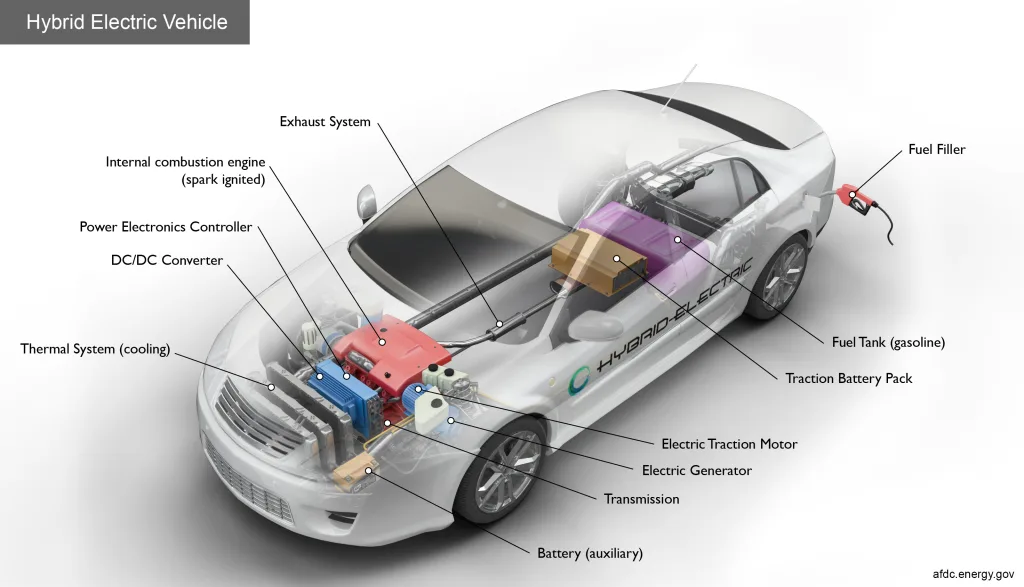
To understand how hybrids work, it helps to break the system into its main pieces.
1. Gasoline engine
The gasoline engine is still a core part of most hybrids. It may drive the wheels directly, help generate electricity, or both, depending on the type of hybrid system.
2. Electric motor
The electric motor helps move the vehicle and can reduce the amount of work the engine has to do. In some hybrids, it can move the car by itself for short periods or at lower speeds.
Toyota’s official Hybrids 101 explains this difference clearly by noting that Toyota’s “full hybrid” systems can run on electric power alone under certain conditions, unlike “mild hybrids” that always rely on the gas engine.
3. High-voltage battery
The battery stores electrical energy used by the motor. In a regular hybrid, this battery is charged automatically by the vehicle itself rather than by plugging in. Honda’s official Sport Hybrid i-MMD guide says the vehicle uses a high-voltage battery that receives charge from a generator driven by the engine or from regenerative braking.
4. Power control electronics
This is the part that manages the flow of electricity between the battery, motor, and engine. You do not usually think about it while driving, but it is one of the reasons hybrids can switch between modes so smoothly.
5. Regenerative braking system
This is one of the most important features in any hybrid. Instead of wasting most braking energy as heat, the system recovers some of that energy and turns it into electricity to recharge the battery. FuelEconomy.gov specifically identifies regenerative braking as one of the key technologies that improves hybrid efficiency. (FuelEconomy.gov)
How a hybrid car actually works while driving
This is where people often imagine something more complicated than it really feels from the driver’s seat. In real life, a hybrid usually behaves like a normal automatic car. The intelligence is happening in the background.
At low speeds, during gentle takeoff, or in stop-and-go traffic, the electric motor may handle more of the work. During stronger acceleration or higher-speed cruising, the gasoline engine may come on or take over more of the load. During braking or coasting, the car may recover energy and send it back into the battery.
Honda’s Sport Hybrid i-MMD description says the system uses both an electric motor and gasoline engine as propulsion sources, while the battery is charged by engine-driven generation and regenerative braking. Toyota’s How Does Toyota Hybrid System Work? likewise explains that the vehicle can blend gas and electric operation automatically without driver intervention.
So the simplest real-world explanation is this: the hybrid system constantly shifts between electric help, gasoline power, and energy recovery to reduce wasted fuel.
Do hybrid cars run only on electricity?
Sometimes, yes, but not in the same way as a fully electric car.
Many full hybrids can drive on electric power alone for short periods or under specific conditions, especially at low speed or during light throttle use. Toyota’s Hybrids 101 says Toyota’s full hybrids can run on electric power alone under certain conditions.
That does not mean a regular hybrid is an EV in disguise. The battery in a standard hybrid is much smaller than the battery in a full electric vehicle, and the car is not designed for long all-electric range. Its goal is efficiency, not extended electric-only driving.
Do you have to plug in a hybrid?
For a standard hybrid, no. That is one of the most common points of confusion.
Regular hybrids recharge themselves through regenerative braking and engine-generated electricity. You drive them like a normal gas car and refuel them at a gas station. There is no charging cable required.
This is different from a plug-in hybrid electric vehicle or PHEV. EPA’s electric and plug-in hybrid overview explains that PHEVs use both gasoline and electricity and can be charged by plugging in, while standard hybrid gasoline-electric vehicles are not treated the same way on federal fuel-economy labeling because they do not rely on external charging.
So if someone says “hybrid” without the word “plug-in,” they usually mean the kind that charges itself.
What is regenerative braking, and why does it matter?
Regenerative braking is one of the biggest reasons hybrids work so well in city driving.
In a normal gas car, much of the energy used to get the car moving is lost as heat when you brake. In a hybrid, the motor can act like a generator during deceleration, converting some of that motion back into electricity and storing it in the battery. FuelEconomy.gov describes regenerative braking as a system that recaptures energy that would otherwise be lost and uses it to recharge the battery. (FuelEconomy.gov)
That matters because it makes stop-and-go driving less wasteful. Instead of constantly burning fuel and throwing energy away at every red light, the hybrid recovers part of that energy and reuses it.
Why hybrids get better fuel economy
The fuel-economy gain does not come from one trick. It comes from several efficiency advantages working together.
These usually include:
- regenerative braking
- electric motor assistance during acceleration
- less engine idling
- better efficiency in low-speed or stop-and-go driving
- optimized engine operation
FuelEconomy.gov’s hybrid technology explanation points directly to those system-level advantages, including regenerative braking and electric assistance. (FuelEconomy.gov)
That is also why hybrids often shine in urban and suburban driving. City traffic gives them more chances to brake, recover energy, and use electric assistance.
What is the difference between a mild hybrid and a full hybrid?
This is one of the most important distinctions people miss.
A mild hybrid usually uses a smaller electric system to assist the engine, improve start-stop operation, and recover some braking energy, but it generally cannot drive the vehicle on electric power alone in the same meaningful way a full hybrid can.
A full hybrid can use the electric motor more actively and, in some systems, drive on electricity alone for limited conditions.
Toyota’s official Hybrids 101 draws this distinction directly by saying Toyota’s system is a full hybrid and that mild hybrids rely on the gasoline engine to power the vehicle at all times while the motor assists as needed.
That is a very useful distinction because shoppers sometimes assume all hybrids behave the same way. They do not.
What is the difference between a hybrid and a plug-in hybrid?
A regular hybrid charges itself through the engine and regenerative braking.
A plug-in hybrid has a larger battery that can be charged from an outside power source and can usually drive farther on electricity before the gas engine becomes necessary.
EPA explains that PHEVs have both a battery and an internal combustion engine and use both gasoline and electricity as fuel sources. The federal fuel-economy label also treats plug-in hybrids differently, because their operation includes both electric and gasoline driving modes. (EPA, EPA/FuelEconomy label guide)
So if you do not want to plug in a car at home or at charging stations, a regular hybrid is the simpler option.
Are hybrids complicated to drive?
No, not really. This is one of the easiest things to overthink.
Most hybrids feel very normal in everyday driving. You put the car in drive, use the accelerator and brake like usual, and let the system handle the energy flow. The complexity is in the engineering, not in the user experience.
Toyota’s hybrid education materials emphasize that the hybrid system automatically manages gas and electric operation. Honda’s i-MMD explanation similarly describes automatic switching between propulsion sources and internal charging. (Toyota, Honda PDF)
That is why hybrids became mainstream in the first place. They offer efficiency benefits without forcing the driver to completely relearn how to use the car.
What happens when the battery gets low?
In a normal hybrid, the car simply relies more on the gasoline engine and continues managing the battery through regeneration and engine-generated charging. The battery is not meant to be treated like the large traction battery in a full EV where you monitor state of charge closely for daily range planning.
Honda’s official hybrid system guide says the battery can be charged by the generator driven by the engine or by regenerative braking. That means the vehicle is designed to maintain its battery as part of normal operation rather than waiting for you to plug it in. (Honda PDF)
Why hybrids are different from full EVs
Full EVs run on electricity stored in a much larger battery and have no gasoline engine. EPA notes that EVs have a battery instead of a gasoline tank and an electric motor instead of an internal combustion engine. (EPA)
A hybrid still has a gasoline engine and still uses gasoline. It simply uses electricity more intelligently to reduce fuel consumption and improve efficiency.
That is why hybrids appeal to people who want better fuel economy without depending entirely on charging infrastructure.
Do hybrids save the most fuel in the city or on the highway?
Usually in the city, because that is where regenerative braking and electric assistance have the most chances to help. Stop-and-go traffic, lower speeds, and frequent deceleration play to a hybrid’s strengths.
On the highway, hybrids can still be efficient, but the advantage is often less dramatic because there are fewer braking events to recover energy and the vehicle may rely more steadily on the engine.
That is one reason many hybrid owners notice the biggest benefit in daily commuting and mixed-use driving rather than in long uninterrupted highway runs.
Are all hybrid systems the same?
No. Different manufacturers use different architectures and tuning priorities.
Toyota has long emphasized full-hybrid operation and electric-only capability under some conditions. Honda’s i-MMD system uses a different operating logic in many applications, with the electric motor playing a very central role in propulsion while the engine may generate electricity or drive directly depending on conditions. Toyota’s and Honda’s official explanations make clear that both systems are hybrids, but they are not carbon copies of each other. (Toyota, Honda PDF)
This matters because a hybrid’s driving feel can vary by brand and system design even if the basic idea is the same.
So how do hybrid cars work?
The cleanest answer is this: hybrid cars work by combining a gasoline engine with an electric motor and battery, then automatically shifting between or blending those power sources to reduce wasted energy and improve fuel efficiency. They recover some braking energy through regenerative braking, use stored electricity to help move the car, and recharge the battery internally in normal hybrid models. (FuelEconomy.gov)
Final verdict
If you want the real-world answer to how do hybrid cars work, it is this: a hybrid uses a gas engine, an electric motor, a battery, and energy recovery from braking to make everyday driving more efficient without forcing you to drive or fuel the car in a completely different way. Regular hybrids usually do not need to be plugged in, because they recharge themselves through regenerative braking and engine-driven generation. Plug-in hybrids are different because they can also charge from an external power source. (EPA, FuelEconomy.gov)
So the smartest short version is this: a hybrid car saves fuel by using electricity whenever it helps most, recovering energy that would otherwise be wasted, and reducing how hard the gasoline engine has to work. That is the whole game.
Connect with us


