




Special California Discounts – Claim Yours Now! Short answer: Jeep Wrangler’s fuel efficiency in California varies by model; generally, it’s around 17-25 MPG depending on engine and driving conditions. When considering the fuel efficiency of the Jeep Wrangler in California, several factors come into play, reflecting its adaptability to the diverse terrain and lifestyle of the Golden State. Short answer: Jeep Wrangler’s fuel efficiency in California varies by model; generally, it’s around 17-25 MPG depending on engine and driving conditions. Engine Options and Efficiency Ratings The Jeep Wrangler offers two primary engine options, each catering to different preferences for performance and fuel economy: 2.0L Turbocharged Inline-4 Engine: Known for its balance of power and efficiency, this engine delivers approximately 21 MPG in the city and 24 MPG on the highway. This makes it an ideal choice for drivers seeking a blend of responsive acceleration and fuel savings during both urban commutes and long-distance trips across California’s highways. 3.6L Pentastar V6 Engine: Recognized for its robust performance capabilities, the V6 engine provides around 17 MPG in city driving conditions and up to 25 MPG on the highway. It offers enhanced towing capacity and off-road prowess, making it suitable for those who prioritize power and versatility across California’s diverse landscapes. Practical Considerations and Driving Conditions Special California Discounts – Claim Yours Now! Fuel efficiency ratings can vary based on driving habits, terrain, and weather conditions unique to California. The Wrangler’s adaptable design ensures that whether navigating through congested Los Angeles traffic or exploring remote trails in the Mojave Desert, drivers can optimize their fuel consumption without sacrificing performance or capability. Urban Maneuverability: In city driving, frequent stops and accelerations can impact fuel efficiency negatively. The Wrangler’s compact size and efficient engine options help mitigate this by optimizing fuel use during urban commuting. Coastal Cruising and Open-Air Freedom: Driving with the top down or doors removed can increase aerodynamic drag, which may slightly decrease fuel efficiency at higher speeds. However, the enjoyment and experience gained often outweigh this minor decrease for enthusiasts. Off-Road Adventure: Off-roading demands more power and torque, which can increase fuel consumption. However, the Wrangler’s advanced 4×4 systems and terrain management systems are designed to optimize power delivery and traction, thereby balancing fuel efficiency with performance. Weather Adaptability and Comfort: Using heating or air conditioning can increase fuel consumption. The Wrangler’s efficient climate control systems help manage interior comfort while minimizing the impact on fuel efficiency, especially important in extreme weather conditions. Environmental Considerations: Engine efficiency and emissions control systems contribute significantly to fuel efficiency. The Wrangler’s modern engine designs and emissions technologies ensure compliance with environmental standards while optimizing fuel use. Overall, the Jeep Wrangler’s systems are designed to provide a balance between performance, capability, and fuel efficiency across various driving conditions in California, ensuring a versatile and enjoyable driving experience while minimizing environmental impact. Environmental Awareness and Compliance California’s stringent emissions standards and environmental initiatives influence the Wrangler’s design and engine technology. The Wrangler’s efficient engine options align with these standards, offering eco-conscious drivers a vehicle that minimizes environmental impact while maximizing adventure opportunities throughout the state. What is the fuel efficiency of a Jeep Wrangler in California? Hybrid options. The Jeep Wrangler 4xe is a plug-in hybrid variant that offers impressive fuel efficiency for its class, combining electric power with a gasoline engine to optimize performance and economy. Here’s a breakdown of its fuel efficiency: Electric-Only Range: The Wrangler 4xe can travel up to approximately 21 miles on electric power alone, making it ideal for short commutes and urban driving without consuming gasoline. Hybrid Mode Efficiency: When operating in hybrid mode, the Wrangler 4xe achieves an EPA-estimated fuel economy of around 49 MPGe (miles per gallon equivalent). This rating accounts for both electric and gasoline power sources, reflecting its efficiency in mixed driving conditions. Gasoline Engine Efficiency: When relying solely on its gasoline engine, the Wrangler 4xe achieves typical MPG figures comparable to conventional gasoline-powered SUVs, depending on driving habits and conditions. The Wrangler 4xe’s hybrid technology not only enhances fuel efficiency but also reduces emissions, making it a compelling choice for environmentally conscious drivers in California and beyond. Its versatility allows it to handle both urban comm Conclusion Understanding the fuel efficiency of the Jeep Wrangler in California underscores its versatility and practicality for drivers seeking both adventure and efficiency. Whether cruising along the Pacific Coast Highway, tackling off-road trails in the Sierra Nevada, or navigating city streets in San Francisco, the Wrangler’s efficient engine options ensure that Californians can enjoy the journey while minimizing fuel costs and environmental footprint. By offering a balance of performance, capability, and eco-friendliness, the Jeep Wrangler continues to be a reliable choice for drivers across California who value both adventure and responsible driving practices in one iconic vehicle. Special California Discounts – Claim Yours Now!
Shocking Truth: Jeep 4XE Owners Left Powerless? The Charging Secret They Don't Want You to Know!
Special California Discounts – Claim Yours Now! Does the Jeep 4xe Come with a Charger? The Jeep Wrangler 4xe represents a significant step forward in automotive innovation, combining legendary off-road capabilities with modern hybrid technology. As more consumers consider the transition to hybrid vehicles, understanding the charging infrastructure becomes crucial. One of the common questions prospective buyers ask is, “Does the Jeep 4xe come with a charger?” This article explores the answer to that question and provides insights into the charging options for the Jeep Wrangler 4xe. Standard Charging Equipment Yes, the Jeep Wrangler 4xe does come with a charger. When you purchase a new Jeep Wrangler 4xe, it includes a Level 1 (120-volt) charging cable as standard equipment. This charger can be plugged into any standard household outlet, making it convenient for everyday use. The Level 1 charger is ideal for overnight charging, especially if you have a typical daily commute or use your Jeep for short trips around town. Charging Time with Level 1 Charger The Level 1 charger included with the Jeep 4xe can fully charge the vehicle’s battery in approximately 12-14 hours. This charging time is suitable for those who can leave their vehicle plugged in overnight or during extended periods when the vehicle is not in use. However, for those who require faster charging, there are additional options available. Upgrading to a Level 2 Charger Special California Discounts – Claim Yours Now! For those seeking quicker charging times, upgrading to a Level 2 (240-volt) charger is an excellent option. While the Level 2 charger is not included with the vehicle, it can be purchased separately and professionally installed at your home. A Level 2 charger can significantly reduce the charging time to around 2-3 hours for a full charge, offering greater convenience for those with busy schedules. Public Charging Stations In addition to home charging options, the Jeep Wrangler 4xe can be charged at public Level 2 charging stations, which are increasingly available in various locations, including shopping centers, workplaces, and public parking areas. Many of these stations offer convenient app-based payment systems and provide real-time information about charger availability. Jeep’s Partnership with Electrify America Special California Discounts – Claim Yours Now! To enhance the charging experience for its customers, Jeep has partnered with Electrify America, one of the largest public charging networks in the United States. Through this partnership, Jeep 4xe owners can access numerous charging stations nationwide, providing additional convenience for long-distance travel and daily use. Some Jeep dealerships also offer charging stations, allowing you to charge your vehicle while servicing or shopping for accessories. Installation of a Level 2 Charger If you decide to upgrade to a Level 2 charger, it’s essential to consider the installation process. Here are some steps to follow: Assessment: Have a licensed electrician assess your home’s electrical system to ensure it can support a Level 2 charger. Purchase: Choose a compatible Level 2 charger that meets your needs and budget. Installation: Have the Level 2 charger professionally installed by the electrician. This process typically involves installing a dedicated 240-volt circuit. Testing: Ensure the charger is properly installed and functioning correctly by testing it with your Jeep 4xe. Benefits of Owning a Charger Special California Discounts – Claim Yours Now! Owning a charger, whether Level 1 or Level 2, offers several benefits: Convenience: Charge your vehicle at home without the need to visit public charging stations frequently. Cost Savings: Charging at home can be more cost-effective than using public charging stations, especially if you take advantage of off-peak electricity rates. Readiness: Always have your vehicle ready to go with a full charge, enhancing your driving experience and reducing range anxiety. Conclusion The Jeep Wrangler 4xe comes standard with a Level 1 charger, providing a convenient and accessible way to charge your vehicle using a standard household outlet. For those seeking faster charging times, upgrading to a Level 2 charger is a viable option that significantly reduces charging time. With the increasing availability of public charging stations and Jeep’s partnership with Electrify America, charging your Jeep 4xe has never been more convenient. Whether you choose to stick with the included Level 1 charger or upgrade to a Level 2 charger, the Jeep Wrangler 4xe offers flexible and practical charging solutions to meet your needs. Special California Discounts – Claim Yours Now!
Is the 4XE Good Off-Road?
Is the 4XE good off-road? How Far Can a Jeep Wrangler 4xe Go in Hybrid Mode? Special California Discounts – Claim Yours Now! The Jeep Wrangler 4xe is a groundbreaking vehicle that combines the rugged capability of a traditional Wrangler with the efficiency of a plug-in hybrid electric vehicle (PHEV). One of the key questions potential buyers have is how far the Wrangler 4xe can travel in hybrid mode. This article explores the range capabilities of the Jeep Wrangler 4xe when utilizing its hybrid mode, highlighting its performance, efficiency, and real-world usability. Understanding Hybrid Mode Hybrid mode in the Jeep Wrangler 4xe allows the vehicle to use both its electric motor and gasoline engine. This mode is designed to optimize fuel efficiency and extend the overall driving range. The Wrangler 4xe’s powertrain consists of a 2.0-liter turbocharged inline-four engine paired with an electric motor and a 17.3 kWh battery pack. Electric-Only Range Special California Discounts – Claim Yours Now! Before diving into the hybrid mode range, it’s important to note the electric-only range of the Jeep Wrangler 4xe. When fully charged, the vehicle can travel up to 21 miles purely on electric power. This is ideal for short commutes, city driving, and reducing emissions during everyday trips. Hybrid Mode Range When operating in hybrid mode, the Jeep Wrangler 4xe utilizes both the gasoline engine and the electric motor to maximize efficiency. Here are the key factors that influence its range in this mode: Combined Fuel Efficiency: The EPA estimates that the Jeep Wrangler 4xe achieves a combined fuel economy of 49 MPGe (miles per gallon equivalent) when using both the electric motor and gasoline engine. Total Driving Range: With a full tank of gas and a fully charged battery, the total driving range of the Jeep Wrangler 4xe in hybrid mode is approximately 370 miles. This includes the initial 21 miles of electric-only driving and the extended range provided by the gasoline engine. Fuel Tank Capacity: The Wrangler 4xe has a fuel tank capacity of 17.2 gallons. This ample fuel capacity, combined with the hybrid powertrain, contributes to its impressive overall range. Factors Affecting Hybrid Mode Range Special California Discounts – Claim Yours Now! Several factors can influence the actual range you achieve in hybrid mode: Driving Habits: Aggressive driving, rapid acceleration, and high speeds can reduce overall fuel efficiency and hybrid range. Terrain: Hilly or mountainous terrain can impact fuel consumption. However, regenerative braking in hybrid mode can help recapture some energy when descending slopes. Weather Conditions: Extreme temperatures can affect battery performance and fuel efficiency. Using climate control systems like heating or air conditioning can also impact range. Payload and Towing: Carrying heavy loads or towing can increase fuel consumption and reduce the overall range. Real-World Usability In real-world scenarios, the Jeep Wrangler 4xe’s hybrid mode provides a versatile driving experience. For daily commuting, many drivers find that the electric-only range covers most of their short trips, reducing the need for gasoline. For longer journeys, the seamless transition between electric and gasoline power ensures that the vehicle remains efficient and capable. Conclusion Special California Discounts – Claim Yours Now! The Jeep Wrangler 4xe offers an impressive range in hybrid mode, combining the benefits of electric driving with the extended range of a gasoline engine. With a total driving range of approximately 370 miles, it’s well-suited for a variety of driving conditions, from daily commutes to long road trips. For more detailed information and to explore the Jeep Wrangler 4xe’s capabilities further, consider visiting Simi Valley Chrysler Dodge Jeep Ram (CDJR), where knowledgeable staff can provide personalized guidance and support. Additional Resources For further reading and to explore more about the Jeep Wrangler 4xe, check out these resources: Jeep Official Website: Comprehensive specifications and features of the Jeep Wrangler 4xe. Edmunds: Expert reviews and insights on the Jeep Wrangler 4xe’s performance. Kelley Blue Book: Vehicle ratings and detailed guides on the Jeep Wrangler 4xe. Autotrader: Listings and comparisons for the Jeep Wrangler 4xe. Is the 4XE good off-road? write a full article wit a ton of links includedChatGPT Is the Jeep Wrangler 4xe Good Off-Road? The Jeep Wrangler 4xe, Jeep’s first plug-in hybrid electric vehicle (PHEV), is a groundbreaking addition to the Wrangler lineup. Known for its off-road prowess, the Wrangler has a reputation for tackling the toughest terrains. But does the hybrid 4xe live up to the legendary off-road capabilities of its predecessors? This article delves into the off-road performance of the Jeep Wrangler 4xe, examining its features, capabilities, and how it compares to traditional gas-powered models. Off-Road Capabilities of the Jeep Wrangler 4xe The Jeep Wrangler 4xe combines a 2.0-liter turbocharged inline-four engine with an electric motor and a 17.3 kWh battery pack. This setup offers several advantages for off-road enthusiasts: Instant Torque from Electric Motor: One of the key benefits of the hybrid powertrain is the immediate torque provided by the electric motor. This instant torque is particularly useful in off-road situations where precise power delivery is essential. Trail Rated Badge: The Jeep Wrangler 4xe proudly wears the Trail Rated badge, indicating it has passed rigorous off-road tests. This includes water fording, maneuverability, articulation, ground clearance, and traction. Selec-Trac® Full-Time 4×4 System: The Wrangler 4xe comes equipped with the Selec-Trac® full-time 4×4 system, which automatically switches between two-wheel drive and four-wheel drive as needed. This system ensures optimal traction on various terrains. Off-Road Pages: The Off-Road Pages feature provides real-time data on key off-road metrics such as wheel articulation, transmission temperature, and more. This information helps drivers navigate challenging trails with confidence. Regenerative Braking: Regenerative braking is another advantage, allowing the 4xe to recover energy while descending hills. This feature not only extends battery life but also enhances control during downhill maneuvers. Comparing to Traditional Gas-Powered Models Special California Discounts – Claim Yours Now! The Jeep Wrangler 4xe maintains many of the features that make the traditional Wrangler a favorite among off-road enthusiasts: Ground Clearance: With a ground clearance of 10.8 inches, the 4xe can easily navigate over rocks, logs, and other obstacles commonly found on trails. Water Fording: The 4xe is capable of fording water up to 30 inches deep, ensuring it can handle river crossings and muddy trails without issue. Articulation and Suspension: The solid front and rear axles, combined with the advanced suspension system, provide excellent articulation. This ensures that the 4xe maintains contact with the ground, even on uneven terrain. Skid Plates and Tow Hooks: Standard skid plates protect the undercarriage from damage, while tow hooks provide recovery points if the vehicle gets stuck. Real-World Off-Road Performance In real-world off-road scenarios, the Jeep Wrangler 4xe has proven to be a formidable performer: Silent Operation: One unique advantage of the 4xe is its ability to operate in electric mode, which is nearly silent. This can enhance the off-road experience, allowing drivers to better hear their surroundings. Electric-Only Range: With an electric-only range of up to 21 miles, the 4xe can tackle trails without using a drop of gasoline. This is particularly beneficial for short off-road excursions. Charging Infrastructure: While charging infrastructure is not typically available on trails, the 4xe’s ability to switch to gasoline power ensures that range anxiety is not an issue. Expert Reviews and Resources Special California Discounts – Claim Yours Now! For more detailed insights and reviews on the off-road capabilities of the Jeep Wrangler 4xe, check out these resources: Simi Valley Chrysler Dodge Jeep Ram (CDJR): Explore detailed information and get personalized assistance on the Jeep Wrangler 4xe. Jeep Official Website: Comprehensive specifications, features, and off-road capabilities of the Jeep Wrangler 4xe. Edmunds: Expert reviews and insights on the Jeep Wrangler 4xe’s performance, including off-road capabilities. MotorTrend: In-depth articles and reviews on the Jeep Wrangler 4xe, highlighting its off-road performance. Car and Driver: Reviews and comparisons of the Jeep Wrangler 4xe with other off-road vehicles. Four Wheeler: Dedicated to off-road enthusiasts, this site offers detailed reviews and tests of the Jeep Wrangler 4xe. Conclusion The Jeep Wrangler 4xe proves that hybrid technology and off-road capability can go hand in hand. With its instant torque, advanced 4×4 systems, and Trail Rated badge, the 4xe is more than capable of tackling challenging terrains. Whether you’re a seasoned off-roader or a newcomer looking for a versatile and eco-friendly vehicle, the Jeep Wrangler 4xe offers a unique blend of traditional Jeep capability and modern hybrid efficiency. For more information and to experience the 4xe firsthand, visit Simi Valley CDJR and explore the future of off-road driving. Special California Discounts – Claim Yours Now!
Is it Better to Lease or Buy a Car in Los Angeles?
Special California Discounts – Claim Yours Now! Is it Better to Lease or Buy a Car in Los Angeles? Leasing vs. Buying a Car in LA: A Comprehensive Guide The decision between leasing and buying a car in Los Angeles can significantly impact your finances, lifestyle, and future flexibility. With the ever-rising cost of living in LA and the variety of transportation needs, it’s crucial to weigh both options thoroughly. Explore Affordable Lease Deals in LA 1. Cost Comparison: Monthly Payments One of the most critical factors when deciding between leasing and buying is the monthly payment. Leasing generally offers lower monthly payments compared to financing a car purchase. Leasing Buying Lower monthly payments Higher monthly payments No ownership You own the car after the loan term Ideal for driving newer models Better long-term value if you keep the car Is it Better to Lease or Buy a Car in Los Angeles? Explore Affordable Lease Deals in LA For example, leasing a new car like the Jeep Grand Cherokee might cost $300-$500 per month, while buying could land you in the $600-$800 range for the same model, depending on the down payment and loan terms . Special California Discounts – Claim Yours Now! 2.Is it Better to Lease or Buy a Car in Los Angeles? Ownership and Long-term Investment When you lease a car, you never own it. After your lease term (usually 2-3 years), you return the vehicle. Buying, on the other hand, gives you full ownership, offering long-term savings, especially if you plan to drive the car for many years. Leasing Buying No ownership Full ownership after loan term No equity Builds equity over time Always under warranty Cost of maintenance increases as car ages Is it Better to Lease or Buy a Car in Los Angeles? If you’re looking to keep a car for more than five years, buying could be more cost-effective as you build equity and avoid continual monthly payments after your loan term ends . Explore affordable Lease Deals in LA 3. Is it Better to Lease or Buy a Car in Los Angeles? Mileage Limits Leasing contracts come with mileage restrictions, typically around 12,000-15,000 miles per year. In a sprawling city like Los Angeles, where you may find yourself driving long distances between work, home, and leisure activities, mileage caps could become an issue. Leasing Buying Mileage limits (12k-15k/year) Unlimited mileage Over-limit fees can be expensive No penalties for extra miles Is it Better to Lease or Buy a Car in Los Angeles? Exceeding your mileage limit in a lease can cost between 15-30 cents per additional mile, adding significant costs by the end of the lease term . Explore affordable lease deals in LA 4. Maintenance and Repairs Special California Discounts – Claim Yours Now! Leasing generally means you’re always driving a new car under warranty, so you won’t pay for major repairs. On the other hand, buying could lead to higher repair costs as the car ages, but you won’t have ongoing lease payments. Leasing Buying Maintenance often covered by warranty Repair costs increase as car ages Less likely to experience major repairs Higher long-term maintenance costs Regular dealer service required Freedom to choose your mechanic Is it Better to Lease or Buy a Car in Los Angeles? For those who prefer low-hassle ownership, leasing can offer peace of mind with minimal out-of-pocket repair costs . Explore affordable lease deals in LA 5.Is it Better to Lease or Buy a Car in Los Angeles? Tax Implications In California, the tax situation can be different for leasing versus buying. When leasing, you pay taxes only on the portion of the car you use, while purchasing a car involves paying sales tax on the total price. Leasing Buying Pay tax on monthly payments Pay tax on full purchase price Lower tax burden Higher upfront tax cost Is it Better to Lease or Buy a Car in Los Angeles? In Los Angeles, where taxes can significantly impact your total out-of-pocket cost, leasing might offer a slight advantage in terms of lower taxes . Explore affordable lease deals in LA 6. Flexibility and Lifestyle in LA Los Angeles is a fast-paced city, and residents’ transportation needs can change rapidly. Leasing gives you the flexibility to switch vehicles every few years. If you’re someone who enjoys driving the latest models and advanced technology, leasing allows you to upgrade more frequently. Leasing Buying Easy to upgrade every 2-3 years Keep the same car for 5-10 years Ideal for those who like new tech Good for those who prefer long-term value Good for uncertain needs Not ideal if you want flexibility in the short-term Is it Better to Lease or Buy a Car in Los Angeles? For people who move often or have changing commute needs, leasing provides the benefit of adjusting your vehicle more easily. Explore affordable lease deals in LA Special California Discounts – Claim Yours Now! Conclusion: The choice between leasing and buying in Los Angeles depends heavily on your financial situation, driving habits, and lifestyle preferences. Leasing offers lower monthly payments, less commitment, and access to newer cars, which might be appealing for city dwellers who value flexibility. Buying, on the other hand, is better suited for those looking for long-term savings, ownership, and unlimited driving potential. Is It Better to Lease or Buy a Car in LA? – Edmunds Leasing vs. Buying in Los Angeles – Autotrader Pros and Cons of Leasing in LA – Consumer Reports Lease vs. Buy in LA: Best Options – US News Exploring Car Lease Deals in LA – Consumer Auto ( Consumer Auto) Lease vs. Finance a Car: 5 Things to Consider – Autotrader ( Autotrader) The Benefits of Leasing in LA – LeaseGuide Buy or Lease a Car in LA? – TrueCar LA Car Leasing Tips – Bankrate Lease vs. Buy: Los Angeles Edition – CarsDirect Should I Lease or Buy a Car in LA? – NerdWallet Los Angeles Leasing Advantages – Car and Driver Best Car Lease Deals in Los Angeles – CarBuzz Los Angeles Auto Leasing Guide – Kelley Blue Book Leasing in LA: How It Works – Investopedia
What Can a 2017 Jeep Grand Cherokee Tow?
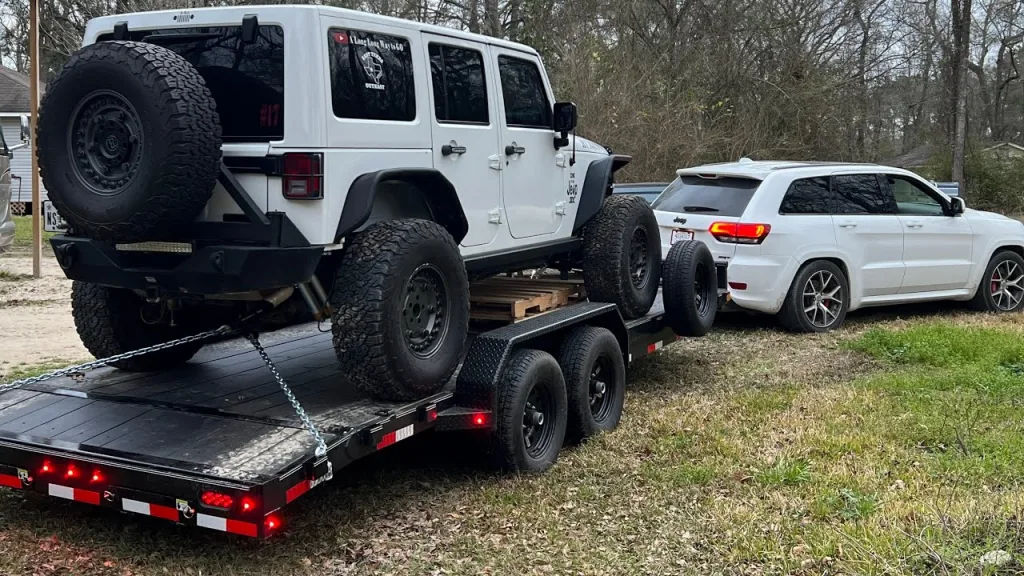
What Can a 2017 Jeep Grand Cherokee Tow? A 2017 Jeep Grand Cherokee can tow up to 7,400 pounds when properly equipped, but the exact number depends on the engine, drivetrain, and factory towing equipment. The simple answer is this: the 3.6L V6 can tow up to 6,200 pounds, while the 5.7L HEMI V8 and 3.0L EcoDiesel can tow up to 7,200 pounds with 4WD or up to 7,400 pounds with 2WD. Edmunds notes that the EcoDiesel and HEMI V8 4x4 models are rated at 7,200 pounds, two-wheel-drive models can tow 7,400 pounds, and gasoline V6 models can tow 6,200 pounds. Edmunds 2017 Jeep Grand Cherokee Towing Capacity by Engine The 2017 Grand Cherokee had several engine choices, and towing capacity changes by engine. 3.6L Pentastar V6: up to 6,200 pounds 5.7L HEMI V8: up to 7,200 pounds 4WD or 7,400 pounds 2WD 3.0L EcoDiesel V6: up to 7,200 pounds 4WD or 7,400 pounds 2WD 6.4L SRT V8: commonly rated around 7,200 pounds The official FCA Canada specification sheet for the 2017 Grand Cherokee lists towing by engine and axle ratio, confirming the V6 and V8/EcoDiesel tow-rating split. FCA 2017 Grand Cherokee specifications What Can the 3.6L V6 Grand Cherokee Tow? The 3.6L V6 Grand Cherokee can tow up to 6,200 pounds when properly equipped. That is enough for many midsize trailers, small campers, utility trailers, motorcycles, ATVs, small boats, and lightweight travel trailers. The V6 is the most common engine in the 2017 Grand Cherokee, so this is the number many used shoppers should pay attention to. Do not assume every V6 Grand Cherokee is ready for 6,200 pounds. You still need the correct hitch, wiring, cooling setup, trailer brakes, payload capacity, and properly loaded trailer. What Can the 5.7L HEMI Grand Cherokee Tow? The 5.7L HEMI V8 is the stronger towing choice. A properly equipped 2017 Grand Cherokee with the HEMI V8 can tow up to 7,200 pounds in 4WD form and up to 7,400 pounds in 2WD form, depending on configuration. The HEMI gives you more torque, easier acceleration with a trailer, and better confidence when towing heavier loads. If you regularly tow near the upper end of the Grand Cherokee’s rating, the V8 is usually the smarter choice than the V6. What Can the EcoDiesel Grand Cherokee Tow? The 3.0L EcoDiesel V6 is also a strong towing engine. Like the HEMI, properly equipped EcoDiesel models can tow up to 7,200 pounds with 4WD or 7,400 pounds with 2WD. The diesel’s biggest advantage is torque and highway efficiency under load. The tradeoff is complexity. Used EcoDiesel buyers should inspect emissions-system history, service records, fuel-system condition, recall completion, oil-change history, and repair records carefully. What Can the Grand Cherokee SRT Tow? The 2017 Grand Cherokee SRT with the 6.4L V8 is commonly rated around 7,200 pounds. It has plenty of power, but it is not the most practical towing-focused Grand Cherokee because it is performance-oriented. Tires, brakes, suspension setup, fuel cost, and vehicle condition matter a lot. If towing is the main priority, the HEMI V8 or EcoDiesel Grand Cherokee is usually the cleaner choice. If you want performance first and occasional towing second, the SRT can still be capable. Does Every 2017 Grand Cherokee Tow the Same? No. Trim alone does not decide towing capacity. A Laredo, Limited, Trailhawk, Overland, Summit, or SRT can have different tow ratings depending on engine, drivetrain, equipment, and factory towing package. For example, Edmunds lists a 2017 Grand Cherokee Summit with the 3.6L V6 at up to 6,200 pounds of towing capacity. Edmunds Summit specs That is why you should check the specific vehicle, not just the model name. What Equipment Do You Need to Tow Safely? To use the full towing capacity, the Grand Cherokee needs the correct towing equipment. That can include: Factory trailer tow package. Class IV receiver hitch. Trailer wiring. Transmission cooling. Engine cooling. Trailer brake controller for heavier trailers. Proper ball mount and hitch rating. Correct tire pressure. Trailer brakes when required. Weight-distribution equipment when appropriate. The tow rating is not just about engine power. It is about the whole setup. Payload Matters Too Payload is where many people make mistakes. Payload includes passengers, cargo, hitch weight, tools, luggage, pets, accessories, and anything else added to the vehicle. Trailer tongue weight also counts against payload. A trailer may be under the tow rating but still overload the Grand Cherokee if the tongue weight is too high or the cabin is full of passengers and gear. Check the driver-side door sticker for the exact payload rating of your specific vehicle. What Trailer Size Makes Sense? For a V6 Grand Cherokee, staying well below the 6,200-pound maximum is usually smarter for comfort and safety. For regular towing, a loaded trailer in the 3,500 to 5,000-pound range is a more comfortable zone for many V6 models. For HEMI or EcoDiesel models, towing in the 5,000 to 6,500-pound range can be more comfortable, assuming the vehicle is properly equipped and the trailer is loaded correctly. Max tow ratings are best treated as limits, not targets. Can a 2017 Grand Cherokee Tow a Camper? Yes, a 2017 Jeep Grand Cherokee can tow many campers. A V6 model can handle lightweight travel trailers, pop-up campers, and smaller campers if properly equipped. A HEMI or EcoDiesel model can handle heavier campers, but you still need to check loaded trailer weight, tongue weight, payload, and brake requirements. Do not use dry trailer weight alone. Campers get heavier when loaded with propane, water, batteries, food, gear, and accessories. Can It Tow a Boat? Yes. The 2017 Grand Cherokee can tow many small and midsize boats. A V6 model can handle many fishing boats, personal watercraft trailers, and smaller bowriders. HEMI and EcoDiesel models are better for heavier boats. Remember to include trailer weight, fuel, gear, and equipment when calculating total towing weight. Can It Tow a Car Trailer? Sometimes, but be careful. A full car trailer plus a vehicle can quickly exceed the Grand Cherokee’s practical limits. A small lightweight trailer with a small car may fit within the rating, but many car-hauler setups are too heavy once loaded. If you are towing vehicles regularly, a Ram 1500 or Ram 2500 is usually a better tool. Final Answer A 2017 Jeep Grand Cherokee can tow between 6,200 and 7,400 pounds, depending on engine and drivetrain. The 3.6L V6 can tow up to 6,200 pounds. The 5.7L HEMI V8 and 3.0L EcoDiesel can tow up to 7,200 pounds with 4WD or 7,400 pounds with 2WD when properly equipped. The SRT is commonly rated around 7,200 pounds. For the safest answer, check the VIN, factory tow package, door sticker, hitch rating, payload, and owner’s manual before towing.
Which Jeep Wrangler is Best on Gas?
Special California Discounts – Claim Yours Now! Understanding why different Jeep Wrangler models have varying fuel economy involves considering several factors such as engine type, vehicle weight, drivetrain, and aerodynamic design. Here’s a breakdown of why the fuel efficiency varies among the Jeep Wrangler models: 1. Jeep Wrangler Sport S (2-Door and 4-Door) Engine: 3.6L V6 Fuel Economy: City: 17 MPG Highway: 23 MPG Combined: 19 MPG Explanation: The Jeep Wrangler Sport S models are powered by the 3.6-liter V6 engine, which provides strong performance but also consumes more fuel compared to smaller or more advanced engines. The relatively low fuel economy is due to the Wrangler’s rugged design, which includes heavy-duty components and a high center of gravity that increase aerodynamic drag and overall weight. Additionally, the 4WD system contributes to lower fuel efficiency as it adds extra weight and mechanical complexity. Special California Discounts – Claim Yours Now! 2. Jeep Wrangler Sahara (4-Door) Engine: 3.6L V6 Fuel Economy: City: 18 MPG Highway: 23 MPG Combined: 20 MPG Explanation: The Sahara trim also uses the 3.6L V6 engine but tends to offer slightly better fuel efficiency compared to the Sport S models. This improvement is due to the Sahara’s design, which focuses on a balance between off-road capability and on-road comfort. The Sahara may feature more aerodynamic enhancements and lighter materials compared to the Rubicon, contributing to its slightly better fuel economy. Special California Discounts – Claim Yours Now! 3. Jeep Wrangler Rubicon (2-Door and 4-Door) Engine: 3.6L V6 Fuel Economy: City: 17 MPG Highway: 22 MPG Combined: 19 MPG Explanation: The Rubicon trim is designed for serious off-road capability, which involves heavier-duty components such as reinforced axles and larger tires. These features increase rolling resistance and vehicle weight, leading to lower fuel economy compared to other trims. The Rubicon’s off-road gear, including locking differentials and a more robust suspension system, further contributes to its decreased fuel efficiency. Special California Discounts – Claim Yours Now! 4. Jeep Wrangler 4xe (Plug-In Hybrid) Engine: 2.0L Turbocharged Inline-4 with Electric Motor Fuel Economy: City: 49 MPGe (Combined Electric and Gas) Highway: 44 MPGe Combined: 47 MPGe (Electric Only) Explanation: The Wrangler 4xe is a plug-in hybrid model that combines a 2.0-liter turbocharged inline-4 engine with an electric motor. This hybrid setup allows for impressive fuel efficiency, especially when operating in electric-only mode. The high MPGe ratings are due to the electric motor’s ability to reduce reliance on gasoline and the hybrid system’s efficiency in converting energy. The 4xe’s advanced technology enables it to achieve significantly higher fuel economy compared to traditional gasoline models. Factors Influencing Fuel Economy Engine Size and Type: Larger engines generally consume more fuel. The 3.6L V6 engines in most Wranglers are powerful but less fuel-efficient than smaller or hybrid engines. Vehicle Weight: Heavier vehicles require more energy to move. The Rubicon’s off-road enhancements add weight, reducing fuel efficiency. Drivetrain and 4WD: Four-wheel drive systems add weight and increase mechanical resistance, which can decrease fuel economy. Aerodynamics: The Wrangler’s design prioritizes off-road capability over aerodynamic efficiency, which can negatively impact highway fuel economy. Hybrid Technology: The Wrangler 4xe benefits from electric propulsion, which reduces gasoline consumption and enhances overall fuel efficiency. By understanding these factors, you can better appreciate why each Jeep Wrangler model has its specific fuel economy ratings and choose the model that best fits your driving needs and preferences. Ready to find your next lease deal? Visit the dealerships in Simi Valley today! Simi Valley Chrysler Dodge Jeep Ram
How Fast Does a Dodge Hornet Go?
How Fast Does a Dodge Hornet Go? The Dodge Hornet is a fresh entrant in the compact crossover SUV market, blending sporty design with practical utility. As a new addition to Dodge’s lineup, the Hornet promises a dynamic driving experience that reflects the brand’s performance heritage. One of the key aspects that enthusiasts and potential buyers often inquire about is its speed and acceleration capabilities. Let’s dive into the specifics of how fast the Dodge Hornet can go and what contributes to its performance. How Fast Does a Dodge Hornet Go? Engine Options and Power The Dodge Hornet offers two main engine configurations: the GT and the R/T. Each provides a different level of performance to cater to various driving preferences. Hornet GT: This model is equipped with a turbocharged 2.0-liter inline-four engine. It produces 268 horsepower and 295 lb-ft of torque. This engine delivers a balanced combination of power and efficiency, making it suitable for both daily driving and spirited driving sessions. Hornet R/T: The R/T variant enhances performance with a plug-in hybrid system. It combines the same 2.0-liter engine with an electric motor, resulting in a total output of 288 horsepower. This setup not only boosts the Hornet’s performance but also offers the benefit of electric-only driving for short distances. Special California Discounts – Claim Yours Now! How Fast Does a Dodge Hornet Go? Acceleration and Speed The acceleration capabilities of the Dodge Hornet vary depending on the model: Hornet GT: The GT version can accelerate from 0 to 60 mph in approximately 6.5 seconds. This is a respectable time for a compact SUV, providing a lively driving experience that is both responsive and engaging. The GT’s acceleration is enhanced by its turbocharged engine, which delivers a robust performance for its class. Hornet R/T: The R/T, with its hybrid powertrain, offers a similar acceleration performance to the GT, reaching 60 mph in around 6.5 seconds. The additional power from the electric motor contributes to a smooth and responsive acceleration experience, though the difference in acceleration between the GT and R/T is minimal. In terms of top speed, the Hornet is not built for high-speed performance in the same way as dedicated sports cars. The top speed of the Hornet is estimated to be around 130 mph, which is competitive within the compact SUV segment but falls short compared to high-performance vehicles. Special California Discounts – Claim Yours Now! How Fast Does a Dodge Hornet Go? Driving Dynamics and Handling While speed is an important aspect of performance, handling and driving dynamics also play a crucial role in the overall driving experience. The Dodge Hornet is designed to offer a balanced ride with responsive handling. Its sport-tuned suspension provides good cornering abilities and a comfortable ride, making it suitable for both city driving and occasional spirited drives. The Hornet’s compact size and nimble handling make it agile in urban environments, while its robust engine options ensure it can keep up with highway speeds and perform well in various driving conditions. Comparison to Peers When compared to other vehicles in its class, the Dodge Hornet holds its own with competitive acceleration and top speed. However, it is not designed to compete with high-performance SUVs or sports cars. Instead, it offers a blend of practicality, efficiency, and sporty driving characteristics. For those seeking a vehicle with superior speed and acceleration, performance-oriented models like the Dodge Hellcat or high-end sports cars will provide significantly faster performance. The Hornet, while quick for a compact SUV, is intended to offer a balance of performance and practicality rather than outright speed. Special California Discounts – Claim Yours Now! How Fast Does a Dodge Hornet Go? Conclusion In summary, the Dodge Hornet is a capable and sporty compact crossover with respectable acceleration and speed. The Hornet GT and R/T models offer similar 0-60 mph times of around 6.5 seconds, making them quick for their class. The Hornet’s top speed is approximately 130 mph, which is competitive within the compact SUV segment but not in the realm of high-performance vehicles. Overall, the Hornet provides a dynamic driving experience that blends practicality with a touch of sporty flair, making it an appealing choice for those seeking a versatile and engaging crossover. Dodge Hornet Official Website Car and Driver – 2023 Dodge Hornet Review MotorTrend – 2023 Dodge Hornet Performance Edmunds – 2023 Dodge Hornet Review Autotrader – 2023 Dodge Hornet Specs
Is the Dodge Charger Hellcat Fast? An In-Depth Analysis
Is the Dodge Charger Hellcat Fast? An In-Depth Analysis The Dodge Charger Hellcat has earned a reputation as one of the most powerful and fastest sedans on the market. With its aggressive styling and an array of impressive specifications, it’s no wonder car enthusiasts and casual drivers alike are curious about its performance. In this article, we’ll explore what makes the Hellcat so fast, its performance metrics, and how it compares to competitors. New Dodge Chargers Used Dodge Chargers Performance Specs Engine Power: The heart of the Charger Hellcat is its supercharged 6.2-liter HEMI V8 engine, which produces a jaw-dropping 707 horsepower and 650 lb-ft of torque. This immense power allows the Charger to accelerate from 0 to 60 mph in just about 3.6 seconds, depending on conditions. Top Speed: The Dodge Charger Hellcat boasts a top speed of approximately 196 mph. This makes it one of the fastest sedans available, capable of competing with high-performance sports cars. Transmission: The Hellcat comes equipped with an 8-speed automatic transmission, which provides quick and smooth gear changes, enhancing acceleration and overall driving dynamics. Drivetrain: The rear-wheel-drive layout contributes to a more engaging driving experience, allowing for better power delivery and control during high-speed maneuvers. New Dodge Chargers Used Dodge Chargers Is the Dodge Charger Hellcat Fast? Factors Influencing Speed Weight: Weighing around 4,500 pounds, the Hellcat is heavier than many sports cars, but its powerful engine compensates for this weight, allowing for impressive acceleration and handling. Aerodynamics: The Charger’s design incorporates aerodynamic elements that reduce drag, which is essential for achieving high speeds. Features like a rear spoiler and sculpted body lines help maintain stability at high velocities. Tires and Traction: The Hellcat is equipped with high-performance tires that provide excellent grip, allowing for better acceleration and cornering. Proper tire maintenance is crucial for optimal performance. Driving Modes: The Charger Hellcat offers various driving modes, including Track Mode, which optimizes throttle response and stability control for maximum performance. This feature allows drivers to tailor their driving experience to their preferences and conditions. New Dodge Chargers Used Dodge Chargers Is the Dodge Charger Hellcat Fast? Real-World Performance Numerous tests and reviews have confirmed the Charger Hellcat’s impressive performance. In various automotive publications, it has been praised for its exhilarating acceleration, sharp handling, and overall driving experience. Here are some resources that highlight the Charger Hellcat’s speed and performance: MotorTrend Review of the Dodge Charger Hellcat Car and Driver: Dodge Charger Hellcat Review Edmunds: Dodge Charger Hellcat Overview Top Speed: Dodge Charger Hellcat Specs and Performance AutoWeek: Why the Hellcat Is a Must-Drive New Dodge Chargers Used Dodge Chargers Is the Dodge Charger Hellcat Fast? Comparison with Competitors The Charger Hellcat faces stiff competition in the high-performance sedan category. Vehicles like the Ford Mustang Shelby GT500 and Chevrolet Camaro ZL1 offer similar horsepower and performance metrics. However, the Charger stands out with its four-door configuration, making it a practical choice for families or those needing extra space without sacrificing speed. New Dodge Chargers Used Dodge Chargers Is the Dodge Charger Hellcat Fast? Conclusion The Dodge Charger Hellcat is undeniably fast, thanks to its powerful engine, advanced transmission, and performance-oriented design. With a top speed nearing 196 mph and the ability to accelerate from 0 to 60 mph in under four seconds, it is a thrilling option for performance enthusiasts. Whether on the track or the open road, the Hellcat delivers an exhilarating driving experience that few can match. For anyone considering a high-performance sedan, the Dodge Charger Hellcat is a top contender that perfectly balances speed, style, and practicality. Here are several links for more information about the Dodge Charger Hellcat and its performance: MotorTrend Review of the Dodge Charger Hellcat Car and Driver: Dodge Charger Hellcat Review Edmunds: Dodge Charger Hellcat Overview Top Speed: Dodge Charger Hellcat Specs and Performance AutoWeek: Why the Hellcat Is a Must-Drive Jalopnik: The Dodge Charger Hellcat’s Performance HotCars: Dodge Charger Hellcat Performance Breakdown
Is the Jeep Wrangler Sahara Good on Gas?
Special California Discounts – Claim Yours Now! Is the Jeep Wrangler Sahara Good on Gas? The Jeep Wrangler is renowned for its rugged design, off-road capability, and iconic look. However, when it comes to fuel efficiency, the Wrangler, particularly the Sahara trim, faces a lot of scrutiny. To fully understand the fuel economy of the Jeep Wrangler Sahara, let’s break down the data and consider its performance, engine options, and comparisons to other vehicles in its class. New Jeep Sahara Used Jeep Sahara Fuel Economy of the Jeep Wrangler Sahara The 2023 Jeep Wrangler Sahara is available with several engine options, each offering different fuel efficiency levels. The most common engines include: 3.6L V6 Engine with eTorque mild-hybrid system 2.0L Turbocharged I4 Engine 3.0L V6 EcoDiesel Engine 4xe Plug-in Hybrid Engine (A new addition in recent years) Each engine brings its own fuel efficiency ratings. Engine City MPG Highway MPG Combined MPG 3.6L V6 17-19 22-24 19-21 2.0L Turbo I4 21 24 22 3.0L V6 EcoDiesel 22 29 25 4xe Plug-in Hybrid 49 MPGe (EV mode) – 20 (gas only) These numbers can give us a good sense of where the Sahara stands in terms of fuel economy. While the Jeep Wrangler Sahara is more fuel-efficient than earlier generations, it still lags behind other SUVs in its class. New Jeep Sahara Used Jeep Sahara Detailed Breakdown of Engine Options 3.6L V6 with eTorque (Mild-Hybrid): Fuel Efficiency: This is the most traditional engine option for the Wrangler Sahara. It’s designed to offer a good balance of performance and efficiency. Fuel Economy: With an EPA rating of 19-21 MPG combined, it’s decent for off-road vehicles but falls behind more street-focused SUVs. Pros: The V6 offers reliable power, making it a great option for off-road enthusiasts. Cons: Gas mileage can suffer during city driving or heavy off-road use. 2.0L Turbocharged I4: Fuel Efficiency: The turbocharged 4-cylinder engine offers improved fuel economy over the V6. Fuel Economy: 22 MPG combined, which is slightly better than the V6 but still not class-leading. Pros: Good for those who want a balance between efficiency and performance. Cons: The turbo engine can sometimes feel underpowered for serious off-roading. 3.0L V6 EcoDiesel: Fuel Efficiency: The diesel engine is the most fuel-efficient of the lineup. Fuel Economy: With 25 MPG combined, the diesel option is more efficient than the gas engines, especially for highway driving. Pros: Excellent for long-distance driving and towing, with improved fuel economy. Cons: Higher upfront costs and maintenance for a diesel engine. 4xe Plug-in Hybrid: Fuel Efficiency: This is the most fuel-efficient option in the lineup, particularly in electric mode. Fuel Economy: With 49 MPGe in electric mode and 20 MPG when running on gas, it offers the best fuel economy for city driving. Pros: Great for those looking to reduce their carbon footprint or take advantage of electric-only driving for short trips. Cons: Higher price tag and the need to charge regularly for full benefits. New Jeep Sahara Used Jeep Sahara Factors Affecting the Wrangler Sahara’s Fuel Economy Special California Discounts – Claim Yours Now! Weight & Aerodynamics: The Wrangler’s boxy, heavy design, while perfect for off-roading, is not aerodynamic. This affects its highway efficiency, as the vehicle faces more wind resistance compared to sleeker SUVs. Off-Road Capabilities: The Wrangler is designed for off-road driving with large tires and a high ground clearance, adding extra weight and reducing fuel efficiency, especially in urban settings. 4WD System: The full-time four-wheel-drive system is fantastic for off-road performance but consumes more fuel compared to two-wheel-drive SUVs. Fuel Efficiency Compared to Other SUVs In terms of fuel efficiency, the Jeep Wrangler Sahara is not a standout in its class. Here’s how it compares to other midsize SUVs: Vehicle Engine Combined MPG Jeep Wrangler Sahara 2.0L Turbo I4 22 MPG Ford Bronco 2.3L Turbo I4 20 MPG Toyota 4Runner 4.0L V6 17 MPG Chevrolet Blazer 2.0L Turbo I4 26 MPG Honda Passport 3.5L V6 22 MPG While the Sahara outperforms the Toyota 4Runner and Ford Bronco in fuel efficiency, it’s still less efficient than road-oriented SUVs like the Chevrolet Blazer and Honda Passport. New Jeep Sahara Used Jeep Sahara Is the Wrangler Sahara Right for You? If fuel efficiency is your top priority, the Jeep Wrangler Sahara might not be the ideal choice. Its off-road features, heavy weight, and non-aerodynamic design all contribute to below-average gas mileage for its class. However, for those who value off-road capabilities, rugged performance, and the ability to conquer any terrain, the Sahara provides a unique balance of modern technology with legendary Jeep ruggedness. Best Engine Choice for Fuel Economy: The 3.0L V6 EcoDiesel offers the best fuel economy for long-distance travel and highway driving, while the 4xe Plug-in Hybrid is perfect for short trips in electric mode. Sources & Useful Links Jeep Official Website: For a full breakdown of the 2023 Wrangler Sahara’s engine options and configurations. Jeep Wrangler Sahara Overview Kelley Blue Book (KBB): Detailed pricing and user reviews of the 2023 Jeep Wrangler. KBB Jeep Wrangler Pricing & Reviews ( Kbb.com) Edmunds Jeep Wrangler Review: Comprehensive review covering fuel efficiency, performance, and features. Edmunds Jeep Wrangler Review New Jeep Sahara Used Jeep Sahara Conclusion The Jeep Wrangler Sahara isn’t known for great gas mileage, but it excels in off-road performance and rugged utility. If fuel economy is a key factor, consider the 3.0L EcoDiesel or the 4xe Plug-in Hybrid for better efficiency. Otherwise, the Jeep Wrangler Sahara remains a strong contender for adventurers and off-road enthusiasts willing to sacrifice a bit of fuel efficiency for unparalleled capability. New Jeep Sahara Used Jeep Sahara Special California Discounts – Claim Yours Now!
How Much Can a RAM 2500 Cost?
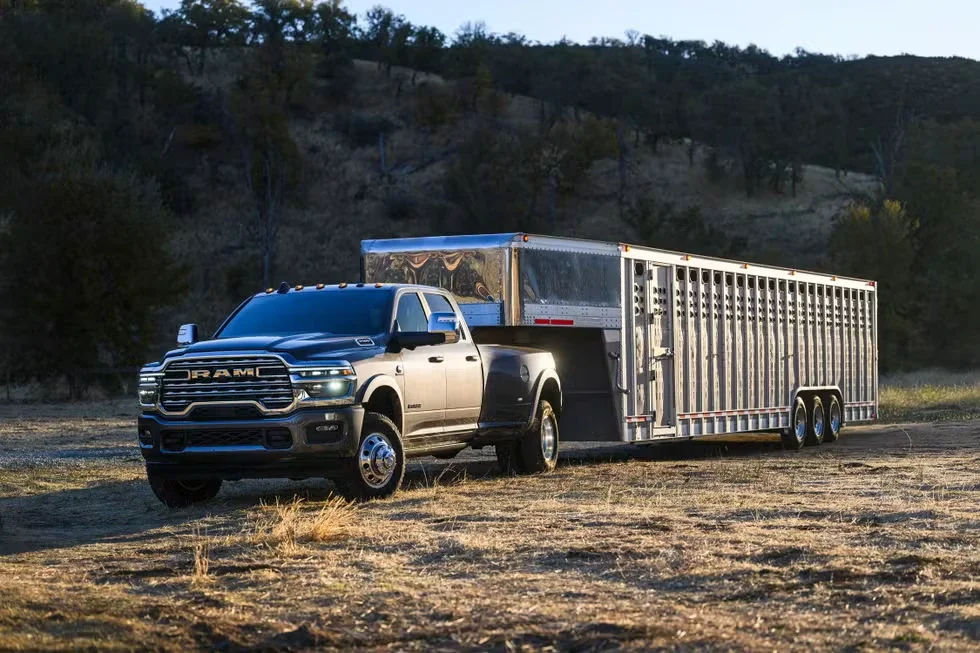
The RAM 2500 i s a popular choice among heavy-duty truck enthusiasts and professionals alike, known for its robust performance, impressive towing capabilities, and versatile configurations. However, potential buyers often wonder about the costs associated with purchasing a RAM 2500. In this article, we will explore the various factors that influence the price of the RAM 2500, including its base price, available trims, optional features, and additional costs to consider. Browse Ram 1500 How Much Can a RAM 2500 Cost? Base Price of the RAM 2500 As of the 2023 model year, the starting price of the RAM 2500 varies based on the trim level and configuration. Here’s a general overview of the base prices for the different trims: RAM 2500 Tradesman: Starting around $43,000. This is the entry-level trim, offering essential features and rugged capability for those who need a reliable work truck. RAM 2500 Big Horn: Starting around $47,000. The Big Horn adds more comfort and technology features, making it a great option for those who want a balance between utility and comfort. RAM 2500 Laramie: Starting around $55,000. The Laramie trim focuses on luxury and technology, featuring a more upscale interior and advanced infotainment systems. RAM 2500 Power Wagon: Starting around $60,000. This off-road-oriented version is equipped with unique features for off-road capability, making it ideal for adventurous buyers. RAM 2500 Limited: Starting around $70,000. The Limited trim is the top-of-the-line model, offering premium materials, advanced technology, and all the luxurious features available. Browse Ram 1500 How Much Can a RAM 2500 Cost? Optional Features and Packages In addition to the base prices, buyers can choose from various optional features and packages that can significantly affect the overall cost of the RAM 2500. Here are some popular options: Engine Upgrades: The RAM 2500 offers engine options such as the 6.4L HEMI V8 and the 6.7L Cummins Turbo Diesel. Choosing the diesel engine can add around $10,000 to the base price but provides greater towing capacity and efficiency. 4WD vs. 2WD: Opting for four-wheel drive (4WD) instead of two-wheel drive (2WD) typically adds an additional $3,000-$4,000 to the cost. This upgrade is often worthwhile for buyers who plan to use their truck in off-road or challenging conditions. Cab Configurations: The RAM 2500 comes in multiple cab configurations (Regular Cab, Crew Cab, and Mega Cab), which can affect the overall price. Larger cab options typically add between $2,000 and $5,000 depending on the specific configuration chosen. Trim Packages: Higher trims like the Laramie and Limited come with more features and technology. Additional packages, such as the Laramie Level 1 and Level 2 Equipment Groups, can add anywhere from $2,000 to $7,000 for enhanced luxury and convenience features. Towing Packages: For buyers who need serious towing capabilities, selecting a towing package can add another $1,000 to $2,000. This package often includes features like upgraded brakes, trailer hitch receivers, and integrated trailer brake controllers. Browse Ram 1500 How Much Can a RAM 2500 Cost? Additional Costs to Consider Beyond the purchase price of the RAM 2500, there are several additional costs to factor into your budget: Taxes and Fees: Depending on your location, sales tax on vehicle purchases can range from 5% to 10% or more. Additionally, you’ll need to consider registration fees, which vary by state. Insurance: Insurance premiums for heavy-duty trucks like the RAM 2500 can be higher than for standard vehicles due to their value and potential repair costs. Buyers should obtain insurance quotes to get an accurate idea of their monthly costs. Maintenance and Repairs: Heavy-duty trucks often require regular maintenance to keep them in top shape. While RAM trucks are generally reliable, it’s essential to budget for routine services such as oil changes, tire rotations, and brake inspections. Fuel Costs: Fuel efficiency varies based on the engine and configuration you choose. Diesel engines tend to be more fuel-efficient when towing, but it’s essential to consider the cost of diesel fuel versus gasoline when budgeting for fuel expenses. Financing: If you plan to finance your RAM 2500, interest rates and loan terms will affect the total cost. Buyers should shop around for the best financing options to secure a favorable rate. Browse Ram 1500 How Much Can a RAM 2500 Cost? Conclusion The cost of a RAM 2500 can vary significantly based on the chosen trim, optional features, and additional expenses. Buyers can expect to pay anywhere from around $43,000 for a base Tradesman model to over $70,000 for a fully loaded Limited trim with premium features. By carefully considering your needs and preferences, you can choose the right configuration that fits your budget and ensures you get the most value from your RAM 2500. Whether you need a reliable workhorse for towing and hauling or a luxurious truck for everyday use, the RAM 2500 offers a range of options to meet your demands. With proper planning and research, you can find the perfect RAM 2500 that fits both your needs and budget. Browse Ram 1500
Is a HEMI better than a Cummins?
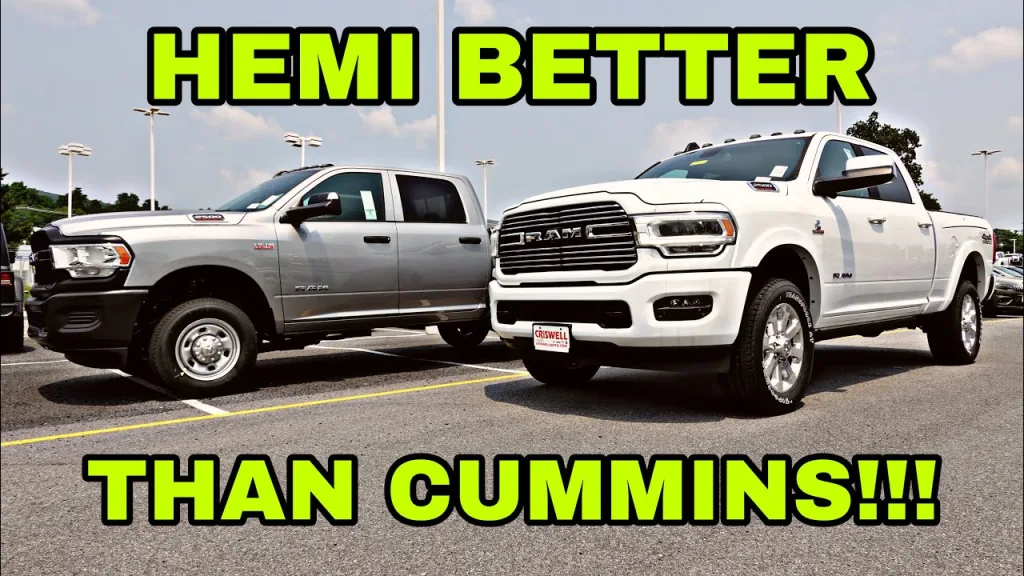
Breaking Down Power, Torque, Reliability, and Real-World Use for RAM Truck Buyers If you’re shopping for a RAM truck—whether it’s a 2500, 3500, or even a 1500—you’ve likely asked the big question: Is a HEMI better than a Cummins? This debate isn’t just about gasoline vs. diesel. It’s about power delivery, long-term ownership, towing, maintenance costs, and what you really need your truck to do. In this guide, we’ll explore how HEMI gas engines and Cummins diesel engines compare in real-world categories like towing, fuel economy, reliability, cost of ownership, and which engine makes sense for different types of drivers. What Are HEMI and Cummins? Before comparing, let’s break down what each engine type is: HEMI A HEMI is a gas-powered V8 engine known for its hemispherical combustion chamber. RAM currently uses two primary HEMI options: 5.7L HEMI V8 (RAM 1500 and some 2500s) 6.4L HEMI V8 (standard on RAM 2500 Power Wagon and some 3500s) HEMIs are naturally aspirated, high-revving, and known for their smooth acceleration and deep exhaust note. Cummins The Cummins 6.7L Turbo Diesel I6 is a straight-six turbocharged diesel engine found in RAM 2500 and RAM 3500 trucks. Built for torque, longevity, and heavy-duty work, it’s a commercial-grade diesel that’s been a staple in RAM HD trucks since 1989. Power & Torque Comparison Engine Horsepower Torque Max Towing Capacity 5.7L HEMI V8 395 hp 410 lb-ft ~11,610 lbs (RAM 1500) 6.4L HEMI V8 410 hp 429 lb-ft ~17,540 lbs (RAM 2500) 6.7L Cummins (standard) 370 hp 850 lb-ft ~22,670 lbs (RAM 2500) 6.7L Cummins HO (RAM 3500 only) 420 hp 1,075 lb-ft ~37,090 lbs (gooseneck) Cummins wins on torque. That’s important for pulling trailers, boats, equipment, and climbing hills while towing at highway speeds. HEMI wins on throttle response. These gas engines feel faster in unloaded daily driving, thanks to quicker revving and more responsive acceleration. Towing and Payload: What Engine Pulls More? If you’re towing a large fifth wheel, car hauler, horse trailer, or heavy machinery, the Cummins diesel is the clear winner. With over 1,000 lb-ft of torque in the HO version, it's built for maximum low-end pulling power. That said, the 6.4L HEMI can tow over 17,000 lbs when properly equipped—more than enough for most weekend warriors or moderate contractors. Payload Comparison: HEMI RAM 2500 (gas): Often offers higher payload (~3,990 lbs) Cummins RAM 2500 (diesel): Lower due to heavier engine (~3,160 lbs) If you haul heavy in-bed loads regularly, the HEMI may provide more legal payload capacity. Fuel Economy: Diesel vs. Gas This is where things get nuanced. While EPA doesn’t officially rate heavy-duty truck MPG, real-world averages tell the story: Engine Empty MPG (Highway) Towing MPG 6.4L HEMI 13–17 mpg 7–10 mpg 6.7L Cummins 17–22 mpg 10–14 mpg The Cummins engine is more efficient, especially under load. Diesel fuel typically costs more per gallon, but improved mileage and range (thanks to a 32+ gallon tank) make it a smarter choice for long hauls or commercial use. Maintenance and Longevity Cummins Diesel: Oil changes: Every 15,000 miles, but with higher oil capacity and cost (~$120+) Fuel filters: Must be changed regularly DEF system: Requires refills and can lead to costly repairs if neglected Turbo & emissions systems: Adds complexity and potential repair costs Expected lifespan: 300,000–500,000 miles with proper maintenance HEMI Gas: Oil changes: Every 6,000–8,000 miles (~$60–$90) Fewer moving parts: Easier and cheaper to service No DEF, no turbo Expected lifespan: 200,000+ miles with good care Cummins engines last longer, but HEMI trucks are cheaper and simpler to maintain for daily drivers and occasional towers. Initial Cost and Resale Value The Cummins option adds $9,500+ to a RAM 2500 or 3500 build. In return, diesel models hold value better and sell quicker on the used market. HEMI-equipped trucks cost less upfront and still hold strong value due to demand and reliability. If you plan to own the truck for 3–5 years and tow occasionally, the HEMI may be more cost-effective. For long-term owners, commercial users, or anyone towing frequently, Cummins’ higher resale value can offset its initial cost. Daily Driving Experience HEMI trucks feel faster in town, rev quicker, and are quieter overall. Cummins trucks sound like a heavy-duty workhorse, which some love—but others find noisy. For highway cruising, the Cummins has lower RPMs, making for a relaxed drive with fewer downshifts. If you don’t tow regularly or need maximum torque, most drivers will enjoy the HEMI experience more on a day-to-day basis. So, Is a HEMI Better Than a Cummins? The answer depends on what you need your RAM truck to do. Here's a breakdown: Use Case Best Engine Light towing + daily driving 6.4L HEMI Hauling max loads regularly Cummins Long-distance towing Cummins Lower maintenance costs HEMI Higher resale after 5–7 years Cummins Lower purchase price HEMI Extreme longevity (300K+ miles) Cummins In-bed payload hauling HEMI Final Verdict from Simi Valley Chrysler Dodge Jeep Ram At Simi Valley CDJR, we help drivers choose the right engine for their lifestyle. If you’re a contractor pulling a skid steer every day, or an RVer with a 35-foot fifth wheel, the Cummins diesel is worth every penny. But if you’re looking for reliable V8 power at a better price point with lower maintenance, the HEMI is your go-to. Both engines are excellent—but they serve different needs. Still debating HEMI vs. Cummins? Stop by Simi Valley Chrysler Dodge Jeep Ram or give us a call to test drive both back-to-back. Our truck experts will walk you through every option—from RAM 2500 Tradesman to Limited and Power Wagon trims. Find your perfect truck at Simi Valley CDJR—where capability meets confidence.
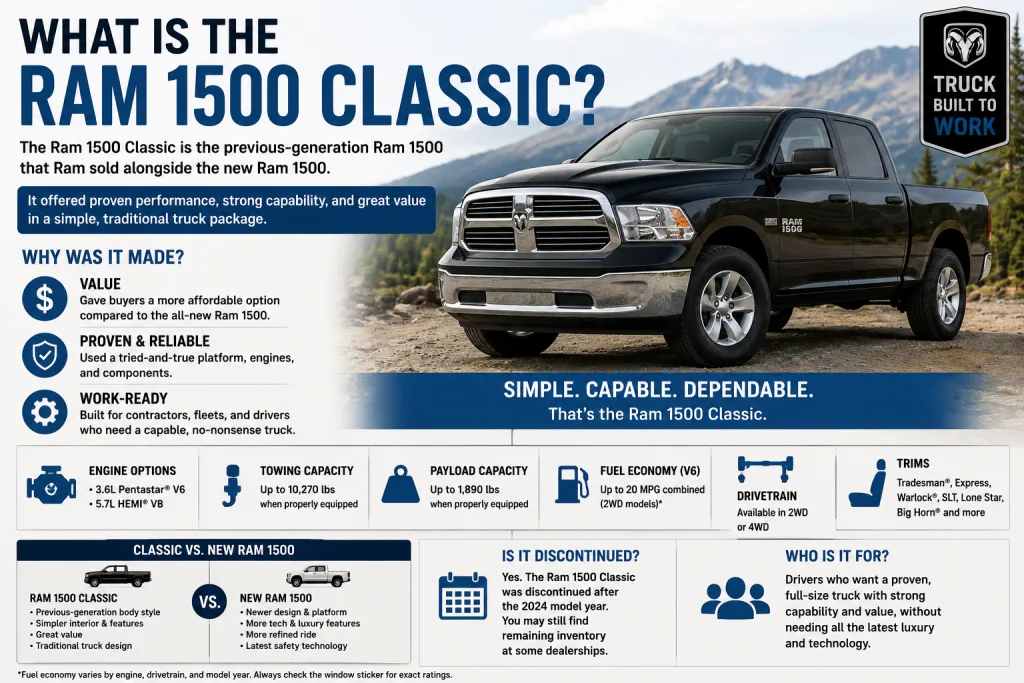
What is the Ram 1500 Classic?
What Is the Ram 1500 Classic? The Ram 1500 Classic is the previous-generation Ram 1500 that Ram continued selling alongside the newer Ram 1500 for several years. It gave truck shoppers a simpler, familiar, and often more affordable way to buy a full-size Ram pickup without moving into the newer fifth-generation design. In simple terms, the Ram 1500 Classic is the older body-style Ram 1500. It kept the traditional Ram truck look, proven engine options, and practical work-truck appeal while the newer Ram 1500 focused more on luxury, technology, and refinement. Ram’s official 1500 Classic FAQ confirms that the Ram 1500 Classic has been discontinued, but remaining units may still be found at some dealerships. Why Did Ram Sell the 1500 Classic? Ram kept the 1500 Classic around because it filled a useful role. Not every buyer wanted the newest and most expensive version of the Ram 1500. Some shoppers wanted a straightforward truck with proven hardware, familiar styling, and strong value. That made the Classic popular with work buyers, fleet customers, contractors, and drivers who cared more about capability and price than having the newest interior design. It was also a smart option for shoppers who liked the older Ram look and wanted a truck that felt more traditional. For many buyers, the Classic was not “old.” It was simple, proven, and practical. Ram 1500 Classic vs. Ram 1500 The main difference is the generation. The Ram 1500 Classic is based on the older fourth-generation Ram 1500 platform. The newer Ram 1500 is the fifth-generation truck with updated styling, newer technology, a more refined cabin, and more modern features. The newer Ram 1500 is generally the better choice if you want the latest interior, newer safety technology, more available luxury features, and a smoother overall feel. The Classic is better if you want a more affordable truck with a traditional design and proven capability. Think of it this way: the Ram 1500 Classic is the value-focused older body style, while the newer Ram 1500 is the more modern and refined version. Engine Options The Ram 1500 Classic was offered with familiar engine choices, including the 3.6L Pentastar V6 and the 5.7L HEMI V8, depending on model year and configuration. The V6 was the practical choice for drivers who wanted a lower purchase price and reasonable fuel economy for a full-size truck. The HEMI V8 was the stronger choice for buyers who wanted more power, better towing confidence, and the classic Ram V8 feel. According to Cars.com, the 2024 Ram 1500 Classic Tradesman came with a 3.6L V6 rated at 305 horsepower in rear-wheel-drive form. Other configurations offered the 5.7L HEMI V8, which was one of the main reasons many buyers liked the Classic. Towing and Capability The Ram 1500 Classic was still a real full-size pickup, not a stripped-down imitation. Depending on engine, drivetrain, cab, bed, and equipment, it could tow serious weight for work and weekend use. Edmunds lists the 2024 Ram 1500 Classic with maximum towing capacity of up to 10,270 pounds when properly equipped. That is enough for many utility trailers, small campers, boats, work trailers, and recreational equipment. For buyers who needed full-size truck ability without paying for the newest Ram 1500, that capability was a major selling point. Fuel Economy Fuel economy depends on the engine and drivetrain. The V6 version was usually the more efficient choice, while the HEMI V8 gave buyers more power at the cost of higher fuel use. Cars.com lists a 2024 Ram 1500 Classic Tradesman V6 rear-wheel-drive model at 20 mpg combined. Edmunds lists a four-wheel-drive 2024 Ram 1500 Classic configuration at 19 mpg combined. That is reasonable for a full-size pickup, especially one built on an older platform. Shoppers who want better fuel economy should usually look for the V6, while shoppers who tow more often may prefer the HEMI. Interior and Features The Ram 1500 Classic interior is simpler than the newer Ram 1500, but that is part of its appeal. It was available in practical trims made for work, as well as better-equipped versions with more comfort and technology. Depending on trim, buyers could find features like a touchscreen, backup camera, Bluetooth, cloth or upgraded seating, power accessories, bedliner options, towing equipment, and four-wheel drive. It does not feel as modern or premium as the newer Ram 1500, especially in higher trims, but it gives many truck buyers exactly what they need: a comfortable cabin, useful controls, and enough technology for daily driving. Is the Ram 1500 Classic Discontinued? Yes. The Ram 1500 Classic has been discontinued. Ram says the Classic ceased production in 2024 and was discontinued to make way for the fifth-generation Ram trucks. That means shoppers looking for one today will likely be looking at remaining dealer inventory, used models, or certified pre-owned options. New availability will depend on what a dealership still has in stock. This also means the Classic may become more appealing to buyers who specifically want the older body style or HEMI V8 availability. Why Do People Still Want the Ram 1500 Classic? The Ram 1500 Classic still has appeal because it is simple, familiar, and capable. Some buyers do not want the newest truck with the highest price. They want something proven, easy to understand, and ready for work. The Classic also has a strong look. Many Ram buyers still like the older front-end design, traditional cabin layout, and straightforward truck feel. It does not try to be a luxury SUV with a bed. It feels like a truck first. For shoppers who want value, the Classic can make a lot of sense on the used market. Is the Ram 1500 Classic Good for Work? Yes, the Ram 1500 Classic is a good work truck, especially in Tradesman and fleet-style configurations. It offers useful towing capacity, available V8 power, practical bed options, and a more affordable entry point than many newer full-size trucks. Contractors, small business owners, delivery users, and drivers who need a dependable pickup may find the Classic appealing. It is not the newest truck in the segment, but it is still capable enough for many real-world jobs. Before buying one for work, check the payload rating, towing equipment, bed length, cab size, and service history. Is the Ram 1500 Classic a Good Used Truck? A used Ram 1500 Classic can be a strong buy if the price, mileage, and condition are right. It gives you full-size truck capability without the cost of a newer-generation Ram 1500. The best examples are clean, well-maintained, and not heavily abused. Look for service records, tire condition, brake condition, accident history, rust, towing wear, and signs of hard commercial use. If you want a used truck for commuting, towing, hauling, or work, the Classic can be a smart option. If you want the newest tech, highest-end interior, or latest safety features, the newer Ram 1500 may be a better fit. Ram 1500 Classic vs. Ram 1500 Tradesman As the Classic exits the lineup, Ram has shifted value-focused buyers toward the newer Ram 1500 Tradesman. Reuters reported that Stellantis ended Classic production at Warren Truck Assembly while moving focus toward Ram 1500 Tradesman production at Sterling Heights. The newer Tradesman is the closest modern replacement for buyers who want a practical Ram truck without paying for luxury trims. It gives shoppers the current-generation platform while keeping the focus on work, value, and capability. If you are comparing both, the Classic may cost less used, while the newer Tradesman gives you the latest Ram design and current warranty coverage. Who Should Buy a Ram 1500 Classic? The Ram 1500 Classic is best for shoppers who want a full-size pickup with proven capability, traditional styling, and strong value. It makes sense for buyers who need a truck for work, light towing, weekend projects, or daily driving. It is also a good fit for drivers who like the older Ram body style or want a HEMI V8 truck without moving into a more expensive newer model. It may not be the best choice if you want the newest infotainment system, latest driver-assistance technology, or the most refined Ram cabin. In that case, the newer Ram 1500 is the better direction. Find the Right Ram Truck The Ram 1500 Classic is the previous-generation Ram 1500 that stayed on sale as a value-focused full-size truck. It offered familiar styling, available V6 and HEMI V8 power, useful towing capacity, and a straightforward truck personality that many buyers still appreciate. Even though production ended in 2024, the Classic can still be a smart used-truck choice if you find the right one. Focus on mileage, condition, service records, accident history, towing equipment, and price before buying. Visit Simi Valley Chrysler Dodge Jeep Ram to browse used inventory, compare new inventory, check your trade-in value, or apply for financing before choosing your next Ram truck.