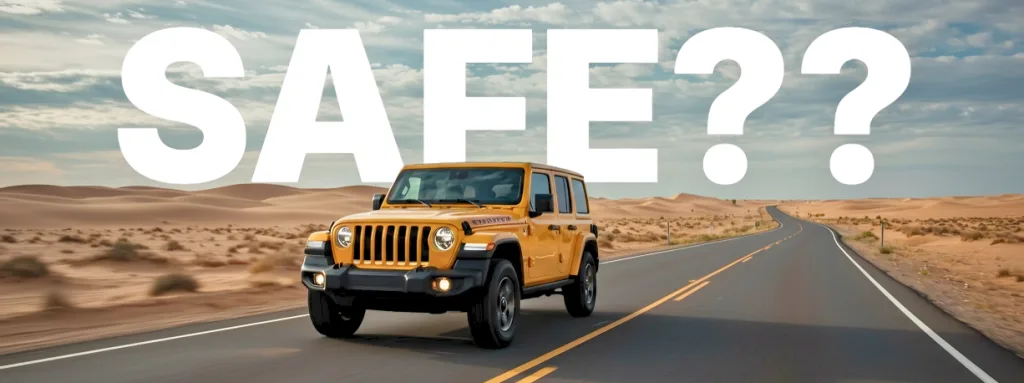





Is the Jeep Wrangler Safe? The Jeep Wrangler is safe enough for its purpose, but it is not the safest SUV you can buy. It is built for off-road capability first, not maximum crash-test performance. Newer Wranglers have improved safety features, but they still have higher rollover risk, weaker crash-test results than many crossovers, and fewer standard driver-assist features on lower trims. If you want a rugged SUV for trails, snow, dirt roads, and open-air driving, the Wrangler makes sense. If your top priority is family safety, quiet highway driving, and the best crash protection, a normal crossover like a Subaru Outback, Honda CR-V, Toyota RAV4, or Volvo XC60 is the safer choice. The Straight Answer The Jeep Wrangler is not unsafe, but it has safety trade-offs. It has strong off-road protection, a tough frame, available driver-assistance features, stability control, airbags, and a reinforced structure. But it also has a tall body, high center of gravity, removable doors, a removable roof, and a design focused more on capability than crash absorption. That means the Wrangler is better on trails than it is in crash-test comparisons. Jeep Wrangler Crash Test Ratings Newer Jeep Wranglers perform better than older models, but their scores are still mixed. The Wrangler has received decent ratings in some government crash tests, especially for frontal and side crash protection. However, rollover risk remains a weak point because the Wrangler sits tall and has a higher center of gravity. The IIHS has also rated the Wrangler lower than many mainstream SUVs in certain crash tests. It has not usually performed like top safety-rated crossovers. This does not mean the Wrangler is dangerous. It means buyers should understand what it is: a rugged off-road SUV, not a safety-first family crossover. Why the Wrangler Has Higher Rollover Risk The Wrangler is tall, narrow, and built with off-road ground clearance. That helps it clear rocks, ruts, snow, and rough terrain, but it also raises the center of gravity. A higher center of gravity increases rollover risk during sharp turns, sudden swerves, or certain crashes. That is one of the biggest safety concerns with the Wrangler. Electronic stability control helps reduce this risk, but it cannot change the basic shape and physics of the vehicle. Safety Features on Newer Jeep Wranglers Newer Wranglers are safer than older ones because they offer more safety technology. Common or available features include: Front airbags Side airbags Rearview camera Anti-lock brakes Electronic stability control Blind-spot monitoring Rear parking sensors Forward collision warning Automatic emergency braking Adaptive cruise control The problem is that some advanced safety features may not be standard on every trim. If safety matters, look for a Wrangler with the available safety packages. Is the Wrangler Safe for Daily Driving? Yes, the Wrangler can be safe for daily driving if you understand its limits. It is fine for commuting, errands, light highway use, and weekend driving. But it does not drive like a normal crossover. It can feel louder, rougher, and less planted at highway speeds. The Wrangler also needs more careful driving. Avoid sharp lane changes, hard cornering, and aggressive high-speed driving. It is not built to behave like a low, wide SUV. Is the Wrangler Safe for Families? The Wrangler can work for families, especially the four-door Wrangler Unlimited. It has more room, easier rear-seat access, and better daily usability than the two-door model. But if safety is your number one priority, there are better family SUVs. Many crossovers offer stronger crash-test results, lower rollover risk, smoother handling, and more standard safety tech. For families who love the Jeep lifestyle, the four-door Wrangler is the better choice. For families who only care about safety and comfort, a regular crossover is smarter. Is the Wrangler Safe Off-Road? Yes, the Wrangler is one of the safer SUVs for off-road use because it is built for that environment. It has strong 4x4 systems, good ground clearance, skid plates, available rock rails, and a reinforced body structure. It is designed to handle trails, steep hills, mud, rocks, and uneven terrain better than most SUVs. But off-roading still carries risk. Rollovers, getting stuck, remote breakdowns, and underbody damage are all possible. Drivers should use proper tires, avoid reckless trail driving, and never off-road alone in risky areas. Do Modifications Make a Wrangler Less Safe? Yes, bad modifications can make a Wrangler less safe. Lift kits, oversized tires, heavy bumpers, poor suspension work, and cheap aftermarket parts can affect braking, steering, rollover risk, crash sensors, and ride stability. A mild, professionally installed setup is usually fine. A poorly built lifted Wrangler can be dangerous. If safety matters, avoid extreme lifts and poorly modified used Wranglers. What to Check Before Buying a Used Wrangler Before buying a used Jeep Wrangler, check: Frame rust Tire wear Suspension condition Steering looseness Brake condition Warning lights Airbag system Recall history Accident history Quality of modifications Hard off-road abuse Do not buy a Wrangler just because it looks good. A lifted Jeep with bad suspension, rust, or cheap parts can become expensive and unsafe. Final Answer The Jeep Wrangler is safe enough if you buy the right one, drive it properly, and understand its limits. It is great for off-road use, weekend adventure, snow, trails, and Jeep lifestyle driving. But it is not the safest SUV for families, long highway commutes, or buyers who want top crash-test scores. Straight answer: the Jeep Wrangler is safe for what it is built to do, but it is not as safe as many modern crossovers. If safety is your top priority, choose a more road-focused SUV. If off-road capability is your priority, the Wrangler still makes sense.