



What Is So Special About the Jeep Rubicon?
The Jeep Rubicon is special because it is the most trail-focused Wrangler trim built from the factory. It is not just a Wrangler with different badges. The Rubicon adds serious off-road hardware that helps it crawl over rocks, climb steep trails, handle deep ruts, and keep traction where normal SUVs would struggle.
The simple answer is this: the Jeep Rubicon is special because it comes with factory off-road equipment that most vehicles need aftermarket upgrades to match. That includes heavy-duty axles, locking differentials, a more aggressive 4×4 system, rock rails, off-road tires, and trail-focused gearing depending on model year and configuration.
Jeep lists the Wrangler Rubicon as a dedicated trim in the Wrangler lineup, while Jeep Canada highlights Rubicon-style equipment such as 33-inch off-road tires, locking rear differential, and trail-focused 4×4 hardware on Wrangler models.
The Rubicon Name Means Something
The Rubicon name comes from the Rubicon Trail in California, one of the most famous off-road trails in North America.
That matters because Jeep did not choose a random adventure-sounding name. The Rubicon badge is tied directly to real off-road credibility. A Wrangler Rubicon is designed for buyers who want more than the look of a Jeep. It is for people who want factory-built capability.
That is why the Rubicon has become one of the most respected names in the off-road SUV world.
Factory Locking Differentials
One of the biggest reasons the Rubicon is special is its locking differentials.
On difficult trails, a regular open differential can send power to the wheel with the least traction. That is bad when one tire is in the air, on loose dirt, or slipping on rock.
A locking differential forces wheels on the same axle to turn together, helping the Jeep keep moving when traction is uneven. This is a major off-road advantage.
Many SUVs do not offer true lockers from the factory. The Rubicon does, which is why serious off-road buyers pay attention to it.
Rock-Trac 4×4 System
The Rubicon also stands out because of its Rock-Trac-style 4×4 capability.
Jeep Canada explains that Rock-Trac uses a heavy-duty transfer case with a 4:1 low-range gear ratio, which helps provide controlled torque delivery for difficult off-road driving.
In plain English, that means the Rubicon can move slowly and powerfully over obstacles instead of needing speed to get through them. That slow-speed control is exactly what you want for rocks, ledges, steep climbs, and technical trails.
Heavy-Duty Axles
Rubicon models are also known for stronger axle hardware.
Older JK Rubicons used heavy-duty Dana 44 front and rear axles, and Quadratec notes that the 2014 Wrangler Rubicon featured heavy-duty Dana 44 axles and a Rock-Trac transfer case with a 4.0:1 low-range gear ratio.
Axles matter because they carry weight, transfer torque, and take abuse from tires, rocks, ruts, and trail impacts. A Rubicon’s axle setup is one of the reasons it is a stronger base for off-road use than a regular Wrangler Sport or Sahara.
Electronic Sway Bar Disconnect
Another major Rubicon feature is the electronic sway bar disconnect on many models.
A sway bar helps control body roll on pavement. But off-road, disconnecting it allows the front suspension to articulate more freely. That helps the tires stay in contact with the ground over uneven terrain.
More tire contact means more traction.
On many off-road builds, owners manually disconnect sway bars before hitting the trail. Rubicon models can make that process much easier from the factory.
Better Trail Tires and Ground Clearance
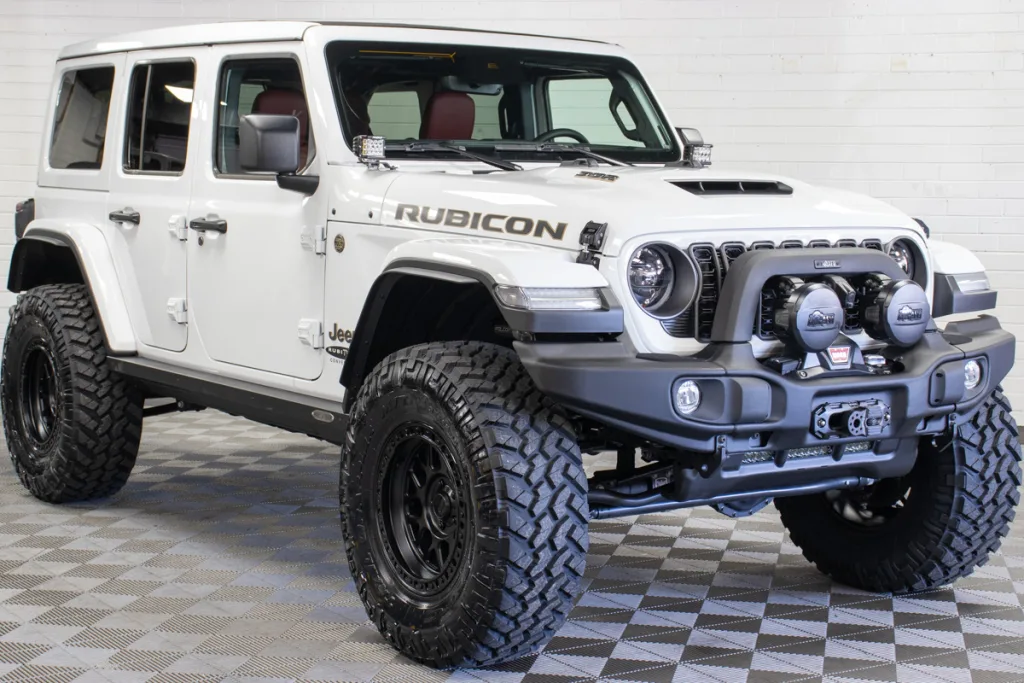
The Rubicon usually comes with more aggressive tires than standard Wrangler trims.
That gives it better traction on dirt, rocks, mud, and uneven trails. Depending on model year and package, Rubicon models may come with 33-inch tires, and some versions offer more aggressive tire and wheel packages.
Tires are one of the most important off-road upgrades. Jeep giving the Rubicon better tires from the factory is a big part of its appeal.
Rock Rails and Trail Protection
The Rubicon is also built with more protection for trail use.
Rock rails help protect the lower body from rocks, stumps, and trail damage. This matters because the underside and rocker panels can take a beating off-road.
If you buy a lower Wrangler trim and plan to off-road seriously, rock rails are often one of the first upgrades. Rubicon buyers get that type of equipment built into the package.
Rubicon vs Sport
The Wrangler Sport is the simpler and more affordable Wrangler. The Rubicon is the more serious off-road version.
A Sport gives you the Wrangler look, removable roof and doors, 4×4 capability, and strong customization potential. It is a good choice if you want a lower price or plan to build the Jeep yourself.
The Rubicon costs more because it comes with trail hardware already installed. If you want lockers, stronger axles, better gearing, and off-road protection from the factory, the Rubicon makes more sense.
In simple terms: Sport is the blank canvas. Rubicon is the factory trail machine.
Rubicon vs Sahara
The Sahara is the comfort-focused Wrangler. The Rubicon is the off-road-focused Wrangler.
A Sahara is better for buyers who want a nicer daily driver, more polished road manners, upgraded appearance, and useful comfort features.
A Rubicon is better for buyers who care about trail performance, rock crawling, and off-road hardware.
Both are Wranglers. They just serve different buyers. Sahara is the city-and-weekend-adventure Wrangler. Rubicon is the trail-first Wrangler.
Is the Rubicon Good as a Daily Driver?
Yes, the Rubicon can be used as a daily driver, but it is not as smooth or quiet as a normal crossover.
It has off-road tires, rugged suspension tuning, removable roof design, and truck-like character. That is part of the charm, but it also means more road noise, more tire noise, and a firmer feel than many SUVs.
If you mostly drive pavement and only like the Rubicon look, a Sahara or Willys may be easier to live with. If you actually want the off-road hardware, the Rubicon is worth the tradeoff.
Why the Rubicon Holds Value
The Rubicon holds value well because buyers understand what it is.
It is not just a trim with cosmetic upgrades. It has real hardware that costs money to add aftermarket. That gives it strong appeal in the used market.
A clean, stock Rubicon with service records is usually easier to sell than a heavily modified Wrangler with unknown parts and questionable workmanship.
For local buyers, comparing used Jeep inventory by trim, mileage, engine, modifications, and service history is the smartest way to understand real-world Rubicon value. Shoppers who want the latest factory equipment can also review current new Jeep inventory.
Is the Rubicon Worth It?
Yes, the Rubicon is worth it if you plan to use the off-road hardware or want the strongest factory Wrangler setup.
It may not be worth it if you only drive on pavement and never need lockers, heavy-duty axles, or extra trail capability. In that case, a Sport, Willys, or Sahara may be the smarter buy.
But if your goal is to buy a Wrangler that is already built for serious off-road use, the Rubicon is the one people talk about for a reason.
FAQs About the Jeep Rubicon
What makes the Jeep Rubicon special?
The Jeep Rubicon is special because it includes factory off-road hardware such as locking differentials, heavy-duty axles, trail-focused 4×4 gearing, rock rails, and off-road tires.
Is a Rubicon better than a regular Wrangler?
For serious off-roading, yes. A Rubicon is better equipped than a standard Wrangler Sport or Sahara. For daily driving only, a Sahara or Sport may be more practical.
Is the Rubicon good for rock crawling?
Yes. The Rubicon is one of the best factory SUVs for rock crawling because of its low-range gearing, lockers, axle setup, and trail protection.
Why is the Rubicon more expensive?
The Rubicon costs more because it includes expensive off-road hardware from the factory. Adding similar equipment aftermarket can cost thousands.
Can you daily drive a Rubicon?
Yes, but expect more road noise and a more rugged feel than a regular SUV. It is still usable every day, but it is built with off-road capability as the priority.
Final Thoughts: The Rubicon Is the Real Factory Off-Roader
The Jeep Rubicon is special because it gives buyers real off-road capability straight from the factory.
It has the hardware that serious trail drivers want: lockers, heavy-duty axles, low-range gearing, rock protection, aggressive tires, and Wrangler’s classic open-air design. It is not the cheapest Wrangler, and it may not be the smoothest daily driver, but it is the trim that best represents what makes Jeep different.
If you want the Wrangler look, other trims can work. If you want the Wrangler built for real trails, the Rubicon is the one that stands out.
Connect with us


