





What Does a Jeep Wagoneer Cost?
The Jeep Wagoneer is one of the largest and most premium SUVs in the Jeep lineup. It is built for drivers who want three-row space, strong towing ability, upscale comfort, and serious road-trip capability. Because of that, it costs more than a typical midsize SUV or basic family crossover.
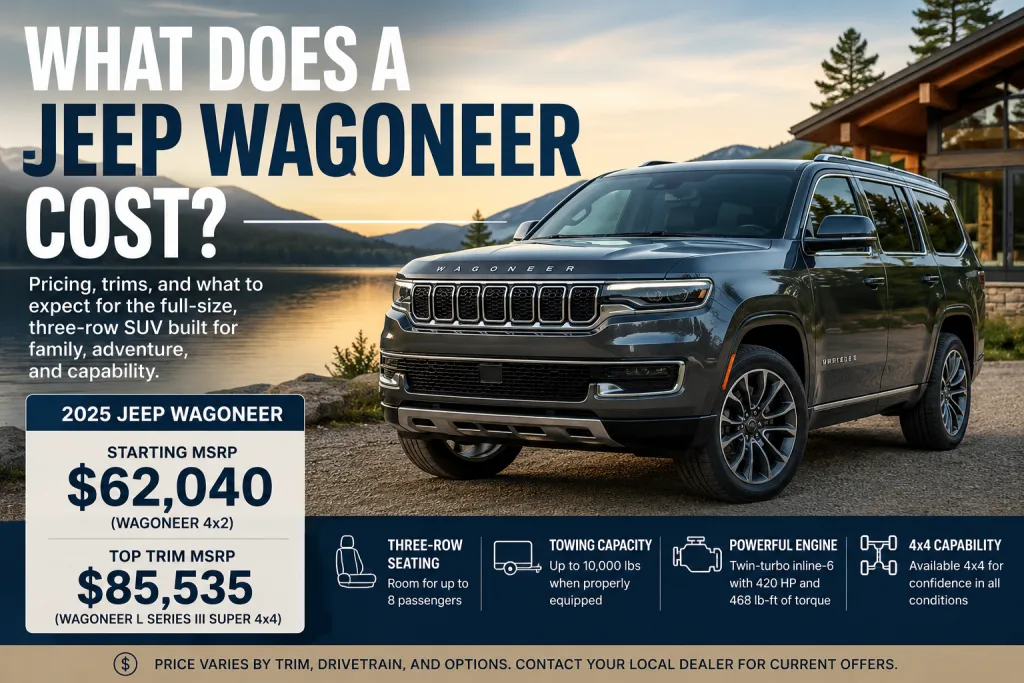
For 2025, the Jeep Wagoneer started at about $62,040, while higher trims moved into the $70,000 and $80,000 range depending on equipment. Car and Driver lists the 2025 Wagoneer range from $62,040 to $82,535, before extra options, taxes, fees, and dealer charges. That makes the Wagoneer a premium full-size SUV, but still below the ultra-luxury pricing of some full-size competitors.
Jeep Wagoneer Starting Price
The 2025 Jeep Wagoneer started around $62,040 for the base model. That price gave buyers a large three-row SUV with a powerful twin-turbo inline-six engine, a spacious cabin, and the capability expected from a large Jeep SUV.
Four-wheel-drive versions cost more than two-wheel-drive models. That matters because many Wagoneer shoppers want 4×4 capability for bad weather, towing, road trips, dirt roads, or family travel. If you live somewhere with snow, rain, hills, or rougher roads, the extra cost of 4×4 may be worth it.
How Much Do Higher Wagoneer Trims Cost?
The Wagoneer gets more expensive as you move into better-equipped trims. Series II, Carbide, Overland, Series III, and long-wheelbase Wagoneer L models can push the price well above the base model.
Most shoppers should expect a well-equipped Wagoneer to land somewhere in the $70,000 range, while upper versions can move into the low-to-mid $80,000 range. Edmunds shows current market pricing can vary by trim, location, and available inventory, so the final number depends on the specific SUV you choose.
This is why it is important to compare the exact vehicle, not just the model name. A base Wagoneer and a fully loaded Wagoneer can feel very different in features, comfort, and final price.
Wagoneer vs. Wagoneer L Cost
The Wagoneer L is the longer version of the Wagoneer. It costs more because it gives you more overall length and more cargo room, especially behind the third row.
That extra space is useful for families who travel with passengers and luggage at the same time. A regular three-row SUV may have enough seats, but cargo room can get tight when every seat is being used. The Wagoneer L helps solve that problem with more room for bags, sports gear, strollers, coolers, and road-trip equipment.
If you mostly drive around town and rarely pack the vehicle full, the standard Wagoneer may be enough. If you take long trips, carry a full family, or need space behind the third row, the Wagoneer L may justify the extra cost.
How Much Is a Used Jeep Wagoneer?
A used Jeep Wagoneer can cost much less than a new one. Pricing depends on model year, mileage, trim, condition, accident history, service records, and local demand.
Because the Wagoneer has a high original MSRP, used models can be attractive for shoppers who want a large premium SUV without paying full new-vehicle pricing. A used Series II or Series III may give you more features for the money compared with buying a new base model.
Before buying used, check the mileage, vehicle history, tire condition, brake condition, warranty status, and service records. A used Wagoneer with clean history and good maintenance can be a strong value. A cheaper one with accident history or neglected maintenance may cost more later.
What Affects the Cost of a Jeep Wagoneer?
The price of a Wagoneer is affected by trim, drivetrain, body length, features, mileage, and condition. New models are priced mainly by equipment and options, while used models depend more heavily on mileage, history, and market demand.
A Wagoneer with 4×4, premium interior features, larger wheels, advanced safety technology, towing equipment, and upgraded audio will cost more than a basic model. A Wagoneer L will usually cost more than a standard-length Wagoneer because of the added space.
For used Wagoneers, mileage and condition matter heavily. A low-mileage, well-kept SUV with clean history will usually cost more than a higher-mileage model with damage, worn tires, or incomplete service records.
Engine and Performance
The 2025 Jeep Wagoneer uses a twin-turbocharged inline-six engine. Edmunds lists the 2025 Wagoneer at 420 horsepower and 468 lb-ft of torque, giving it the strength needed for a full-size SUV.
That power matters because the Wagoneer is a large vehicle. It needs enough engine strength to move confidently with passengers, cargo, and a trailer. The engine also helps the Wagoneer feel smoother on highways, hills, and long-distance drives.
This is one reason the Wagoneer costs more than smaller SUVs. You are paying for size, power, towing ability, and a more premium driving experience.
Towing Capacity
Towing ability is one of the biggest reasons buyers consider the Wagoneer. When properly equipped, the 2025 Wagoneer can tow up to 10,000 pounds. Edmunds lists that maximum towing figure, which puts the Wagoneer among the stronger full-size SUVs in its class.
That kind of capability makes it useful for campers, boats, utility trailers, small equipment, and family adventure gear. If you only need a vehicle for commuting, that towing capacity may not matter much. But if you tow regularly, it can help justify the price.
Interior Space and Family Use
The Wagoneer is expensive because it is designed to carry people and cargo comfortably. It offers three rows of seating, a wide cabin, and a more upscale interior than many mainstream SUVs.
For families, the value is in the space. The Wagoneer gives passengers more room than many smaller three-row SUVs. It also works well for road trips because it has the size and comfort needed for long drives.
The regular Wagoneer is already large, but the Wagoneer L is better if cargo space is a major priority. Families who travel with luggage, sports equipment, or pets may find the longer version more practical.
Is the Wagoneer Still Available New?
The standard Jeep Wagoneer changed after the 2025 model year. For 2026, Jeep moved the focus to the Grand Wagoneer name. The official Jeep Grand Wagoneer page now presents the 2026 Grand Wagoneer as the brand’s full-size premium SUV, with MSRP starting at just under $67,000.
That means shoppers looking for a Wagoneer may be looking at remaining 2025 inventory, used Wagoneer models, or the newer Grand Wagoneer lineup. Availability will depend on dealer inventory and local market conditions.
Jeep Wagoneer vs. Grand Wagoneer Cost
The Grand Wagoneer has traditionally been the more luxurious version of the Wagoneer family. It usually costs more because it adds more premium materials, more technology, more comfort features, and a higher-end interior feel.
For 2026, Jeep adjusted the lineup and pricing. The new Grand Wagoneer starts closer to where the older Wagoneer sat, which may make it more appealing to shoppers who want a premium full-size Jeep SUV without moving too far into luxury-brand pricing.
If you are comparing both, focus on equipment, not just the name. A used Wagoneer Series III may offer excellent value, while a new Grand Wagoneer may give you the latest design, features, and warranty coverage.
Is the Jeep Wagoneer Worth the Price?
The Jeep Wagoneer makes sense if you need a true full-size SUV. It is not the cheapest three-row vehicle, but it offers more size, more towing strength, and more premium comfort than many smaller SUVs.
It is a good fit for families who need space, drivers who tow, and shoppers who want a large SUV that feels more upscale than a basic utility vehicle. It can handle daily driving, road trips, weekend travel, towing, and family hauling in one package.
The downside is cost. The purchase price is high, and ownership costs such as fuel, insurance, tires, and maintenance should also be considered. If you want the best value, a used Wagoneer may be worth comparing against a new one.
How to Get the Best Price on a Jeep Wagoneer
The best way to shop for a Wagoneer is to compare new, used, and remaining previous-year inventory. Pricing can change based on trim, mileage, incentives, dealer inventory, and local demand.
Start by deciding whether you need 4×4. Then decide whether the standard Wagoneer gives you enough space or if the Wagoneer L is a better fit. After that, compare trims based on the features you actually want.
Also check your trade-in value before shopping. A strong trade-in can reduce the amount you need to finance and make a higher-trim Wagoneer more realistic.
You can browse new inventory, compare used inventory, or get your trade-in value before making a decision.
Find the Right Jeep Wagoneer for Your Budget
A Jeep Wagoneer cost depends on the year, trim, drivetrain, body length, mileage, condition, and market availability. A 2025 Wagoneer started around $62,040 and could move into the $80,000 range in higher trims, while the newer 2026 Grand Wagoneer starts just under $67,000 before taxes, fees, and options.
For shoppers who want a large three-row SUV with strong towing ability, premium comfort, and Jeep capability, the Wagoneer can be worth the price. For buyers focused on value, comparing used Wagoneer models with new Grand Wagoneer inventory is the smartest move.
Visit Simi Valley Chrysler Dodge Jeep Ram to explore available Jeep Wagoneer and Grand Wagoneer options, compare pricing, and find the full-size SUV that fits your family, lifestyle, and budget.
Connect with us


