





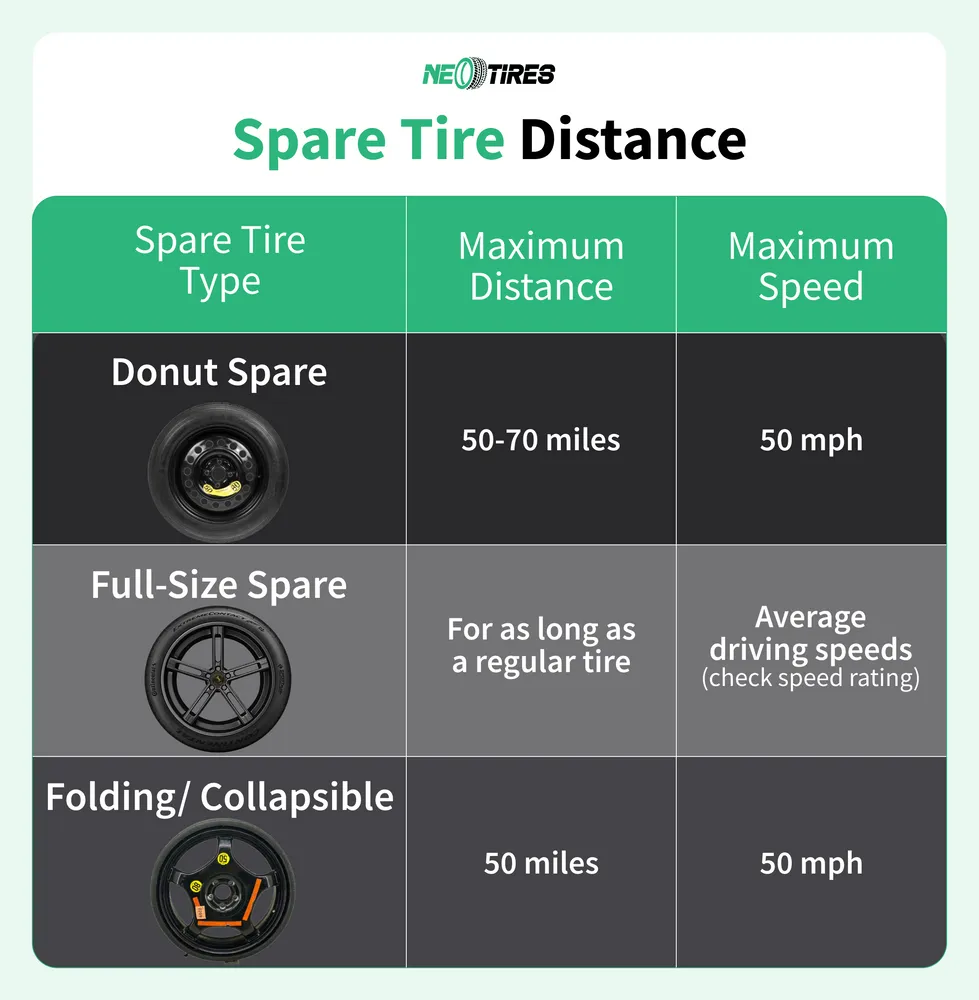
A spare tyre is not a free pass to keep driving normally. It is an emergency mobility tool designed to get you to a safe place and then to a repair facility, with limits that depend on the type of spare you have. In most real-world cases, the safe rule is:
- Temporary “space saver” or “donut” spare: keep speeds low and distance short, typically around 50 mph (80 km/h) and roughly 50 miles (80 km) as a planning baseline. (AAA)
- Full-size spare: you can usually drive more normally, but you still should treat it as temporary and match tire size, load rating, and inflation, especially on AWD systems.
If you drive a Chrysler, Dodge, Jeep, or Ram and want the safest, quickest path to get the flat fixed or replaced, start with Simi Valley CDJR service here:
https://www.simivalleychryslerdodgejeepram.com/service.aspx
Or book directly here:
https://www.simivalleychryslerdodgejeepram.com/book-your-service.html
The most important thing: what kind of spare is it?
People ask “how long can I drive on a spare tyre” as if there is one number. There is not. The answer changes dramatically based on spare type.
1) Temporary spare (space saver, donut)
This is the skinny, compact spare that saves weight and trunk space. It is designed for short-distance, low-speed use only.
Authoritative road clubs and tire brands consistently point to similar limits:
- AAA says you should not drive over 50 mph and no more than 50 miles on a donut-type spare. (AAA)
- UK guidance commonly sets the maximum speed at 50 mph for space saver spares. (RAC)
- Australia-focused guidance frequently notes space saver spares are typically limited to 80 km/h and short distance, with the exact limit on the sidewall or vehicle manual. (NRMA)
These are not “performance numbers.” They are safety limits driven by the spare’s narrower contact patch, different construction, and reduced grip.
2) Full-size spare
A full-size spare is the same size as your normal wheel and tire, or at least the same rolling diameter and load rating. This is the best spare to have from a drivability and safety standpoint.
Even so, you still want to:
- Confirm tire pressure is correct
- Confirm the tire size matches
- Avoid hard driving until you repair the original tire
- Be especially cautious if the vehicle is AWD and the tires are unevenly worn
3) Run-flat or extended-mobility tires (not a spare, but relevant)
Some vehicles have no spare because the tires can be driven temporarily when deflated. These have their own strict distance and speed limits. For example, Goodyear notes deflated operation is typically restricted to 50 mph (80 km/h) for up to 50 miles (80 km) for certain extended mobility designs, but you must follow your specific tire and vehicle guidance. (Goodyear Canada)
The practical baseline limits that answer your keyword directly
If you want a simple, high-confidence baseline for a temporary spare, this is the safest planning answer to “how long can you drive on a spare tyre”:
Typical temporary spare limits
- Speed: do not exceed 50 mph (80 km/h) (AAA)
- Distance: aim to keep it under 50 miles (80 km) as a conservative “get to a shop” guideline (AAA)
That covers the dominant real-world scenario: a space saver spare.
Two important notes:
- Your spare’s sticker and sidewall are the final authority. Many space saver spares have a clear speed marking, and your owner’s manual may specify distance and placement restrictions. The AA (UK) specifically advises checking your handbook and labels and notes there can be restrictions such as front-only or rear-only use for safety or drivetrain reasons. (The AA)
- Distance is not a “legal allowance.” It is a risk threshold. Some safety groups say there may be no explicit legal mileage cap, but it is still not recommended to drive far on a space saver. (TyreSafe | Safe Tyres Save Lives)
UK specific: how long can you drive on a spare tyre UK?
In the UK, “space saver” is the common phrase. The consistent guidance from major UK motoring organizations is:
- Do not exceed 50 mph with a space saver spare (RAC)
- Treat it as temporary mobility only, with altered handling and braking characteristics (RAC)
The RAC also highlights that grip and stability are reduced, and heavy braking or acceleration can make the vehicle more likely to skid. (RAC)
In other words, the UK version of the answer is:
- 50 mph max
- Replace or repair the original tyre as soon as possible
- Drive gently and avoid long trips
Australia specific: how long can you drive on a spare tyre Australia?
In Australia, the common rule-of-thumb for space saver spares is:
- 80 km/h maximum (NRMA)
Distance guidance varies depending on spare design, but many Australian sources describe space savers as designed for short, emergency use to reach a repair facility, often implying an “as little as necessary” approach. (NRMA)
The best Australia-specific answer is:
- Treat it as short-term emergency use
- Do not exceed 80 km/h unless the spare explicitly states a lower limit
- Head straight to a tire shop
Why the limits exist (and what actually changes when you install a spare)
A temporary spare changes your vehicle in ways that matter:
1) Less grip, especially under braking and in the wet
Space saver spares are narrower and can have different rubber compounds and tread patterns. Reduced contact patch equals reduced traction.
2) Different handling balance
One corner of the car now has a tire with different grip and stiffness. Under cornering and braking, stability can feel “off.” This is why UK organizations emphasize reduced grip and altered handling. (RAC)
3) ABS, traction control, and stability control behavior can change
These systems infer wheel speed and traction based on what the wheels are doing. If the spare has a different rolling circumference or grip level, the system can respond differently.
4) Potential drivetrain stress on AWD or 4WD
If the spare is not the same rolling diameter as the other tires, AWD systems can be forced to compensate constantly. Even a small mismatch can create heat and wear over time. This is one reason you do not want to “run it for a week” if you have AWD.
A clear “how long” answer by spare type
Here is a direct guide you can use.
Temporary spare (space saver, donut)
- Max speed: commonly 50 mph (80 km/h) (AAA)
- How long: treat as “get to repair” only, often planned around 50 miles (80 km) (AAA)
Full-size spare
- Max speed: typically normal road speeds, assuming correct rating and pressure
- How long: you can drive longer than a space saver, but you should still repair the original tire soon. If it is a matching full-size tire, the risk is far lower than a donut.
Run-flat mobility (no spare)
- Max speed and distance: depends on the tire and vehicle; 50 mph (80 km/h) for up to 50 miles (80 km) is a common design reference point in some systems, but always follow your tire’s guidance (Goodyear Canada)
What you should do immediately after installing a spare tyre
This is where people accidentally create risk.
1) Inflate the spare properly
Space saver spares often require higher PSI than your normal tires. The correct PSI is usually on:
- the spare tire sidewall
- a sticker in the trunk area
- the driver door placard
- the owner’s manual
2) Check the spare’s condition
Spare tires age out. If it is cracked, dry-rotted, or visibly damaged, it may not be safe even if it has tread.
3) Retorque the lug nuts
After driving a short distance, it is good practice to have lug torque verified. This reduces risk of wheel vibration or loosening.
4) Adjust your driving style
With a temporary spare:
- Increase following distance
- Avoid sudden lane changes
- Avoid hard braking
- Avoid potholes and rough roads where possible
- Keep speed comfortably below the spare’s rating
Can you drive on the motorway or highway with a spare?
You can, but it is not ideal with a temporary spare because highway speeds often exceed the spare’s limits, and the consequences of failure are higher.
If you must use a motorway:
- Keep speed under the spare’s rating (often 50 mph, which is below typical motorway flow) (RAC)
- Use hazard awareness and stay in the safest lane for your region
- Get off as soon as reasonably possible
The correct mindset is: a spare tyre is to get you off the road hazard and to service, not to continue your trip.
What if the spare tyre is on the front vs rear?
Some vehicles have restrictions about where a temporary spare can be used. The AA notes that temporary spares can be restricted to front-only or rear-only to avoid interference with braking components or transmission damage. (The AA)
This matters because:
- Some cars have larger front brakes that may not clear certain spares
- Some drivetrains react badly if the spare is on a driven axle
- Stability can change if the spare is on the steering axle
If you have any label on the spare that indicates front or rear placement only, follow it.
When you should not drive at all on a spare
Do not drive, even slowly, if:
- The spare is underinflated and you cannot inflate it
- The spare has visible cracking, bulging, or cord showing
- You have multiple damaged tires
- You have severe vibration after installing the spare
- The spare is a different bolt pattern or does not seat correctly
If any of those apply, tow is safer and often cheaper than dealing with a wheel-off or blowout scenario.
How long should you keep the spare on before replacing the original tyre?
The honest, safety-first answer is: as short as possible. Even when no law limits distance, multiple safety resources emphasize minimal necessary travel and prompt replacement or repair. (The AA)
A practical guideline:
- Space saver: same day repair if possible
- Full-size spare: repair within a few days, and sooner on AWD
If you need tire service and you are local, book through Simi Valley CDJR:
https://www.simivalleychryslerdodgejeepram.com/service.aspx
https://www.simivalleychryslerdodgejeepram.com/book-your-service.html
A simple reference table
| Spare type | Typical max speed | Practical distance mindset |
|---|---|---|
| Space saver, donut | 50 mph (80 km/h) | Get to repair, roughly 50 miles (80 km) baseline |
| Full-size spare | Normal, if properly rated | Short-term is fine, still repair soon |
| Run-flat mobility | Often 50 mph (80 km/h) in deflated mode | Often up to 50 miles (80 km) depending on tire |
Speed and distance references align with major guidance like AAA and Goodyear, but always defer to the tire label and your manual. (AAA)
Bottom line
If you are on a temporary spare, the safest in-depth answer is:
- Keep it under 50 mph (80 km/h) (AAA)
- Keep distance minimal, often planned around 50 miles (80 km) (AAA)
- Repair or replace your original tyre as soon as possible (The AA)
Connect with us


