





Diesel Exhaust Filter Cleaning: What It Means, How It Works, and When You Actually Have a DPF Problem
If you searched diesel exhaust filter cleaning, you are probably dealing with one of two situations. Either your truck or van has displayed a message like Cleaning Exhaust Filter, Exhaust Filter Full, or Regeneration in Process, or you are trying to figure out whether a diesel exhaust filter cleaner in a bottle can solve a real diesel particulate filter problem.
Those are not the same thing.
On modern diesel vehicles, the “diesel exhaust filter” people are usually referring to is the diesel particulate filter, or DPF. Its job is to trap soot from the exhaust stream and then burn that soot off through a process called regeneration. Ford, GM, and Ram owner materials all describe this as a normal part of diesel aftertreatment operation, not a defect. Ford manuals explicitly refer to Exhaust Filter Cleaning as the diesel particulate filter cleaning process; GM’s Duramax manual says the DPF traps particulates and the engine computer initiates cleaning when needed; and Ram’s diesel supplement describes the DPF as self-cleaning when the right conditions are met. (Ford Service Content)
That point matters because a lot of owners see the message and assume the truck is failing. Often, it is not. Sometimes it is just asking for the type of driving that allows the system to finish its cleaning cycle.
What diesel exhaust filter cleaning actually is
In plain English, cleaning diesel exhaust filter usually means the truck or van is trying to burn accumulated soot out of the DPF. The filter sits in the exhaust system and captures particulate matter. Over time, soot builds up. When the engine computer determines that the soot load is high enough, it raises exhaust temperatures to burn the soot off and restore normal flow through the filter. GM states that the DPF filters or traps particulates and that, when cleaning is needed, the engine computer initiates a cleaning action by warming the exhaust gas temperature; Ford and Ram describe similar automatic self-cleaning behavior in their owner documentation. (GMC)
This is why messages such as Cleaning Exhaust Filter, Exhaust Filter XX% Full, or Regeneration in Process are not automatically panic-level warnings. In many cases they are simply telling you the system is actively doing what it was designed to do. Ford’s diesel supplement says the Cleaning Exhaust Filter message is the normal regeneration process. Ram’s diesel material says Regeneration in Process indicates the DPF is self-cleaning. GM’s Duramax guide says the cleaning feature is designed to operate automatically. (Ford Service Content)
Why DPF cleaning matters so much
The DPF is central to diesel emissions control. DieselNet describes the DPF as the core particulate-control technology in modern diesel aftertreatment, and notes that ash accumulation and oil-derived contamination can significantly affect filter performance over time. DieselNet also notes that metallic fuel-borne catalyst additives have been studied to help regeneration, but that authorities remain cautious about metallic additives because they can increase ash emissions and are not a simple cure-all for modern systems. (dieselnet.com)
That means the DPF has two different enemies:
- Soot, which is meant to be burned off during regeneration.
- Ash, which does not burn off the same way and gradually accumulates over the life of the filter.
This distinction is where many owners get confused. Normal regeneration removes soot. It does not magically remove all ash forever. Over long mileage, a DPF can become ash-loaded and eventually require professional off-vehicle cleaning or replacement. DieselNet specifically notes that lubricating oil consumption is a major source of ash accumulation in DPFs and that excessive ash loading increases pressure drop and service needs. (dieselnet.com)
The three kinds of diesel exhaust filter cleaning people mix together
When people talk about diesel exhaust filter cleaning, they are usually lumping together three different things.
1. Automatic regeneration
This is the normal process. The vehicle handles it on its own while you drive, provided conditions are right. GM says the DPF cleaning feature is designed to operate automatically, and Ram says automatic regeneration self-cleaning cycles occur when the correct operating conditions are met. (GMC)
2. Driver-assisted or manual/stationary regeneration
Some trucks allow a more deliberate regeneration procedure if automatic cleaning cannot complete. Ford refers to operator commanded regeneration in its diesel supplement, and Ram’s diesel materials discuss manual DPF regeneration on certain applications. (Ford Service Content)
3. Professional DPF cleaning or replacement
This is a service procedure for a filter that is ash-loaded, clogged, damaged, or unable to regenerate properly anymore. That is not the same thing as just taking the truck on a highway drive.
If you do not separate these three categories, it becomes very easy to waste money on the wrong fix.
What the “Cleaning Exhaust Filter” message usually means
For Ford owners searching terms like ford diesel exhaust filter cleaning, ford 6.7 diesel cleaning exhaust filter, 08 ford diesel cleaning exhaust filter, or ford transit diesel exhaust filter cleaning, the big point is this: Ford documentation treats Cleaning Exhaust Filter as the normal regeneration message, not automatically a fault. The 2015 Ford diesel supplement says that if you operate the vehicle in a manner that allows effective automatic cleaning, the display will show a cleaning exhaust filter message, which is the normal regeneration process. Ford also warns that if the system gets more loaded, you may see messages like Exhaust Overloaded Drive to Clean, at which point the vehicle is asking you to drive in a way that allows regeneration or to use operator-commanded regeneration where applicable. (Ford Service Content)
Ford’s 2022 Super Duty manual also states that Exhaust Filter Cleaning means the DPF is full of soot and the vehicle is not being operated in a way that currently allows the system to finish regeneration. (Ford Service Content)
That means a Ford owner who only does short trips, extended idling, or low-speed city operation is much more likely to encounter repeated DPF-cleaning messages than someone who regularly drives longer highway distances.
Ford Transit diesel exhaust filter cleaning
The same logic applies to Transit diesels. Ford Transit owner materials include a DPF section and note that regeneration can involve very high temperatures, changes in exhaust sound, heat, and even fans running after shutdown. Ford’s Transit manuals describe the DPF as requiring periodic regeneration to maintain proper operation. (Ford Service Content)
For Transit owners, this often becomes a route-pattern issue. Delivery vans, service vans, and urban fleet vehicles tend to live in exactly the sort of short-trip, stop-and-go use cycle that is hardest on DPF regeneration. So if your search is ford transit diesel exhaust filter cleaning, the most likely explanation is repeated incomplete regeneration caused by duty cycle, not instantly a failed filter.
Dodge diesel exhaust filter cleaning
For Ram and Cummins owners searching dodge diesel exhaust filter cleaning, the system behaves in a very similar broad way. Ram’s diesel supplements explain that the truck is equipped with a DPF that removes soot from the exhaust gas and that automatic regeneration self-cleaning cycles occur when the correct operating conditions are met. Ram’s cluster messaging includes warnings such as Exhaust Filter XX% Full, Regeneration in Process, and Regeneration Completed, and its manuals also discuss conditions where manual regeneration may be needed. (Manuals+)
That means for a Dodge or Ram diesel, seeing a regeneration message is not inherently unusual. What matters is whether regeneration completes and whether the messages escalate.
Chevy diesel truck cleaning exhaust filter
For GM and Duramax owners searching chevy diesel truck cleaning exhaust filter, the owner manuals are also very direct. GM’s Duramax supplement says the filter needs to be cleaned of accumulated solids, and when cleaning is needed, the engine computer initiates a cleaning action by warming exhaust temperature. GM also says that when the message Cleaning Exhaust Filter Keep Driving Until Message Is Cleared appears, the vehicle should be driven above about 50 km/h (30 mph) until the message goes away, which the manual says can take around 30 minutes on the cited model-year guidance. (GMC)
That is one of the clearest OEM descriptions of how to respond: keep driving under the right conditions and let the truck finish the process.
Why your diesel keeps asking to clean the exhaust filter
Repeated DPF cleaning messages usually come down to one or more of these factors:
- Too many short trips
- Too much idling
- Low exhaust temperatures
- Interrupted regeneration cycles
- Excessive soot production from another engine issue
- Oil consumption contributing to aftertreatment contamination
- A sensor or aftertreatment malfunction
Ford, GM, and Ram all describe normal regeneration as dependent on correct operating conditions. DieselNet adds the important technical point that excessive oil consumption can increase ash loading and degrade DPF performance over time. (Ford Service Content)
So while driving pattern is often the first culprit, it is not the only one. If the same truck keeps requesting regeneration unusually often, you have to consider whether the engine is generating too much soot or the aftertreatment system is not functioning correctly.
How to help the system finish cleaning
If your truck is asking for diesel exhaust filter cleaning, the first-line response is usually not additives. It is operating the vehicle in a way that lets regeneration complete.
In general, OEM guidance points toward:
- Driving long enough for exhaust temperatures to stay elevated
- Avoiding shutting the vehicle off during an active regeneration
- Avoiding extended idle if the vehicle is already requesting cleaning
- Following cluster instructions rather than guessing
GM specifically says to keep driving above 50 km/h (30 mph) until the message clears on the referenced Duramax manual. Ford and Ram both indicate that proper operating conditions are necessary for automatic self-cleaning, and Ford/ Ram also outline commanded or manual regeneration procedures on supported vehicles when automatic cleaning cannot complete. (GMC)
The practical version is simple: if the truck is trying to regenerate, do not keep interrupting it with short trips if you can avoid it.
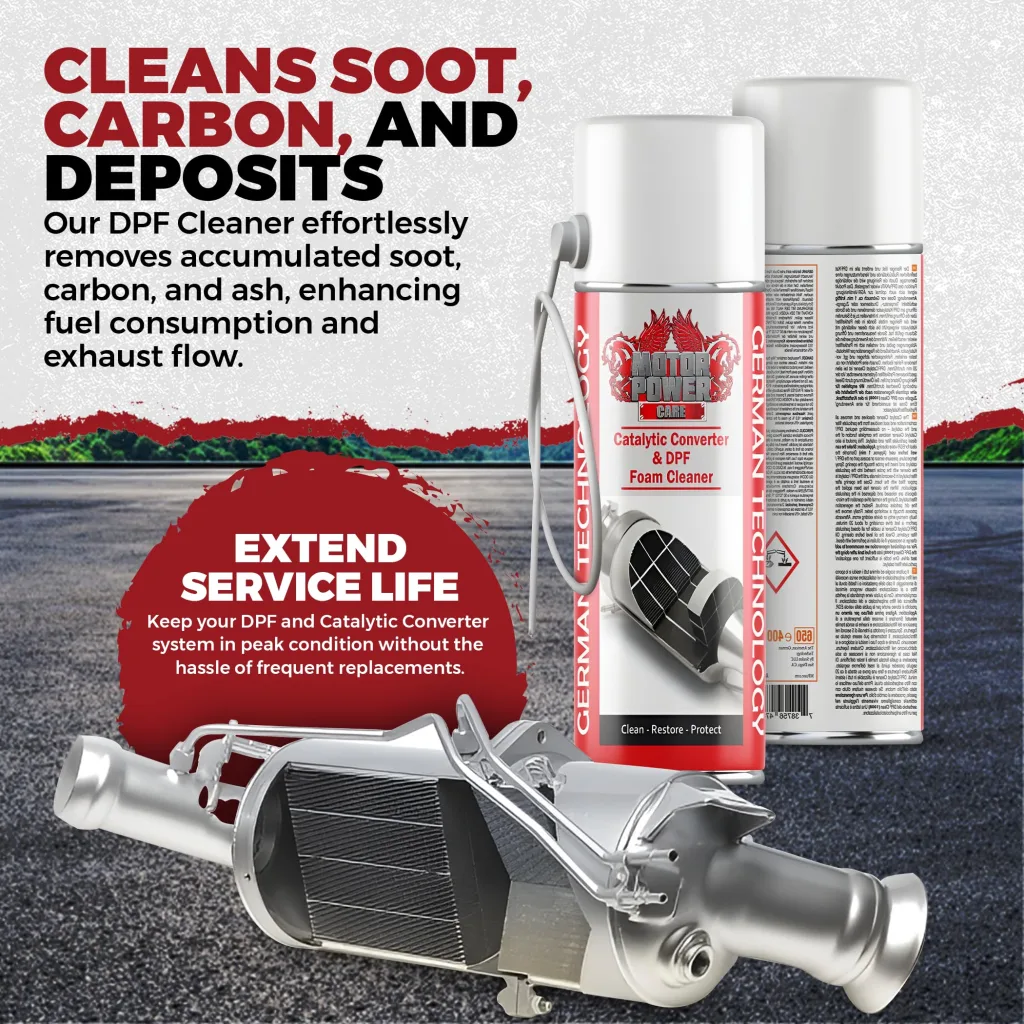
Diesel exhaust filter cleaner: does it work?
This is where the internet gets messy.
Searches for diesel exhaust filter cleaner often mix together:
- Fuel additives
- DPF spray cleaners
- Forced-service cleaners
- Off-vehicle industrial DPF cleaning
These are not interchangeable.
DieselNet’s technical material on fuel-borne catalysts shows that additives can influence soot oxidation and regeneration behavior in some systems, but it also cautions that metallic additives can increase ash concerns and are not universally embraced as a simple solution in modern diesel emissions systems. (dieselnet.com)
The safest general conclusion is:
- A bottle additive may help some soot-related situations.
- It will not reverse ash loading.
- It will not repair a cracked or melted DPF.
- It will not fix a bad sensor, injector issue, turbo issue, EGR fault, or oil-burning engine.
- It should not be treated as a substitute for OEM regeneration strategy or proper diagnosis.
So if you are comparing highway regeneration versus a diesel exhaust filter cleaner, the first one is normal system operation. The second is, at best, a supplemental product with limits.
When the DPF problem is no longer “normal cleaning”
You should stop thinking in terms of routine regeneration and start thinking diagnosis when:
- The warning messages escalate instead of clearing
- The truck goes into reduced power or derate
- Regeneration will not complete
- The warning returns unusually quickly
- You have related fault codes
- Fuel economy drops sharply
- There is excessive smoke, oil use, or another clear engine problem
Ram’s diesel supplement notes that if regeneration is disabled due to a malfunction, the cluster can show Exhaust Service Required — See Dealer Now and the powertrain control module will register a fault. Ford’s diesel supplement similarly distinguishes routine cleaning messages from more serious overload conditions. (Mopar Vehicle Information)
That is the line between “let it clean” and “this needs troubleshooting.”
The hidden cause many owners miss: oil consumption and ash
One of the most important technical points in this whole topic is that soot and ash are not the same problem. Soot is what regeneration is designed to burn off. Ash is what gradually accumulates from engine oil additives and other non-combustible material.
DieselNet notes that lubricating oil consumption can significantly impact DPFs because most ash accumulation in the filter is attributed to oil consumed in the engine, and that high ash load can increase pressure drop, increase regeneration frequency, and degrade the substrate over time. (dieselnet.com)
So if a diesel has persistent DPF trouble, you should think beyond “the filter is dirty.” Sometimes the filter is the victim. The real problem may be:
- Excessive oil consumption
- Injector or combustion problems creating excess soot
- Turbo issues
- EGR issues
- Repeated interrupted regens
- An aging DPF that is simply reaching its ash-capacity limit
Professional cleaning vs replacement
If the filter is ash-loaded but structurally sound, professional off-vehicle cleaning may make sense. If the substrate is cracked, melted, contaminated beyond recovery, or the system has other major failures, replacement may be necessary.
What you should not do is assume that every DPF issue means “replace the filter now.” Nor should you assume every problem can be fixed by taking one long drive. The correct path depends on whether the issue is:
- Normal soot loading
- Incomplete regeneration
- Ash accumulation
- Hardware failure
- Upstream engine problems
Final thoughts
Diesel exhaust filter cleaning is usually the diesel particulate filter regeneration process, and on Ford, GM, and Ram diesels it is a normal part of ownership when the system is working properly. Ford calls Cleaning Exhaust Filter the normal regeneration process, GM says the engine computer initiates DPF cleaning by raising exhaust temperature, and Ram describes the DPF as self-cleaning when conditions are correct. (Ford Service Content)
The key is understanding what kind of “cleaning” you are dealing with.
If the vehicle is simply asking to regenerate, the solution is often to let it complete the cycle under the right driving conditions. If messages escalate, regeneration will not complete, or the system keeps coming back with the same issue, then you are likely beyond routine cleaning and into diagnosis territory. And if ash loading or oil consumption is the underlying problem, no generic diesel exhaust filter cleaner is going to solve that permanently. DieselNet’s technical guidance is especially useful here: soot can be burned off, but ash accumulation and oil-related contamination are longer-term issues that eventually require service attention. (dieselnet.com)
Connect with us


