





The Engines of the 2025 Ram 2500: Power

The 2025 Ram 2500 is set to impress truck enthusiasts and heavy-duty users with its robust engine lineup. This model year brings significant advancements in powertrain technology, ensuring that the Ram 2500 remains a top choice for those needing reliable performance for both work and play.
Engine Options Overview
- 6.4-Liter HEMI® V8
- Performance: The standard engine option for the Ram 2500 is the 6.4-liter HEMI V8, which produces an impressive 410 horsepower and 429 lb-ft of torque. This powerful gas engine is designed to handle a variety of tasks, from towing trailers to everyday driving (MoparInsiders)(Pontos Auto).
- Transmission: Paired with an 8-speed automatic transmission, the HEMI V8 provides a smooth driving experience and improved fuel efficiency(Pontos Auto).
- 6.7-Liter Cummins® Turbo Diesel I6
- The 6.7-liter Cummins Turbo Diesel engine is another option that enhances the 2025 Ram 2500’s capabilities. It comes in two configurations:
- Standard Output: This version delivers around 370 horsepower and 850 lb-ft of torque, making it ideal for heavy-duty towing and payload tasks(MoparInsiders).
- High Output: The high-output variant is designed for maximum performance, generating approximately 420 horsepower and an astonishing 1,075 lb-ft of torque. This configuration is particularly suited for users who need to tow heavy loads(Pontos Auto)(MoparInsiders).
- The 6.7-liter Cummins Turbo Diesel engine is another option that enhances the 2025 Ram 2500’s capabilities. It comes in two configurations:
Performance Enhancements
One of the standout features of the 2025 Ram 2500 is the introduction of a new ZF 8-speed automatic transmission, which replaces the previous 6-speed models. This upgrade promises to enhance performance, improve responsiveness, and increase overall drivability(
). With smoother shifts and better acceleration, drivers can expect a more engaging and efficient driving experience.
Towing and Payload Capacities
With the new engine options and enhanced transmission, the 2025 Ram 2500 is expected to achieve impressive towing capacities, likely exceeding the previous maximum of 19,990 pounds. This is particularly crucial for users who rely on their trucks for towing heavy trailers, boats, or equipment(
MoparInsiders The combination of power and technology makes the Ram 2500 a formidable choice in the heavy-duty truck segment.
Fuel Efficiency and Technology
While heavy-duty trucks are primarily known for their power, the Ram 2500 also aims to deliver competitive fuel efficiency. The HEMI engine and Cummins diesel are designed with modern technology to maximize performance while minimizing fuel consumption(
MoparInsiders). Furthermore, the introduction of advanced features like adaptive cruise control and a 360-degree camera enhances the overall driving experience and safety.
Conclusion
The 2025 Ram 2500 is poised to continue the legacy of its predecessors with an impressive range of engine options that cater to a variety of needs. Whether you choose the reliable HEMI V8 for everyday performance or the robust Cummins diesel for heavy towing, the Ram 2500 promises exceptional power, improved efficiency, and advanced technology. For more detailed information about the engines and specifications, you can explore the following resources:
- Mopar Insiders – 2025 Ram 2500 Overview
- Pontos Auto – 2025 Ram 2500 Features
- Car and Driver – 2025 Ram 2500 Review
These insights make it clear that the 2025 Ram 2500 is engineered to meet the demands of the most discerning truck buyers, offering a blend of power, efficiency, and cutting-edge technology.
Which is more reliable Cummins or Power Stroke?
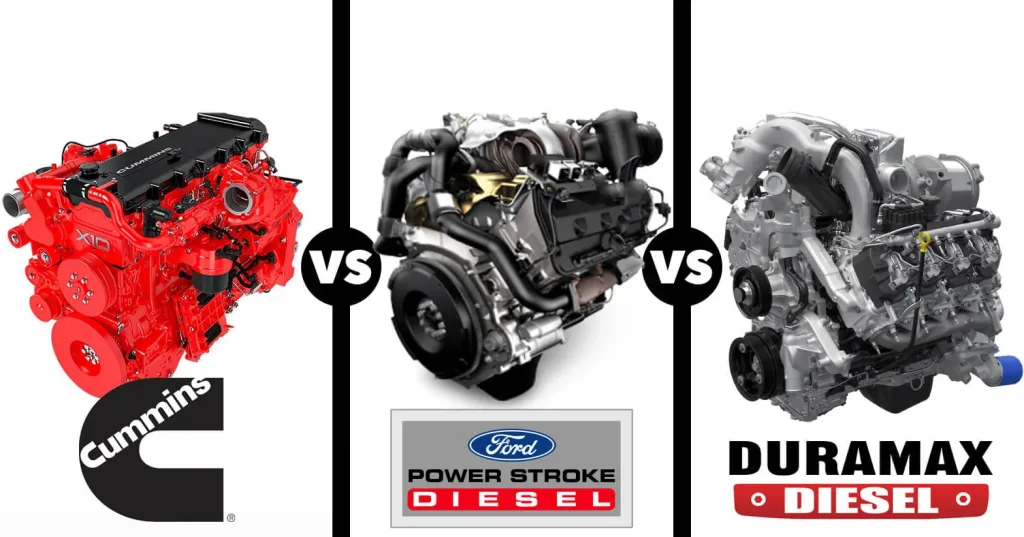
When comparing the reliability of Cummins and Power Stroke engines, two of the most prominent diesel engines in the heavy-duty truck market, several factors come into play, including performance, durability, maintenance, and user experiences. Let’s take a closer look at each engine type and how they stack up against each other.
1. Overview of Cummins and Power Stroke Engines
- Cummins: The Cummins diesel engine, particularly the 6.7L model, is widely regarded for its durability and longevity. Used primarily in Ram trucks, Cummins engines have a reputation for high torque output and efficient performance, making them ideal for towing and hauling heavy loads.
- Power Stroke: The Ford Power Stroke engine, especially the 6.7L version, is designed to offer a balance of power and fuel efficiency. Found in Ford Super Duty trucks, Power Stroke engines feature advanced technology to optimize performance and emissions.
2. Reliability and Longevity
- Cummins Reliability: Cummins engines are known for their robustness and reliability. Many owners report that their Cummins engines can exceed 300,000 miles with regular maintenance. The simplicity of the engine design, along with fewer complex emissions components, contributes to its longevity. Cummins engines are often praised for their ability to handle high mileage without significant issues .
- Power Stroke Reliability: Power Stroke engines have improved over the years, particularly with the introduction of the 6.7L model. However, some users have reported issues related to the emissions systems, particularly the Diesel Particulate Filter (DPF). While many Power Stroke engines also last beyond 300,000 miles, they may require more frequent maintenance due to the complexity of the emissions control systems .
3. Maintenance and Repairs
- Cummins Maintenance: Maintenance costs for Cummins engines are generally lower than for Power Stroke engines. The straightforward design allows for easier access to parts and repairs. Users often report that routine maintenance tasks are simpler and more affordable .
- Power Stroke Maintenance: Power Stroke engines can be more expensive to maintain due to the complexity of their emissions systems. While modern technology helps improve performance and efficiency, it can also lead to more components that may require attention over time .
4. User Experiences and Reviews
User reviews and experiences play a significant role in understanding the reliability of these engines:
- Cummins Owners: Many Cummins owners express satisfaction with their engine’s performance and reliability. Forums and reviews frequently highlight the engine’s ability to withstand heavy loads and high mileage without major failures .
- Power Stroke Owners: Power Stroke owners often appreciate the engine’s power and responsiveness. However, some report concerns about the longevity of specific components, particularly related to emissions systems. This can lead to varying opinions on overall reliability compared to Cummins .
5. Conclusion: Which Is More Reliable?
In conclusion, both Cummins and Power Stroke engines have their strengths, but overall reliability tends to favor the Cummins engine:
- Choose Cummins if you prioritize reliability, lower maintenance costs, and long-term durability. Many users have reported high mileage and fewer issues over time, making it a solid choice for heavy-duty applications.
- Choose Power Stroke if you value power and advanced technology, but be prepared for potentially higher maintenance costs. While the Power Stroke engine has made significant advancements, its complexity may lead to reliability concerns in some models.
Ultimately, the best choice depends on your specific needs, how you plan to use your truck, and your willingness to manage maintenance costs. Both engines have proven themselves in the market, but Cummins often stands out for reliability in long-term ownership.
For more in-depth information, you can explore these links:
Is Dodge Really Discontinuing the Challenger?

Is Dodge Really Discontinuing the Challenger?
The Dodge Challenger, a beloved muscle car known for its raw power and retro styling, has been a staple of American automotive culture since its revival in 2008. Recent rumors and announcements have sparked concerns among enthusiasts and potential buyers: Is Dodge really discontinuing the Challenger? Let’s dive into the details to understand the current status and future of this iconic vehicle.
Background of the Dodge Challenger
The Dodge Challenger first hit the streets in 1970, quickly becoming a symbol of American muscle with its aggressive design and powerful engine options. After a hiatus, the Challenger made a dramatic comeback in 2008, reimagined with modern technology while retaining the classic aesthetic that enthusiasts adore.
Recent Developments and Rumors
In recent years, speculation about the future of the Dodge Challenger has intensified. Here’s a breakdown of the factors contributing to the uncertainty surrounding its discontinuation:
1. Industry Trends
The automotive industry is undergoing significant changes, with a shift towards electric vehicles (EVs) and stricter emissions regulations. Many automakers are investing heavily in EV technology and discontinuing internal combustion engines to comply with new regulations. This shift has led to concerns that iconic models like the Challenger might be phased out in favor of more environmentally friendly options.
2. Dodge’s New Strategies
Dodge has been making headlines with its new lineup of performance vehicles, including the Dodge Hornet and the upcoming Dodge EVs. The brand’s focus on expanding its range to include electric and hybrid models has fueled speculation that the Challenger could be discontinued as part of a broader strategy to adapt to changing market demands.
3. Official Statements and Announcements
Dodge has made several statements about its future product plans, which have only added to the confusion:
- Limited Editions: Dodge has released special, limited-edition versions of the Challenger, such as the Challenger SRT Hellcat Redeye and the Challenger SRT Super Stock. While these editions celebrate the Challenger’s performance, they also create uncertainty about the car’s long-term future.
- Future Plans: In recent announcements, Dodge has hinted at the possibility of introducing new models that might replace or evolve from the Challenger. This has led to speculation that while the Challenger may not be entirely discontinued, it could undergo significant changes or be replaced by a new performance vehicle.
4. Enthusiast Reactions
Car enthusiasts and collectors have expressed concern about the Challenger’s potential discontinuation. The Challenger has a loyal fan base that appreciates its unique blend of classic design and modern performance. The idea of losing such an iconic vehicle has led to calls for Dodge to preserve the Challenger or at least offer a fitting successor.
What Does This Mean for Buyers?
For potential buyers and current owners of the Challenger, the uncertainty around the car’s future raises several questions:
- Resale Value: If the Challenger is discontinued, its rarity could potentially increase its resale value. However, this is speculative and depends on various market factors.
- Availability of Parts and Service: Discontinuation could affect the availability of replacement parts and service for the Challenger. It’s essential to consider the long-term implications for maintenance and repairs.
- Future Models: Dodge’s focus on new performance vehicles and EVs suggests that the brand will continue to offer high-performance options, albeit potentially in a different form than the current Challenger.
Conclusion
While Dodge has not officially confirmed the discontinuation of the Challenger, the vehicle’s future remains uncertain amidst industry trends and evolving brand strategies. The Challenger has been a significant part of Dodge’s lineup, and its potential discontinuation would mark the end of an era for muscle car enthusiasts. However, Dodge’s commitment to innovation and performance suggests that while the Challenger might be phased out, its spirit could live on through new models and technologies.
For now, enthusiasts and potential buyers should stay tuned for official announcements from Dodge regarding the Challenger’s future. Whether it’s a final farewell or a transformation into a new performance vehicle, the Challenger’s legacy is likely to influence Dodge’s performance offerings for years to come.
Dodge: Official Dodge Challenger Page
- Explore features, specs, and trims on the official Dodge site.
Edmunds: 2023 Dodge Challenger Review
- Get expert reviews, pricing, and performance details.
Kelley Blue Book: 2023 Dodge Challenger
- Detailed pricing, consumer reviews, and feature highlights.
MotorTrend: Dodge Challenger Overview
- Offers in-depth reviews, specs, and comparisons.
Car and Driver: 2023 Dodge Challenger
- Comprehensive review with pros, cons, and performance analysis.

Is Charging an Electric Car Cheaper Than Gas in California?
With the growing popularity of electric vehicles (EVs) in California, a common question that arises is whether charging an electric car is more cost-effective than fueling a traditional gas-powered vehicle. Given the state’s ambitious environmental goals and the high cost of gasoline, understanding the cost differences between charging and refueling can significantly impact your decision to switch to an electric vehicle. In this article, we’ll delve into the costs associated with charging an EV versus filling up with gasoline, considering various factors that affect these expenses.
1. Understanding the Cost of Charging an Electric Car
Charging an electric vehicle involves different costs compared to gasoline. The cost of charging can vary based on several factors:
Electricity Rates
Electricity rates in California can vary widely depending on your utility provider and the time of day. On average, residential electricity rates in California range from $0.20 to $0.30 per kilowatt-hour (kWh). Charging at home during off-peak hours may offer lower rates, thanks to time-of-use (TOU) plans offered by many utility companies.
Charging Levels
EVs can be charged at different levels, each with its associated costs:
- Level 1 Charging: Uses a standard 120-volt outlet and is the slowest form of charging. It’s typically used at home and incurs minimal additional cost, usually covered by standard residential electricity rates.
- Level 2 Charging: Requires a 240-volt outlet and offers faster charging. Installing a Level 2 home charger may involve an initial setup cost, but the charging cost itself remains within standard electricity rates.
- DC Fast Charging: Provides rapid charging and is often found at public charging stations. The cost can vary but typically ranges from $0.20 to $0.50 per kWh, depending on the provider.
Charging Costs Example
To estimate the cost of charging an EV, consider the following example:
- EV Efficiency: Assume an electric vehicle consumes 30 kWh to travel 100 miles.
- Electricity Cost: At an average rate of $0.25 per kWh, charging the vehicle would cost about $7.50 for 100 miles.
2. Understanding the Cost of Gasoline
The cost of gasoline in California is influenced by various factors, including global oil prices, state taxes, and seasonal changes. As of recent data, the average price of gasoline in California is around $4.50 to $5.50 per gallon.
Fuel Efficiency
To compare gasoline costs, consider the fuel efficiency of a typical gas-powered vehicle:
- Average MPG: A mid-sized car may have an average fuel efficiency of around 25 miles per gallon (MPG).
- Gasoline Cost Example: At $5.00 per gallon, driving 100 miles in a vehicle with 25 MPG would cost $20.00 in gasoline.
3. Comparing Charging Costs to Gasoline Costs
To determine whether charging an EV is cheaper than gasoline, let’s compare the costs directly.
Charging Cost Comparison
- Cost per 100 Miles: With the example provided, charging an EV at $0.25 per kWh costs approximately $7.50 to drive 100 miles.
Gasoline Cost Comparison
- Cost per 100 Miles: With gasoline at $5.00 per gallon and a vehicle achieving 25 MPG, it costs approximately $20.00 to drive 100 miles.
4. Additional Considerations
While the basic comparison shows that charging an EV is typically cheaper than buying gasoline, there are additional factors that can influence the overall cost of ownership:
Initial Vehicle Costs
- Purchase Price: EVs generally have a higher upfront cost compared to gas-powered vehicles, although this can be offset by various incentives, rebates, and tax credits.
Maintenance Costs
- Maintenance Savings: EVs generally have lower maintenance costs since they have fewer moving parts and don’t require oil changes. This can result in additional savings over the vehicle’s lifetime.
Charging Infrastructure
- Public Charging: While home charging is generally cheaper, public DC fast chargers can be more expensive. However, the convenience of public charging may offset the higher per-kWh cost.
Utility Rates
- Time-of-Use Plans: Some utility companies offer time-of-use plans that allow you to charge your EV during off-peak hours at reduced rates, further lowering charging costs.
Environmental Impact
- Emission Savings: Beyond cost, EVs contribute to reduced greenhouse gas emissions and lower air pollution, which has broader environmental and public health benefits.
5. Real-World Examples and Case Studies
Several studies and real-world examples illustrate the cost benefits of EVs:
- Case Study 1: In urban areas with high gasoline prices and high utility rates, such as San Francisco, charging an EV can be significantly cheaper than buying gasoline. Residents often see substantial savings on their monthly transportation costs.
- Case Study 2: For long-distance travelers who rely on DC fast charging, the cost difference may be less pronounced, but overall savings on daily commutes and maintenance still favor EVs.
6. Conclusion
In California, charging an electric car is generally cheaper than fueling a traditional gasoline vehicle. With electricity rates often lower than gasoline prices per mile driven, EV owners can enjoy significant cost savings. Additionally, the lower maintenance costs associated with EVs further enhance the financial benefits of going electric.
While the initial purchase price of EVs may be higher, various incentives and rebates can help offset these costs. Considering the broader environmental benefits and long-term savings on maintenance, switching to an electric vehicle represents a smart choice for both your wallet and the planet.
As California continues to lead the charge toward a sustainable future, the cost advantages of electric vehicles will likely become even more pronounced, making them an increasingly attractive option for drivers across the state.
California Clean Vehicle Rebate Project (CVRP) – Learn About the $750 EV RebateApply for the $750 EV Rebate – Start Your Application HereCheck Eligible Vehicles for the $750 Rebate – See Which EVs QualifyCalifornia EV Incentives Overview – Explore All EV IncentivesFederal EV Tax Credit Information – Understand Federal IncentivesCalifornia EV Charging Incentives – Find Charging Station RebatesUtility Company EV Incentives – Discover Local Utility RebatesClean Air Vehicle Decals – Apply for HOV Lane AccessEV Lease and Purchase Offers – Find Deals on EVsCalifornia Air Resources Board (CARB) EV Programs – CARB’s EV Initiatives
Is the Dodge Hornet an Old Model?

Is the Dodge Hornet an Old Model?
In the ever-evolving automotive market, new models frequently emerge to meet the demands of contemporary drivers. The Dodge Hornet, introduced in 2023, is one such new entrant that has garnered considerable attention. But is the Dodge Hornet an old model, or is it a fresh addition to the market? Let’s explore its background and context to determine its standing in today’s automotive landscape.
The Birth of the Dodge Hornet
The Dodge Hornet is a modern vehicle that signifies Dodge’s return to the compact crossover SUV segment. Although the name “Hornet” may evoke nostalgia for some, the 2023 model is a completely new design. The nameplate was originally used by American Motors Corporation (AMC) in the 1970s for a compact car, but the current Dodge Hornet is not related to the old model in terms of design or engineering.

The new Hornet was introduced to fill a gap in Dodge’s lineup, as the brand had previously focused more on muscle cars and larger SUVs. The 2023 Hornet is designed to offer a blend of sporty performance and practical features, targeting drivers who seek a versatile and engaging compact SUV.
Modern Features and Technology
One of the key aspects that set the Dodge Hornet apart is its modern features and technology. Unlike older models or their contemporaries, the Hornet comes equipped with the latest advancements in automotive technology. This includes:
- Powertrain Options: The Hornet offers a turbocharged 2.0-liter inline-four engine in the GT model, delivering 268 horsepower. The R/T variant adds a plug-in hybrid system, combining the same engine with an electric motor to produce a total of 288 horsepower. These powertrains reflect current automotive trends towards both performance and hybrid efficiency.
- Interior and Infotainment: Inside, the Hornet boasts a contemporary design with advanced infotainment systems, including a touchscreen interface compatible with Apple CarPlay and Android Auto. The interior is designed to offer comfort and convenience, featuring modern materials and a user-friendly layout.
- Safety Features: The Hornet is equipped with a suite of safety technologies, such as adaptive cruise control, lane-keeping assist, and automatic emergency braking. These features align with the latest industry standards for driver and passenger protection.
Comparison with Older Models
When comparing the Dodge Hornet to older models, it becomes clear that it represents a significant departure from its predecessors. The 2023 Hornet is a response to current market trends and consumer preferences, focusing on fuel efficiency, technology, and practical performance.
The original Hornet, produced by AMC in the 1970s, was a compact car known for its affordability and simplicity. While it was well-regarded in its time, the automotive landscape has changed dramatically since then. The new Hornet incorporates the latest engineering and design principles, making it a modern vehicle by today’s standards.
The Evolution of the Hornet Nameplate
The name “Hornet” may have historical significance, but the 2023 model represents a fresh start for the nameplate. It draws on the legacy of the original Hornet in terms of spirited driving but is built with contemporary technology and design. The decision to reuse the name highlights Dodge’s intention to evoke a sense of heritage while introducing a new and relevant vehicle.
Conclusion
In conclusion, the Dodge Hornet is not an old model; rather, it is a new and modern addition to Dodge’s lineup. While it shares its name with a historic model from the 1970s, the 2023 Hornet is a product of current automotive trends and technology. It offers a contemporary design, advanced features, and performance that align with the expectations of today’s drivers. As such, the Dodge Hornet stands as a testament to Dodge’s ability to innovate and adapt while paying homage to its past.
What Is the Best Year to Buy a RAM 1500?
What Is the Best Year to Buy a RAM 1500?
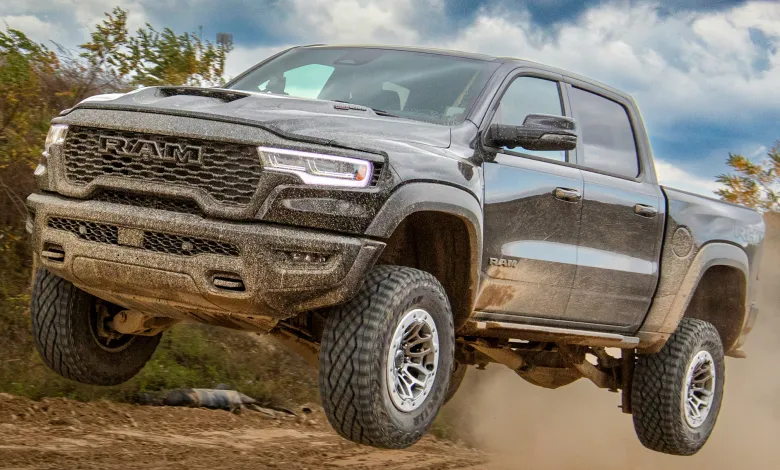
When it comes to purchasing a RAM 1500, choosing the right year is crucial for ensuring you get the best value, performance, and reliability. Over the years, the RAM 1500 has undergone significant improvements in design, technology, and engine performance. In this article, we’ll explore which model years stand out and why they might be the best options for buyers.
1. The 2019 RAM 1500: A Major Redesign
The 2019 RAM 1500 is often hailed as one of the best model years to buy due to its comprehensive redesign. This year marked the introduction of a new platform that improved ride quality, handling, and fuel efficiency. With a more modern and upscale interior, the 2019 model features an impressive infotainment system with a large touchscreen and advanced connectivity options.
Key Features:
- Improved towing capacity of up to 12,750 pounds.
- Enhanced safety features, including adaptive cruise control and blind-spot monitoring.
- High-quality interior materials that elevate the overall experience.
For those interested in the 2019 RAM 1500, you can explore more about its features and specifications here.
2. The 2020 RAM 1500: Building on Success
The 2020 RAM 1500 built on the strengths of its predecessor while introducing additional features that further enhanced its appeal. This model year continued to offer a luxurious interior and excellent ride quality, along with a new EcoDiesel engine option, which provides exceptional fuel efficiency.
Key Features:
- Fuel economy of up to 32 mpg on the highway with the EcoDiesel.
- Additional technology upgrades, including a 12-inch touchscreen and updated safety features.
- Strong towing capacity and payload ratings that cater to various needs.
The 2020 RAM 1500 received positive reviews from experts and owners alike, making it a solid choice for buyers looking for reliability and performance. Learn more about the 2020 model here.
3. The 2021 RAM 1500: Continued Excellence
The 2021 RAM 1500 continued the trend of excellence established in previous years, offering new technology and convenience features. This year introduced a TRX trim, designed for off-road enthusiasts and performance seekers, showcasing the RAM 1500’s versatility.
Key Features:
- TRX model with a supercharged 6.2L HEMI V8 engine, producing 702 horsepower.
- Enhanced driver assistance features and improved infotainment options.
- High towing capacity and payload, making it suitable for work and play.
With its advanced features and impressive performance, the 2021 RAM 1500 is an excellent choice for those wanting a truck that excels in both capability and comfort. Discover more about the 2021 model here.
4. Why the 2014 RAM 1500 Is Still Relevant
For budget-conscious buyers, the 2014 RAM 1500 is often recommended. It won the Motor Trend Truck of the Year award and was recognized for its innovative design and strong performance. Despite being older, it still offers a well-rounded package for those looking for a reliable truck without breaking the bank.
Key Features:
- Available EcoDiesel engine, providing excellent fuel efficiency for a full-size truck.
- Quality interior with user-friendly technology.
- Good towing capacity and a comfortable ride.
The 2014 RAM 1500 remains a favorite among used truck buyers. More information can be found here.
Conclusion
When determining the best year to buy a RAM 1500, the 2019, 2020, and 2021 models stand out for their reliability, performance, and innovative features. Each of these model years offers unique advantages that cater to different needs, whether you’re looking for a luxurious ride, off-road capability, or exceptional fuel efficiency. Meanwhile, the 2014 RAM 1500 serves as a solid budget option without sacrificing quality. Ultimately, your choice should align with your specific requirements and budget, ensuring you get the best value for your investment in a RAM 1500.
The Dodge Charger GT is one of the most popular trims in the Charger lineup, offering a blend of performance, practicality, and muscle car appeal. One of the most frequently asked questions about the Charger GT is whether it’s powered by a V6 or a V8 engine. This article will explore the engine specifics of the Charger GT, what makes it unique in the Charger family, and how it stacks up in terms of performance.
The Dodge Charger GT Comes with a V6 Engine
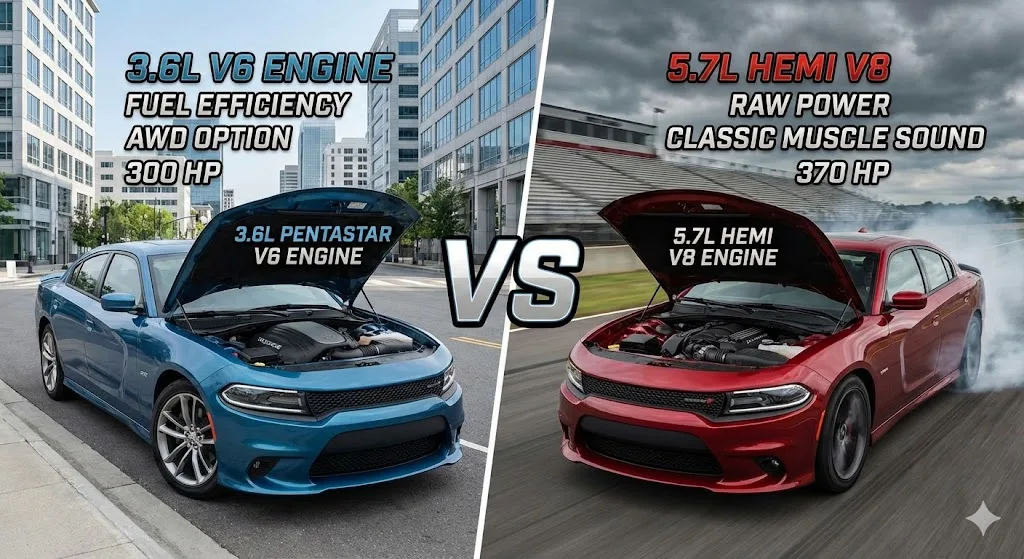
The Dodge Charger GT is powered by a 3.6L Pentastar® V6 engine. This engine has been a cornerstone of the Dodge lineup for years and is known for its reliability, efficiency, and respectable performance.
Key specs of the 3.6L V6 engine in the Charger GT include:
- Horsepower: 300 horsepower
- Torque: 264 lb-ft
- Transmission: 8-speed automatic
- Fuel Economy: Up to 30 MPG on the highway
This V6 engine provides more than enough power for daily driving while still delivering the muscle car experience that Charger fans expect. The Charger GT’s V6 is designed to give drivers the best of both worlds: strong performance and better fuel economy compared to the larger V8 options in other Charger trims.
Why the V6 Engine in the Charger GT is Ideal for Many Drivers
The V6 engine in the Charger GT strikes a balance between performance and efficiency, making it an appealing option for a variety of drivers. Here’s why:
1. Power for Everyday Driving
With 300 horsepower under the hood, the V6 engine in the Charger GT provides plenty of power for most driving scenarios. Whether you’re merging onto the highway, passing slower traffic, or simply enjoying an open road, the Charger GT delivers a satisfying and responsive driving experience.
2. Better Fuel Economy
One of the main advantages of the V6 engine is its fuel efficiency compared to the larger V8 engines in other Charger trims. The Charger GT achieves up to 30 MPG on the highway, making it a more economical choice for drivers who want muscle car performance without the higher fuel costs associated with V8 engines.
3. All-Wheel Drive (AWD) Capability
Unlike the V8-powered Charger models, the Charger GT is available with all-wheel drive (AWD), which makes it a great option for those who live in areas with varying weather conditions. AWD provides enhanced traction and control on wet, snowy, or icy roads, making the Charger GT more versatile for year-round driving.
4. Lower Insurance and Maintenance Costs
The V6 engine typically results in lower insurance premiums compared to the V8 models. Additionally, maintenance and repair costs for a V6 tend to be more affordable due to its less complex design and better fuel efficiency, saving you money over time.
How the Charger GT Compares to V8-Powered Chargers
While the Charger GT offers a V6 engine, some of the more performance-oriented trims, such as the Charger R/T and Charger Scat Pack, come with V8 engines. Let’s break down how the Charger GT compares to these V8-powered options.
V8 Models: Charger R/T and Scat Pack
- Charger R/T: Powered by a 5.7L HEMI® V8, producing 370 horsepower and 395 lb-ft of torque.
- Charger Scat Pack: Equipped with a 6.4L HEMI® V8, generating a staggering 485 horsepower and 475 lb-ft of torque.
These V8 engines provide a significant boost in power and performance, making the Charger R/T and Scat Pack ideal for enthusiasts who crave the thrill of raw muscle car power. However, they come with trade-offs in terms of fuel economy, insurance costs, and everyday drivability.
Charger GT vs. Charger R/T and Scat Pack
- Fuel Economy: The Charger GT’s V6 engine offers significantly better fuel efficiency than the V8 models. If you’re using your Charger as a daily driver, the GT is more economical.
- Performance: While the V6 in the Charger GT is powerful, it can’t match the raw performance of the V8s. For those seeking the ultimate muscle car experience, the R/T or Scat Pack might be more appealing.
- Practicality: The Charger GT is more practical for everyday use, especially with its available AWD option. It’s a better choice for drivers who want performance without sacrificing practicality or comfort.
Who Should Choose the Charger GT?
The Dodge Charger GT is perfect for drivers who want a balance of performance and efficiency. Here’s a breakdown of who might prefer the Charger GT over the V8 models:
- Everyday Drivers: If you need a muscle car that’s comfortable for daily commuting and long road trips, the Charger GT’s V6 offers enough power without compromising on fuel economy.
- Those in Areas with Harsh Weather: The availability of all-wheel drive on the Charger GT makes it ideal for drivers in regions with heavy rain, snow, or ice.
- Budget-Conscious Shoppers: The V6 engine means lower fuel costs, insurance premiums, and maintenance expenses. If you’re looking to save in these areas, the Charger GT is the smart choice.
- Drivers Who Still Want Power: While it’s not a V8, the 300-horsepower V6 in the Charger GT still delivers a muscle car experience that’s far from boring.
Who Should Consider a V8-Powered Charger?
While the Charger GT is a great option for many, some drivers may prefer the V8-powered Charger models. Here’s who might benefit from the extra power of the Charger R/T or Charger Scat Pack:
- Performance Enthusiasts: If you crave maximum horsepower and torque, a V8-powered Charger will deliver the exhilarating acceleration and speed you’re looking for.
- Weekend Racers: For drivers who want to take their car to the track or enjoy spirited driving, the V8 models are better suited for high-performance situations.
- Collectors and Muscle Car Purists: The V8 engines in the Charger R/T and Scat Pack are part of Dodge’s iconic muscle car legacy. If you’re looking for a piece of that history, a V8 model is the way to go.
Conclusion: The Charger GT is a V6, and It’s a Great One
The Dodge Charger GT comes equipped with a V6 engine, offering a fantastic combination of performance, efficiency, and practicality. It’s ideal for drivers who want the muscle car experience without the additional costs and fuel consumption of a V8 engine. With all-wheel drive availability and plenty of customization options, the Charger GT stands out as one of the most versatile options in the Charger lineup.
For those seeking more raw power, the V8-powered Charger R/T and Charger Scat Pack offer higher horsepower and performance but at a higher cost. Ultimately, whether you choose the V6-powered Charger GT or a V8 model, you’ll be getting a piece of American muscle car history.
Explore Dodge Charger GT for Sale
Ready to experience the Dodge Charger GT? Browse our inventory to find the perfect Charger GT for you, or visit your nearest Dodge dealership for a test drive today.
How long will a Jeep Grand Cherokee last?

How Long Will a Jeep Grand Cherokee Last?
The Jeep Grand Cherokee is a popular and enduring model known for its off-road capability, robust performance, and luxury features. Prospective buyers and current owners often wonder about its longevity. Several factors influence how long a Jeep Grand Cherokee can last, including maintenance, driving habits, and the specific model year. This article explores these factors in detail, drawing on various sources to provide a comprehensive answer.

Average Lifespan of a Jeep Grand Cherokee
Typically, a well-maintained Jeep Grand Cherokee can last between 200,000 to 300,000 miles. For an average driver who covers about 15,000 miles per year, this translates to approximately 13 to 20 years of use. However, achieving this lifespan depends heavily on regular maintenance and responsible driving habits.
Factors Influencing Longevity
1. Regular Maintenance
Routine maintenance is crucial for extending the life of any vehicle, including the Jeep Grand Cherokee. This includes:
- Oil Changes: Regular oil changes help maintain engine health by reducing friction and preventing wear and tear. Most experts recommend changing the oil every 3,000 to 5,000 miles.
- Tire Rotation and Alignment: Proper tire maintenance ensures even wear, which can prevent suspension and alignment issues. Tires should be rotated every 6,000 to 8,000 miles.
- Brake Inspections: Regular brake checks and timely replacements prevent damage to the brake system and ensure safety.
- Fluid Checks: Regularly checking and replacing transmission fluid, coolant, and brake fluid is essential for the smooth operation of the vehicle.
2. Driving Habits
How you drive significantly impacts the longevity of your Jeep Grand Cherokee. Factors include:
- Gentle Acceleration and Braking: Avoiding rapid acceleration and harsh braking reduces stress on the engine, transmission, and brakes.
- Off-Road Driving: While the Grand Cherokee is designed for off-road use, frequent off-roading can increase wear and tear. If you do engage in off-roading, ensure your vehicle receives the necessary maintenance afterward.
- Load Carrying: Regularly carrying heavy loads can strain the suspension and transmission. It’s important to stay within the manufacturer’s recommended load limits.
3. Model Year and Build Quality
The longevity of a Jeep Grand Cherokee can also depend on the model year and build quality. Some model years have better reputations for reliability than others. For example:
- 2011-2013 Models: These years have reported more issues compared to others, particularly with the transmission and electrical systems.
- 2014-Present Models: These newer models generally have better reliability ratings and have benefited from improvements in technology and manufacturing.
Common Issues and Repairs
Understanding common issues can help owners address problems early and extend the lifespan of their Grand Cherokee. Common issues include:
- Transmission Problems: Some older models, particularly from the early 2010s, have reported transmission issues. Regular transmission fluid changes and software updates can mitigate these problems.
- Electrical Issues: Electrical problems, such as issues with the infotainment system and sensors, have been reported. Keeping software updated and addressing issues promptly can prevent further complications.
- Suspension Wear: Given the vehicle’s off-road capability, suspension components can wear out faster if frequently used in rugged conditions. Regular inspections and timely replacements are crucial.
Real-World Longevity Reports
Many Jeep Grand Cherokee owners have reported impressive longevity. Anecdotal evidence from owner forums and reviews indicates that with proper care, many Grand Cherokees have surpassed the 200,000-mile mark. Some owners have even reported their vehicles reaching 300,000 miles and beyond with minimal major repairs.
For example, one owner on a popular Jeep forum shared their experience of reaching 250,000 miles on their 2005 Grand Cherokee with regular maintenance and occasional repairs .
Conclusion
The Jeep Grand Cherokee can be a long-lasting vehicle, capable of providing reliable service for up to 20 years or more with proper care. Regular maintenance, mindful driving habits, and choosing a reliable model year are key factors in achieving this longevity. For those willing to invest in upkeep, the Grand Cherokee offers a robust and dependable vehicle option.
For more information on maintaining your Jeep Grand Cherokee and ensuring its longevity, consider visiting the following resources:
How Long Can A Cummins Engine Last?

The Cummins B6.7L can last a very long time, but there is no single official mileage number that applies to every application. Cummins markets the B6.7 as a medium-duty engine family used across trucks, buses, vocational equipment, and motorhomes, with outputs that vary by calibration and application. That matters because engine life is shaped by duty cycle, idle time, maintenance discipline, emissions-system health, and how hard the engine is worked, not just by the odometer. Cummins also emphasizes the platform’s long production history and reliability, noting the B6.7 family has been in production for decades and has seen maintenance interval extensions on later versions. (Cummins Mart)
The practical answer is this: a well-maintained Cummins B6.7L often reaches high mileage or high operating hours before major overhaul, while a neglected one can get expensive much earlier. In commercial use, engine life is often judged in hours, rebuild economics, and total cost of ownership, not only miles. A school bus, box truck, tow truck, shuttle, or motorhome can all use the same basic engine family but rack up wear very differently. (Cummins Mart)
What the B6.7L Actually Is
The Cummins B6.7 is a 6.7-liter inline-six turbo-diesel used in medium-duty and specialty applications. Cummins lists versions in the 200 to 325 hp range and up to 750 lb-ft of torque for certain medium-duty truck calibrations, with different ratings depending on use case. The engine’s dry weight is listed at about 1,150 lb on the 2021 medium-duty truck version.
That is important because this is not a small, lightly stressed passenger-car diesel. It is an engine family designed for work. The B6.7 platform is used in applications such as medium-duty trucks, school buses, vocational vehicles, fire and emergency apparatus, and motorhomes, which tells you a lot about its intended durability envelope.
So, How Long Can It Last in Real Life?
A realistic framework is:
- Poorly maintained / hard-use / lots of idling: life can shorten dramatically.
- Normally maintained commercial or RV use: many B6.7 engines can run for hundreds of thousands of miles or many thousands of hours.
- Well-maintained, properly warmed up, serviced on time, not chronically overloaded: lifespan can extend far beyond what most owners ever use.
The reason I am giving a range instead of a single number is that Cummins itself does not publish a universal “this engine lasts X miles” figure in the product pages or operator maintenance documents I reviewed. What Cummins does publish is the engine’s intended work class, long-running production history, and maintenance schedule logic. From that, the sound conclusion is that the B6.7 is built for long-service commercial use, but its real-world longevity depends heavily on operating conditions.
Why Some Cummins B6.7L Engines Last So Long
1. It is built for medium-duty work
The B6.7 is not marketed as a disposable powertrain. Cummins positions it as a medium-duty reliability platform with decades of development behind it. That usually translates into stronger bottom-end expectations, robust cooling strategy, and calibration durability compared with lighter-duty engine categories.
2. Cummins has extended maintenance on newer versions
Cummins explicitly states that the EPA 2021 B6.7 lineup synchronized and extended scheduled maintenance intervals to improve uptime and lower total cost of ownership. Manufacturers generally do not extend intervals on a weak platform they do not trust. That does not prove a mileage number, but it does support the idea that Cummins sees the B6.7 as a durable, mature engine family.
3. It is used in duty cycles that demand durability
School buses, emergency vehicles, vocational trucks, and motorhomes are not applications where owners expect a short-lived engine. These are sectors where reliability, serviceability, and long-run operating economics matter. The fact that Cummins continues to sell the B6.7 across these categories supports its reputation for longevity.

What Usually Determines B6.7L Life More Than the Engine Block Itself
For many modern diesels, the question is not just “how long will the core engine last?” It is also “how long can the entire system stay healthy without a major cost event?” That includes:
- turbocharger condition
- fuel system health
- cooling system health
- emissions components
- sensors and controls
- aftertreatment operation
- wiring and electronic management
Cummins’ own maintenance material for the EPA 2021 B6.7 references a VGT, EGR, DPF/SCR aftertreatment, and the ECM’s integrated control role. That means longevity is partly mechanical and partly systems-based. The long block may be capable of a very long life, but downtime and repair cost can be driven by supporting components.
The Biggest Factors That Affect How Long a Cummins B6.7L Lasts
Maintenance quality
This is the biggest one. If oil changes, filter service, coolant care, and fuel system maintenance are delayed, the engine’s life expectancy drops. Cummins’ maintenance documentation specifically calls out scheduled intervals and daily fuel-filter water draining in relevant use cases. That tells you the company expects owners and fleets to stay on top of service as part of the engine’s durability equation.
Idle time
Idle-heavy operation can make an engine’s condition look better on miles than it really is. A B6.7 in a shuttle bus, service truck, or RV generator-support role may accumulate wear that is not obvious from odometer readings alone. This is why engine hours matter so much.
Load and heat
A lightly loaded motorhome cruising long highway stretches is very different from a truck that is constantly overloaded, stop-and-go, or heat-soaked. Continuous high-load use stresses cooling, turbo, oil, and aftertreatment systems.
Emissions-system health
Modern diesel durability is heavily tied to whether the EGR, DPF, SCR, DEF dosing, and related sensors stay healthy. Cummins’ current documentation makes clear these are fully integrated parts of the B6.7 system. If those systems are neglected or used in duty cycles that are bad for regeneration, ownership costs can rise before the engine’s core internals are truly worn out.
Fuel quality
Clean fuel matters on modern high-pressure diesel platforms. Water contamination and filtration neglect can damage injectors or the fuel system and indirectly shorten engine life.
Warm-up and shutdown habits
Repeated cold abuse, immediate heavy-load operation, and poor shutdown habits after hard runs can affect turbo and long-term wear.
Miles vs Hours: The Mistake Many Owners Make
One of the biggest mistakes in discussing a Cummins B6.7L lifespan is focusing only on miles. For medium-duty diesels, hours can be just as important as miles, and sometimes more important.
A motorhome, school bus, or delivery truck may spend substantial time idling, crawling, or operating in duty cycles that build heat and stress without adding a ton of distance. That is why two B6.7 engines with the same mileage can have very different wear profiles.
Cummins’ own maintenance literature for the platform is built around operating realities, not just consumer-car style mileage logic.
Signs a Cummins B6.7L Still Has a Long Life Ahead
A B6.7 usually has a good future if it shows most of the following:
- strong cold starts
- stable oil pressure
- clean service history
- no recurring overheating
- no chronic DEF/DPF/SCR issues
- no excessive blow-by
- no major coolant contamination
- normal fuel economy for application
- no repeated fault-code cycles
- turbo and charge-air system in good order
None of those signs alone guarantees longevity, but together they usually indicate the engine is aging well.
Signs Engine Life May Be Shortening
On the other side, life expectancy starts looking less favorable when you see:
- hard starting
- injector-related roughness
- chronic low-power complaints
- rising oil consumption
- overheating history
- repeated regeneration or aftertreatment problems
- coolant loss with no obvious external leak
- excessive crankcase pressure
- metallic noise or bearing concerns
- poor maintenance documentation
At that point, the question shifts from “how long can it last?” to “how much money will it take to keep it worth running?”
Is the Core Engine Usually the First Thing to Fail?
Not always. On many modern diesels, the supporting systems create the first major ownership headache. The B6.7’s VGT, EGR, DPF/SCR system, ECM controls, sensors, and associated plumbing all play a role in keeping the engine operating correctly. Cummins’ official B6.7 maintenance and product material makes clear that these components are fully integrated into the engine package.
That means a B6.7 can remain a fundamentally durable engine while still becoming expensive if aftertreatment or fuel-system issues stack up. In other words, engine longevity and cost-effective ownership longevity are related, but not identical.
How To Make a Cummins B6.7L Last Longer
Change fluids and filters on time
Use the proper oil and filters for the exact B6.7 calibration and application. Cummins provides maintenance guidance by engine serial number and application-specific manual support.
Watch coolant health
Cooling neglect kills diesels. Keep coolant chemistry and service intervals where they should be.
Treat idle time as real wear
Hours matter. Long idle-heavy use should influence your maintenance mindset.
Stay ahead of fuel contamination
Cummins specifically references draining water from the fuel filter in relevant operating guidance. Water and dirty fuel are expensive problems.
Do not ignore emissions warnings
A small aftertreatment problem becomes a bigger one if you keep driving until the system derates or damages related parts.
Check manuals by ESN
Cummins points owners to manuals and wiring diagrams through the engine serial number. That is the right way to avoid generic advice that does not fit your exact B6.7 variant.
Is the B6.7L a “Million-Mile” Engine?
That is where people often overstate things. The B6.7 has a strong durability reputation, but calling every B6.7 a guaranteed “million-mile engine” would go beyond what the official material supports. Cummins does not publish a blanket million-mile claim for the B6.7 in the sources reviewed here. A few very well-maintained commercial engines may run extraordinary distances or hours, but that should be treated as an outcome of use case and maintenance, not a promise.
A more disciplined conclusion is that the Cummins B6.7L is engineered for long commercial service life, and many examples can run a very long time if maintained properly.
Buying a Used Vehicle With a Cummins B6.7L: What Matters Most
If you are evaluating a used B6.7-powered vehicle, focus on:
- service records
- engine hours if available
- idle-heavy history
- emissions-system repair history
- coolant and oil condition
- blow-by check
- fault-code history
- turbo condition
- evidence of overheating
- injector/fuel-system behavior
A high-mile B6.7 with documented care can be a better bet than a lower-mile one with poor records and lots of idle time.
Final Verdict
So, how long can a Cummins B6.7L last?
The best honest answer is: a long time. The Cummins B6.7 is a mature, medium-duty diesel platform with decades of production history, broad commercial use, and extended maintenance logic on newer versions. It is clearly designed for long-service work, not short-life throwaway duty.
But there is no universal mileage number that tells the whole story. A B6.7’s lifespan depends on maintenance, hours, load, idle time, fuel quality, cooling care, and the health of the emissions and control systems around it. In real-world terms, a well-kept B6.7 can outlast many owners’ needs. A neglected one can become expensive much sooner.
Are Jeep Wranglers a lot of Maintenance?

Are Jeep Wranglers a Lot of Maintenance?
Jeep Wranglers are iconic for their rugged design and off-road prowess, but potential buyers often wonder about the maintenance demands of these vehicles. This article delves into the maintenance requirements of Jeep Wranglers, backed by insights from automotive professionals.
General Maintenance Overview
Jeep Wranglers, like any vehicle, require regular maintenance to ensure longevity and performance. Basic maintenance includes oil changes, tire rotations, brake inspections, and fluid top-offs. However, due to their off-road capabilities and unique design, Wranglers may require additional attention compared to standard vehicles.
What kind of maintenance does a Jeep Wrangler need?
| Mileage Interval | Maintenance Task |
|---|---|
| Every 5,000 miles | – Oil change |
| – Tire rotation | |
| – Brake inspection | |
| Every 15,000 miles | – Air filter replacement |
| – Inspect and clean throttle body | |
| Every 30,000 miles | – Replace transmission fluid |
| – Inspect and replace differential fluid | |
| – Transfer case fluid inspection | |
| Every 60,000 miles | – Replace spark plugs |
| – Inspect and replace coolant | |
| – Brake fluid replacement | |
| Additional Recommendations | – Regularly check suspension and steering components, especially after off-road use |
| – Inspect undercarriage and body for rust | |
| – Keep electrical components dry and clean | |
| – Regularly check and replace battery terminals |
Full Jeep Wrangler Maintenance Schedule Updated for 2024 What kind of maintenance does a Jeep Wrangler need?
Are Jeep Wranglers a lot of maintenance? Common Maintenance Issues
- Suspension and Steering Components
- Expert Insight: According to Mike Quinn, a mechanic with over 20 years of experience, “Wranglers often need more frequent inspections of suspension and steering components. The off-road use puts extra stress on these parts, leading to faster wear and tear.”
- Recommendation: Regularly check for any signs of wear or damage in the suspension and steering systems, especially after extensive off-road driving.
- Rust and Corrosion
- Expert Insight: Auto body specialist Sarah Jacobs emphasizes, “Jeep Wranglers, especially older models, are prone to rust due to their design and the environments they are often used in.”
- Recommendation: Regularly inspect the undercarriage and body for rust, and apply anti-rust treatments if necessary.
- Electrical Issues
- Expert Insight: Electrician and auto specialist David Lee notes, “Wranglers can sometimes suffer from electrical issues, particularly related to the battery and wiring due to their exposure to water and mud during off-roading.”
- Recommendation: Keep electrical components dry and clean. Ensure that the battery terminals are free from corrosion and the wiring is intact.
- Transmission and Drivetrain
- Expert Insight: Transmission specialist Linda Carter points out, “The drivetrain and transmission in Jeep Wranglers are built for rugged use, but regular maintenance is crucial to prevent issues. Off-roading can put extra strain on these components.”
- Recommendation: Regularly check and replace transmission fluid, and inspect the drivetrain for any signs of damage or wear.
Are Jeep Wranglers a lot of maintenance? Scheduled Maintenance
Jeep recommends the following for Wranglers:
- Every 5,000 miles: Oil change, tire rotation, brake inspection.
- Every 15,000 miles: Air filter replacement, inspect and clean the throttle body.
- Every 30,000 miles: Replace transmission fluid, inspect and replace the differential fluid, transfer case fluid inspection.
- Every 60,000 miles: Replace spark plugs, inspect and replace coolant, brake fluid replacement.
Are Jeep Wranglers a lot of Maintenance? Cost of Maintenance
The cost of maintaining a Jeep Wrangler can be higher than average due to its specialized components and potential for off-road damage. According to RepairPal, the average annual maintenance cost for a Jeep Wrangler is approximately $694, compared to the industry average of $652 for similar vehicles.
Are Jeep Wranglers a lot of Maintenance? Professional Opinions
- John Davis, Host of MotorWeek: “Jeep Wranglers require diligent maintenance, especially if used extensively off-road. Regular inspections and timely repairs can prevent costly issues down the line.”
- Rachel Stevens, Automotive Journalist: “While Wranglers are built tough, their maintenance shouldn’t be overlooked. Owners need to be proactive in addressing minor issues before they escalate.”
Is a Jeep Expensive to Maintain?
The cost of maintaining a Jeep can vary widely depending on the model, usage, and maintenance practices. Here are some factors to consider:
- Model:
- Different Jeep models have varying maintenance costs. For example, the Jeep Wrangler, known for its off-road capabilities, may have higher maintenance costs due to wear and tear from off-roading compared to a Jeep Cherokee, which is often used more for daily driving.
- Age and Mileage:
- Older Jeeps or those with high mileage may require more frequent repairs and part replacements, leading to higher maintenance costs.
- Driving Conditions:
- Jeeps used for off-roading or in harsh conditions may experience more wear and tear, necessitating more frequent maintenance.
- Parts and Labor:
- Genuine Jeep parts can be expensive, and labor costs at dealerships or specialized mechanics can also be high.
- Routine Maintenance:
- Regular maintenance such as oil changes, tire rotations, and brake pad replacements are typical for any vehicle, but costs can add up, especially if done at a dealership.
- Repairs:
- Jeeps, like any vehicle, can face unexpected repairs. Issues with the transmission, suspension, or electrical systems can be costly to fix.
Average Maintenance Costs
According to data from sources like RepairPal, the average annual maintenance cost for a Jeep is around $634. However, this can vary significantly based on the model:
- Jeep Wrangler: Approximately $694 per year
- Jeep Cherokee: Approximately $520 per year
- Jeep Grand Cherokee: Approximately $666 per year
Tips to Manage Maintenance Costs
- Regular Maintenance: Keeping up with regular maintenance schedules can prevent more costly repairs down the line.
- DIY Repairs: For those mechanically inclined, some basic maintenance tasks can be done at home, reducing labor costs.
- Use Aftermarket Parts: Aftermarket parts can be less expensive than OEM (original equipment manufacturer) parts.
- Extended Warranty: An extended warranty or a maintenance plan can help cover unexpected repairs and spread out costs.
Conclusion
While Jeeps can be more expensive to maintain than some other brands, especially if used heavily for off-roading, proper maintenance and care can help manage and potentially reduce these costs. Always consider the specific model and your intended use when evaluating maintenance costs.
Conclusion
Jeep Wranglers demand a higher level of maintenance than some other vehicles, primarily due to their off-road capabilities and unique design features. Regular inspections, preventive care, and addressing issues promptly are essential to keep a Wrangler in optimal condition. For those willing to invest the time and effort, the rewards of owning a Jeep Wrangler—a versatile and adventure-ready vehicle—are well worth it.
Sources:
- Mike Quinn, Professional Mechanic
- Sarah Jacobs, Auto Body Specialist
- David Lee, Electrician and Auto Specialist
- Linda Carter, Transmission Specialist
- RepairPal: Average Annual Maintenance Cost for Jeep Wranglers
- John Davis, Host of MotorWeek
- Rachel Stevens, Automotive Journalist
Connect with us


