





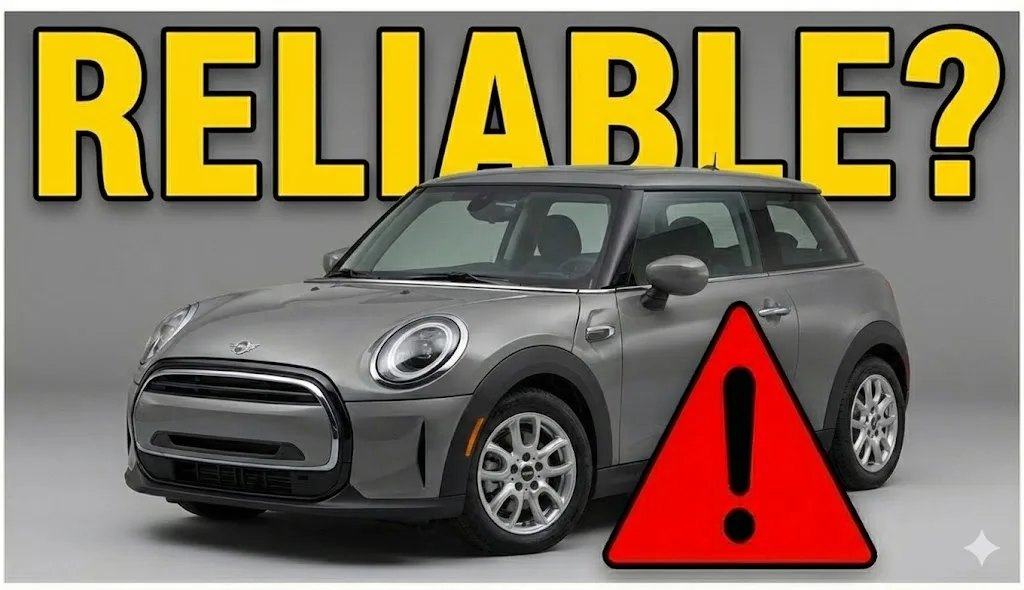
Are Mini Coopers Reliable? Most Owners Learn the Hard Way
Mini Coopers can be reliable, but they are not cheap, low-maintenance economy cars.
The honest answer is this: newer Mini Coopers are much better than older ones, but maintenance and repairs can still cost more than many small cars. A well-maintained Mini can be fun, stylish, and dependable. A neglected used Mini can turn into an expensive lesson very quickly.
RepairPal gives the Mini Cooper a reliability rating of 3.0 out of 5.0, ranking it 21st out of 21 subcompact cars. It also lists the average annual repair cost at $846, compared with $456 for subcompact cars and $652 for all vehicle models. RepairPal
So, are Mini Coopers reliable? They can be, especially newer models, but they are expensive for their size and very sensitive to maintenance history.
Why Mini Cooper Reliability Has a Bad Reputation
Mini Cooper reliability has a rough reputation because many older models were expensive to repair, cramped to work on, and loaded with BMW-related engineering complexity.
Mini is owned by BMW, and that gives the car a more premium feel than a basic compact hatchback. But it also means parts, diagnostics, and labor can cost more than a Toyota Corolla, Honda Civic, Mazda3, or Hyundai Elantra.
That is where many owners learn the hard way. They buy a used Mini because it is cute, fun, and affordable upfront. Then they discover that maintenance costs feel closer to a European premium car than a basic economy car.
A Mini Cooper is small, but it is not simple.
Are Newer Mini Coopers Reliable?
Yes, newer Mini Coopers are generally more reliable than older ones.
Mini quality has improved, especially compared with the troubled years many people remember from the late 2000s and early 2010s. J.D. Power gives the 2020 Mini Cooper Hardtop 4 Door a Quality & Reliability score of 84 out of 100, which falls into its “Great” range. J.D. Power
The 2021 Mini Cooper Hardtop also scores well, with J.D. Power listing a Quality & Reliability score of 82 out of 100. J.D. Power
That does not mean every newer Mini is perfect. It means the newer generation is much easier to recommend than many older used examples.
Are Used Mini Coopers Reliable?
Used Mini Coopers can be reliable, but they must be bought carefully.
The problem with used Minis is that many were not maintained properly. Some owners treat them like cheap small cars, even though they need European-style maintenance discipline. Skipped oil changes, ignored warning lights, cheap repairs, and deferred maintenance can create big bills later.
A used Mini is usually safer if it has:
Clean service records.
No warning lights.
No coolant leaks.
No oil leaks.
No overheating history.
Smooth transmission behavior.
Good tires and brakes.
No major accident history.
No open recalls.
A clean pre-purchase inspection.
Avoid buying a used Mini Cooper just because it is cheap. There is usually a reason.
Best Mini Cooper Years for Reliability
For reliability, newer Mini Coopers are usually better than older ones.
A good used Mini Cooper range to consider is generally 2018 and newer, especially if the car has maintenance records and has not been abused. Models from 2020 and 2021 have strong J.D. Power reliability scores, which makes them easier to recommend than many earlier used Minis.
Older Minis can still be fun, but they need much more caution. The cheaper the Mini is, the more important the inspection becomes.
If you are buying a Mini from the 2007 to 2013 era, be very careful. Those cars can be charming, but they are also the ones most associated with expensive ownership surprises.
Mini Cooper Years to Avoid
The riskiest Mini Coopers are usually older, high-mileage cars with poor records.
Be especially careful with older turbocharged Cooper S models, cars with overheating history, cars with timing-chain noise, cars that have been modified, and cars with automatic transmission issues.
Do not buy a Mini with coolant leaks, smoke, rough idle, warning lights, or vague seller explanations.
A $5,000 Mini can become a $10,000 Mini very quickly if it needs cooling system work, timing-related repairs, suspension parts, oil leak repairs, or transmission attention.
Common Mini Cooper Problems
Mini Cooper problems vary by year and engine, but common trouble areas can include oil leaks, coolant leaks, thermostat housing issues, water pump problems, timing-chain issues on some older models, carbon buildup on direct-injection engines, suspension wear, electrical problems, and turbo-related repairs on Cooper S models.
These problems are not guaranteed, but they are common enough that buyers should inspect carefully before purchase.
Because the engine bay is compact, labor can also be higher than expected. A repair that seems simple on another small car may take more time on a Mini.
Are Mini Cooper Repairs Expensive?
Yes, Mini Cooper repairs are usually expensive for a small car.
RepairPal lists the average annual repair cost for the Mini Cooper at $846, which is far higher than the average for subcompact cars. RepairPal
That does not mean every Mini owner spends that every year. But it does show that Mini ownership costs are not economy-car cheap.
Brakes, tires, batteries, suspension repairs, cooling system work, oil leak repairs, and diagnostics can cost more than shoppers expect. Dealer service can be especially expensive, although a good independent Mini or BMW specialist can help reduce costs.
Is the Mini Cooper S Reliable?
The Mini Cooper S can be reliable, but it is usually riskier and more expensive than the base Cooper.
The Cooper S has more power and more performance appeal. That is the fun part. The tradeoff is higher heat, turbocharger complexity, more aggressive driving from previous owners, and potentially higher repair costs.
If you want the lowest-risk Mini, the regular Cooper is usually safer. If you want the Cooper S, buy the cleanest one you can find, verify service records, and get a pre-purchase inspection.
Do not buy a cheap Cooper S with warning lights and assume it will be fine.
Is the Mini Cooper Countryman Reliable?
The Mini Countryman is more practical than the regular Cooper, but it can still carry Mini/BMW ownership costs.
The Countryman gives you more space, available all-wheel drive, and a more SUV-like shape. It can be a good choice if you like the Mini brand but need more room.
However, it is still not a Toyota RAV4 or Honda CR-V in terms of low-cost maintenance. RepairPal’s Mini brand data lists average annual repair costs at $854 across all Mini models, which is higher than the all-model average. RepairPal
A Countryman can be a good buy if it is newer, maintained well, and inspected before purchase.
Are Electric Mini Coopers Reliable?
The electric Mini Cooper SE can be appealing because EVs have fewer traditional engine parts, but battery and electrical systems still matter.
BMW announced a worldwide recall of Mini Cooper SE electric models in 2024 because of battery issues that could lead to overheating and fire risk. Reuters reported the recall affected more than 140,000 vehicles globally, including around 39,000 in Germany. Reuters
That does not mean the electric Mini should be avoided completely. It means buyers should check recall completion, battery warranty, charging behavior, and service history carefully.
Mini Cooper Maintenance: What Owners Should Expect
Mini Coopers need consistent maintenance.
Oil changes should be done on time. Coolant issues should be fixed early. Warning lights should not be ignored. Tires and brakes should be checked regularly. If the car is turbocharged, oil quality and oil-change discipline matter even more.
A Mini Cooper rewards owners who stay ahead of maintenance. It punishes owners who delay repairs.
That is the main ownership lesson. Mini Coopers are not necessarily unreliable because they always break. They become unreliable when owners treat them like cheap disposable cars.
Mini Cooper vs Toyota, Honda, and Mazda
Mini is usually more expensive to maintain than Toyota, Honda, and Mazda.
A Toyota Corolla, Honda Civic, or Mazda3 is usually a safer choice if your main goal is low-cost reliability. Those cars are easier to service, cheaper to maintain, and generally less risky as used vehicles.
A Mini Cooper makes sense if you want personality, design, compact size, sharp handling, and a more premium feel.
In other words, buy a Mini because you want the Mini experience. Do not buy it because you think it will be the cheapest small car to own.
Should You Buy a Mini Cooper?
Yes, a Mini Cooper can be worth buying if you understand the cost.
Buy one if you want a fun, stylish, compact car and are willing to maintain it properly. Avoid one if you only want cheap transportation.
The best Mini Cooper buyer is someone who values driving feel, design, and personality, but also budgets for maintenance. The worst Mini Cooper buyer is someone who buys the cheapest used one available and expects Toyota-level ownership costs.
What to Check Before Buying a Used Mini Cooper
Before buying a used Mini, get a pre-purchase inspection from a shop that knows Mini or BMW products.
Check for oil leaks, coolant leaks, timing-chain noise, turbo issues, rough idle, overheating history, transmission behavior, suspension noise, electrical problems, warning lights, and recall status.
Use the official NHTSA recall lookup to check the VIN before buying. Recalls are not always a dealbreaker, but open safety campaigns should be completed.
FAQs About Mini Cooper Reliability
Are Mini Coopers reliable?
Mini Coopers can be reliable, especially newer models, but they have higher repair costs than many small cars. RepairPal ranks the Mini Cooper low among subcompact cars and lists average annual repair costs at $846.
Are newer Mini Coopers more reliable?
Yes. Newer Mini Coopers are generally more reliable than many older models. J.D. Power gives the 2020 Mini Cooper Hardtop 4 Door an 84 out of 100 Quality & Reliability score.
Are Mini Coopers expensive to fix?
Yes, Mini Coopers can be expensive to fix for their size. They are small cars with BMW-related engineering, so parts and labor can cost more than typical economy cars.
What Mini Cooper years should I avoid?
Be cautious with older high-mileage Minis, especially 2007 to 2013 models, older turbo Cooper S versions, and any Mini with poor maintenance records, overheating history, timing-chain noise, or warning lights.
Is a Mini Cooper S reliable?
The Mini Cooper S can be reliable, but it is usually more expensive and riskier than the base Cooper because of turbocharging, added heat, and performance use.
Is a Mini Cooper good after 100,000 miles?
A Mini Cooper can still be good after 100,000 miles if it has excellent service records and a clean inspection. Without records, a high-mileage Mini is risky.
Final Thoughts: Mini Coopers Can Be Reliable, But They Are Not Cheap Cars to Own
Mini Coopers are fun, stylish, and much better than their worst reputation suggests, especially newer models.
But most owners learn the hard way when they buy a cheap used Mini and expect cheap ownership. That is not how these cars work. A Mini Cooper needs proper maintenance, quality repairs, and a realistic budget.
If you want the safest Mini, buy newer, buy clean, avoid neglected examples, and get an inspection. A well-kept Mini can be a great car. A neglected Mini can be one of the most expensive “cheap cars” you will ever own.
Connect with us


