




Simi Valley Chrysler Dodge Jeep Ram

Blog

What Cars Are Made in America? The Real Answer Is Bigger Than Just Ford, Chevy, and Tesla

American-Made-Index

If you search what cars are made in America, you are probably expecting a simple list. But this is one of those automotive questions where the short answer is usually incomplete. Do you mean cars built by American brands? Cars assembled in the United States? Cars with the most U.S. and Canadian parts content? Or cars that contribute the most to the American economy through assembly, sourcing, and manufacturing jobs?

Those are not all the same thing.

That is exactly why this topic gets confusing so fast. A car can wear an American badge and still be built outside the United States. A foreign-branded car can be assembled in Alabama, Ohio, Indiana, Kentucky, South Carolina, or Texas. And a “made in America” label in the legal sense often depends on federal disclosure rules that do not match the casual way most shoppers talk about the subject.

The smartest answer starts here: cars made in America are generally cars assembled in the United States, but the full picture also includes parts sourcing, engine and transmission origin, and the jobs created by the vehicle’s production. The federal framework for this comes from the National Highway Traffic Safety Administration’s American Automobile Labeling Act reports, while Cars.com’s annual American-Made Index looks at several factors together to estimate which vehicles contribute most to the U.S. economy.

Why this question is more complicated than people expect

A lot of people assume the answer is just a brand list: Ford, Chevrolet, Cadillac, GMC, Dodge, Jeep, Ram, Tesla, Lincoln, Chrysler, and so on. But that is only one layer of the story.

For example, a vehicle can be sold by an American brand but assembled abroad. At the same time, a vehicle sold by Honda, Acura, Toyota, BMW, Mercedes-Benz, Volkswagen, Subaru, Kia, Hyundai, Nissan, or Lexus may be built in the United States depending on the model. That is why the phrase made in America needs a little more discipline than most casual discussions give it.

The U.S. government requires certain passenger vehicles to carry origin disclosures under the American Automobile Labeling Act. Those reports identify U.S./Canadian parts content, major foreign sources of parts, final assembly country, and engine and transmission origin. That means the official answer is not just about badge nationality. It is about where and how the vehicle is built.

What “made in America” usually means in the real world

In normal conversation, most people use “made in America” to mean assembled in the United States. That is the easiest version of the answer and often the most useful one.

But if you want a more serious answer, there are really three ways to think about it:

  1. American brands: brands headquartered in the United States or historically identified as American.
  2. Vehicles assembled in the U.S.: cars, trucks, SUVs, and EVs built at U.S. plants.
  3. Vehicles with high American economic contribution: those that combine U.S. assembly with strong domestic parts content and manufacturing employment.

Cars.com’s 2025 American-Made Index explicitly says it evaluates vehicles on five factors to determine how “American” a vehicle is, which is a much more useful consumer lens than just asking whether the badge is domestic.

American brands do not always build their cars in America

This is the first big misconception buyers need to drop.

Being an American brand does not automatically mean every model is built in the United States. Global manufacturing is too complex for that. Ford, General Motors, Stellantis, and Tesla all operate international production networks. That means some vehicles from American brands are built in the U.S., while others are assembled in Canada, Mexico, or elsewhere depending on the product and supply strategy.

So if your goal is specifically to buy a car built in America, you should not stop at the badge. You need to check where the vehicle is actually assembled.

That is exactly why the NHTSA AALA reports are useful. They list individual carlines along with final assembly country and related sourcing information.

Foreign brands build a lot of cars in America too

This is the part that surprises many shoppers. Some of the strongest “made in America” vehicles are not sold by Detroit brands at all.

Honda is one of the clearest examples. Honda says on its official U.S. manufacturing page that across 12 U.S. manufacturing plants, its associates build Honda and Acura vehicles and other products in the United States. Honda’s U.S. operations are not a token presence. They are a deeply embedded manufacturing network. The company’s Honda in America site makes that clear.

Honda’s Alabama operation is a particularly strong example. In February 2025, Honda said the Alabama Auto Plant launched production of the all-new 2026 Passport and Passport TrailSport and noted that more than 4,500 associates there manufacture Honda light trucks including the Passport, Pilot, Odyssey, and Ridgeline. That means some of the vehicles many shoppers casually think of as “Japanese” are absolutely built in America. (Honda in America)

Tesla is one of the strongest answers to this question

If you want one of the cleanest current examples of cars made in America, Tesla belongs near the top of the conversation.

Tesla’s official factory pages say the Fremont factory in California builds the Model S, Model 3, Model X, and Model Y, while Gigafactory Texas is the company’s global headquarters, a U.S. manufacturing hub for the Model Y, and the home of the Cybertruck. That means Tesla is not just an American brand in a corporate sense. It is also a major U.S. manufacturer in a literal plant-and-jobs sense. (Tesla Fremont Factory, Tesla Giga Texas)

That is one reason Tesla performs so strongly in Cars.com’s ranking. The 2025 American-Made Index says the Tesla Model 3 returned to the top spot for model-year 2025, with the Model Y, Model S, and Model X also placing near the top.

What cars are currently among the most American-made?

If you want the most useful practical answer, Cars.com’s American-Made Index is one of the best consumer-facing snapshots available because it blends assembly, parts, and employment logic rather than relying on badge nationalism.

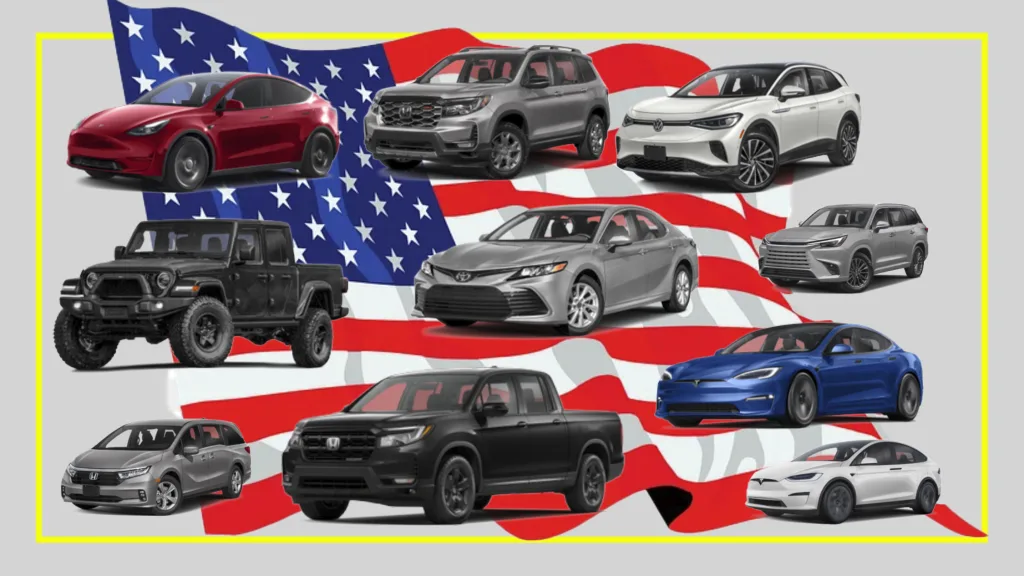
According to Cars.com’s 2025 American-Made Index, the top 10 for model-year 2025 were:

  1. Tesla Model 3
  2. Tesla Model Y
  3. Tesla Model S
  4. Honda Passport
  5. Volkswagen ID.4
  6. Tesla Model X
  7. Jeep Gladiator
  8. Kia EV6
  9. Honda Odyssey
  10. Honda Ridgeline

That list tells you almost everything you need to know about how misleading the old mental model can be. Four of the top six are Teslas. Honda is heavily represented. Volkswagen and Kia also appear. And yes, an American-brand truck like the Jeep Gladiator is there too. That is what the modern U.S. manufacturing map looks like.

So which brands actually build vehicles in the United States?

A large number of brands build vehicles in America. Depending on the model year and plant allocation, the list commonly includes:

  • Tesla
  • Ford
    n- Chevrolet
  • GMC
  • Cadillac
  • Jeep
  • Ram
  • Chrysler
  • Lincoln
  • Honda
  • Acura
  • Toyota
  • Lexus
  • Nissan
  • Infiniti
  • BMW
  • Mercedes-Benz
  • Volkswagen
  • Subaru
  • Kia
  • Hyundai

The important point is that you should never assume all models from these brands are U.S.-built. Some are, some are not. Final assembly is model-specific.

That is why the AALA alphabetical report for model-year 2025 matters. It lets you check actual carlines rather than guessing from national stereotypes.

Why the AALA report matters more than random lists

A lot of internet lists about “cars made in America” are sloppy because they mix brand origin, assembly country, and patriotic marketing into one vague pile.

The NHTSA Part 583 / AALA reports are much better because they come from the federal disclosure framework. They do not tell you which car is “best,” but they do tell you where the vehicle is finally assembled and how much U.S./Canadian parts content is reported.

That is also why the label language can frustrate people. A car assembled in the U.S. may still have large foreign parts content. A vehicle assembled abroad may still come from an American brand. And because the law groups U.S. and Canadian parts content together, the label does not always match what some shoppers emotionally mean when they say “American made.”

Honda, not just Detroit, is a major American builder

Honda deserves its own section because it breaks a lot of lazy assumptions. Many people still think of Honda as a foreign automaker first and a U.S. manufacturer second. But Honda’s own U.S. manufacturing footprint is enormous.

On its official site, Honda says it operates broad manufacturing in America, and it continues to announce U.S.-built product launches from Alabama and other states. In March 2026, Honda even announced plans to export the U.S.-designed, developed, and built Honda Passport to Japan. That is one of the clearest examples of a vehicle that is not just sold in America but built here strongly enough to be exported out. (Honda in America)

That should reset how people think about “American-made” cars. The badge is not the whole story.

Tesla, Honda, and even Volkswagen can beat old assumptions

The modern “American-made” story is full of examples that would have sounded strange a decade or two ago.

A Tesla often scores as more American-made than many Detroit vehicles. A Honda SUV or minivan can be one of the most American-made vehicles on sale. A Volkswagen EV like the ID.4 can rank high in an American-made list.

That does not make Ford, Chevy, Jeep, or Ram unimportant. It just means American auto manufacturing is now a web of domestic plants, global suppliers, cross-border content, and model-specific production plans. That is why the consumer needs a better question than “Is this a U.S. brand?”

The better question is: Where is this exact model assembled, and how strong is its domestic manufacturing footprint?

If you want to buy a car made in America, how should you check?

There are three strong ways to verify it.

First, check the Cars.com American-Made Index if you want an easy consumer-facing ranking.

Second, check the NHTSA AALA reports if you want official disclosure data on assembly country, parts content, and major component origin.

Third, check the manufacturer’s own plant or U.S.-manufacturing pages, especially if you are interested in a specific model. Tesla, Honda, BMW, Mercedes-Benz, Toyota, Subaru, and others often publish official plant information.

That three-step approach is much better than trusting dealership copy or vague “built here” slogans.

So what cars are made in America?

The most accurate answer is this: many cars are made in America, but the list includes both American and foreign brands. Vehicles commonly built in the U.S. include models from Tesla, Ford, Chevrolet, Jeep, Ram, Honda, Acura, Toyota, Volkswagen, BMW, Mercedes-Benz, Subaru, Kia, and others. The exact answer depends on the specific model, trim, and model year.

If you want the strongest current shorthand examples, the 2025 American-Made Index says the Tesla Model 3, Tesla Model Y, Tesla Model S, Honda Passport, Volkswagen ID.4, Tesla Model X, Jeep Gladiator, Honda Odyssey, and Honda Ridgeline are among the strongest answers. (Cars.com 2025 AMI)

Final verdict

If you ask what cars are made in America, the old answer would have been a badge list. That answer is no longer good enough.

Today, a car made in America usually means a vehicle assembled in the United States, but the full reality also includes parts sourcing, engine and transmission origin, and manufacturing employment. That is why some of the most American-made vehicles on sale are Teslas, Hondas, and even Volkswagens, not just traditional Detroit products. (Cars.com AMI, NHTSA AALA Reports)

So the smartest version of the answer is not “only American brands.” It is this: cars made in America come from many brands, and the only reliable way to know is to check where the specific model is assembled and how it performs on official or well-documented American-made metrics.

Recommended Posts

Turbocharger Wastegate Problems: How Small Mechanical Faults Can Affect Boost Control

Turbocharger Wastegate Problems: How Small Mechanical Faults Can Affect Boost Control

Turbocharger problems are often associated with failure of the entire unit. Loss of power, unstable boost, or unusual noise under acceleration may suggest that the turbocharger itself is worn out. Yet boost control depends on more than the compressor wheel, turbine, and bearings. The wastegate regulates exhaust energy reaching the turbine, keeping turbocharger speed and boost pressure within the intended range. When its flap, shaft, linkage, or related hardware wears, the symptoms can resemble a larger failure. This is why a Wastegate Repair Kit may be relevant when the turbocharger core remains serviceable but its boost-control mechanism has localized wear. What Happens When the Wastegate Mechanism Wears Wastegate wear usually appears as changes in boost behaviour rather than one clear symptom. Excessive clearance around the flap or shaft can cause a metallic rattle, while poor sealing may let exhaust gas bypass the turbine too early. This can result in underboost, weaker acceleration, or inconsistent response across the RPM range. If the mechanism fails to open correctly, excessive boost may develop and trigger engine-management intervention. Typical symptoms include: Boost pressure differing from the expected target. Underboost during acceleration or sustained load. Overboost or boost-control warnings. Intermittent power delivery. Rattling near the turbocharger. Reduced response at certain RPM ranges. These symptoms do not confirm a wastegate fault. Leaks, actuators, sensors, control valves, hoses, software issues, or internal turbocharger damage can behave similarly. Diagnosis should compare commanded and actual boost while checking the wastegate's mechanical operation. Why Replacing the Entire Turbo May Be Excessive A turbocharger can develop localized mechanical wear without its complete assembly failing. Compressor and turbine wheels, bearings, shaft, housings, and lubrication systems may remain serviceable while the wastegate deteriorates. A precise repair separates the failed component from parts that are still usable, avoiding unnecessary replacement of the entire unit. The decision should follow a complete inspection. A technician should determine whether there is: Significant rotating-assembly damage. Excessive shaft movement or bearing wear. Damaged compressor or turbine wheels. Housing damage affecting safe operation. A fault limited to the wastegate mechanism. If the core remains sound and the fault is clearly localized, targeted repair may be appropriate. Complete replacement can still be justified by secondary damage, thermal distortion, severe corrosion, or extensive wear. The key is to establish the condition of the whole turbocharger first. When a Targeted Repair Is the Better Approach When diagnostics confirm localized wastegate wear and the rest of the turbocharger remains serviceable, targeted repair can be more logical than replacing the complete assembly. A Wastegate Repair Kit may allow worn components to be replaced while retaining sound original parts. Compatibility must be confirmed for the specific turbocharger design and application. Repair should begin with inspection rather than simple parts selection. The technician needs to identify why the mechanism stopped working correctly and which components have deteriorated. Particular attention should be given to: Flap and shaft condition. Mechanical play and seating surfaces. Linkage and actuator movement. Heat damage, corrosion, or distortion. Condition of the rotating assembly. A component that fits physically but does not reproduce the original geometry can create another boost-control problem. Part quality is also critical. A wastegate operates under high temperatures, vibration, repeated movement, and strong exhaust-gas forces, so correct dimensions and materials directly affect the function of the flap, shaft, and related components.

/What is the Most Common Problem with the Jeep Grand Cherokee

What is the Most Common Problem with the Jeep Grand Cherokee

The Most Common Problem with the Jeep Grand Cherokee: What Every Owner Should Know The Jeep Grand Cherokee has a reputation that’s equal parts rugged capability and frustrating reliability. It can tow, crawl over rocks, and haul the family in comfort. But if you talk to enough owners—or spend time digging through complaint databases—you’ll notice a pattern. One issue comes up again and again. The most common problem with the Jeep Grand Cherokee is electrical system failure. That’s not just a minor annoyance. Electrical gremlins can leave you stranded, drain your battery overnight, or cause a chain reaction of warning lights that makes you wonder if the whole SUV is falling apart. Here’s a closer look at what goes wrong, which models are most affected, and what you can do about it. WHY ELECTRICAL ISSUES TOP THE LIST Across multiple model years, electrical complaints dominate owner reports and NHTSA data. For the 2024 Grand Cherokee, owners frequently report engines losing power, batteries dying, exterior lighting malfunctioning, and infotainment systems freezing. But the problem isn’t new. Older generations have their own electrical headaches, especially the infamous TIPM. The TIPM Problem The Totally Integrated Power Module (TIPM) is a fuse box on steroids. It controls fuel pump operation, lighting, wipers, and more. When it fails—and it often does—you might experience: - A fuel pump that won’t prime or stops working - Wipers that run nonstop or won’t turn on - Random warning lights - Battery drain that kills the battery overnight Replacing a TIPM isn’t cheap, and diagnosing the issue can be a nightmare because the symptoms mimic other problems. Battery Drain and Infotainment Glitches Modern Grand Cherokees are rolling computers. That means parasitic battery drains, unresponsive touchscreens, and software bugs are common. Some owners have replaced batteries multiple times only to find the real culprit is a faulty module that never sleeps. OTHER COMMON PROBLEMS WORTH KNOWING While electrical faults are the most frequent, they aren’t the only issues. If you’re shopping for a Grand Cherokee, keep these in mind too. Transmission Trouble Rough shifting, delayed engagement, and occasional slipping into neutral are common complaints, especially in model years from 2005 through 2015. Some owners describe a “clunk” when shifting from park to drive. Engine and Cooling Issues The 2024 model has seen reports of stalling, overheating, and excessive oil consumption. Older models (2011–2014) have fuel-related stalling complaints, often at higher mileage. Suspension Recall Jeep recently recalled over 328,000 Grand Cherokees from 2021–2023 because rear coil springs could detach while driving. It’s the third recall for the same problem, which tells you something about persistence. MODEL YEARS TO WATCH Based on complaint data, these model years are often flagged as ones to approach with caution: - 2011 - 2012 - 2014 - 2015 - 2018 - 2021–2024 That doesn’t mean every single one is a lemon. But electrical failure rates on some of these years are up to 3.2 times the model’s median. If you’re buying used, a pre-purchase inspection by a mechanic who knows Jeeps is worth every penny. WHAT YOU CAN DO If you own a Grand Cherokee or plan to buy one: 1. Check for recalls using your VIN on the NHTSA website. 2. Scan for stored codes before buying. Electrical issues often leave ghost codes. 3. Test the battery and charging system—a weak battery can trigger dozens of false warnings. 4. Consider an extended warranty if you’re buying an older model with known electrical quirks. 5. Join owner forums to learn the specific workarounds for your model year. THE BOTTOM LINE The Jeep Grand Cherokee is still a capable, comfortable, and iconic SUV. But its Achilles’ heel is the electrical system. From TIPM failures to battery drains and infotainment glitches, these problems are the most common complaints among owners. If you can look past them—or budget for repairs—you’ll enjoy everything else the Grand Cherokee does well. Just don’t ignore the warning signs. Have you dealt with electrical issues in your Grand Cherokee? Share your story in the comments—it might help another owner avoid the same headache.

Freightliner Bumpers and Cascadia Fairing Panels for a Stronger, Sleeker Truck

Shop durable Freightliner truck bumpers and Cascadia fairing panels for sale. Precise-fit exterior components for 2008-2017 and 2018+ trucks with fast shipping and expert support. Keeping a Freightliner Cascadia in top condition is about more than the engine under the hood — the exterior body components play a huge role in how the truck performs, looks, and holds its value. Side fairings, step skirts, and front-end pieces all work together to cut drag, protect vulnerable systems, and give the rig a clean, professional presence on the road. Operators searching for quality freightliner bumpers for sale often find that upgrading the entire front and side profile delivers the biggest return. When you pair durable freightliner truck bumpers with well-fitted aerodynamic panels, your Cascadia gains both protection and efficiency in one smart upgrade. The Value of a Complete Exterior Upgrade A truck's exterior is its first line of defense and its calling card all at once. Aerodynamic fairing panels smooth the airflow around the fuel tanks and drive area, lowering wind resistance and helping every gallon of diesel go further. A solid front end absorbs impacts and shields the radiator and cooling system from road debris. Together these components reduce long-term repair costs while keeping the truck looking sharp mile after mile. Over time, that combination of efficiency and protection adds up to real savings, since a truck that burns less fuel and stays out of the repair bay simply earns more for its owner on every route. At tacoma-truckparts.com, the Cascadia selection covers front, middle, and rear fairing panels, step skirts, extensions, and complete sets for both driver and passenger sides. Whether you run a 2008-2017 model or a 2018-and-newer truck, there are pieces engineered to match your exact frame and factory mounting points. Precision Fit for Every Model Year Fitment is everything with exterior body components. Panels and front-end pieces built for your specific model year line up cleanly with existing hardware, so installation is straightforward and the finished surface sits flush and secure. Durable materials stand up to road spray, gravel, and constant vibration, keeping the truck looking its best season after season. Reinforced panels and aluminum step skirts add both function and a polished, professional finish that owner-operators take pride in. Choosing correctly-sized components also protects everything around them. Well-fitted fairings shield tanks, steps, and wiring from flying debris, while a strong front end guards the systems behind it. That kind of protection keeps your Cascadia earning out on the highway instead of sitting in the shop. Efficiency, Protection, and Uptime Downtime is expensive, which is why fast order processing and dependable availability matter as much as the parts themselves. Orders ship quickly, backed by knowledgeable support that understands the daily demands facing fleet managers and independent drivers alike. Being able to find the exact panel, skirt, or front-end piece you need without guesswork keeps maintenance simple and predictable. Investing in your Cascadia's exterior is a smart move for fuel economy, curb appeal, and long-term resale value. With aerodynamic fairings and dependable front-end components working together, your truck cuts cleanly through the wind, looks its best, and stays ready for the next long haul. A well-maintained, polished rig also builds trust with customers and makes a strong impression during inspections. Browse the full selection today and give your Freightliner Cascadia the efficient, protected, road-ready finish it truly deserves.