




Simi Valley Chrysler Dodge Jeep Ram

Blog

Does Gasoline Go Bad?

does gasoline go bad

Does Gasoline Go Bad?

Yes, gasoline does go bad.

The simple answer is this: regular gasoline usually starts degrading after about 3 to 6 months, and ethanol-blended gasoline can degrade even faster, especially if it is stored in heat, humidity, or a poorly sealed container. AAA says gasoline generally lasts three to six months, while ethanol-based gas can lose combustibility in one to three months.

That does not mean old gas instantly becomes useless the day it turns six months old. It means the fuel begins losing volatility, oxidizing, absorbing moisture, and forming gums or varnish that can make engines run poorly.

Why Gasoline Goes Bad

Gasoline is a refined fuel made from petroleum and blended with additives. Over time, its lighter, more volatile components evaporate. The fuel also oxidizes, which can create sticky deposits.

The U.S. Energy Information Administration explains that finished gasoline is blended from crude oil and other petroleum liquids before being sold at stations. Because gasoline is a blend, its stability can vary depending on fuel type, seasonal formula, ethanol content, and storage conditions.

Ethanol-blended fuel is especially sensitive because ethanol attracts water. If enough moisture enters the fuel, it can cause phase separation, where the ethanol and water separate from the gasoline. That can lead to rough running, corrosion, and fuel-system problems.

How Long Does Gasoline Last?

Most untreated gasoline lasts around 3 to 6 months.

Premium fuel may last slightly longer in some cases, while ethanol-blended fuel may degrade faster. J.D. Power notes that regular gasoline has a shelf life of about three to six months, premium or high-octane fuel may last closer to nine months, and ethanol-based gasoline can lose combustibility in one to three months.

Storage conditions matter a lot. Gas stored in a sealed approved gas can in a cool place will usually last longer than gas sitting in a hot vehicle, lawn mower, generator, motorcycle, or open container.

Signs Gasoline Has Gone Bad

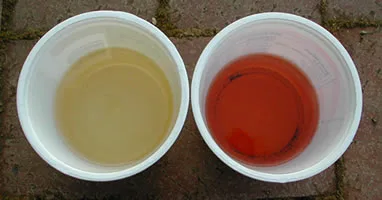
Bad gasoline may look darker than fresh gas, smell sour or varnish-like, or have debris, haze, or water separation.

Your engine may also tell you the fuel is bad. Common symptoms include hard starting, rough idle, hesitation, stalling, poor acceleration, engine knocking, reduced fuel economy, or a check engine light.

Small engines are often more sensitive than cars. Lawn mowers, snowblowers, motorcycles, generators, ATVs, and carbureted equipment can have trouble quickly if stale gas gums up jets, lines, or filters.

Can Old Gas Damage an Engine?

Yes, old gas can damage or clog fuel-system components.

Stale gasoline can leave varnish and gum deposits in fuel injectors, carburetors, fuel pumps, fuel lines, and filters. In severe cases, contaminated fuel can cause poor combustion, corrosion, and expensive repairs.

If the gasoline is only slightly old and still looks and smells normal, it may be usable when diluted with fresh fuel in some situations. But if it smells bad, looks dark, contains water, or has been sitting for a year or more, do not risk it.

Can Fuel Stabilizer Stop Gas From Going Bad?

Fuel stabilizer can help, but it works best when added to fresh gasoline before storage.

A stabilizer does not magically restore badly degraded fuel. It slows oxidation and helps keep fuel usable longer. STA-BIL says its Storage formula is designed to keep fuel ready to use for up to 24 months, while its 360 formulas are designed for up to 12 months.

For seasonal vehicles and equipment, add stabilizer before storage, run the engine long enough to circulate treated fuel, and store the fuel system according to the owner’s manual.

How to Store Gasoline So It Lasts Longer

Store gasoline in an approved fuel container, tightly sealed, in a cool, dry, well-ventilated area away from heat, sparks, flames, and living spaces.

Do not store gas in random plastic jugs, water bottles, open buckets, or glass containers. The CPSC explains that portable fuel containers must meet safety standards, including rules for gasoline containers sold empty.

The best storage habits are simple: buy only what you need, use fresh fuel, keep containers sealed, label the purchase date, and add stabilizer if the gas will sit for more than a couple of months.

What Should You Do With Bad Gasoline?

Do not pour old gasoline on the ground, into a drain, into a storm sewer, into regular trash, or into a fire.

Old gasoline should be taken to a household hazardous waste facility or approved local disposal site. The EPA warns that household hazardous waste should not be poured down drains, on the ground, into storm sewers, or thrown out with regular trash.

If you are not sure where to take it, search your city or county website for “household hazardous waste gasoline disposal.”

FAQs About Gasoline Going Bad

Does gasoline go bad in a car?

Yes. Gasoline can go bad in a car, especially if the vehicle sits for months without being driven. Heat, air exposure, ethanol, and moisture can speed up degradation.

How long can gas sit in a car?

Gas can usually sit for about 3 to 6 months before quality starts becoming a concern. If the vehicle will sit longer, use fuel stabilizer or follow the storage guidance in the owner’s manual.

How can you tell if gas is bad?

Bad gas may smell sour or like varnish, look darker than normal, appear cloudy, contain sediment, or cause hard starting, rough idle, hesitation, stalling, or poor acceleration.

Can you mix old gas with new gas?

If the gas is only slightly old and not contaminated, it may sometimes be diluted with fresh gas. If it smells bad, looks dark, contains water, or has been sitting a long time, dispose of it safely instead.

Does premium gas last longer?

Premium fuel may last slightly longer than regular in some cases, but it still goes bad. Storage conditions and ethanol content matter more than octane alone.

Does ethanol gas go bad faster?

Yes. Ethanol-blended gasoline can degrade faster because ethanol attracts moisture, which can lead to water contamination and phase separation.

Final Thoughts: Gasoline Does Go Bad

Gasoline absolutely goes bad, especially when it sits for months in a tank, can, mower, motorcycle, generator, or rarely driven vehicle.

Use 3 to 6 months as the practical shelf-life range for untreated gas. Ethanol fuel can go bad faster. Stabilizer can extend storage life if added early, but it will not rescue badly degraded fuel.

The safest move is to buy only what you will use, store fuel properly, treat seasonal fuel before storage, and dispose of old gasoline through a hazardous waste program when it is clearly bad.

Recommended Posts

Turbocharger Wastegate Problems: How Small Mechanical Faults Can Affect Boost Control

Turbocharger Wastegate Problems: How Small Mechanical Faults Can Affect Boost Control

Turbocharger problems are often associated with failure of the entire unit. Loss of power, unstable boost, or unusual noise under acceleration may suggest that the turbocharger itself is worn out. Yet boost control depends on more than the compressor wheel, turbine, and bearings. The wastegate regulates exhaust energy reaching the turbine, keeping turbocharger speed and boost pressure within the intended range. When its flap, shaft, linkage, or related hardware wears, the symptoms can resemble a larger failure. This is why a Wastegate Repair Kit may be relevant when the turbocharger core remains serviceable but its boost-control mechanism has localized wear. What Happens When the Wastegate Mechanism Wears Wastegate wear usually appears as changes in boost behaviour rather than one clear symptom. Excessive clearance around the flap or shaft can cause a metallic rattle, while poor sealing may let exhaust gas bypass the turbine too early. This can result in underboost, weaker acceleration, or inconsistent response across the RPM range. If the mechanism fails to open correctly, excessive boost may develop and trigger engine-management intervention. Typical symptoms include: Boost pressure differing from the expected target. Underboost during acceleration or sustained load. Overboost or boost-control warnings. Intermittent power delivery. Rattling near the turbocharger. Reduced response at certain RPM ranges. These symptoms do not confirm a wastegate fault. Leaks, actuators, sensors, control valves, hoses, software issues, or internal turbocharger damage can behave similarly. Diagnosis should compare commanded and actual boost while checking the wastegate's mechanical operation. Why Replacing the Entire Turbo May Be Excessive A turbocharger can develop localized mechanical wear without its complete assembly failing. Compressor and turbine wheels, bearings, shaft, housings, and lubrication systems may remain serviceable while the wastegate deteriorates. A precise repair separates the failed component from parts that are still usable, avoiding unnecessary replacement of the entire unit. The decision should follow a complete inspection. A technician should determine whether there is: Significant rotating-assembly damage. Excessive shaft movement or bearing wear. Damaged compressor or turbine wheels. Housing damage affecting safe operation. A fault limited to the wastegate mechanism. If the core remains sound and the fault is clearly localized, targeted repair may be appropriate. Complete replacement can still be justified by secondary damage, thermal distortion, severe corrosion, or extensive wear. The key is to establish the condition of the whole turbocharger first. When a Targeted Repair Is the Better Approach When diagnostics confirm localized wastegate wear and the rest of the turbocharger remains serviceable, targeted repair can be more logical than replacing the complete assembly. A Wastegate Repair Kit may allow worn components to be replaced while retaining sound original parts. Compatibility must be confirmed for the specific turbocharger design and application. Repair should begin with inspection rather than simple parts selection. The technician needs to identify why the mechanism stopped working correctly and which components have deteriorated. Particular attention should be given to: Flap and shaft condition. Mechanical play and seating surfaces. Linkage and actuator movement. Heat damage, corrosion, or distortion. Condition of the rotating assembly. A component that fits physically but does not reproduce the original geometry can create another boost-control problem. Part quality is also critical. A wastegate operates under high temperatures, vibration, repeated movement, and strong exhaust-gas forces, so correct dimensions and materials directly affect the function of the flap, shaft, and related components.

/What is the Most Common Problem with the Jeep Grand Cherokee

What is the Most Common Problem with the Jeep Grand Cherokee

The Most Common Problem with the Jeep Grand Cherokee: What Every Owner Should Know The Jeep Grand Cherokee has a reputation that’s equal parts rugged capability and frustrating reliability. It can tow, crawl over rocks, and haul the family in comfort. But if you talk to enough owners—or spend time digging through complaint databases—you’ll notice a pattern. One issue comes up again and again. The most common problem with the Jeep Grand Cherokee is electrical system failure. That’s not just a minor annoyance. Electrical gremlins can leave you stranded, drain your battery overnight, or cause a chain reaction of warning lights that makes you wonder if the whole SUV is falling apart. Here’s a closer look at what goes wrong, which models are most affected, and what you can do about it. WHY ELECTRICAL ISSUES TOP THE LIST Across multiple model years, electrical complaints dominate owner reports and NHTSA data. For the 2024 Grand Cherokee, owners frequently report engines losing power, batteries dying, exterior lighting malfunctioning, and infotainment systems freezing. But the problem isn’t new. Older generations have their own electrical headaches, especially the infamous TIPM. The TIPM Problem The Totally Integrated Power Module (TIPM) is a fuse box on steroids. It controls fuel pump operation, lighting, wipers, and more. When it fails—and it often does—you might experience: - A fuel pump that won’t prime or stops working - Wipers that run nonstop or won’t turn on - Random warning lights - Battery drain that kills the battery overnight Replacing a TIPM isn’t cheap, and diagnosing the issue can be a nightmare because the symptoms mimic other problems. Battery Drain and Infotainment Glitches Modern Grand Cherokees are rolling computers. That means parasitic battery drains, unresponsive touchscreens, and software bugs are common. Some owners have replaced batteries multiple times only to find the real culprit is a faulty module that never sleeps. OTHER COMMON PROBLEMS WORTH KNOWING While electrical faults are the most frequent, they aren’t the only issues. If you’re shopping for a Grand Cherokee, keep these in mind too. Transmission Trouble Rough shifting, delayed engagement, and occasional slipping into neutral are common complaints, especially in model years from 2005 through 2015. Some owners describe a “clunk” when shifting from park to drive. Engine and Cooling Issues The 2024 model has seen reports of stalling, overheating, and excessive oil consumption. Older models (2011–2014) have fuel-related stalling complaints, often at higher mileage. Suspension Recall Jeep recently recalled over 328,000 Grand Cherokees from 2021–2023 because rear coil springs could detach while driving. It’s the third recall for the same problem, which tells you something about persistence. MODEL YEARS TO WATCH Based on complaint data, these model years are often flagged as ones to approach with caution: - 2011 - 2012 - 2014 - 2015 - 2018 - 2021–2024 That doesn’t mean every single one is a lemon. But electrical failure rates on some of these years are up to 3.2 times the model’s median. If you’re buying used, a pre-purchase inspection by a mechanic who knows Jeeps is worth every penny. WHAT YOU CAN DO If you own a Grand Cherokee or plan to buy one: 1. Check for recalls using your VIN on the NHTSA website. 2. Scan for stored codes before buying. Electrical issues often leave ghost codes. 3. Test the battery and charging system—a weak battery can trigger dozens of false warnings. 4. Consider an extended warranty if you’re buying an older model with known electrical quirks. 5. Join owner forums to learn the specific workarounds for your model year. THE BOTTOM LINE The Jeep Grand Cherokee is still a capable, comfortable, and iconic SUV. But its Achilles’ heel is the electrical system. From TIPM failures to battery drains and infotainment glitches, these problems are the most common complaints among owners. If you can look past them—or budget for repairs—you’ll enjoy everything else the Grand Cherokee does well. Just don’t ignore the warning signs. Have you dealt with electrical issues in your Grand Cherokee? Share your story in the comments—it might help another owner avoid the same headache.

Freightliner Bumpers and Cascadia Fairing Panels for a Stronger, Sleeker Truck

Shop durable Freightliner truck bumpers and Cascadia fairing panels for sale. Precise-fit exterior components for 2008-2017 and 2018+ trucks with fast shipping and expert support. Keeping a Freightliner Cascadia in top condition is about more than the engine under the hood — the exterior body components play a huge role in how the truck performs, looks, and holds its value. Side fairings, step skirts, and front-end pieces all work together to cut drag, protect vulnerable systems, and give the rig a clean, professional presence on the road. Operators searching for quality freightliner bumpers for sale often find that upgrading the entire front and side profile delivers the biggest return. When you pair durable freightliner truck bumpers with well-fitted aerodynamic panels, your Cascadia gains both protection and efficiency in one smart upgrade. The Value of a Complete Exterior Upgrade A truck's exterior is its first line of defense and its calling card all at once. Aerodynamic fairing panels smooth the airflow around the fuel tanks and drive area, lowering wind resistance and helping every gallon of diesel go further. A solid front end absorbs impacts and shields the radiator and cooling system from road debris. Together these components reduce long-term repair costs while keeping the truck looking sharp mile after mile. Over time, that combination of efficiency and protection adds up to real savings, since a truck that burns less fuel and stays out of the repair bay simply earns more for its owner on every route. At tacoma-truckparts.com, the Cascadia selection covers front, middle, and rear fairing panels, step skirts, extensions, and complete sets for both driver and passenger sides. Whether you run a 2008-2017 model or a 2018-and-newer truck, there are pieces engineered to match your exact frame and factory mounting points. Precision Fit for Every Model Year Fitment is everything with exterior body components. Panels and front-end pieces built for your specific model year line up cleanly with existing hardware, so installation is straightforward and the finished surface sits flush and secure. Durable materials stand up to road spray, gravel, and constant vibration, keeping the truck looking its best season after season. Reinforced panels and aluminum step skirts add both function and a polished, professional finish that owner-operators take pride in. Choosing correctly-sized components also protects everything around them. Well-fitted fairings shield tanks, steps, and wiring from flying debris, while a strong front end guards the systems behind it. That kind of protection keeps your Cascadia earning out on the highway instead of sitting in the shop. Efficiency, Protection, and Uptime Downtime is expensive, which is why fast order processing and dependable availability matter as much as the parts themselves. Orders ship quickly, backed by knowledgeable support that understands the daily demands facing fleet managers and independent drivers alike. Being able to find the exact panel, skirt, or front-end piece you need without guesswork keeps maintenance simple and predictable. Investing in your Cascadia's exterior is a smart move for fuel economy, curb appeal, and long-term resale value. With aerodynamic fairings and dependable front-end components working together, your truck cuts cleanly through the wind, looks its best, and stays ready for the next long haul. A well-maintained, polished rig also builds trust with customers and makes a strong impression during inspections. Browse the full selection today and give your Freightliner Cascadia the efficient, protected, road-ready finish it truly deserves.